What Is Guar Gum? Benefits, Side Effects & Safety
What guar gum (E412) is, why it's in ice cream, sauces and gluten-free food, its benefits for cholesterol and digestion, its side effects and who should be careful.
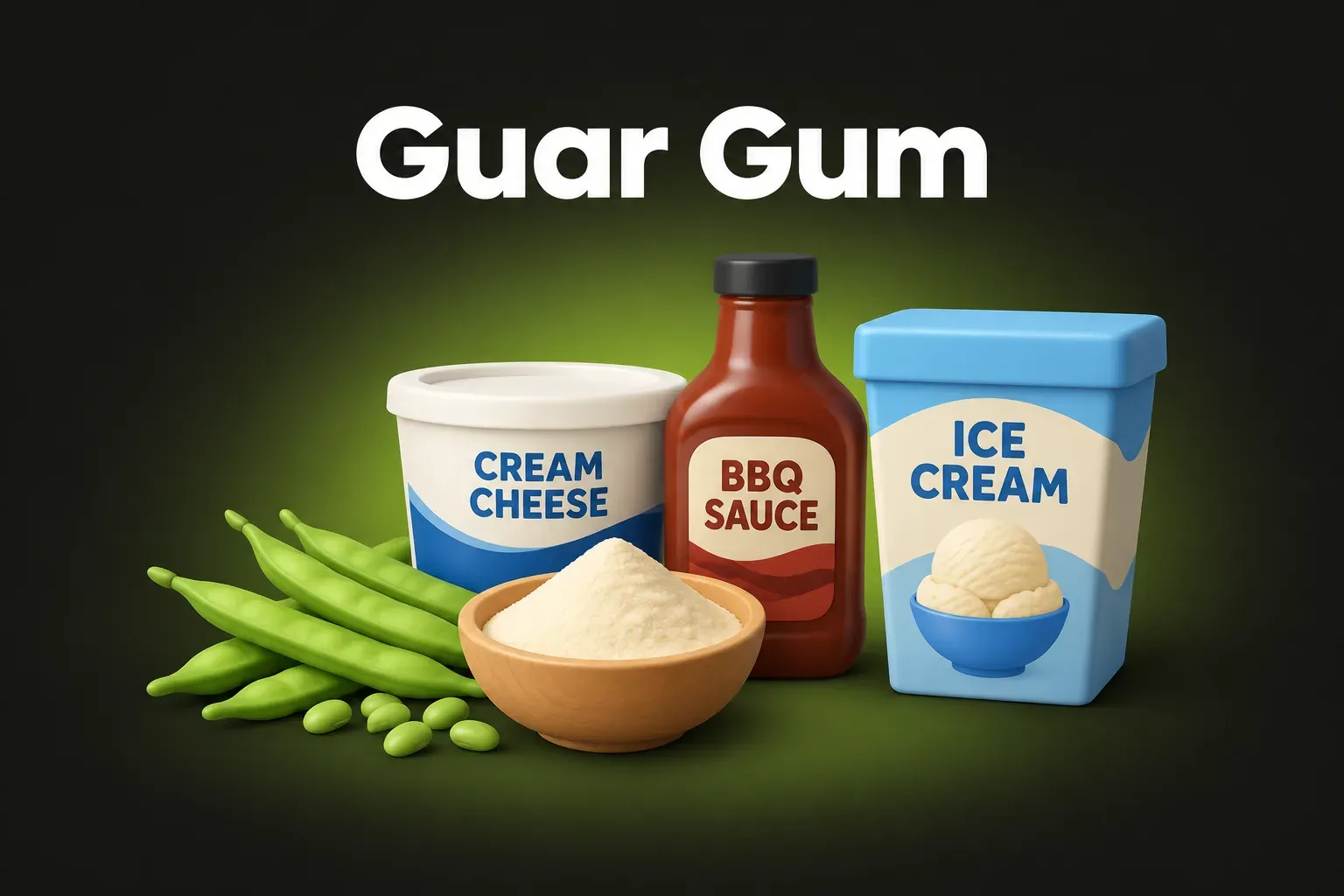
Guar gum is a thickener made from beans. It’s in ice cream, cream cheese, sauces, gluten-free bread and many “healthy” products – and unlike most additives, it’s also a fiber that can have real benefits. But it has a few downsides worth knowing about.
The short answer: guar gum is one of the gentler additives. It’s a fiber that can lower cholesterol and help with constipation. But in larger amounts it causes gas and bloating. As dry diet pills, it has caused dangerous blockages. A large French study linked eating more of it to a slightly higher risk of type 2 diabetes. And in mice, a guar gum diet made gut inflammation worse. In normal food amounts, most people don’t need to worry. But people with a sensitive gut may want to limit it.
What is guar gum?
Guar gum comes from the seeds of the guar plant, a bean that grows mainly in India and Pakistan. The seeds are peeled and ground into a fine powder. It soaks up water and becomes a thick gel, so a very small amount thickens a lot of liquid.
In food, a small amount is used to:
- thicken sauces, soups and dressings
- make ice cream creamy and stop ice crystals
- give cream cheese and yogurts a smooth texture
- help gluten-free dough hold together
- add fiber to drinks and supplements
On labels, you’ll see it as:
| Name | Where you’ll see it |
|---|---|
| Guar gum | Ingredient lists worldwide |
| E412, “thickener: E412”, “stabilizer: E412” | European Union, UK and many other countries |
| Partially hydrolyzed guar gum (PHGG) | Fiber supplements and some drinks |
The benefits of guar gum
Because guar gum is a fiber that dissolves in water, it works a bit like the fiber in oats and beans:
- Lower cholesterol: a review of 19 trials found that guar gum supplements lowered total and LDL cholesterol in adults (Setayesh et al., British Journal of Nutrition, 2023).
- Blood sugar: it slows digestion, which can make blood sugar rise less after meals.
- Digestion: a gentler, partly broken-down form called PHGG is sold as a fiber supplement. In small studies, it helped some people with constipation and IBS.
These benefits come from supplement doses – usually several grams a day – not from the small amounts in a scoop of ice cream.
Is guar gum bad for you? What the research says
What regulators say
In its 2017 review, the European Food Safety Authority (EFSA) found no harmful effects at the highest doses tested in long-term and cancer studies and saw no need to set a daily limit. Guar gum doesn’t pass into the blood. It goes to the large intestine, where gut bacteria break it down (EFSA, 2017).
Gas and bloating
When gut bacteria break it down, they make gas. So larger amounts can cause bloating, gas and cramps – especially if you’re not used to fiber, or if you have IBS.
Blockages from diet pills
In the late 1980s, a guar gum diet pill called Cal-Ban 3000 was sold to help people feel full. The FDA got reports of 18 people with a blocked food pipe and 7 with a blocked small intestine. One person died after surgery (Lewis et al., American Journal of Gastroenterology, 1992). Dry guar gum swells into a thick gel. That’s why guar gum diet pills were banned, and why any fiber supplement should be taken with plenty of water.
Type 2 diabetes
In the French NutriNet-Santé study of over 100,000 adults, people who ate more guar gum from processed foods had a slightly higher risk of type 2 diabetes – about 11% higher for every extra 500 mg a day (Salame et al., The Lancet Diabetes & Endocrinology, 2024). This study followed people over time, so it shows a link, not proof. The link may partly come from the ultra-processed foods that contain guar gum. Small trials with guar gum supplements actually found the opposite effect on blood sugar.
Gut inflammation in mice
In a 2024 study, mice that ate guar gum got much worse colitis (gut inflammation) than mice that ate cellulose, a different fiber. Their gut bacteria changed and their gut sent out more inflammation signals. When antibiotics removed the bacteria, the effect went away (Paudel et al., Gut Microbes, 2024). The authors warn that refined fibers added to processed foods may not be as harmless as people thought – at least for those who easily get inflammatory bowel disease.
This was done in mice because they share most of their genes and many body processes with humans. And testing it on people would put their health at risk. It doesn’t prove the same happens in humans, but it’s a reason for people with Crohn’s disease or colitis to be careful with refined fibers.
Babies
EFSA has looked separately at guar gum in special formulas for babies under 16 weeks, as young babies may be more sensitive to digestive side effects. Thickened formulas should only be used on a doctor’s advice.
Which foods contain guar gum?
- Dairy and desserts: ice cream, cream cheese, yogurts, puddings
- Sauces and soups: BBQ sauce, ketchup, gravies, instant soups, salad dressings
- Gluten-free and vegan products: bread, baking mixes, plant milks, vegan cheese
- Drinks: smoothies, protein shakes, fiber drinks
- Other: fiber supplements, some medicines, cosmetics
Should you avoid guar gum?
For most people, there’s no need. Consider limiting it if you:
- have IBS or get bloated after gluten-free bread, protein shakes or ice cream
- have Crohn’s disease or ulcerative colitis, given the mouse study above
- eat a lot of ultra-processed foods, where guar gum is one of many additives
If you take a guar gum or other fiber supplement, always take it with a full glass of water and don’t take it right before lying down.
Spot guar gum on any label in seconds. With NutriSmart, you photograph the ingredient list or scan the barcode, and the app tells you right away if the product has guar gum. Turn on an alert for it, and the app warns you every time a product you scan contains it. You’ll also see every other additive, the risks of each one and a health score out of 100.Get the app free
You can also read about similar thickeners: xanthan gum and carrageenan.
The bottom line
Guar gum is a fiber from beans and one of the more harmless additives. In supplement doses, it can even lower cholesterol. But it can cause bloating, and dry guar gum pills have caused dangerous blockages. New research in mice and people also suggests that refined fibers in processed foods aren’t always as gentle as they seem. Enjoy it in normal foods, take supplements with plenty of water, and be careful if you have a sensitive gut.
FAQ
Is guar gum bad for you?
In the small amounts used in food, it's considered safe. It's actually a type of fiber that can lower cholesterol. But large amounts can cause gas and bloating, and it should always be taken with plenty of water. A French study also linked eating more of it to a slightly higher risk of type 2 diabetes. And in mice it made gut inflammation worse.
What is guar gum made from?
It's made from the seeds of the guar plant, a bean that grows mainly in India and Pakistan. The seeds are peeled and ground into a fine white powder.
Is guar gum good for weight loss?
Not really. Guar gum swells in the stomach and may help you feel full, but studies haven't shown meaningful weight loss. In the past, guar gum diet pills caused dangerous blockages in the throat and gut, and the FDA banned them.
Is guar gum gluten-free and vegan?
Yes. Guar gum comes from a bean, contains no gluten and is plant-based, which is why it's widely used in gluten-free baking and vegan products.
Does guar gum cause bloating?
It can. Gut bacteria break down guar gum, and this makes gas. Most people don't notice the small amounts in food, but people with IBS or a sensitive gut may feel bloated, especially from supplements or gluten-free products that contain more of it.
What is E412?
E412 is the European code for guar gum. On labels you'll see it as "guar gum", "thickener: E412" or "stabilizer: E412".