What Is Xanthan Gum? Is It Safe or Bad for You?
What xanthan gum (E415) is, how it's made, why it's in sauces and gluten-free bread, its side effects, who should avoid it and what studies say.
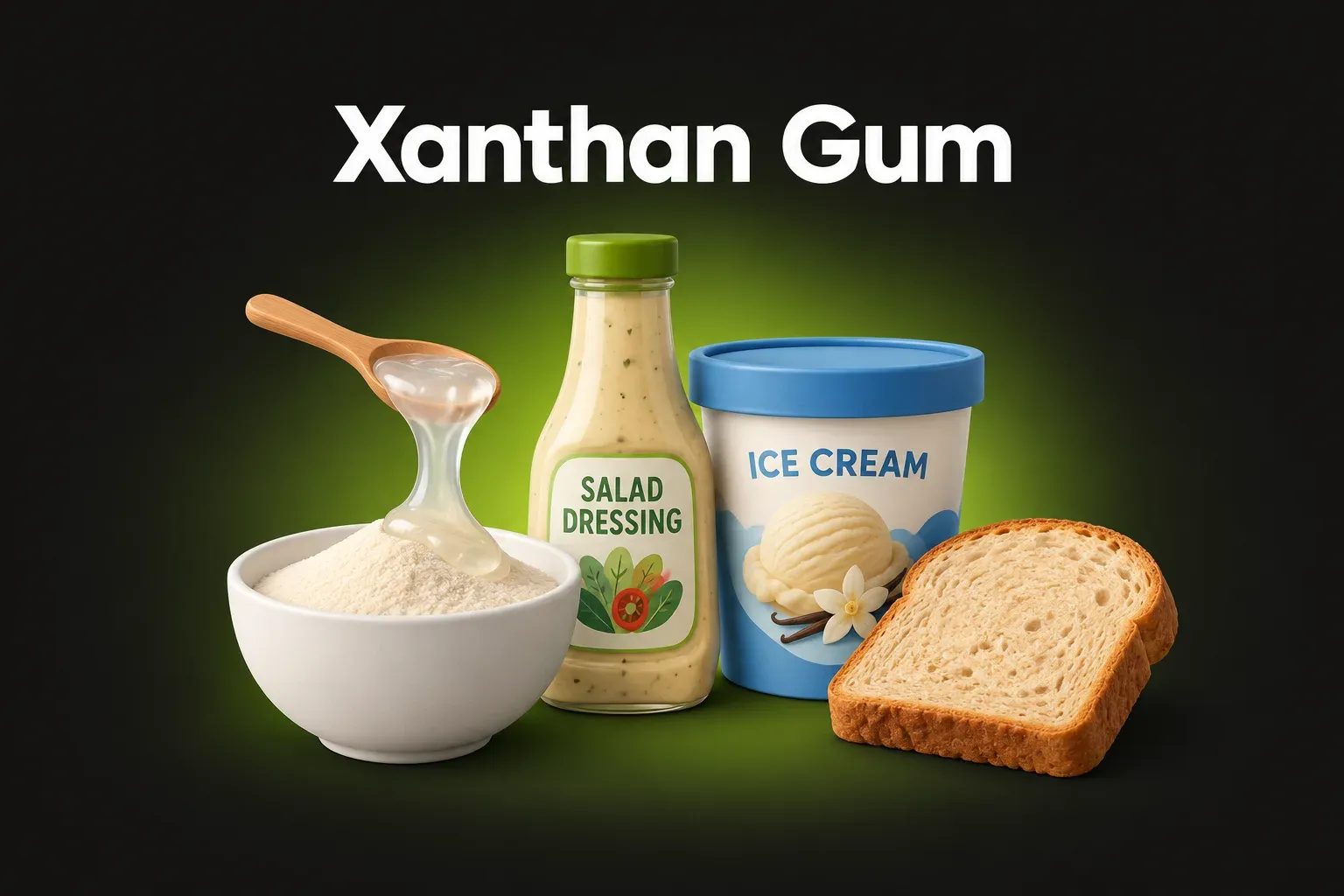
Xanthan gum is one of the most common thickeners in packaged food. You’ll find it in salad dressings, sauces, ice cream, gluten-free bread and even toothpaste. It sounds like a chemical, but it’s made by bacteria – and it’s one of the additives with the fewest warning signs.
The short answer: for most people, xanthan gum is safe in the small amounts used in food. Long-term animal studies found no harm. But in larger amounts it can cause gas, bloating and loose stools. It’s not safe for babies born too early. And a large French study linked eating more thickeners like it to a slightly higher risk of type 2 diabetes. Like most additives, it’s also a sign that a product is ultra-processed.
What is xanthan gum?
Xanthan gum is made by bacteria. Bacteria called Xanthomonas campestris eat sugar and make a thick, sticky substance. This is dried and ground into a fine powder. The sugar often comes from corn, soy, wheat or sugar beets.
A tiny amount – often less than half a percent of the food – is enough to:
- thicken sauces, soups and dressings
- keep ingredients mixed, so dressings and drinks don’t separate
- stop ice crystals forming in ice cream
- hold gluten-free dough together, doing part of the job gluten does
- give creaminess to low-fat products
On labels, you’ll see it as:
| Name | Where you’ll see it |
|---|---|
| Xanthan gum | Ingredient lists worldwide |
| E415, “thickener: E415”, “stabilizer: E415” | European Union, UK and many other countries |
Is xanthan gum bad for you? What the research says
What regulators say
In its 2017 review, the European Food Safety Authority (EFSA) looked at long-term and cancer studies in animals. Even the highest doses tested caused no harm. The body doesn’t take in xanthan gum. It goes to the large intestine, where gut bacteria break it down. EFSA saw no need to set a daily limit. But it noted that some adults got an upset stomach when they took large amounts for ten days (EFSA, 2017). In the US, the FDA also allows it as a food additive.
Digestive side effects
Your gut bacteria feed on xanthan gum, much like they do with fiber. So larger amounts can cause gas, bloating and softer stools. People with IBS or a sensitive gut may notice this more. The small amounts in a normal serving of sauce or ice cream rarely cause problems.
Babies born too early
This is the one clear risk. In 2011, the FDA warned against giving a thickener made with xanthan gum to babies born too early. Some babies who got it developed necrotizing enterocolitis, a serious bowel disease (Beal et al., Journal of Pediatrics, 2012). If a doctor suggests thickening a baby’s feeds, ask which thickener is safe for your baby’s age.
Type 2 diabetes
The French NutriNet-Santé study follows over 100,000 adults. It looked at thickeners and emulsifiers in people’s diets. People who ate more xanthan gum had a slightly higher risk of type 2 diabetes – about 8% higher for every extra 500 mg a day (Salame et al., The Lancet Diabetes & Endocrinology, 2024). The study followed people over time, so it shows a link, not proof. And the link may partly come from the ultra-processed foods xanthan gum is found in.
But some small, older studies point the other way. People with diabetes ate muffins with 12 g of xanthan gum a day. Their blood sugar and cholesterol went down, probably because the gum slows digestion like fiber does (Osilesi et al., American Journal of Clinical Nutrition, 1985). More research is needed.
Gut bacteria
A 2022 study found that in rich countries, many people’s gut bacteria can break down xanthan gum. This depends on one type of bacteria. In mice, eating xanthan gum made these bacteria grow in number (Ostrowski et al., Nature Microbiology, 2022). So an additive that’s only been in our food since the late 1960s is changing which bacteria live in our gut. Scientists don’t know yet if this matters for health.
Allergies
Allergic reactions to xanthan gum are rare. It’s made from sugar that may come from corn, soy or wheat. So people with severe allergies to these foods sometimes ask the company which source it uses.
Which foods contain xanthan gum?
- Sauces and dressings: salad dressings, mayonnaise-style sauces, ketchup, gravies
- Dairy and desserts: ice cream, puddings, yogurts and creamers
- Gluten-free products: bread, cakes, pasta and baking mixes
- Drinks: plant-based milks, smoothies and protein shakes
- Other: instant soups, frozen meals, toothpaste and some medicines
Should you avoid xanthan gum?
For most people, there’s no need to worry about the small amounts in food. Consider limiting it if you:
- have IBS or notice bloating after sauces, gluten-free bread or protein shakes
- are caring for a baby born too early or a very young baby – never use thickeners without a doctor’s advice
- eat a lot of ultra-processed foods, where xanthan gum is usually one of many additives
- are watching your blood sugar, given the link found in the French study
How to eat less xanthan gum
- Read the ingredient list for “xanthan gum” and “E415”.
- Make simple dressings at home with olive oil, lemon or vinegar and mustard – mustard keeps them mixed naturally.
- Choose plain dairy, like plain yogurt and regular cream, which usually need no thickeners.
- For gluten-free baking, try psyllium husk or ground chia or flax seeds instead.
Spot xanthan gum on any label in seconds. With NutriSmart, you photograph the ingredient list or scan the barcode, and the app tells you right away if the product has xanthan gum. Turn on an alert for it, and the app warns you every time a product you scan contains it. You’ll also see every other additive, the risks of each one and a health score out of 100.Get the app free
You can also read about other thickeners: guar gum, carrageenan and carboxymethylcellulose.
The bottom line
Xanthan gum is one of the gentler food additives. Long-term animal studies found no harm, and the small amounts in food are fine for most people. Larger amounts can upset your stomach, and it’s not for babies born too early. Early research also links thickeners like it to type 2 diabetes and to changes in gut bacteria. If you have a sensitive gut – or just want fewer additives – choose simpler foods and make your own dressings and sauces.
FAQ
Is xanthan gum bad for you?
For most people, no. It's one of the better-studied food additives, and long-term animal studies found no harm. In large amounts, it can cause gas, bloating and loose stools. It's not safe for babies born too early. And a large French study linked eating more thickeners like it to a slightly higher risk of type 2 diabetes.
What is xanthan gum made from?
It's made by bacteria (Xanthomonas campestris) that feed on sugar, often from corn, soy, wheat or sugar beets. What they make is dried and ground into a fine white powder.
Is xanthan gum vegan and gluten-free?
Yes, it's usually both. It's made by bacteria, not from animals, and it has no gluten. That's why it's used so much in gluten-free baking. If you have a severe allergy to corn, soy or wheat, ask the brand which sugar source it uses.
What does xanthan gum do in food?
It thickens liquids and keeps ingredients from separating. A tiny amount makes sauces and dressings smooth, stops ice crystals in ice cream and helps gluten-free dough hold together.
Can xanthan gum cause digestive problems?
Yes, in larger amounts. Your gut bacteria feed on it, which can cause gas, bloating and softer stools. People with IBS (a sensitive bowel) may notice it more. The small amounts in most foods rarely cause problems.
What is E415?
E415 is the European code for xanthan gum. On labels you'll see it as "xanthan gum", "thickener: E415" or "stabilizer: E415".