What Is Carrageenan? Is It Safe or Bad for You?
What carrageenan (E407) is, why it's in plant milks and ice cream, what studies say about gut inflammation, diabetes and cancer, and how to avoid it.
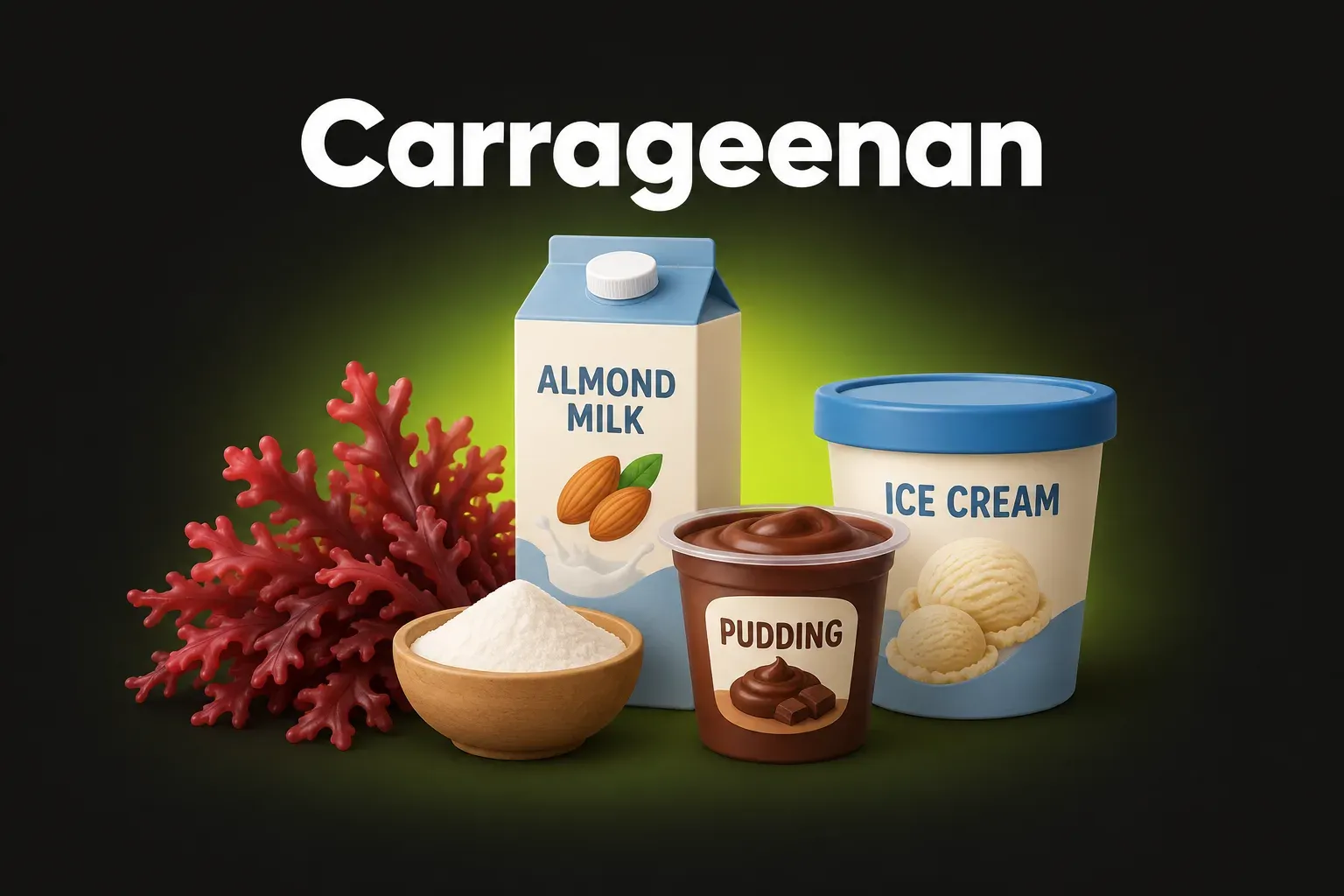
Carrageenan is a thickener made from red seaweed. You’ll find it in many plant-based milks, ice creams, creamers and deli meats. It’s also at the center of a long debate: is it harmless, or does it quietly inflame your gut?
The short answer: carrageenan is approved as safe by the FDA and the European Food Safety Authority (EFSA). But animal studies keep showing it can cause gut inflammation, and a few small human trials point the same way. Large studies that followed people for years also link eating more of it to type 2 diabetes and breast cancer. None of this proves harm. But carrageenan adds nothing except texture, so limiting it is an easy choice – especially if you have a gut condition such as IBD or IBS.
What is carrageenan?
Carrageenan is a carbohydrate taken from red seaweed (such as Irish moss). It holds on to water and proteins. So food makers use it to thicken and gel foods: to stop plant milks from separating, make ice cream creamier or make deli meats firmer.
On labels, you’ll see it as:
| Name | What it is |
|---|---|
| Carrageenan / E407 | Refined carrageenan |
| Processed Eucheuma seaweed / E407a | A less refined form, regulated together with E407 |
| Irish moss | The seaweed itself, sometimes sold as a supplement |
There are three main types – kappa, iota and lambda – which gel differently. Food carrageenan is not the same as degraded carrageenan (poligeenan). That one is made with strong acid and high heat, is used in some medical scans and is not allowed in food.
Is carrageenan bad for you? What the research says
Gut inflammation
This is the main concern. For decades, labs have used carrageenan to cause inflammation in animals on purpose. And many cell and animal studies show it can damage the gut lining and lead to colitis (gut inflammation).
- A review of animal experiments found that degraded carrageenan, and also the kind used in food, were linked to ulcers and tumors in the gut. The author thinks food carrageenan may partly break down during normal digestion (Tobacman, Environmental Health Perspectives, 2001).
- In rats exposed to a cancer-causing chemical, carrageenan in the diet promoted the growth of colon tumors (Arakawa et al., Journal of Nutritional Science and Vitaminology, 1988).
Animal studies are done in rodents because they share most of their genes and many body processes with humans. And testing a suspect substance on people would put their health at risk. They don’t prove the same effects in humans, but these warning signs have been found again and again.
In people, the evidence is still limited:
- In a small trial, 12 people with ulcerative colitis (a gut disease) had no symptoms. They took either carrageenan capsules or fake capsules for up to a year. Three of the people taking carrageenan got sick again; none of those taking the fake capsules did. Blood tests for inflammation also rose in the carrageenan group (Bhattacharyya et al., Nutrition and Healthy Aging, 2017). The trial was very small, but it’s the reason many doctors suggest avoiding carrageenan with IBD.
Blood sugar and insulin
In mice, a low dose of carrageenan in drinking water raised blood sugar and made insulin work less well. It did this by blocking insulin’s signals in the liver. The same effect was seen in human liver cells (Bhattacharyya et al., Diabetologia, 2012).
A human trial later pointed the same way. In a 2024 trial, 20 young men took carrageenan or dummy capsules for two weeks each, without knowing which. Overall, there was no difference. But in the men who were overweight, carrageenan made their bodies respond worse to insulin – an early step toward type 2 diabetes. It also raised blood tests for inflammation and made the gut “leakier” (Wagner et al., BMC Medicine, 2024).
Type 2 diabetes and cancer
The French NutriNet-Santé study, which follows over 100,000 adults, looked at emulsifiers and thickeners in their diets:
- Eating more carrageenan was linked to a higher risk of type 2 diabetes – about 3% higher for every extra 100 mg a day (Salame et al., The Lancet Diabetes & Endocrinology, 2024).
- People who ate the most carrageenan had a 32% higher risk of breast cancer (Sellem et al., PLoS Medicine, 2024).
These studies followed people over time, so they show links, not proof. The authors say they need to be confirmed in other groups of people.
What regulators say
- EU: In its 2018 review, EFSA found no safety problem at the amounts people eat today. But it called its safe daily limit of 75 mg per kg of body weight “temporary”, because data was missing, and asked for more research. It didn’t assess use in formula for infants under 12 weeks (EFSA, 2018).
- US: The FDA allows carrageenan as a food additive.
Which foods contain carrageenan?
- Plant-based milks and creamers: some almond, oat, soy, coconut and rice drinks, coffee creamers
- Dairy: chocolate milk, ice cream, whipped cream, cream cheese, cottage cheese, some yogurts
- Desserts: puddings, custards, jelly and gummy sweets
- Meat and alternatives: deli turkey and ham, processed chicken, some vegan meat and cheese substitutes
- Other: canned soups and sauces, infant formula in some countries, toothpaste and some medicines
Many brands have removed carrageenan in recent years, often replacing it with gellan gum or guar gum – so check the label rather than the brand.
Should you avoid carrageenan?
For most healthy people, an occasional food with carrageenan is unlikely to cause problems. Consider avoiding it if you:
- have inflammatory bowel disease (Crohn’s disease or ulcerative colitis) or IBS
- notice bloating or digestive symptoms after plant milks, ice cream or creamers
- drink plant milk or use creamer every day – these are the biggest everyday sources
- want to eat fewer ultra-processed foods in general
How to avoid carrageenan
- Read the ingredient list for “carrageenan”, “E407” and “E407a”.
- Choose plant milks with short ingredient lists – many are now carrageenan-free.
- Pick plain dairy: plain yogurt, regular cream and cheeses usually don’t need thickeners.
- Buy fresh meat instead of processed deli meat.
- Make desserts at home with gelatin or agar (E406), another seaweed-based gelling agent that hasn’t raised the same concerns.
Spot E407 in seconds. Thickeners are easy to miss in a long ingredient list. With NutriSmart, you photograph the label or scan the barcode and the app highlights additives like carrageenan, explains what each one is and gives the product a health score out of 100 – so you can compare two plant milks or ice creams on the spot.Get the app free
You can also read about other thickeners and emulsifiers: xanthan gum, guar gum, carboxymethylcellulose and polysorbate 80.
The bottom line
Carrageenan is legal and approved, and one serving won’t hurt you. But it’s one of the additives with the most steady warning signs. It causes inflammation in animal studies, and small human trials point the same way. A large study of French adults also linked it to diabetes and breast cancer. Regulators themselves call its safe limit “temporary”. If you have a sensitive gut – or simply have a choice between two similar products – picking the one without carrageenan is an easy win.
FAQ
Is carrageenan bad for you?
It's approved as safe by the FDA and the European Food Safety Authority. But animal studies have linked it to gut inflammation. A few small human trials suggest it may make ulcerative colitis worse, or make insulin work less well, in some people. And large studies that followed people for years link eating more of it to type 2 diabetes and breast cancer. The evidence isn't final, but it's reasonable to limit it – especially if you have a gut condition.
Is carrageenan natural?
It's made from red seaweed, so it comes from a natural source. But it's taken out and processed in factories and used only for texture. So it's a typical sign of ultra-processed food, not a whole food.
Does carrageenan cause cancer?
Food-grade carrageenan hasn't been shown to cause cancer. The cancer concern comes from degraded carrageenan (poligeenan), a different substance that isn't allowed in food. A 2024 French study did find that people who ate more carrageenan had a higher risk of breast cancer. But that's a link that needs to be confirmed.
What foods contain carrageenan?
Mostly plant-based milks and creamers, chocolate milk, ice cream, whipped cream, cream cheese, puddings, deli meats and some vegan products. It's also used in toothpaste and some medicines. On labels, look for carrageenan, E407 or E407a.
Should people with IBS or IBD avoid carrageenan?
Many gut doctors suggest it. Carrageenan reliably causes gut inflammation in animals. And in a small trial of people with ulcerative colitis who had no symptoms, those given carrageenan got sick again sooner. If you have IBD or IBS, cutting it out is easy and low-risk.
Is carrageenan the same as agar?
No. Both come from red seaweed and both thicken or gel foods, but they're different substances. Agar (E406) hasn't been linked to gut inflammation in the same way and is often used to replace carrageenan.