Gelatin: What It's Made Of, Benefits and Risks
What gelatin is made from, whether it helps joints, skin and muscles, who may be allergic to it, how it differs from collagen and how to use it in the kitchen.
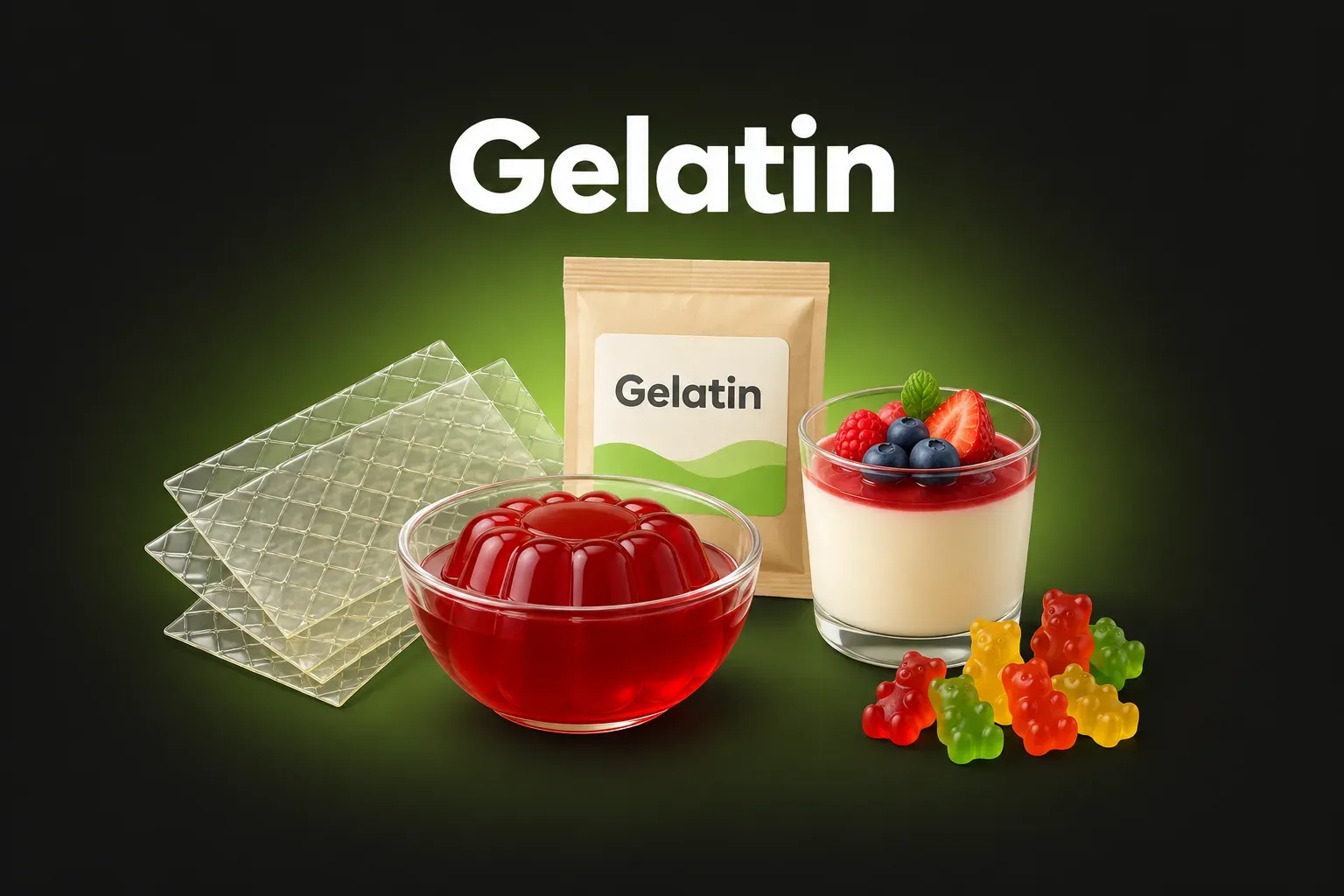
Gummy bears, jelly desserts, panna cotta, marshmallows, capsules – and “collagen” drinks for skin and joints. Gelatin is in many more products than people think. It’s natural and safe for almost everyone. But it’s made from animals, it’s not as “healthy” as the collagen marketing suggests, and a few people can be allergic to it.
The short answer: gelatin is cooked collagen from pig skin, cattle hides and bones or fish. It’s almost pure protein and safe for most people. But it’s an incomplete protein – it has no tryptophan – so it can’t replace other proteins. Collagen supplements may ease joint pain in knee osteoarthritis. Most gelatin, though, is eaten in sugary gummies and desserts. It’s not vegetarian, and people with a red meat allergy (alpha-gal) may react to it.
What is gelatin made of?
Gelatin comes from collagen, the main protein in skin, bones, tendons and cartilage. When these are boiled for a long time, the collagen breaks down and dissolves in the water. Factories do the same on a large scale: they clean the raw material, boil out the collagen, filter it and dry it into sheets or powder.
The main sources are:
- Pig skin – most gelatin in Europe
- Cattle hides and bones
- Fish skin and scales – a small but growing part, used for halal and kosher products
Gelatin has almost no taste or smell. When it’s warm, it dissolves; when it cools, it turns liquid into a soft, wobbly gel. That’s why it’s used in so many foods.
In the EU, gelatin is considered a food, not an additive, so it has no official E-number. You may still see it listed online as E428. On labels, it appears as gelatin, pork gelatin, beef gelatin or fish gelatin.
Which foods contain gelatin?
- Sweets: gummy bears and other gummies, marshmallows, jelly beans, some chocolate bars and fillings
- Desserts: jelly, panna cotta, mousses, cheesecakes, cake fillings and glazes
- Dairy: some yogurts, cream cheese and low-fat dairy desserts
- Meat: aspic, pâté, some ham and canned meat
- Drinks: some wine and juice are cleared with gelatin (it doesn’t always appear on the label)
- Capsules: many medicines and supplements come in gelatin capsules
Nutrition: how much protein is in gelatin?
| Per 10 g (about 1 packet) | Gelatin powder |
|---|---|
| Calories | About 35 kcal |
| Protein | About 8.5 g |
| Fat | 0 g |
| Carbs | 0 g |
Gelatin is 85–90% protein. But it’s a low-quality protein: it contains no tryptophan and very little of some other essential amino acids. In a study, collagen protein didn’t help muscles grow after exercise the way a milk protein did (Oikawa et al., Medicine & Science in Sports & Exercise, 2020). So gelatin can’t replace meat, fish, eggs, dairy or legumes – see our list of high-protein foods.
Benefits of gelatin and collagen: what the research says
Joints
- A review of 11 trials with 870 people with knee osteoarthritis found that collagen supplements improved pain and function compared with a placebo (Simental-Mendía et al., Clinical and Experimental Rheumatology, 2025). The results varied a lot between studies.
- In a small study with 8 young men, 15 g of gelatin with vitamin C taken an hour before short exercise doubled a blood marker of collagen building (Shaw et al., American Journal of Clinical Nutrition, 2017). That’s an interesting sign for tendons and ligaments, but it’s not proof of fewer injuries.
Most of these studies used purpose-made collagen supplements, not jelly or gummies. A bowl of jelly has only a few grams of gelatin – and often a lot of sugar.
Skin, hair and nails
Collagen drinks and powders are sold for younger-looking skin. Some trials found small improvements in skin moisture and elasticity, but many were paid for by collagen makers. Eating collagen doesn’t send collagen straight to your skin: your body breaks it down into amino acids like any other protein.
Risks of gelatin
Allergies
Gelatin allergy is rare, but it can be serious:
- Red meat allergy (alpha-gal). Some people become allergic to red meat after tick bites. In an Australian study, 30 of 40 people with red meat allergy also tested positive for gelatin, and 12 had reactions to it (Mullins et al., Journal of Allergy and Clinical Immunology, 2012).
- Vaccines. In the 1990s, gelatin used to stabilize some vaccines caused allergic reactions in children in Japan. After the makers removed or changed the gelatin, the reactions almost stopped (Kuno-Sakai and Kimura, Biologicals, 2003).
If you have a red meat allergy or have reacted to a vaccine, tell your doctor – gelatin is also in some medicines, capsules and IV fluids used in hospitals.
Mad cow disease?
In the 1990s, people worried that beef gelatin could spread mad cow disease (BSE). Since then, the EU has set strict rules on which animal parts can be used and how gelatin is processed. Experts consider the risk extremely low.
Sugar in gelatin products
The bigger problem is usually what comes with the gelatin: gummies and jelly desserts are mostly sugar, often with colorings like Red 40 or carmine. Sugar-free versions often use sweeteners like aspartame instead.
Gelatin and diets: vegetarian, vegan, halal and kosher
Gelatin is not vegetarian or vegan. Because most of it comes from pigs, regular gelatin is also not halal or kosher – look for fish gelatin or certified beef gelatin.
Plant-based alternatives:
- Agar (E406) – from seaweed, sets firmer and stays solid at room temperature
- Pectin (E440) – from fruit, used for jams and fruit gummies
- Carrageenan (E407) – from seaweed, used in dairy and vegan desserts
How to use gelatin in the kitchen
- Soak first: put sheets in cold water for 5–10 minutes, or sprinkle powder over a little cold water and let it swell.
- Dissolve gently: squeeze the sheets and stir them into a warm (not boiling) liquid. Boiling weakens the gel.
- Use the right amount: as a rough guide, about 10 g of gelatin sets 500 ml of liquid – but check the packet.
- Watch out for some fresh fruit: fresh pineapple, kiwi, papaya, mango and figs contain enzymes that stop gelatin from setting. Use cooked or canned fruit instead.
- Chill for at least 4 hours.
Spot gelatin on any label in seconds. With NutriSmart, you photograph the ingredient list or scan the barcode, and the app tells you right away if the product has gelatin. Turn on an alert for it, and the app warns you every time a product you scan contains it. You’ll also see every other additive, the risks of each one and a health score out of 100.Get the app free
The bottom line
Gelatin is cooked collagen from pig skin, cattle hides and bones or fish. It’s safe for almost everyone and almost pure protein, but it’s an incomplete protein that can’t replace other protein sources. Collagen supplements may ease knee osteoarthritis pain, but gummies and jelly desserts are mostly sugar. Gelatin isn’t vegetarian, and people with a red meat allergy may react to it. If you want a plant-based option, use agar or pectin.
FAQ
What is gelatin made of?
Gelatin is made from collagen, a protein in animal skin, bones and connective tissue. Most gelatin in Europe comes from pig skin. The rest comes from cattle hides and bones, and a small part from fish skin. The collagen is boiled out, filtered and dried into sheets or powder.
Is gelatin healthy?
It's a safe food for almost everyone and is almost pure protein, with few calories. But it's an incomplete protein – it has no tryptophan – so it can't replace meat, dairy, eggs or legumes. Most gelatin is eaten in jelly desserts and gummies, which bring a lot of sugar.
Is gelatin good for joints?
Possibly. Reviews of trials found that collagen supplements eased pain and stiffness in knee osteoarthritis. In a small study, 15 g of gelatin with vitamin C before exercise doubled a marker of collagen building in the blood. But these were mostly purpose-made collagen supplements, not jelly desserts.
What's the difference between gelatin and collagen?
Gelatin is cooked collagen. Collagen peptides (hydrolyzed collagen) are collagen broken down even more, so they dissolve in cold water and don't gel. Your body digests both into the same building blocks (amino acids).
Is gelatin vegetarian or halal?
No, gelatin is not vegetarian or vegan. Most of it comes from pigs, so regular gelatin isn't halal or kosher either – look for fish or certified beef gelatin. Plant-based alternatives are agar, pectin and carrageenan.
Can you be allergic to gelatin?
Yes, but it's rare. Some people allergic to red meat (alpha-gal allergy, often after tick bites) also react to gelatin. In the past, gelatin in some vaccines caused allergic reactions in children, so many vaccines now use less or no gelatin.