Aspartame Side Effects: Is It Safe or Bad for You?
What aspartame (E951) is, what studies say about cancer, heart health, the brain and weight, how much is safe per day, and which foods contain it.
Aspartame is one of the most widely used sweeteners in the world – and one of the most debated. It’s in diet sodas, sugar-free gum and thousands of “light” products. In 2023, it made headlines when the World Health Organization’s cancer agency said it might cause cancer. Here’s what the research says about aspartame side effects – and how much is too much.
The short answer: the FDA, the European Food Safety Authority and the WHO’s food additive experts say aspartame is safe if you stay below the daily limit. Most people stay far below it. The cancer label is based on limited evidence. It doesn’t mean aspartame is proven to cause cancer. It’s not safe for people with phenylketonuria (PKU), and the WHO doesn’t recommend sweeteners as a way to lose weight. A diet soda now and then is fine. If you drink several a day, every day, it’s worth cutting back.
What is aspartame?
Aspartame is an artificial sweetener made from two amino acids, the building blocks of protein: aspartic acid and phenylalanine. It’s about 200 times sweeter than sugar, so a tiny amount sweetens a whole drink with almost no calories.
You’ll find it under several names:
| Name | Where you’ll see it |
|---|---|
| Aspartame | Ingredient lists worldwide |
| E951 | European Union, UK and many other countries |
| NutraSweet, Equal, Canderel | Brand names of tabletop sweeteners and ingredients |
| “Contains a source of phenylalanine” / “Phenylketonurics: contains phenylalanine” | Required warning on products with aspartame (EU / US) |
Aspartame breaks down when heated for a long time, so it’s used mostly in drinks and cold foods rather than baking. It’s often combined with another sweetener, acesulfame K (E950), to give a more sugar-like taste.
Is aspartame bad for you? What the research says
Cancer
In July 2023, two WHO bodies published their conclusions on the same day – and they seemed to disagree:
- The International Agency for Research on Cancer (IARC) said aspartame is “possibly carcinogenic to humans” (Group 2B). It based this on limited evidence in people, mainly for a type of liver cancer (IARC, The Lancet Oncology, 2023).
- The FAO/WHO food additive experts (JECFA) said the evidence linking aspartame to cancer wasn’t convincing and kept the safe daily limit at 40 mg/kg (WHO, 2023).
The two don’t really disagree. IARC looks at whether something could cause cancer at all. Its Group 2B also includes aloe vera extract and Asian pickled vegetables. JECFA looks at how much is safe to eat. The IARC label means the question is open and needs more research – not that a diet soda gives you cancer.
One of the studies IARC used followed over 100,000 French adults. Those who had the most aspartame had a 15% higher risk of cancer than those who had none (Debras et al., PLoS Medicine, 2022). The study followed people over time, so it shows a link, not proof.
A Harvard study followed thousands of US nurses and health workers for 22 years. It found a similar signal: men who drank one or more diet sodas a day had a 31% higher risk of non-Hodgkin lymphoma and twice the risk of multiple myeloma, two blood cancers (Schernhammer et al., American Journal of Clinical Nutrition, 2012). The same link wasn’t seen in women.
What animal studies show
Several independent laboratories have found worrying effects in animals:
- Cancer in rats: at the Ramazzini Institute in Italy, rats got aspartame in their food from before birth until they died naturally. They developed more lymphomas, leukemias and breast cancers, even at doses close to what people eat (Soffritti et al., Environmental Health Perspectives, 2007). EFSA questioned how these studies were done, but IARC looked at them in 2023. And the lymphoma signal matches the Harvard findings in men.
- Anxiety passed on to offspring: mice drank water with aspartame at only 8–15% of the FDA’s daily maximum. They became very anxious. And the anxiety was passed on to two generations of their babies, which never had aspartame (Jones et al., PNAS, 2022).
- Clogged arteries: aspartame sharply raised insulin in mice and monkeys. In mice that easily get heart disease, it made the fatty deposits in their arteries bigger, through inflammation (Wu et al., Cell Metabolism, 2025).
Why animal studies matter: they’re done in rodents because rodents share most of their genes and many body processes with humans. And testing a suspect substance on people would put their health at risk. They don’t prove the same effects in humans, but when several labs find similar warning signs, they deserve to be taken seriously.
Heart health
In the same French study, people who had more artificial sweeteners had a higher risk of heart disease. Aspartame was linked to a 17% higher risk of stroke and similar problems (Debras et al., BMJ, 2022). Again, this shows a link, not proof: people who drink a lot of diet soda may already have more health risks.
The brain and memory
A Brazilian study followed 12,772 adults for eight years. Those who had the most low- and no-calorie sweeteners, including aspartame, saw their memory and thinking get worse faster than those who had the least. The link was seen in people under 60 and not in older adults (Gonçalves et al., Neurology, 2025). It’s the first large study of its kind, and it needs to be confirmed.
Some people report headaches after aspartame. Studies on this are small and mixed, but if you notice a pattern, it’s reasonable to avoid it.
Weight and blood sugar
Aspartame doesn’t raise blood sugar, and swapping a sugary soda for a diet one saves around 140 calories per can. But in long-term studies, sweeteners haven’t led to lasting weight loss. That’s why the WHO advises against using non-sugar sweeteners for weight control and recommends cutting down on sweetness overall instead (WHO, 2023). The guideline doesn’t apply to people who already have diabetes.
Sweeteners may also affect the gut. In a trial, all four sweeteners tested, including aspartame, changed the volunteers’ gut bacteria within two weeks. But only saccharin and sucralose clearly changed their blood sugar (Suez et al., Cell, 2022).
Phenylketonuria (PKU)
This is the one group for whom aspartame is clearly harmful. People with PKU can’t break down phenylalanine, and it builds up to toxic levels. That’s why every product with aspartame must carry a phenylalanine warning.
How much aspartame is safe?
The safe daily limit (officially, the “acceptable daily intake”) is the amount you could eat every day for your whole life without a real risk:
| Regulator | Safe daily limit | For a 70 kg (154 lb) adult |
|---|---|---|
| WHO (JECFA) and EU (EFSA) | 40 mg per kg of body weight | 2,800 mg a day |
| US (FDA) | 50 mg per kg of body weight | 3,500 mg a day |
A can of diet soda has roughly 200–300 mg of aspartame. So, according to the WHO, a 70 kg adult would have to drink more than 9 to 14 cans a day to go over the limit, if they got no aspartame from other foods (WHO, 2023). For a child weighing 20 kg, the limit is 800 mg – about three to four cans.
Which foods contain aspartame?
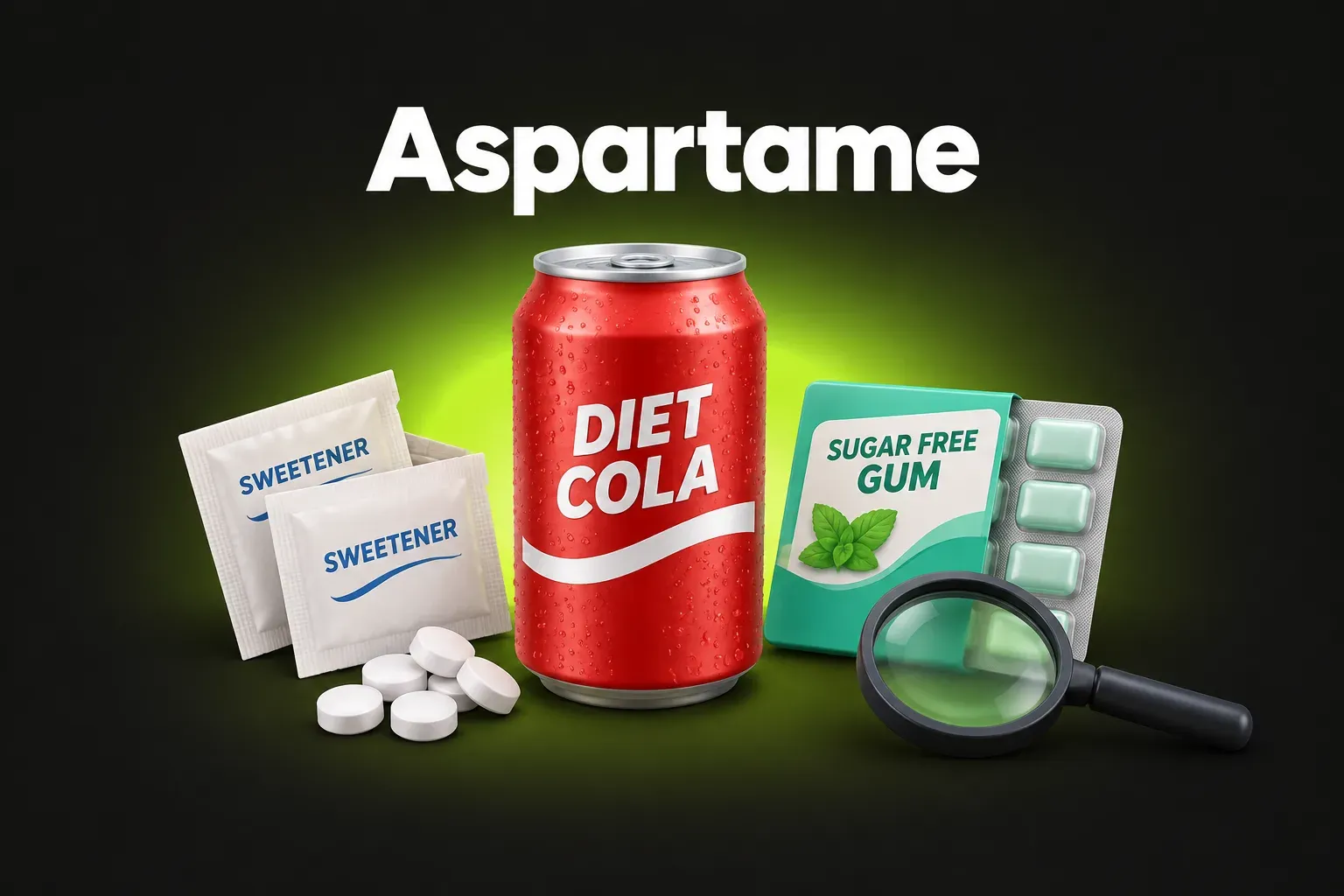
- Drinks: diet and “zero sugar” colas and sodas, flavored waters, powdered drink mixes, some energy drinks
- Sweeteners: tabletop tablets and sachets (Equal, Canderel and store brands)
- Sweets: sugar-free chewing gum, mints and candy
- Dairy and desserts: light and diet yogurts, sugar-free puddings and gelatin
- Other: some breakfast cereals, protein products, chewable vitamins and medicines
Recipes change and differ between countries, so always check the label. Many brands now use sucralose, stevia or acesulfame K instead of aspartame, or together with it.
Should you avoid aspartame?
For most people, an occasional diet soda or a piece of sugar-free gum isn’t a concern. Consider cutting back if you:
- drink several diet sodas every day
- are using sweeteners to lose weight (the evidence says they don’t help long term)
- notice headaches or other symptoms after aspartame
- give diet drinks to young children, who reach the limit faster
Avoid it completely if you have phenylketonuria.
Easy swaps
- Water, sparkling water or water with lemon instead of diet soda – the best option overall.
- Unsweetened tea or coffee, and slowly reduce the sweetness you add.
- Plain yogurt with fruit instead of light or diet yogurt.
- If you want a sweetener, use it occasionally rather than in every drink.
Find aspartame in seconds. It’s easy to miss E951 in a long ingredient list. With NutriSmart, you photograph the label or scan the barcode and the app highlights sweeteners and other additives, explains what each one is and gives the product a health score out of 100 – so you can compare products on the spot.Get the app free
You can also read about other sweeteners: sucralose, acesulfame K, saccharin and erythritol. And find out whether Diet Coke and Coke Zero are bad for you.
Compare all sweeteners and their NutriSmart ratings in our full list of artificial sweeteners.
The bottom line
Aspartame is one of the most studied food additives, and within the daily limit, regulators consider it safe. The 2023 cancer label is based on limited evidence, not proof, and most people have far less than the limit. But sweeteners don’t help with weight loss in the long run. A few large studies have raised questions worth taking seriously. And diet drinks add nothing good to your diet. Treat them as an occasional replacement for sugary drinks – not as a daily habit.
FAQ
Does aspartame cause cancer?
It hasn't been proven. In 2023, the WHO's cancer agency (IARC) said aspartame is "possibly carcinogenic to humans" (Group 2B). It based this on limited evidence, mainly for liver cancer. On the same day, the WHO's food additive experts (JECFA) said the evidence wasn't convincing and kept the same safe daily limit.
How much aspartame is safe per day?
The safe daily limit is 40 mg per kg of body weight in the EU and by the WHO, and 50 mg per kg in the US. For a 70 kg adult, that's 2,800 mg a day – roughly 9 to 14 cans of diet soda, depending on how much aspartame each contains.
What are the side effects of aspartame?
For people with the genetic disorder phenylketonuria (PKU), aspartame is dangerous because it contains phenylalanine. For everyone else, some studies have linked a lot of artificial sweeteners to a slightly higher risk of cancer and heart disease, and to memory getting worse faster. But these studies show a link, not proof. Some people report headaches.
Is aspartame worse than sugar?
Not in an obvious way. Swapping sugary drinks for diet drinks cuts calories and sugar, and aspartame doesn't raise blood sugar. But the WHO advises against relying on sweeteners for weight control, because long-term studies don't show lasting weight loss. Water and unsweetened drinks are the better swap.
Which foods contain aspartame?
Mostly diet and "zero sugar" soft drinks, sugar-free chewing gum, tabletop sweeteners (such as Equal or Canderel), light or diet yogurts, sugar-free desserts and some medicines and vitamins. On labels it appears as aspartame or E951.
Is aspartame safe during pregnancy?
Regulators consider aspartame within the daily limit safe during pregnancy, except for women with PKU. Because diet drinks offer no nutritional benefit, many doctors suggest keeping them occasional and choosing water or milk instead.