Acesulfame K (E950): Safety, Side Effects and Studies
What acesulfame potassium (E950) is, where it's hidden, what studies link it to, why EFSA raised its safe limit in 2025, and how it compares.
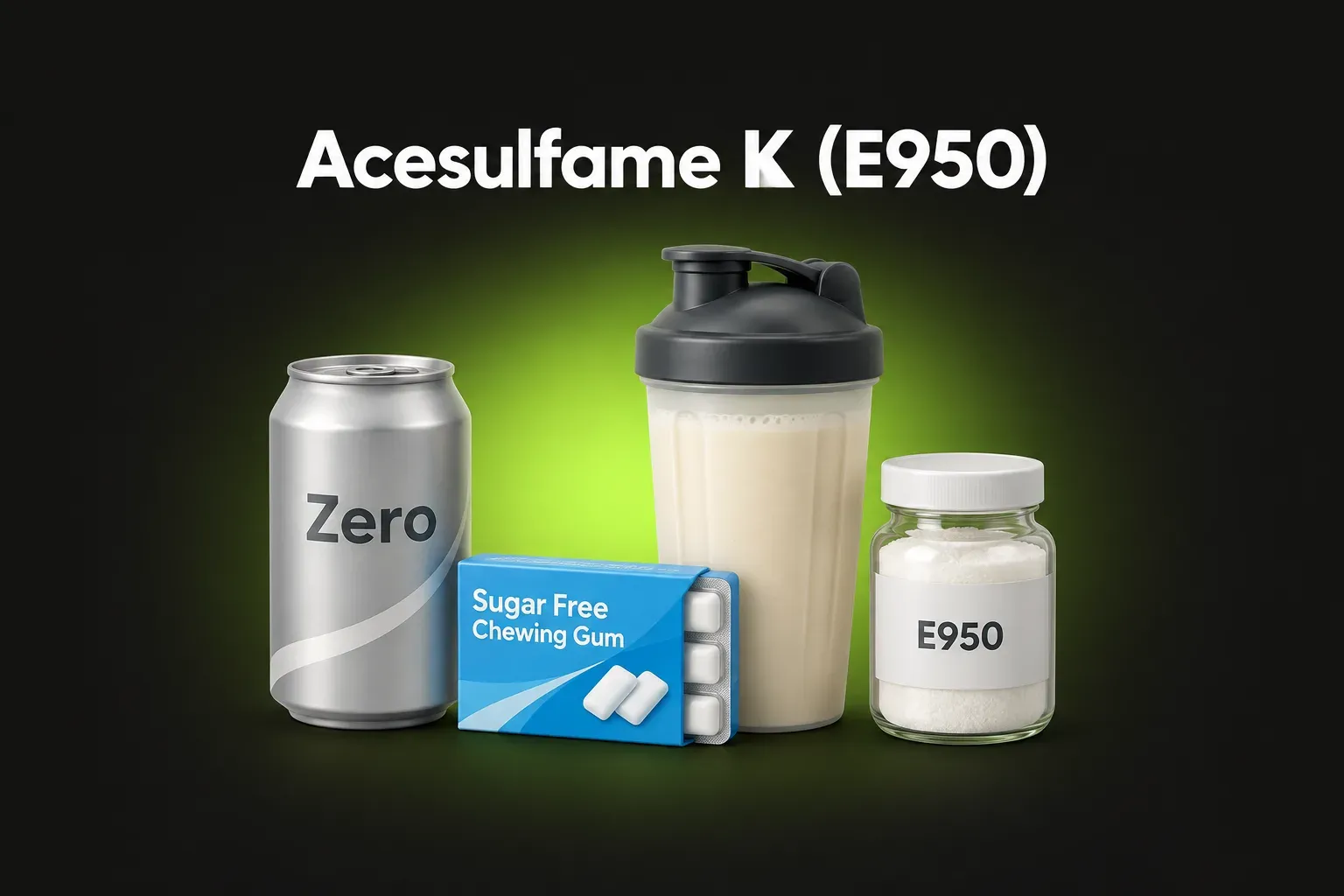
If your drink says “zero sugar”, it very likely contains acesulfame K. It’s one of the most used sweeteners in the world – but few people know its name, because it’s almost always hidden next to a better-known partner like aspartame or sucralose.
The short answer: acesulfame K (E950) is a calorie-free sweetener about 200 times sweeter than sugar. The body doesn’t use it – it leaves unchanged in the urine. In 2025, the European Food Safety Authority raised its safe daily limit to 15 mg per kg of body weight. But a large French study linked higher intake to a 13% higher risk of cancer and a 40% higher risk of coronary heart disease. Those are links, not proof. Small amounts are fine – but it’s no reason to drink “zero” sodas every day.
What is acesulfame K?
Acesulfame potassium was discovered by accident in 1967 by a German chemist who licked his finger in the lab. It’s sold under names like Sunett and Sweet One.
- It’s about 200 times sweeter than sugar
- It has no calories and doesn’t raise blood sugar
- The body doesn’t break it down – it leaves in the urine unchanged
- It’s stable when heated, so it’s used in baked goods
- It has a slightly bitter aftertaste, so it’s usually mixed with aspartame or sucralose – together they taste more like real sugar
On labels, look for acesulfame K, acesulfame potassium, Ace-K or E950.
Where is acesulfame K found?
- Diet and “zero” soft drinks, flavored water and energy drinks
- Protein shakes, powders and bars
- Sugar-free gum, candy and chocolate
- Yogurts, desserts and ice cream labeled “light” or “no added sugar”
- Tabletop sweeteners
- Medicines and toothpaste
Is acesulfame K safe? What the research says
What EFSA says
In 2025, the European Food Safety Authority finished its re-evaluation. It found no new studies showing harm at the doses people eat and raised the safe daily limit from 9 to 15 mg per kg of body weight – about 1 gram a day for a 70 kg adult. Even high consumers stay below this limit. EFSA did flag a possible genotoxicity concern for one impurity (5-chloro-acesulfame) and asked for a strict limit on it (EFSA, 2025).
Cancer
The NutriNet-Santé study in France followed more than 100,000 adults and recorded what they ate in detail. People who consumed the most acesulfame K had a 13% higher risk of cancer than people who didn’t consume artificial sweeteners. Aspartame showed a similar link (Debras et al., PLOS Medicine, 2022).
Heart disease
In the same group of 103,388 people, higher intake of acesulfame K was linked to a 40% higher risk of coronary heart disease (Debras et al., BMJ, 2022).
These are observational studies: they show links, not proof. People who use a lot of sweeteners may differ in other ways – for example, they may already have weight or blood sugar problems. The researchers tried to account for this, but it’s impossible to rule out completely.
Gut bacteria and weight
In a study in mice, four weeks of acesulfame K changed their gut bacteria, and male mice gained more weight (Bian et al., PLOS ONE, 2017). Animal studies matter: mice share most of their genes with us, and you can’t feed people a substance for years to see whether it harms them, because that would put their health at risk. But mouse results don’t always apply to humans.
In 2023, the World Health Organization advised not to use sugar substitutes for weight control, because they didn’t help people lose weight in the long run.
The environment
Because the body doesn’t break it down, acesulfame K ends up in wastewater and isn’t fully removed by treatment plants. It’s so common in rivers and groundwater that scientists use it as a marker of sewage pollution.
Acesulfame K vs other sweeteners
| Sweetener | Sweeter than sugar | Main concern |
|---|---|---|
| Acesulfame K (E950) | About 200 times | Links to cancer and heart disease in a French study |
| Aspartame (E951) | About 200 times | “Possibly carcinogenic” label (IARC, 2023) |
| Sucralose (E955) | About 600 times | Gut bacteria, breakdown products when heated |
| Saccharin (E954) | 300–500 times | Gut bacteria, blood sugar in some people |
| Stevia (E960) | 200–300 times | Few, but often mixed with other sweeteners |
How to cut back
- Read labels – acesulfame K often hides next to aspartame or sucralose.
- Don’t drink “zero” sodas every day – water, sparkling water, unsweetened tea and coffee are better.
- Choose plain yogurt and add fruit yourself.
- Check protein shakes and bars – many contain two or three sweeteners.
- Get used to less sweetness step by step – it takes a few weeks.
Spot acesulfame K on any label in seconds. With NutriSmart, you photograph the ingredient list or scan the barcode, and the app tells you right away if the product has acesulfame K. Turn on an alert for it, and the app warns you every time a product you scan contains it. You’ll also see every other additive, the risks of each one and a health score out of 100.Get the app free
Compare all sweeteners and their NutriSmart ratings in our full list of artificial sweeteners.
The bottom line
Acesulfame K (E950) is a calorie-free sweetener found in most “zero” drinks, protein products and sugar-free sweets, usually together with aspartame or sucralose. In 2025, EFSA raised its safe daily limit. But a large French study linked higher intake to more cancer and coronary heart disease, and a mouse study found changes in gut bacteria. Occasional use is fine – but water is still the best drink.
FAQ
What is acesulfame K?
Acesulfame K (acesulfame potassium, E950) is a calorie-free artificial sweetener about 200 times sweeter than sugar. It was discovered in Germany in 1967. It's almost always mixed with other sweeteners like aspartame or sucralose, because together they taste more like sugar.
Is acesulfame K safe?
Regulators consider it safe in normal amounts. In 2025, the European Food Safety Authority even raised its safe daily limit to 15 mg per kg of body weight. But a large French study linked higher intake to a higher risk of cancer and heart disease. These are links, not proof, but they're a reason not to have it in large amounts every day.
What foods contain acesulfame K?
Diet and zero-sugar soft drinks, flavored water, protein shakes and bars, sugar-free gum and candy, yogurts, ice cream, tabletop sweeteners, sports drinks, and some medicines and toothpastes.
Does acesulfame K cause weight gain?
It has no calories, but it doesn't seem to help with weight loss either. In a study in mice, it changed gut bacteria and male mice gained more weight. In 2023, the WHO advised against using sweeteners for weight control because long-term studies didn't show a benefit.
Is acesulfame K the same as aspartame?
No. They're different chemicals, but they're often used together in the same drink. Aspartame is broken down in the body, while acesulfame K passes through unchanged and leaves in the urine.
Can acesulfame K cause side effects?
Most people don't notice any. Some people dislike its slightly bitter aftertaste. A few report headaches or stomach problems after sweeteners, but this hasn't been clearly shown in studies.