Artificial Sweeteners: Full List, Risks and Safest Choices
A list of all artificial and low-calorie sweeteners with a risk rating for each – aspartame, sucralose, stevia, erythritol and more – and what studies show.
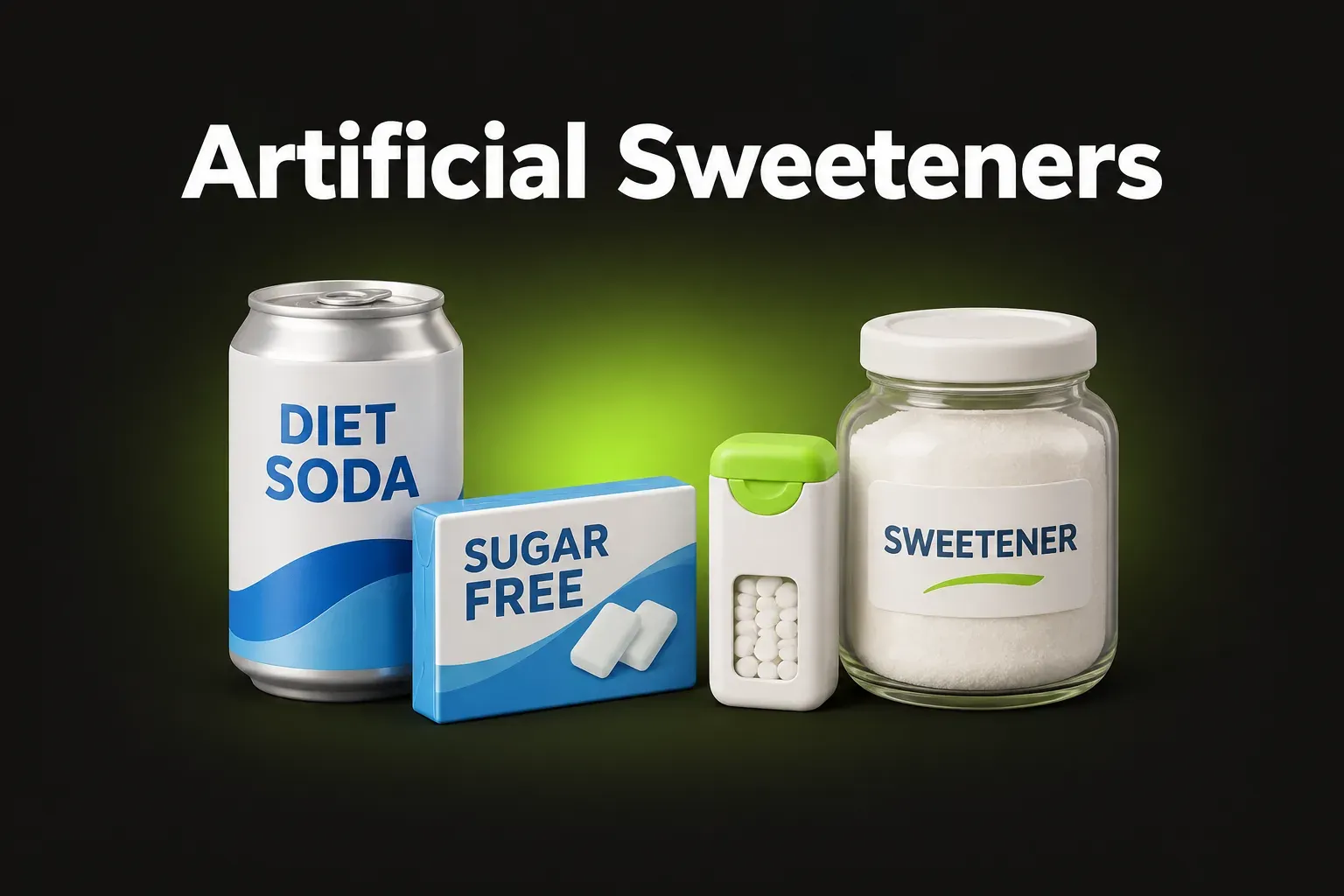
Diet soda, sugar-free gum, “zero” yogurts, protein bars, low-sugar ketchup – sweeteners are in thousands of products. They promise sweetness without sugar or calories. But are they safe? And which ones are worth avoiding? Here’s a full list of artificial and low-calorie sweeteners, what each one is, the risk rating it gets in the NutriSmart app, and what recent studies show.
The short answer: sweeteners fall into three groups: intense sweeteners (aspartame, sucralose, acesulfame K, saccharin), plant-based sweeteners (stevia, monk fruit, thaumatin) and sugar alcohols (erythritol, xylitol, sorbitol, maltitol). They’re approved by food agencies, but large studies have linked some of them to cancer, heart problems, blood clots and changes in gut bacteria. NutriSmart rates aspartame, acesulfame K, sucralose, erythritol and xylitol as high risk. Stevia has the fewest concerns. And sweeteners don’t help with long-term weight loss, according to the WHO.
The three types of sweeteners
| Type | Examples | Calories | How sweet |
|---|---|---|---|
| Intense (artificial) | Aspartame, sucralose, acesulfame K, saccharin | Almost none | 30–20,000× sugar |
| From plants | Stevia, thaumatin, monk fruit | Almost none | 200–3,000× sugar |
| Sugar alcohols (polyols) | Erythritol, xylitol, sorbitol, maltitol | 0–2.4 kcal/g | 0.4–1× sugar |
Intense sweeteners are used in tiny amounts, because they’re hundreds of times sweeter than sugar. Sugar alcohols are used in larger amounts, like sugar, and are common in sugar-free candy, chocolate and gum.
Full list of sweeteners with NutriSmart ratings
Ratings come from the NutriSmart additive database (October 2026). In the app, each rating lowers the product’s health score: low −2.5, moderate −10, high −15 points.
| E number | Sweetener | How sweet | Rating |
|---|---|---|---|
| E420 | Sorbitol | 0.6× | Moderate |
| E421 | Mannitol | 0.5–0.7× | Low |
| E950 | Acesulfame K | 200× | High |
| E951 | Aspartame | 200× | High |
| E952 | Cyclamate | 30–50× | Moderate |
| E953 | Isomalt | 0.5× | Low |
| E954 | Saccharin | 300–500× | Moderate |
| E955 | Sucralose | 600× | High |
| E957 | Thaumatin | 2,000–3,000× | No known risk |
| E959 | Neohesperidin DC | 1,500× | Low |
| E960 | Stevia (steviol glycosides) | 200–300× | Low |
| E961 | Neotame | 7,000–13,000× | Moderate |
| E962 | Aspartame-acesulfame salt | 350× | High |
| E964 | Polyglycitol syrup | 0.5–0.75× | Low |
| E965 | Maltitol | 0.9× | Low |
| E966 | Lactitol | 0.4× | Low |
| E967 | Xylitol | 1× | High |
| E968 | Erythritol | 0.6–0.7× | High |
| E969 | Advantame | 20,000× | Low |
| – | Monk fruit | 150–250× | Not an additive |
| – | Allulose | 0.7× | Not an additive |
Cyclamate is banned in the US but allowed in the EU. Monk fruit and allulose aren’t E-numbered additives: in the US they’re sold as “generally recognized as safe”, while the EU has approved only one water-based monk fruit extract and hasn’t approved allulose. For all other additives, see our full E numbers list.
What studies show about sweeteners
Food agencies set a safe daily limit (ADI) for each sweetener, and most people stay below it. But newer independent studies have raised concerns that make it worth limiting some of them:
- Cancer: a French study of more than 100,000 adults (NutriNet-Santé) found that people who consumed the most aspartame had a 15% higher risk of cancer, and those with the most acesulfame K a 13% higher risk (Debras et al., PLoS Medicine, 2022). In 2023, the WHO’s cancer agency classified aspartame as “possibly carcinogenic” (IARC, The Lancet Oncology, 2023).
- Heart and blood vessels: in the same French group, aspartame was linked to a 17% higher risk of stroke, and acesulfame K to a 40% higher risk of coronary heart disease (Debras et al., BMJ, 2022).
- Blood clots: people with the most erythritol in their blood had about twice the risk of a heart attack, stroke or death over three years, and drinking erythritol made blood clot more easily (Witkowski et al., Nature Medicine, 2023). A similar effect was later found for xylitol (Witkowski et al., European Heart Journal, 2024).
- Gut and blood sugar: in a trial with 120 healthy adults, two weeks of saccharin or sucralose changed gut bacteria and made blood sugar control worse – even below the official daily limits (Suez et al., Cell, 2022).
- DNA: sucralose-6-acetate, a substance found in sucralose and made from it in the gut, damaged DNA in lab tests (Schiffman et al., Journal of Toxicology and Environmental Health, 2023).
Many of these are observational studies or lab and animal studies, so they show links and warning signs, not final proof. But when several independent research groups find similar signals, it makes sense to limit those sweeteners as a precaution.
Do sweeteners help with weight loss?
Swapping a sugary soda for a diet one saves about 140 calories per can, and sweeteners don’t raise blood sugar the way sugar does. But in long-term studies, people who use sweeteners don’t keep weight off better. That’s why, in 2023, the World Health Organization advised against using non-sugar sweeteners for weight control and suggested cutting down on sweetness overall (WHO, 2023). The advice doesn’t apply to people who already have diabetes.
The best approach is to slowly get used to less sweetness: water, sparkling water, plain yogurt with fruit, and unsweetened coffee and tea. Read more about the calorie deficit.
Sugar alcohols: watch your stomach
Sugar alcohols are only partly absorbed. The rest reaches the large intestine, where it pulls in water and gets fermented by bacteria. In larger amounts, that means gas, bloating and diarrhea. Sorbitol is the strongest laxative; erythritol is the gentlest. In the EU and UK, foods with more than 10% polyols must say “excessive consumption may produce laxative effects”. People with IBS are usually more sensitive.
How to spot sweeteners on a label
- Look for the names: aspartame, sucralose, acesulfame K (acesulfame potassium), saccharin, stevia (steviol glycosides, Reb A), erythritol, xylitol, sorbitol, maltitol.
- Look for the E numbers: E950–E969, plus E420 and E421.
- Check the front of the pack: “sugar-free”, “zero”, “diet”, “light” and “no added sugar” often mean sweeteners.
- In the EU and UK, labels must say “with sweetener(s)”, and products with aspartame must say “contains a source of phenylalanine”.
- Watch for blends: many products use two or three sweeteners together, for example aspartame plus acesulfame K.
Spot every sweetener in seconds. With NutriSmart, you scan the barcode or photograph the ingredient list, and the app finds each sweetener, explains what it does and how risky it is, and gives the product a health score out of 100.Get the app free
You can also read about ultra-processed foods, high fructose corn syrup and our guide to the healthiest soda.
The bottom line
Artificial and low-calorie sweeteners are approved and have few or no calories, but they’re not all equal. Large studies link aspartame, acesulfame K and sucralose to cancer or heart risks, and erythritol and xylitol to blood clots, so NutriSmart rates several of them moderate or high risk. Stevia and thaumatin have the fewest concerns. Sweeteners don’t help with long-term weight loss, so the best plan is to use them less and get used to less sweetness overall.
FAQ
What are artificial sweeteners?
They're substances that taste sweet but have few or no calories. The best known are aspartame, sucralose, acesulfame K and saccharin. Plant-based sweeteners like stevia and sugar alcohols like erythritol and xylitol are often grouped with them as "low-calorie sweeteners".
Which artificial sweeteners should I avoid?
NutriSmart rates acesulfame K (E950), aspartame (E951), sucralose (E955), aspartame-acesulfame salt (E962), xylitol (E967) and erythritol (E968) as high risk, based on studies linking them to cancer, heart problems, blood clots or gut changes. Saccharin, cyclamate, neotame and sorbitol are rated moderate.
What is the safest sweetener?
Among approved sweeteners, stevia (E960) has the fewest concerns in studies, and thaumatin (E957), a sweet protein, has none known. Small amounts of real sugar or honey are also fine for most people. The healthiest option is to slowly get used to less sweetness overall.
Do artificial sweeteners help you lose weight?
Not in the long run. In 2023, the World Health Organization advised against using sweeteners for weight control, because long-term studies don't show lasting weight loss and suggest a higher risk of type 2 diabetes and heart disease. Swapping one sugary soda for a diet one saves calories, but water is better.
How do I know if a product has sweeteners?
Look at the ingredient list for names like aspartame, sucralose, acesulfame K, stevia or erythritol, or E numbers from E950 to E969 plus E420 and E421. In the EU and UK, the label must also say "with sweetener(s)". Products with aspartame say "contains a source of phenylalanine".
Are sugar alcohols artificial sweeteners?
Not exactly. Sugar alcohols (polyols) like sorbitol, maltitol, xylitol and erythritol are bulk sweeteners with fewer calories than sugar. They don't spike blood sugar much, but in larger amounts they cause gas, bloating and diarrhea.