What Is a Calorie Deficit? How to Calculate Yours
What a calorie deficit is, how to calculate yours step by step, how big it should be to lose weight safely, and why weight loss slows down over time.
A calorie deficit is the one thing every weight-loss diet has in common – whether it’s keto, intermittent fasting or simply eating smaller portions. So what is a calorie deficit, exactly? Once you understand how it works, you can lose weight without following any strict diet at all.
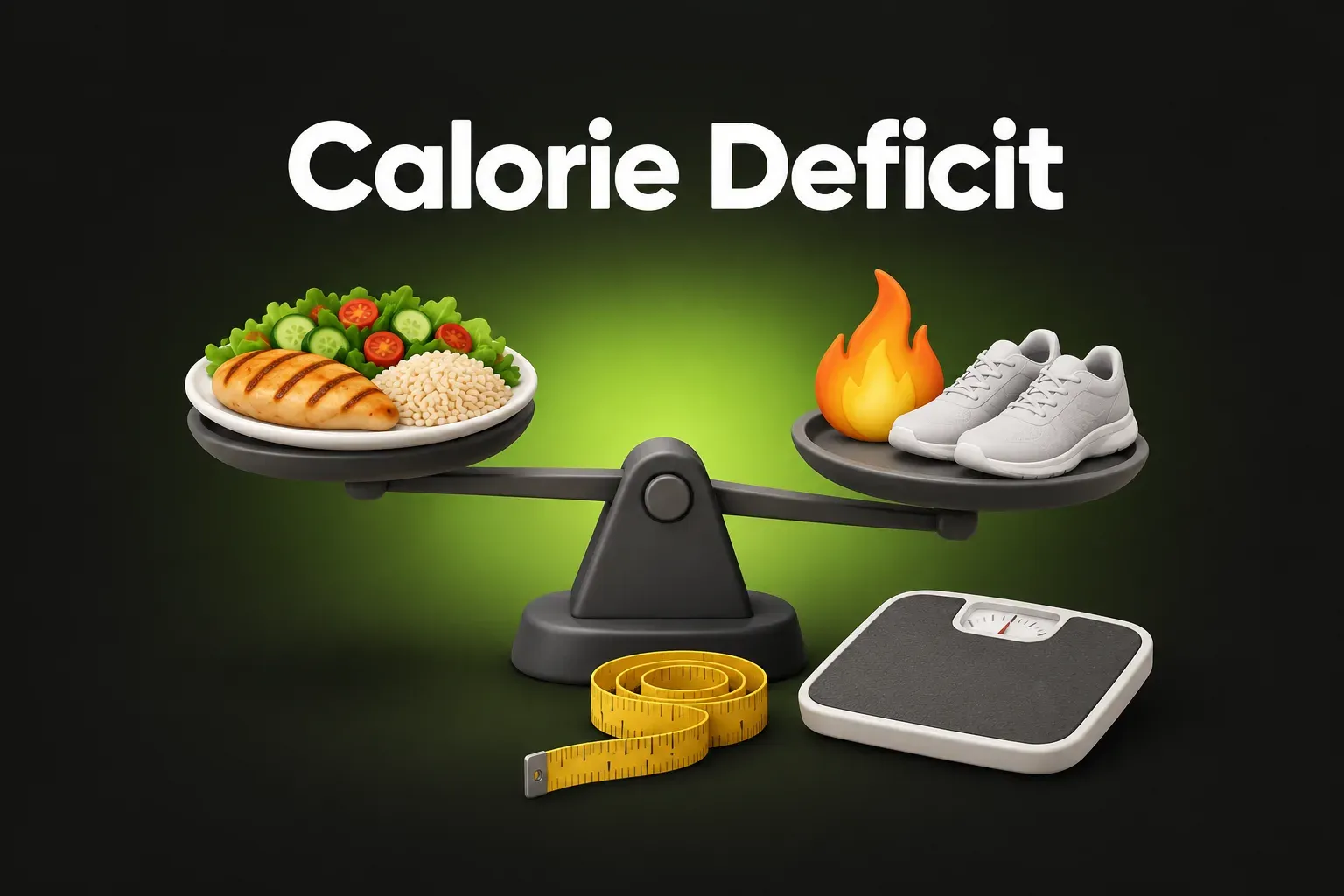
The short answer: a calorie deficit means eating fewer calories than your body burns. Your body then uses stored energy – mostly fat – to make up the difference. For steady weight loss that lasts, most people do well eating about 15–25% fewer calories than they burn. That usually means losing around 0.25–0.5 kg (0.5–1 lb) a week. Our free calorie calculator works out your number in a minute.
What is a calorie deficit?
Your body uses energy all day: to breathe, keep your heart beating, digest food and move. This energy is measured in calories. Every day, you have:
- Calories in: everything you eat and drink
- Calories out: the energy your body uses
When calories in are lower than calories out, you’re in a calorie deficit. Your body then takes the missing energy from its stores – mostly fat. When they’re higher, you’re in a surplus and store the extra. When they’re equal, your weight stays the same – that’s called maintenance.
How many calories does your body burn?
The calories you burn in a day are called your TDEE (total daily energy expenditure). It has two parts:
- BMR (basal metabolic rate): the energy your body needs even if you stay in bed all day – usually 60–70% of the total.
- Activity: everything else – walking, working, exercise and even digesting food.
BMR is usually worked out with the Mifflin-St Jeor formula, which uses your sex, age, height and weight. You then multiply BMR by a number that shows how active you are:
| Activity level | What it means | Factor |
|---|---|---|
| Sedentary | Desk job, little exercise | 1.2 |
| Lightly active | Light exercise 1–3 days a week | 1.375 |
| Moderately active | Exercise 3–5 days a week | 1.55 |
| Very active | Hard exercise 6–7 days a week | 1.725 |
| Extremely active | Physical job plus daily training | 1.9 |
How to calculate your calorie deficit: an example
Take a woman who is 35 years old, 165 cm (5’5”) tall, weighs 75 kg (165 lb) and exercises lightly a few times a week.
- BMR (Mifflin-St Jeor for women: 10 × weight + 6.25 × height − 5 × age − 161) = 750 + 1,031 − 175 − 161 = about 1,445 calories
- TDEE = 1,445 × 1.375 = about 1,987 calories – the calories that keep her weight the same
- Deficit of 20% = 1,987 × 0.8 = about 1,590 calories a day
That’s about 400 calories less than she burns each day, or around 2,800 a week. Since roughly 7,700 calories equal 1 kg of body fat, she would lose about 0.35 kg (0.8 lb) a week at first.
You don’t need to do the maths yourself: our calorie calculator does every step, and the macro calculator splits your calories into protein, carbs and fat.
How big should your deficit be?
| Deficit | Approximate weight loss | What to expect |
|---|---|---|
| 10% | Slow | Easy to keep up; good for the last few kilos |
| 15–20% | Steady | A good balance for most people |
| 25% | Faster | Works well with high protein and some exercise |
| 30% or more | Fast | Hard to sustain; more hunger, tiredness and muscle loss |
Health agencies such as the US CDC recommend losing about 0.5–1 kg (1–2 lb) a week. People who lose weight at that pace are more likely to keep it off. To stay safe, without a doctor’s help, don’t eat less than about 1,200 calories a day for women and 1,500 for men.
Why weight loss slows down
In the first week or two, the scale often drops quickly – much of it is water. After that, weight loss slows, and that’s normal:
- You burn less as you get lighter. A smaller body needs less energy, so the same intake becomes a smaller deficit.
- Your body adapts. You tend to move a little less without noticing, and your metabolism slows slightly.
Researchers at the US National Institutes of Health showed that the old rule “3,500 calories = 1 lb” promises too much in the long run. Your body adapts as your weight changes. The full effect of a change in eating takes about a year to show (Hall et al., The Lancet, 2011). The NIH’s free Body Weight Planner uses this model.
What to do: recalculate your target every 4–5 kg (10 lb) you lose, and check your portions again – they tend to grow over time.
How to stay in a calorie deficit without feeling hungry
- Eat enough protein. Protein keeps you full longer and helps you keep muscle while you lose fat (Leidy et al., American Journal of Clinical Nutrition, 2015). Our protein calculator shows how much you need, and these high protein snacks make it easier.
- Fill half your plate with vegetables. They add volume and fiber for very few calories.
- Cut liquid calories first. Soda, juice, sweet coffee drinks and alcohol add a lot of calories without making you full.
- Eat fewer ultra-processed foods. In one trial, people ate about 500 calories more per day on an ultra-processed diet than on an unprocessed one. Read more about ultra-processed foods.
- Move more during the day. Walking adds up – it often burns more than a short workout. See how many steps a day you need and how many calories walking burns.
- Sleep enough. Short sleep increases hunger and cravings.
- Weigh yourself regularly and look at the weekly average, not single days.
Signs your deficit is too big
- You feel tired, cold or irritable most of the time
- You’re always hungry or thinking about food
- Your strength in the gym drops quickly
- You lose hair, or periods become irregular
- You end up overeating at weekends
If this sounds like you, eat a bit more. A smaller deficit you can keep for months works better than a big one you give up after two weeks.
Track it without the guesswork. With NutriSmart, you log meals by snapping a photo of what you eat, and the app counts calories and protein for you and shows how close you are to your daily target. It sets that target with the same method as our calculator.Get the app free
Want to see what a deficit looks like on your plate? Our 1500, 1800 and 2000 calorie meal plans give you a full week of meals with calories and protein for each one.
Looking for filling meals that fit a deficit? Try our healthy dinner ideas – most have 380–610 calories.
Snacks are the easiest calories to forget – here are 40 low calorie snacks that fit a deficit.
The bottom line
A calorie deficit simply means eating a little less than your body uses. Find out how many calories you burn, eat about 15–25% less, eat plenty of protein and choose mostly simple, whole foods. Then be patient: weight you lose slowly is the weight that stays off. Start with our free calorie calculator to find your number.
FAQ
What is a calorie deficit?
A calorie deficit means eating fewer calories than your body uses in a day. To cover the difference, your body uses stored energy – mostly fat – so you lose weight over time.
How big should my calorie deficit be?
For most people, eating about 15–25% fewer calories than they burn works well. That's often around 300–500 calories a day. You lose roughly 0.25–0.5 kg (0.5–1 lb) a week without feeling exhausted. Bigger deficits work faster, but they're harder to keep up and you lose more muscle.
How do I calculate my calorie deficit?
First work out how many calories your body burns in a day (TDEE). That depends on your age, height, weight and how active you are. Then subtract 15–25%. Our free calorie calculator does both steps for you in a minute.
Can I lose weight without counting calories?
Yes. If you eat more protein, vegetables and simple foods, and fewer ultra-processed foods and sugary drinks, you often eat less without trying. Counting calories, even for a few weeks, simply makes it easier to see where the calories come from.
Why have I stopped losing weight in a calorie deficit?
As you lose weight, your body burns fewer calories, so the same intake becomes a smaller deficit. Portions also tend to creep up over time. Recalculate your target every 4–5 kg (10 lb) lost and check your portions for a week.
What is the lowest number of calories I should eat?
A common rule: without a doctor's help, don't go below about 1,200 calories a day for women and 1,500 for men. Below that, it's hard to get enough protein, vitamins and minerals.