Ultra-Processed Foods: What They Are, List & Risks
What ultra-processed foods are, a list of common examples, what studies link them to, and simple ways to eat less of them – without giving up convenience.
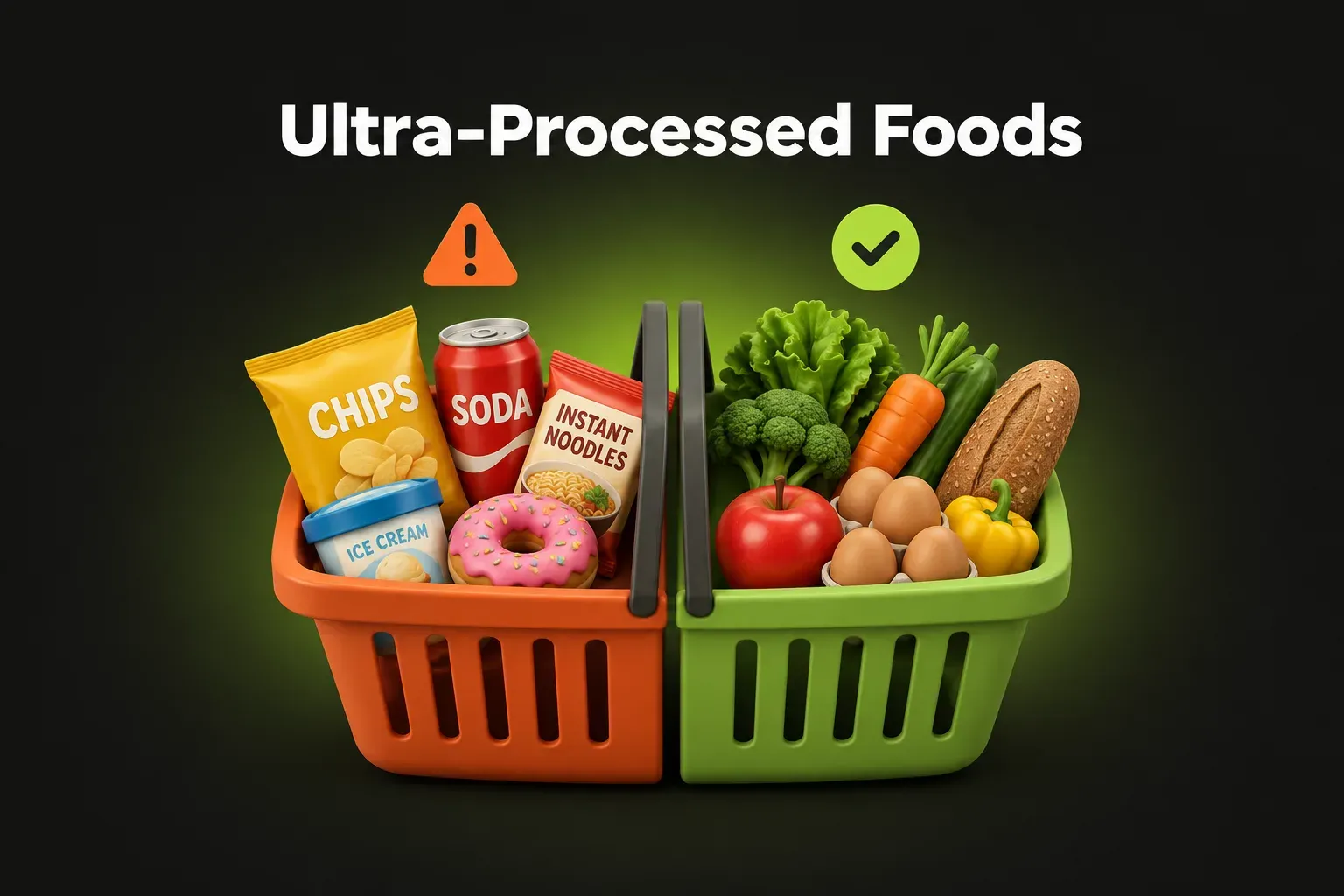
Ultra-processed foods make up more than half of what many people eat. They’re cheap, tasty and easy. And more and more studies link them to weight gain, heart disease, type 2 diabetes and other health problems.
The short answer: ultra-processed foods are factory products. They’re made mostly from parts taken out of foods (like starches, sugars, oils and protein powders) and additives you wouldn’t use in your own kitchen – flavorings, emulsifiers, sweeteners and colors. Common examples are soft drinks, packaged snacks, instant noodles, processed meats and most breakfast cereals. You don’t need to cut them out completely. But eating less of them is one of the simplest ways to eat better.
What are ultra-processed foods?
The term comes from the NOVA system, made by scientists at the University of São Paulo in Brazil. It sorts foods by how much they’ve been processed and why – not by their nutrients:
| Group | What it is | Examples |
|---|---|---|
| 1. Unprocessed or minimally processed | Whole foods, possibly cleaned, frozen, dried or pasteurized | Fruit, vegetables, eggs, meat, milk, plain yogurt, rice, oats |
| 2. Processed cooking ingredients | Things taken from foods, used in cooking | Oils, butter, sugar, salt, flour |
| 3. Processed foods | Group 1 foods with salt, sugar or oil added | Canned beans, cheese, fresh bread, canned fish, salted nuts |
| 4. Ultra‑processed foods | Factory products with ingredients and additives not used at home | Soft drinks, chips, candy, instant noodles, chicken nuggets, most packaged bread |
So processing itself isn’t the problem. Frozen vegetables, canned beans and cheese are all processed. What makes a food ultra-processed is the recipe. Factory-made ingredients are put back together with additives. The result is cheap to make, lasts a long time and is very easy to eat.
A list of common ultra-processed foods
Drinks
- Soft drinks, energy drinks and sports drinks
- Fruit-flavored drinks (not 100% juice)
- Sweetened iced teas and flavored coffee drinks
Snacks and sweets
- Chips, flavored crackers and puffed snacks
- Candy, chocolate bars and cereal bars
- Packaged cookies, cakes and pastries
- Most ice cream and frozen desserts
Meals and meat
- Instant noodles and powdered soups
- Frozen pizza and ready meals
- Hot dogs, sausages, chicken nuggets and most deli meats
- Fast food burgers and fries
Breakfast, bread and dairy
- Sweetened breakfast cereals
- Packaged sliced bread and buns with emulsifiers or preservatives
- Flavored and “light” yogurts with sweeteners or thickeners
- Margarine, flavored spreads and coffee creamers
Sauces and extras
- Ketchup, bottled dressings and many sauces
- Meat substitutes made from protein powders
- Protein bars and shakes
What the research says
Overeating and weight gain
The best-known study was done in 2019 at the US National Institutes of Health. Twenty adults lived in a research center for four weeks. They ate an ultra-processed diet for two weeks and an unprocessed diet for two weeks. They could eat as much as they wanted. Both diets offered the same calories, sugar, fat, fiber and salt. On the ultra-processed diet, people ate about 500 calories more per day and gained weight. On the unprocessed diet, they lost weight (Hall et al., Cell Metabolism, 2019).
A 2025 UK study found something similar, even when both diets followed healthy-eating advice. People lost about twice as much weight on meals that were barely processed than on ultra-processed versions of the same meals (2% vs 1% of body weight in 8 weeks) (Dicken et al., Nature Medicine, 2025).
Ultra-processed foods are often soft, quick to eat and have many calories in a small amount. So it’s easy to eat more than you need before you feel full.
Heart disease, diabetes and mental health
A large review in the BMJ combined 45 earlier reviews with almost 10 million people. It found strong proof that eating more ultra-processed food is linked to a higher risk of death from heart disease, type 2 diabetes, anxiety and other common mental health problems. It also found weaker signs for many other diseases (Lane et al., BMJ, 2024).
In a large French study, every 10% more of the diet from ultra-processed foods was linked to a 12% higher risk of heart disease (Srour et al., BMJ, 2019).
Cancer
The same French study found that every 10% more ultra-processed food in the diet was linked to a 12% higher risk of cancer overall and an 11% higher risk of breast cancer (Fiolet et al., BMJ, 2018).
What these studies can and can’t tell us
Most of the proof comes from studies that followed people over time. These show links, not proof. People who eat more ultra-processed food may also live differently in other ways. But the results are the same in many countries. The feeding studies show a clear effect on how much people eat. And in 2025, The Lancet published a series of articles in which scientists asked governments to help people eat less ultra-processed food (Monteiro et al., The Lancet, 2025).
It’s likely that several things play a part at once. These foods have more sugar, salt and white starch, and less fiber. They’re eaten quickly. And some additives are being studied for their effects on the gut and behavior – such as certain emulsifiers, maltodextrin and lab-made dyes like Red 40.
How much ultra-processed food do we eat?
In the United States, ultra-processed foods make up 55% of all calories people eat – and 62% for children and teenagers (CDC, 2025). The biggest sources are sandwiches and burgers, sweet bakery products, sugary drinks, savory snacks and pizza.
How to spot ultra-processed food on the label
The front of the pack won’t tell you. “High protein”, “low fat” and “natural” products can all be ultra-processed. The ingredient list will:
- Ingredients you wouldn’t cook with: high-fructose corn syrup, maltodextrin, dextrose, hydrolyzed or isolated protein, hydrogenated or interesterified oils, modified starch
- Additives just for looks and taste: flavorings, flavor enhancers (such as MSG, E621), colors, emulsifiers (such as E471, lecithins, carrageenan), sweeteners (such as sucralose or aspartame), thickeners and glazing agents
- A long list: a long ingredient list isn’t proof on its own, but most ultra-processed foods have many ingredients
- Compare similar products: two loaves of bread or two yogurts can be completely different – one with four ingredients, the other with fifteen
How to eat less ultra-processed food
You don’t have to cook everything from scratch. Small swaps add up:
- Start with drinks. Swap soft drinks and energy drinks for water, sparkling water, unsweetened tea or coffee. It’s usually the easiest change with the biggest effect.
- Choose simpler versions of the same food. Plain yogurt with fruit instead of flavored yogurt, oats instead of sweetened cereal, bakery bread with a short ingredient list instead of packaged sliced bread.
- Keep convenient whole foods at home. Frozen vegetables, canned beans and fish, eggs, nuts and fruit are just as quick as ready meals.
- Cook a few basics in bulk – a pot of soup, a tray of roasted vegetables, cooked grains – so there’s always something ready.
- Limit processed meat like hot dogs, sausages and deli meats, which have some of the strongest links to poor health.
- Read ingredients, not just calories. A low-calorie snack can still be ultra-processed.
Spot ultra-processed foods in seconds. With NutriSmart, you photograph the ingredient list or scan the barcode, and the app tells you right away if the product is ultra-processed and which ingredients make it so. You’ll also see every additive, the risks of each one and a health score out of 100, so you can pick the better product right in the store.Get the app free
If you’re also watching your weight, our free calorie calculator shows how much you need each day.
Guide to common additives and ingredients
Ultra-processed foods are recognizable by their additives. Here are our guides to the most common ones, grouped by what they do:
- Sweeteners: aspartame, sucralose, erythritol, xylitol, sorbitol, maltitol, stevia, monk fruit and allulose
- Sugars and starches: high fructose corn syrup, dextrose and maltodextrin
- Emulsifiers: mono and diglycerides, polysorbate 80, carboxymethylcellulose and soy lecithin
- Thickeners: carrageenan, xanthan gum, guar gum, gellan gum, pectin and sodium alginate
- Preservatives: sodium benzoate, potassium sorbate, calcium propionate, TBHQ, natamycin and citric acid
- Colors: Red 40, Yellow 5, Blue 1, titanium dioxide and annatto
- Flavors: MSG and natural flavors
- Other additives: sodium phosphate, potassium bromate and calcium carbonate
- Oils and fats: seed oils, canola oil, sunflower oil and palm oil
Not sure what an E number on the label means? Look it up in our E numbers list.
The bottom line
Ultra-processed foods aren’t poison, and you don’t need to avoid every one of them. But when they make up most of your diet, it’s easy to eat too much. And they’re linked to a long list of health problems. Cutting back – starting with sugary drinks, processed meats and packaged snacks – is one of the best changes you can make. Reading the ingredient list is the easiest way to know what you’re buying.
FAQ
What is the difference between processed and ultra-processed food?
Processed foods are whole foods with salt, sugar or oil added – think canned beans, cheese or fresh bread with a few ingredients. Ultra-processed foods are factory products. They're made mostly from parts taken out of foods or changed in a factory, such as white starches, protein powders and hardened oils. They also contain additives you wouldn't use at home, such as flavorings, emulsifiers and colors.
Is bread ultra-processed?
It depends on the bread. Bread made with flour, water, yeast and salt is processed, not ultra-processed. Most packaged sliced bread contains emulsifiers, preservatives or added sugars, which makes it ultra-processed. The ingredient list tells you which one you have.
Is yogurt ultra-processed?
Plain yogurt made from milk and cultures is not ultra-processed. Flavored yogurts with sweeteners, flavorings, modified starch or other thickeners usually are.
Can ultra-processed food cause cancer?
Large studies that followed people for years link diets high in ultra-processed foods to a higher risk of cancer. In one French study, every 10% more of the diet from ultra-processed foods was linked to a 12% higher cancer risk. These studies show a link, not proof. But they keep finding the same thing.
How much ultra-processed food do people eat?
A lot. In the United States, ultra-processed foods make up about 55% of the calories people eat, and about 62% for children and teenagers, according to the CDC's 2021–2023 data.
Are all ultra-processed foods unhealthy?
Not all in the same way. Some, like whole-grain packaged bread, plain plant milks with added vitamins or some breakfast cereals, can fit into a healthy diet. The strongest links to poor health are with sugary drinks, processed meats, and sweet and salty packaged snacks.