Yellow 5 (Tartrazine): Side Effects, ADHD & Bans
What Yellow 5 (tartrazine, E102) is, which foods contain it, what studies show about hyperactivity, allergies and DNA damage, and why it's being phased out in the US.
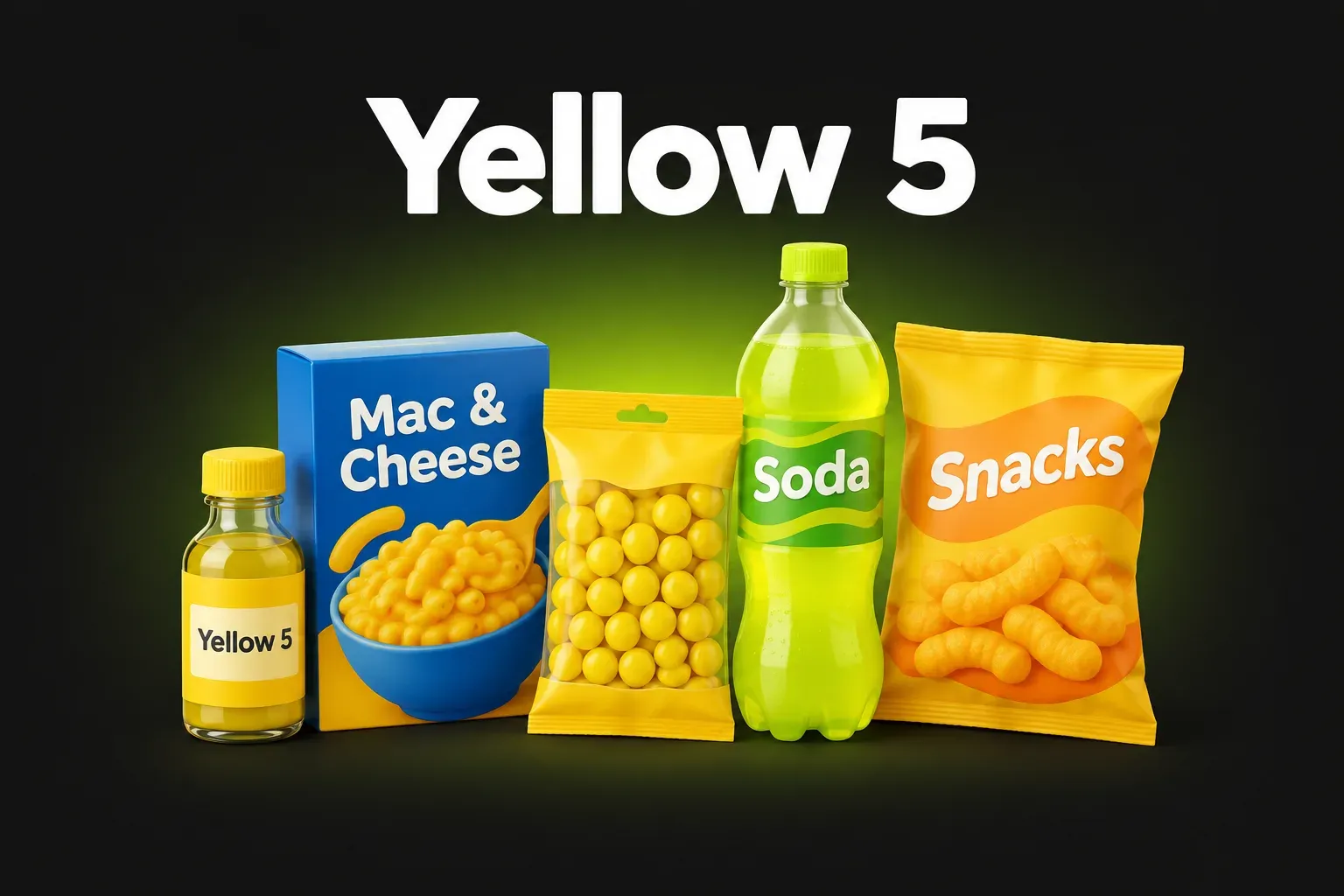
Yellow 5 gives candy, soft drinks, chips, macaroni and cheese and many medicines their bright yellow color – and mixed with Blue 1, it makes things green. It’s one of the most used lab-made dyes, and one of the most studied for side effects.
The short answer: Yellow 5 (tartrazine, E102) is a lab-made dye made from petroleum. It’s still allowed in the US and EU. But it was part of the Southampton study that linked lab-made dyes to hyperactivity in children. It can cause hives and asthma in sensitive people. And recent animal and lab studies found DNA damage. In the EU, foods with it must carry a warning label. In 2025, the FDA asked companies to stop using it. There’s no reason to eat it – especially for children.
What is Yellow 5?
Yellow 5 – also called tartrazine or FD&C Yellow No. 5 – is a lemon-yellow dye made from petroleum. It’s cheap, lasts long and is very bright, so it’s used in thousands of products.
On labels, you’ll see it as:
| Name | Where you’ll see it |
|---|---|
| Yellow 5, FD&C Yellow No. 5 | US ingredient lists |
| Yellow 5 Lake | A form joined with aluminum, for coatings and dry foods |
| Tartrazine, E102 | European Union, UK and many other countries |
Some people are allergic to it. So the FDA requires Yellow 5 to be listed by name on food and medicine labels.
Which foods contain Yellow 5?
- Candy and gummies, especially yellow, green and orange ones
- Soft drinks, sports drinks and powdered drink mixes
- Chips and cheese snacks
- Boxed macaroni and cheese and instant noodles
- Cereals, cake mixes, frosting and custard
- Pickles, mustard and some sauces
- Ice cream, popsicles and gelatin desserts
- Medicines and vitamins – tablets, capsules and syrups
Is Yellow 5 bad for you? What the research says
Hyperactivity in children
- The Southampton study tested nearly 300 ordinary children aged 3 and 8–9. Some drank juice with a mix of lab-made dyes – including tartrazine – plus sodium benzoate. Others drank juice with no additives. With the dye drinks, the children became more hyperactive (McCann et al., The Lancet, 2007). After this study, the EU required a warning on foods with tartrazine and five other dyes: “may have an adverse effect on activity and attention in children.”
- An Australian study looked at children sent to doctors for hyperactivity. Tartrazine made sensitive children grumpy and restless, and they slept worse. This happened at every dose tested – and higher doses made the effects last longer (Rowe and Rowe, Journal of Pediatrics, 1994).
Allergic reactions
Yellow 5 is one of the dyes most often linked to hives, itching, swelling and asthma attacks in sensitive people. Reactions are rare but well known. That’s why US labels must name it.
DNA damage and organ effects: what animal and lab studies show
- In a 2026 study, tartrazine damaged DNA in human white blood cells in the lab. Rats also got it for 7–21 days, at doses starting at half the official daily limit. They had blood changes and DNA damage. Higher doses and more days made it worse. Mixing it with another yellow dye, Sunset Yellow, also made the effects worse (Hayat et al., Journal of Applied Toxicology, 2026).
- Rats got high doses of tartrazine for three weeks. Their kidneys worked less well, and their kidney cells had DNA damage (Yavaş et al., Regulatory Toxicology and Pharmacology, 2026).
These are animal and lab studies, and many used higher doses than people usually eat. But testing a dye on children for years to see if it damages DNA would put their health at risk. And rats share most of their genes with us, and their bodies work in many of the same ways. The dye adds nothing good to food, and there are several warning signs. So it makes sense to avoid it.
What regulators say
The FDA and the European Food Safety Authority still allow Yellow 5. The EU safe daily limit is 7.5 mg per kg of body weight. But in April 2025, the FDA asked food companies to remove Yellow 5 and five other dyes made from petroleum by the end of 2026. California will ban it in public school food. West Virginia passed a law to ban it in food sold in the state.
Yellow 5 vs other dyes
| Dye | EU code | Linked to hyperactivity (Southampton) | FDA phase-out |
|---|---|---|---|
| Yellow 5 (tartrazine) | E102 | Yes | Yes |
| Yellow 6 (sunset yellow) | E110 | Yes | Yes |
| Red 40 | E129 | Yes | Yes |
| Blue 1 | E133 | Not tested | Yes |
| Annatto (natural) | E160b | No proof | No |
How to avoid Yellow 5
- Read labels – look for Yellow 5, Yellow 5 Lake, FD&C Yellow No. 5, tartrazine or E102.
- Be careful with bright yellow, orange and green foods – candy, soft drinks, chips and boxed mac and cheese.
- Choose products colored with turmeric, saffron, beta-carotene or annatto – or no color at all.
- Check medicines and vitamins, especially if you’re allergic – ask your pharmacist for dye-free versions.
- Limit lab-made dyes for children, who eat the most colorful foods.
Spot Yellow 5 on any label in seconds. With NutriSmart, you photograph the ingredient list or scan the barcode, and the app tells you right away if the product has Yellow 5. Turn on an alert for it, and the app warns you every time a product you scan contains it. You’ll also see every other additive, the risks of each one and a health score out of 100.Get the app free
You can also read about other food colorings: Red 40, Blue 1, annatto and carmine.
Tartrazine is one of six colours that carry a warning label in the UK and EU – see the full E numbers list.
The bottom line
Yellow 5 (tartrazine) is a dye made from petroleum that adds only color. It was part of the dye mix that made children more hyperactive in the Southampton study. It can cause hives and asthma. And recent animal and lab studies found DNA damage. The EU requires a warning, and the FDA has asked companies to remove it. There’s no reason to eat it. Choose foods with no added color or with natural colors, especially for children.
FAQ
What is Yellow 5?
Yellow 5, also called tartrazine or FD&C Yellow No. 5 (E102 in Europe), is a lab-made lemon-yellow dye made from oil (petroleum). It's used in candy, soft drinks, chips, cereals, macaroni and cheese, pickles and many medicines. Mixed with Blue 1, it makes green.
Is Yellow 5 bad for you?
It's still allowed in the US and EU. But it's one of the most studied dyes for side effects. It was part of the Southampton study that linked lab-made dyes to hyperactivity in children. It can cause hives and asthma in sensitive people. And recent animal and lab studies found DNA damage. The FDA has asked companies to stop using it.
Does Yellow 5 cause ADHD?
It hasn't been shown to cause ADHD. But it can make some children more hyperactive, grumpy and restless. In an Australian study, tartrazine made behavior and sleep worse in sensitive children – and more dye meant longer effects. It was also part of the dye mix that made ordinary children more hyperactive in the Southampton study.
Can you be allergic to Yellow 5?
Yes. A small number of people react to Yellow 5 with hives, itching, swelling or asthma symptoms. Because of this, the FDA requires it to be listed by name on food and medicine labels in the US.
Is Yellow 5 banned?
Not yet in the US or EU. In the EU, foods with tartrazine must carry a warning that it "may have an adverse effect on activity and attention in children." In 2025, the FDA asked companies to remove it on their own. California and West Virginia have passed laws that limit it.
What is E102?
E102 is the European code for tartrazine, the same dye as Yellow 5. On labels you'll see "Yellow 5", "FD&C Yellow No. 5", "Yellow 5 Lake", "tartrazine" or "E102".