Blue 1 Food Dye: Is It Safe? Side Effects & Bans
What Blue 1 (Brilliant Blue FCF, E133) is, which foods contain it, what studies show about the brain and absorption, and why the FDA and US states are phasing it out.
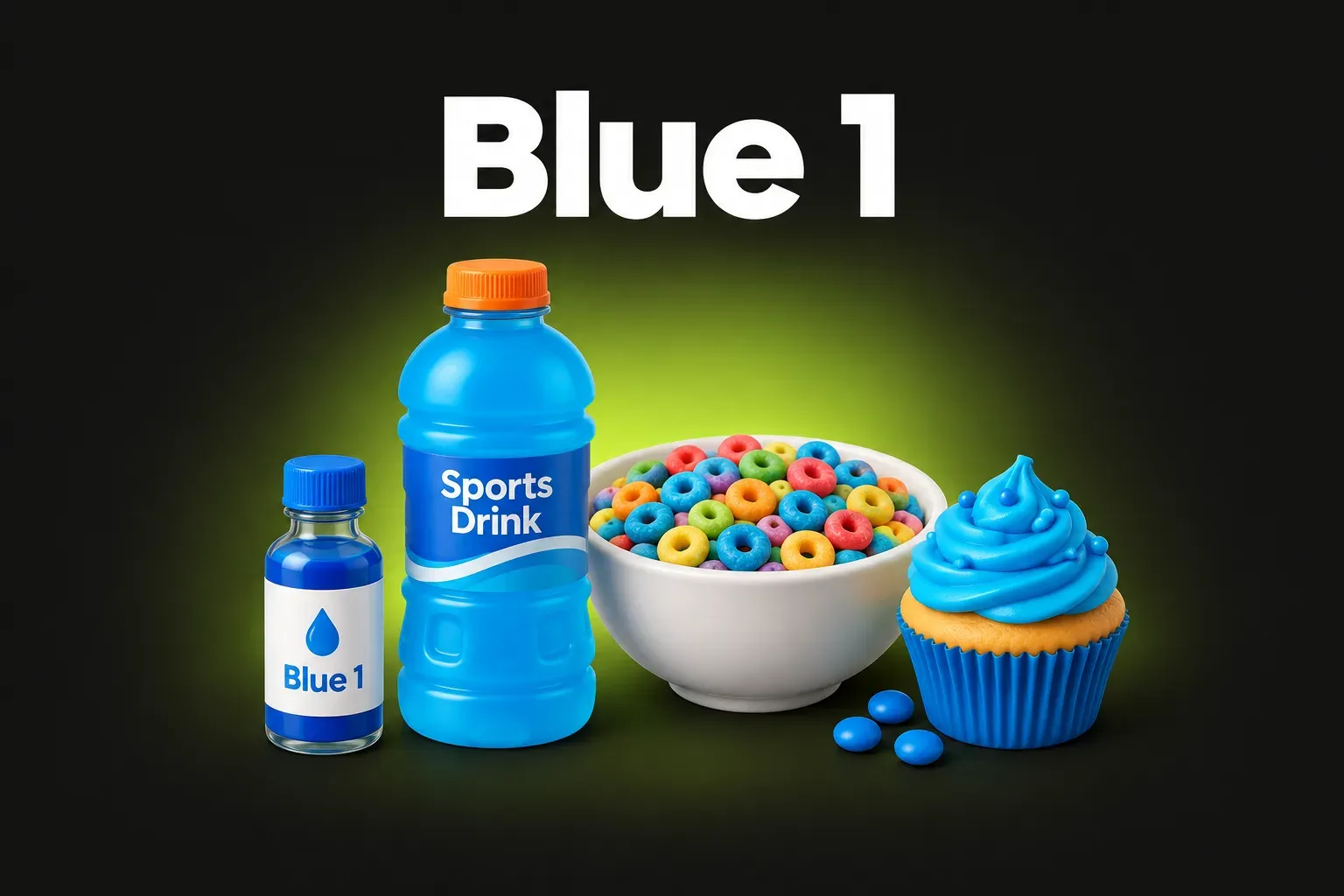
Blue 1 gives candy, sports drinks, cereals, frosting and ice cream their bright blue color – and, mixed with yellow dyes, makes many foods green. It’s one of the most widely used synthetic dyes, and like the others, it’s now on the FDA’s list of dyes to phase out.
The short answer: Blue 1 is a synthetic dye made from petroleum. It’s still allowed in the US and EU, and most of it passes through the gut without entering the blood. But in a lab study, Blue 1 together with glutamate (as in MSG) harmed young nerve cells. It has been linked to deaths in very sick hospital patients who took it in through feeding tubes. And in 2025 the FDA asked companies to remove it from food. There’s no proof that the amounts in food harm healthy people. But it adds nothing except color, so it’s worth limiting, especially for children.
What is Blue 1?
Blue 1 – also called FD&C Blue No. 1 or Brilliant Blue FCF – is a bright blue dye made from petroleum. It has been used in food since the 1920s. It’s very stable and strong, so tiny amounts give an intense color.
On labels, you’ll see it as:
| Name | Where you’ll see it |
|---|---|
| Blue 1, FD&C Blue No. 1 | US ingredient lists |
| Blue 1 Lake | A form bound to aluminum, used in coatings and dry foods |
| Brilliant Blue FCF, E133 | European Union, UK and many other countries |
Which foods contain Blue 1?
- Candy: hard candy, gummies, candy-coated chocolates, lollipops
- Drinks: sports drinks, sodas, powdered drink mixes, slushies
- Cereals: colorful breakfast cereals and marshmallows
- Desserts: frosting, cake decorations, ice cream, popsicles, gelatin desserts
- Green foods: mint ice cream, green candy and drinks (Blue 1 mixed with Yellow 5)
- Non-food: mouthwash, toothpaste, shampoo, cosmetics and some medicines
Is Blue 1 bad for you? What the research says
What regulators say
The FDA and the European Food Safety Authority (EFSA) allow Blue 1. EFSA set a safe daily limit of 6 mg per kg of body weight. Most of it doesn’t enter the blood. It passes through the gut and leaves the body in stool. That’s why a lot of blue candy can turn stool blue or green.
But in April 2025, the FDA and the US Department of Health asked food companies to remove six petroleum-based dyes, including Blue 1, by the end of 2026. It’s a request, not yet a law. Several US states have gone further: California will ban Blue 1 and five other dyes in public school food, and West Virginia passed a law to ban them in food sold in the state.
Nerve cells: Blue 1 and glutamate
In a 2006 study at the University of Liverpool, scientists tested common food additives on young mouse nerve cells, alone and in pairs. Blue 1 together with L-glutamic acid (the substance that gives MSG its taste) stopped nerve cells from growing much more than either one alone. Together, they were worse than the sum of their parts. The same happened with Quinoline Yellow and aspartame (Lau et al., Toxicological Sciences, 2006).
This was a study on cells in a dish, and the doses don’t translate directly to people. But it raises an important point: additives are usually tested one at a time, while we eat them together – blue candy, flavored chips and diet soda in the same afternoon.
When Blue 1 is absorbed: hospital patients
For years, hospitals added Blue 1 to the liquid food given through feeding tubes. It helped them see if patients breathed in their food. But in very sick patients with sepsis (a severe blood infection), the gut becomes leaky and lets the dye into the blood. Doctors reported patients whose skin, urine and blood turned blue or green, and some of them died. Blue 1 and similar dyes harm mitochondria, the energy factories of cells. In 2003, the FDA warned hospitals to stop doing this (Maloney et al., Nutrition in Clinical Practice, 2002).
In healthy people, very little Blue 1 gets into the blood, so this doesn’t mean food dye is deadly. But it shows that the dye is harmful once it gets into the body. That’s why it matters that it stays in the gut.
Hyperactivity in children
The Southampton study, which linked synthetic dyes to hyperactivity in children, didn’t include Blue 1. So the evidence is weaker than for Red 40 or Yellow 5. But because synthetic dyes are often eaten together, many experts and the new state laws treat them as one group. They recommend limiting them all for children.
Studies on animals and cells matter, because giving children synthetic dyes for years to see if they cause harm would put their health at risk. Blue 1 has no health benefit and shows some warning signs, so limiting it is a sensible step.
Allergic reactions
Rarely, Blue 1 can cause allergic reactions such as hives or asthma symptoms, especially in people sensitive to other dyes.
Blue 1 vs other synthetic dyes
| Dye | EU code | Linked to hyperactivity (Southampton) | FDA phase-out |
|---|---|---|---|
| Blue 1 | E133 | Not tested | Yes |
| Red 40 | E129 | Yes | Yes |
| Yellow 5 | E102 | Yes | Yes |
| Yellow 6 | E110 | Yes | Yes |
| Red 3 | E127 | – | Banned from food from 2027 |
How to avoid Blue 1
- Read labels – look for Blue 1, Blue 1 Lake, FD&C Blue No. 1, Brilliant Blue or E133.
- Be careful with blue and green foods – candy, sports drinks, frosting, mint ice cream and colorful cereals.
- Choose products colored with spirulina extract, which gives a natural blue, or simply uncolored products.
- Drink water instead of blue sports drinks unless you’re exercising for a long time.
- Limit synthetic dyes for children, who eat the most colorful foods relative to their body weight.
Spot Blue 1 on any label in seconds. With NutriSmart, you photograph the ingredient list or scan the barcode, and the app tells you right away if the product has Blue 1. Turn on an alert for it, and the app warns you every time a product you scan contains it. You’ll also see every other additive, the risks of each one and a health score out of 100.Get the app free
You can also read about other food colorings: Red 40, titanium dioxide, annatto and carmine.
Read also about Blue 2, a darker blue dye, and Red Dye 3.
The bottom line
Blue 1 is a petroleum-based dye that adds only color. Most of it stays in the gut, and it’s still allowed in the US and EU. But in a lab study, it harmed young nerve cells together with glutamate. It has been linked to deaths in very sick patients who took it in. And the FDA has asked companies to remove it. There’s no reason to eat it, so choose uncolored or naturally colored foods when you can, especially for children.
FAQ
What is Blue 1?
Blue 1, also called FD&C Blue No. 1 or Brilliant Blue FCF (E133 in Europe), is a synthetic blue food dye made from petroleum. It's used to color candy, drinks, cereals, frosting, ice cream and many other foods. It's often mixed with yellow dyes to make green.
Is Blue 1 bad for you?
Regulators in the US and EU still allow it, and most of it stays in the gut instead of entering the blood. But in a lab study, Blue 1 together with glutamate (as in MSG) harmed young nerve cells more than either one alone. It has also been linked to deaths in very sick hospital patients who took in large amounts. And the FDA has asked companies to stop using it. It's best to limit it, especially for children.
Is Blue 1 banned?
Not yet. Blue 1 is allowed in the US and the EU. But in 2025, the FDA asked food companies to stop using it and other petroleum-based dyes. Several US states, including California and West Virginia, have passed laws that will limit it in school food or in all food in the coming years.
Does Blue 1 cause hyperactivity?
Blue 1 wasn't part of the famous Southampton study that linked six synthetic dyes to hyperactivity in children. So the evidence is weaker than for Red 40 or Yellow 5. But many experts and some states group all synthetic dyes together and recommend limiting them for children.
Why does Blue 1 turn poop green or blue?
Most Blue 1 passes through the gut without entering the blood. So large amounts – for example from blue candy, frosting or drinks – can color stool blue or green. This is harmless, but it shows how much dye was eaten.
What is E133?
E133 is the European code for Brilliant Blue FCF, the same dye as Blue 1. On labels you'll see "Blue 1", "FD&C Blue No. 1", "Blue 1 Lake", "Brilliant Blue FCF" or "E133".