Titanium Dioxide in Food: Why Is It Banned in Europe?
What titanium dioxide (E171) is, which foods contain it, why the EU banned it in 2022, why it's still allowed in the US and what studies show about DNA and the gut.
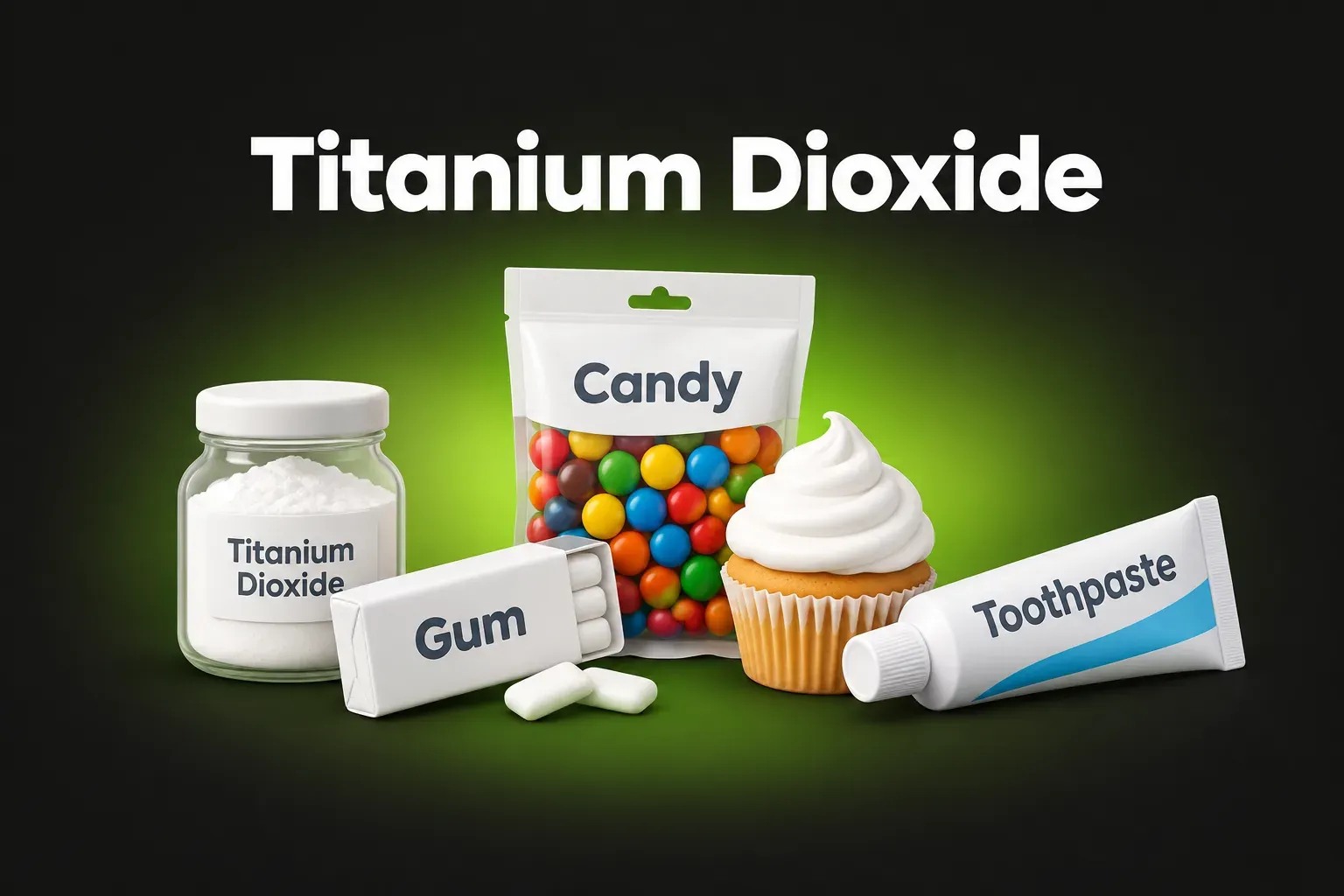
Titanium dioxide makes candy, chewing gum, frosting and coffee creamer look bright white – and makes other colors look brighter. It has no taste and no nutrients. It’s there only for looks. And it’s one of the few additives that Europe banned while it’s still allowed in the US. Here’s what you need to know about titanium dioxide in food.
The short answer: in 2021, the European Food Safety Authority said titanium dioxide (E171) can no longer be called safe. The main reason: it couldn’t rule out that it damages DNA. The EU banned it in food from 2022. In animal studies, it caused gut inflammation and early signs of colon cancer. In a 2026 study in people, it caused more cell damage and changed genes in the colon linked to colon cancer. In the US it’s still allowed. So it’s worth reading labels and avoiding it – especially for children, who eat the most candy.
What is titanium dioxide?
Titanium dioxide is a white mineral powder made from titanium rock. It’s used in paint, plastics, paper, sunscreen and toothpaste. In food, it’s used as a white color.
The kind used in food has particles of many sizes. Some are nanoparticles – so tiny that they can pass through the gut wall and build up in organs.
On labels, you’ll see it as:
| Name | Where you’ll see it |
|---|---|
| Titanium dioxide | Ingredient lists in the US and other countries |
| “Color added”, “artificial color” | US labels may not name it |
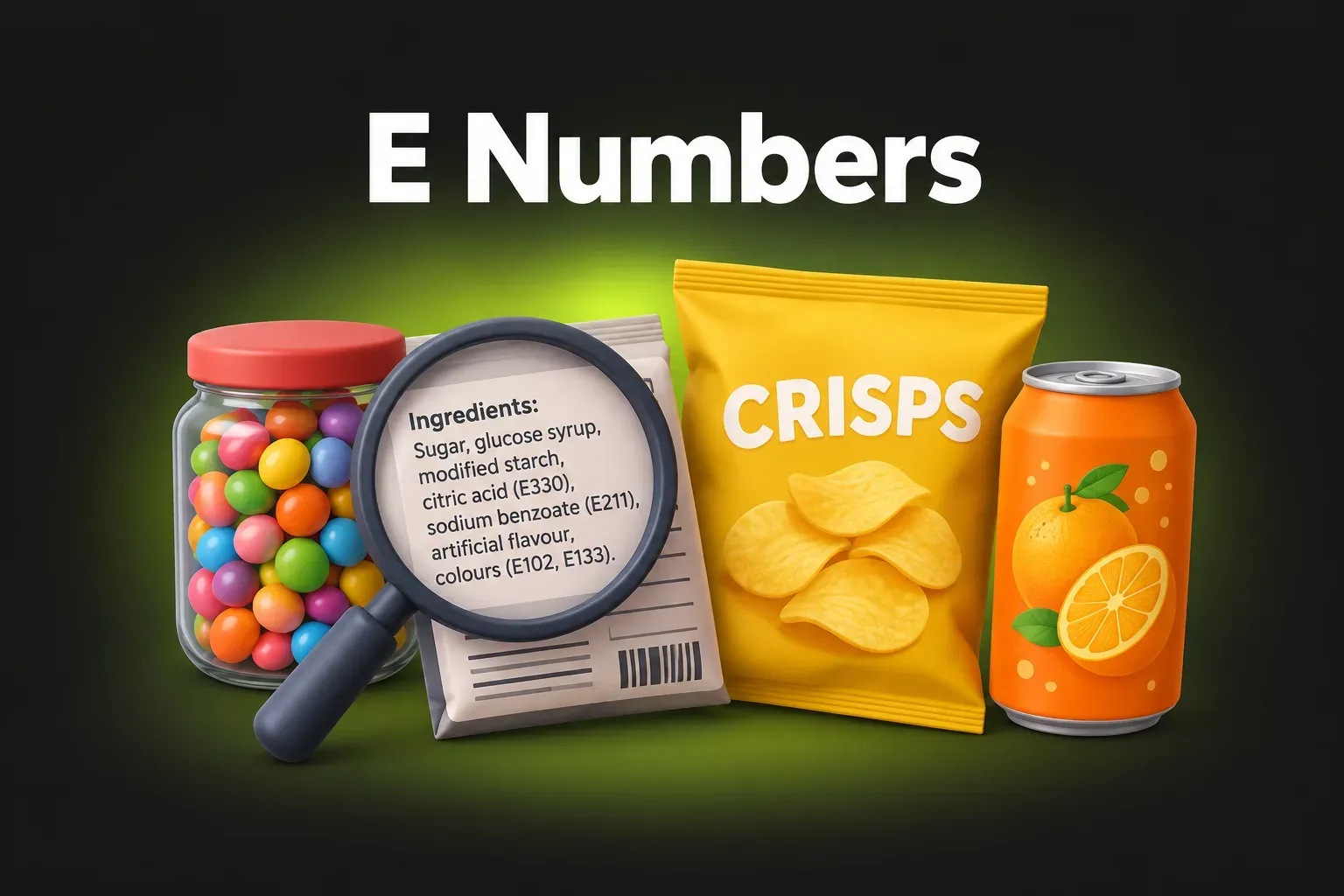
| E171, “color: E171” | Countries outside the EU that use E numbers |
Which foods contain titanium dioxide?
- Candy: hard candy, chewing gum, mints, candy-coated chocolates, jelly beans
- Baked goods: frosting, icing, cake decorations, donuts with white glaze
- Dairy and drinks: coffee creamers, some flavored milks and drink mixes
- Other foods: marshmallows, some sauces, dressings and cheese products
- Supplements and medicines: tablet coatings and capsules
- Non-food: toothpaste, sunscreen, makeup and cosmetics
Children eat the most titanium dioxide, because it’s most common in candy, gum and desserts.
Why is titanium dioxide banned in Europe?
In 2021, the European Food Safety Authority (EFSA) looked at all the studies. It said titanium dioxide “can no longer be considered safe” as a food additive. The main reason: it couldn’t rule out that titanium dioxide particles damage DNA, which can lead to cancer. Because of that, EFSA couldn’t set any safe daily amount (EFSA, 2021).
The EU banned titanium dioxide in food from August 2022. France had already banned it in 2020.
Is titanium dioxide still allowed in the US?
Yes. The FDA still allows it as a color additive, up to 1% of the food’s weight. In 2023, consumer groups formally asked the FDA to ban it. The FDA says it’s looking at the request. But as of October 2026, it hadn’t made a decision (FDA).
So the same candy can be made without titanium dioxide in Europe and with it in the US. This shows it isn’t needed.
What the research says
In people
In a 2026 study in the Netherlands, 31 adults took titanium dioxide every day for two weeks. The amount was what people who eat a lot of it really get. They also spent two weeks without it. While taking it, they had more oxidative stress – a kind of cell damage – in their blood. Samples from their colon showed changes in 73 processes inside the cells, including some linked to colon cancer. The authors say the results “strengthen regulatory concerns” about the additive (Bischoff et al., Molecular Nutrition & Food Research, 2026).
Titanium dioxide also reaches babies before birth. Scientists found titanium in all the placentas they tested (the organ that feeds the baby in the womb). They also found it in babies’ first poop. In the lab, they showed that titanium dioxide nanoparticles from food can pass through the placenta (Guillard et al., Particle and Fibre Toxicology, 2020).
What animal studies show
Many of these effects can only be tested on animals. Giving people an additive that may damage DNA for months would put their health at risk. Rats and mice share most of their genes with humans, and their bodies work in many of the same ways. That’s why these studies are used to spot dangers early:
- Early signs of colon cancer in rats: rats got titanium dioxide in amounts like those people eat. Their gut’s defenses got weaker. After 100 days, they had colon inflammation and early changes that can lead to colon cancer (Bettini et al., Scientific Reports, 2017).
- More tumors in mice with gut inflammation: in mice with colitis (a swollen colon), titanium dioxide made colon tumors grow more. It also lowered the number of cells that protect the colon lining (Urrutia-Ortega et al., Food and Chemical Toxicology, 2016).
- Gut bacteria and inflammation: titanium dioxide nanoparticles upset gut bacteria and caused colon inflammation in mice. The effects were stronger in obese mice (Cao et al., Small, 2020).
How to avoid titanium dioxide
- Read labels on candy, gum, frosting, creamers and supplements – look for “titanium dioxide” or E171.
- Be careful with very white or very bright foods – the brighter the white, the more likely it contains it.
- Choose brands that removed it – many companies make titanium dioxide-free versions, especially for Europe.
- Check supplements and medicines – ask your pharmacist about versions without it.
- Limit candy for children – they get the most titanium dioxide for their body weight.
Spot titanium dioxide on any label in seconds. With NutriSmart, you photograph the ingredient list or scan the barcode, and the app tells you right away if the product has titanium dioxide. Turn on an alert for it, and the app warns you every time a product you scan contains it. You’ll also see every other additive, the risks of each one and a health score out of 100.Get the app free
You can also read about Red 40, another color additive, and about ultra-processed foods.
Related: Silicon dioxide (E551), another additive with nanoparticle questions.
The bottom line
Titanium dioxide (E171) only makes food look whiter and brighter. Europe banned it in 2022 because it couldn’t rule out that it damages DNA. In animals, it causes gut inflammation and early signs of colon cancer. In people, it changes genes in the colon linked to cancer. In the US it’s still allowed. So read labels – especially on candy, gum and frosting – and choose products without it.
FAQ
Is titanium dioxide in food bad for you?
In 2021, Europe's food safety agency said it can no longer be called safe. The agency couldn't rule out that titanium dioxide particles damage DNA. In animal studies, it caused gut inflammation (swelling) and early signs of colon cancer. In a 2026 study in people, it caused more cell damage and changed genes in the colon linked to colon cancer. It's best to avoid it.
Why is titanium dioxide banned in Europe?
In 2021, the European Food Safety Authority (EFSA) said titanium dioxide (E171) could no longer be called safe as a food additive. The main reason: it couldn't rule out that its particles damage DNA. So it couldn't set a safe daily amount. The EU banned it in food from August 2022.
Is titanium dioxide banned in the US?
No. In the US, it's still allowed as a color additive, up to 1% of the food's weight. In 2023, consumer groups asked the FDA to ban it. The FDA says it's looking at that request. But as of October 2026, it hadn't made a decision.
What foods contain titanium dioxide?
Mostly foods that are bright white or have bright colors: candy, chewing gum, candy-coated chocolates, frosting and cake decorations, marshmallows, coffee creamers, some sauces and dressings, and supplements and medicines in tablet or capsule form. It's also in toothpaste, sunscreen and cosmetics.
How do I know if a food contains titanium dioxide?
In the US, look for "titanium dioxide" or sometimes only "color added" or "artificial color" on the label. In other countries, look for E171. Foods sold in the EU since 2022 shouldn't contain it.
Is titanium dioxide in toothpaste and sunscreen dangerous?
The worry in food is about swallowing particles every day. Toothpaste is mostly spit out. Sunscreen goes on the skin, which lets very little in. Breathing in titanium dioxide powder is a different worry: it's listed as possibly causing cancer when breathed in. Children swallow more toothpaste, so use only a small amount.