Silicon Dioxide (E551) in Food: Is It Safe? Nanoparticles
What silicon dioxide (E551) is, why it's in salt, spices and supplements, whether it's the same as sand, what EFSA says and what we know about nanoparticles.
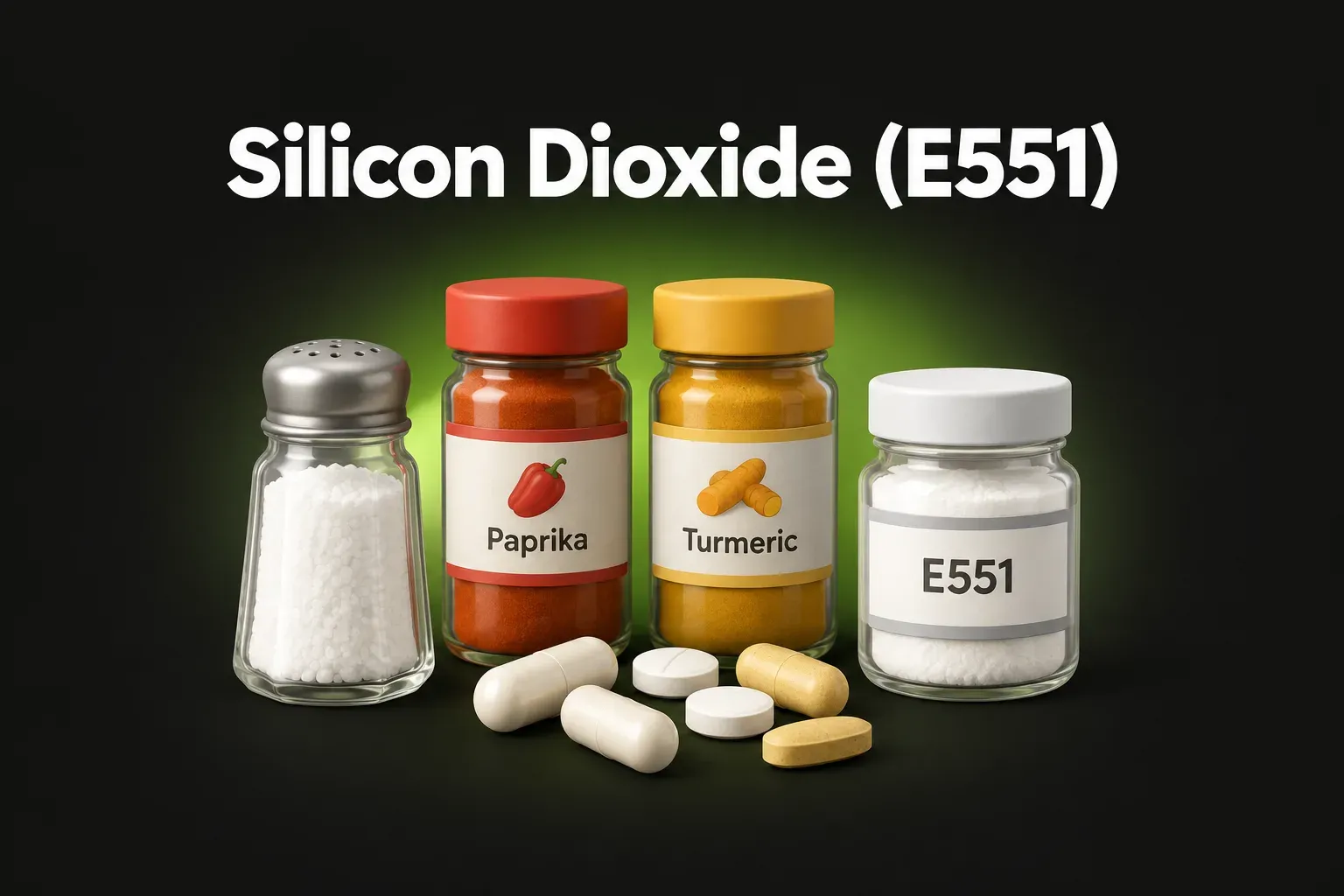
Silicon dioxide sounds alarming – like eating sand or glass. In fact, it’s one of the most common additives in salt, spices, powdered drinks and supplements, where it keeps powders from clumping. Most people never notice it. The real question isn’t about sand, but about nanoparticles.
The short answer: silicon dioxide (E551) is a synthetic, amorphous silica used as an anti-caking agent. It’s not sand and most of it passes through the body without being absorbed. In 2024, the European Food Safety Authority concluded it doesn’t raise a safety concern at the amounts used in food. But it didn’t set a safe daily limit, because the studies have gaps – especially about the nanoparticles it contains. One rat study found more liver scarring at high doses.
What is silicon dioxide?
Silicon dioxide (silica) is made of silicon and oxygen – the two most common elements in the Earth’s crust. It occurs naturally in sand, quartz and plants like oats, barley and rice, and in drinking water.
The silica used in food isn’t dug out of the ground. It’s made in factories as a fine, fluffy white powder called synthetic amorphous silica (SAS). “Amorphous” means its particles have no crystal structure, unlike sand and quartz.
In food, it:
- stops powders from clumping (anti-caking agent)
- helps powders flow in machines
- clears beer and wine
- carries flavors and vitamins
On labels, it appears as silicon dioxide, silica or E551.
Which foods contain silicon dioxide?
- Salt and seasoning salts
- Spices and spice mixes, especially ground paprika, garlic and onion powder
- Powdered drinks: instant coffee and cocoa, drink mixes, protein powders
- Powdered milk, coffee creamer, soups and sauces
- Grated cheese and baking mixes
- Supplements and medicines – in capsules and tablets
- Sweets, such as sugar-coated candy and chewing gum
Is silicon dioxide safe? What the research says
What EFSA says
EFSA first re-evaluated E551 in 2018 and found too little data to set a safe daily limit. In 2024, it looked again – including its use in foods for babies under 16 weeks. It still didn’t set a limit, because of gaps in the studies. Instead, it compared people’s intake with the highest dose that caused no harm in animals and concluded that E551 doesn’t raise a safety concern for any age group at the reported uses. It also found no concern for gene damage, and asked for stricter specifications for the additive (EFSA, 2024).
Nanoparticles
Food-grade silica is made of tiny particles that clump together. Part of them are in the nano range – smaller than 100 nanometers, about a thousand times thinner than a hair. Nanoparticles can behave differently in the body than larger particles, and could reach organs more easily.
In a Dutch study, rats ate silica, including a nanostructured form, for up to 84 days. Blood tests showed no problems, but rats that got the nanostructured silica had more liver fibrosis (scarring). The researchers also found silica building up in the spleen (van der Zande et al., Particle and Fibre Toxicology, 2014). The doses were far higher than people eat, and the authors said more studies are needed.
Animal studies matter: rats share most of their genes with us, and you can’t test for years whether something damages people’s livers, because that would put their health at risk. This study is one reason EFSA wants better data on nanoparticles.
Sand, quartz and lungs
Breathing in crystalline silica dust – from cutting stone, sand blasting or making engineered stone countertops – causes silicosis, a serious lung disease. That’s a workplace problem, not a food problem: food-grade silica is amorphous and is eaten, not inhaled.
Silicon dioxide vs other anti-caking agents
| Additive | E‑number | Notes |
|---|---|---|
| Silicon dioxide | E551 | Most common; nanoparticle questions |
| Calcium silicate | E552 | Similar use in salt and powders |
| Calcium carbonate | E170 | Also adds calcium |
| Sodium ferrocyanide | E535 | Used in salt; releases very little cyanide |
How to eat less silicon dioxide
You don’t need to avoid it completely, but if you want less:
- Buy whole spices and grind them yourself.
- Choose plain sea salt or rock salt without anti-caking agents.
- Make drinks from real ingredients instead of instant powders.
- Check supplement labels – some brands make capsules without it.
- Grate cheese yourself instead of buying pre-grated.
Spot silicon dioxide on any label in seconds. With NutriSmart, you photograph the ingredient list or scan the barcode, and the app tells you right away if the product has silicon dioxide. Turn on an alert for it, and the app warns you every time a product you scan contains it. You’ll also see every other additive, the risks of each one and a health score out of 100.Get the app free
You can also read about titanium dioxide, another additive where nanoparticles were the main concern – and which the EU banned in 2022.
The bottom line
Silicon dioxide (E551) is a synthetic, amorphous silica that keeps salt, spices, powdered drinks and supplements from clumping. It’s not sand, and most of it passes through the body. EFSA concluded in 2024 that it doesn’t raise a safety concern at current uses, but couldn’t set a safe daily limit because of gaps in the data, and nanoparticles remain an open question. It’s not something to worry about in a pinch of salt – but whole spices, plain salt and fewer instant powders are easy ways to eat less of it.
FAQ
What is silicon dioxide in food?
Silicon dioxide (silica, E551) is a fine white powder added mainly as an anti-caking agent: it stops powders like salt, spices, powdered drinks and supplements from clumping. The kind used in food is a synthetic, amorphous form, not crystals or sand.
Is silicon dioxide safe to eat?
The European Food Safety Authority concluded in 2024 that E551 doesn't raise a safety concern at the amounts used in food, for all age groups. But it didn't set a safe daily limit, because the studies have gaps. The main open question is about nanoparticles.
Is silicon dioxide the same as sand?
Chemically, both are silicon and oxygen. But sand and quartz are crystalline, while food-grade silicon dioxide is amorphous – its particles have no crystal structure. Breathing in crystalline silica dust at work damages the lungs; that's a different problem from eating amorphous silica in food.
Why is silicon dioxide in supplements?
It helps powders flow smoothly in machines and stops capsules and tablets from sticking together. The amount per tablet is very small.
Does silicon dioxide contain nanoparticles?
Yes, a part of it. Food-grade silica is made of tiny particles that clump into bigger ones, and some of them are in the nano range (under 100 nanometers). In a rat study, nanostructured silica fed for 84 days was linked to more liver scarring, at doses far higher than people eat.
Is silicon dioxide good for hair and skin?
Silicon is sold as a supplement for hair, skin and nails, but there's little good evidence. The silicon dioxide used as an anti-caking agent is added for technical reasons, not for health, and most of it passes through the body without being absorbed.