Calcium Carbonate: Uses, Side Effects and Safety
What calcium carbonate (E170) is, why it's in food, supplements and antacids, how much calcium it gives, its side effects and what studies show about supplements and the heart.
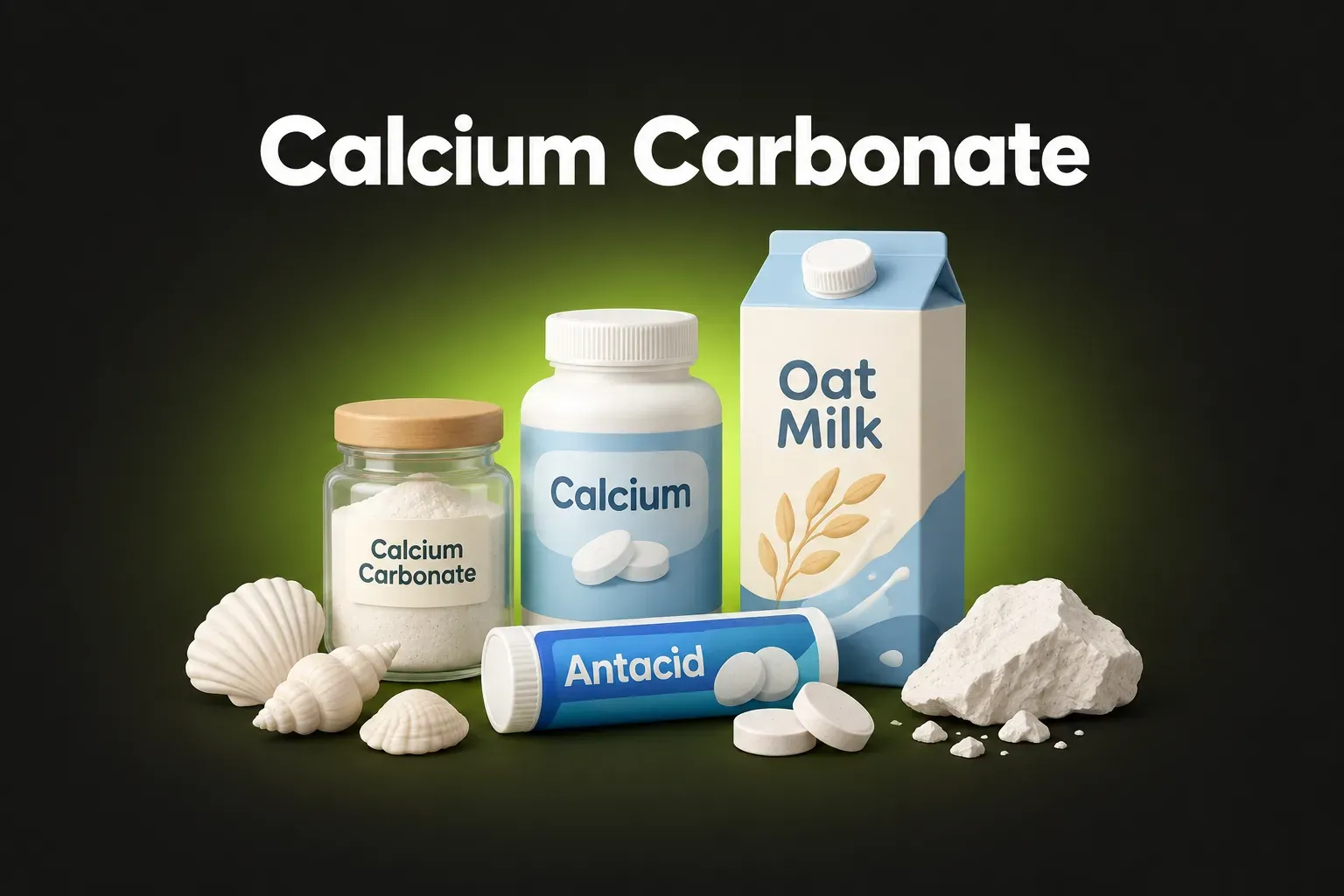
Calcium carbonate is everywhere: in calcium supplements, in antacids for heartburn, in plant milks and flour as added calcium, and on ingredient lists as E170. It’s the same mineral found in limestone, chalk, eggshells and seashells.
The short answer: as a food additive, calcium carbonate is safe – and it’s a useful way to add calcium to foods like plant milks. The concerns are about high doses from supplements and heartburn tablets. They can cause constipation and bloating and raise the risk of kidney stones. In some studies, calcium supplements were also linked to a higher risk of heart attack. Getting calcium from food is better than from pills.
What is calcium carbonate?
Calcium carbonate is a natural mineral made of calcium, carbon and oxygen. It’s the main part of limestone, marble, chalk, eggshells, oyster shells and coral. For food and supplements, it’s dug out of limestone or made from shells, then cleaned and ground into a fine white powder.
It has three main uses:
| Use | What it does | Examples |
|---|---|---|
| Food additive (E170) | White color, controls sourness, stops clumping, firms food, adds calcium | Plant milks, flour, bread, cereals, candy, chewing gum |
| Calcium supplement | Provides calcium for bones | Calcium tablets, chewables, multivitamins |
| Antacid | Cancels out stomach acid | Chewable heartburn tablets |
Calcium carbonate is 40% calcium by weight – more than any other supplement form – so 1,250 mg of calcium carbonate gives 500 mg of calcium.
Where you’ll find calcium carbonate in food
- Plant milks and yogurts (oat, soy, almond) – to match the calcium in cow’s milk
- Flour and bread – in the UK, white flour must be fortified with calcium carbonate
- Breakfast cereals and orange juice with added calcium
- Tofu – sometimes used to set it
- Candy, chewing gum and frosting – as a white color or filler
- Baking powder, crackers and cookies
As a food additive, it’s considered safe in the US and EU.
How much calcium do you need?
| Group | Calcium per day (US recommendation) | Upper limit |
|---|---|---|
| Adults 19–50 | 1,000 mg | 2,500 mg |
| Women 51+ | 1,200 mg | 2,000 mg |
| Men 51–70 | 1,000 mg | 2,000 mg |
| Adults 71+ | 1,200 mg | 2,000 mg |
The best sources are dairy, calcium-fortified plant milks, tofu set with calcium, canned fish with bones, almonds, beans and leafy greens like kale and bok choy.
Calcium carbonate supplements: what the research says
Bones
Calcium and vitamin D are essential for bones, but supplements help less than many people think. The large Women’s Health Initiative trial followed over 36,000 women after menopause. Calcium plus vitamin D made hip bones slightly stronger, but didn’t clearly reduce broken bones overall. And it raised the risk of kidney stones by 17% (Jackson et al., New England Journal of Medicine, 2006). Women who took their pills consistently did have fewer hip fractures.
Heart attacks
An analysis of 15 trials found that people who took calcium supplements without vitamin D had a 31% higher risk of heart attack than people who took a fake pill (Bolland et al., BMJ, 2010). One possible reason: a supplement causes a sudden spike in blood calcium, which doesn’t happen with calcium from food. Other studies haven’t found the same risk, and scientists still disagree. But it’s one reason many doctors now prefer calcium from food, and supplements only when needed.
Side effects
- Constipation, bloating and gas – the most common
- Kidney stones, especially at high doses
- Too much calcium in the blood and, rarely, milk-alkali syndrome – a serious problem from taking large amounts of calcium carbonate (often as heartburn tablets), which can damage the kidneys
- Interactions with thyroid medicine (levothyroxine), iron, some antibiotics and osteoporosis medicines – take them 2–4 hours apart
Calcium carbonate as an antacid
Calcium carbonate cancels out stomach acid within minutes, so it works well for heartburn now and then. But:
- Don’t take it every day for long periods without talking to your doctor – frequent heartburn needs a proper diagnosis.
- Count it toward your calcium – several antacid tablets a day can add up to a lot of calcium.
- Using large amounts for a long time can cause milk-alkali syndrome.
How to take calcium carbonate well
- Get calcium from food first – dairy, fortified plant milks, tofu, canned sardines and leafy greens.
- If you need a supplement, take it with a meal – your body needs stomach acid to take in calcium carbonate.
- Take no more than about 500 mg of calcium at once, and split larger doses.
- Choose calcium citrate instead if you take medicines that lower stomach acid.
- Don’t go over the upper limit – count food, supplements and antacids together.
- Get enough vitamin D – it helps your body take in calcium. Ask your doctor about your levels.
Spot calcium carbonate on any label in seconds. With NutriSmart, you photograph the ingredient list or scan the barcode, and the app tells you right away if the product has calcium carbonate. Turn on an alert for it, and the app warns you every time a product you scan contains it. You’ll also see every other additive, the risks of each one and a health score out of 100.Get the app free
You can also read about other nutrients: foods high in iron and high fiber foods.
Related: Silicon dioxide (E551), a common anti-caking agent.
The bottom line
Calcium carbonate is a natural mineral used as a food additive, a calcium supplement and an antacid. In food it’s safe and useful – for example, to add calcium to plant milks. Supplements and antacids are a different story: they can cause constipation and kidney stones, and some studies link calcium supplements to heart attacks. Get your calcium from food when you can, and use supplements with a meal, in small doses, only when you need them.
FAQ
What is calcium carbonate?
Calcium carbonate is a natural mineral – the main part of limestone, chalk, eggshells and seashells. It's used as a food additive (E170), as a calcium supplement and as a heartburn tablet, because it cancels out stomach acid.
Is calcium carbonate safe in food?
Yes. As a food additive, calcium carbonate is considered safe, and it's often used to add calcium to plant milks, flour and cereals. The concerns are mostly about high doses from supplements and antacids, not the amounts in food.
What are the side effects of calcium carbonate supplements?
The most common are constipation, bloating and gas. Very high doses can raise the calcium in your blood too much. Rarely, they cause milk-alkali syndrome, which can damage the kidneys. Calcium supplements have also been linked to kidney stones and, in some studies, a higher risk of heart attack.
Should I take calcium carbonate with food?
Yes. Your body needs stomach acid to take in calcium carbonate, so take it with a meal. If you take medicines that lower stomach acid, calcium citrate works better. Take no more than about 500 mg of calcium at once.
Does calcium carbonate interact with medicines?
Yes. It can make your body take in less of some medicines: thyroid hormone (levothyroxine), iron, some antibiotics (tetracyclines and fluoroquinolones) and bone-loss medicines (bisphosphonates). Take these at least 2–4 hours apart from calcium carbonate, or as your doctor or pharmacist advises.
What is E170?
E170 is the European code for calcium carbonate. In food it's used as a white color, to control sourness, to stop powders from clumping and to add calcium. On labels you'll see "calcium carbonate" or "E170".