Tricalcium Phosphate (E341): Uses, Safety and Side Effects
What tricalcium phosphate (E341) is, why it's in salt, spices and fortified juice, what EFSA says about phosphates, and who should limit them.
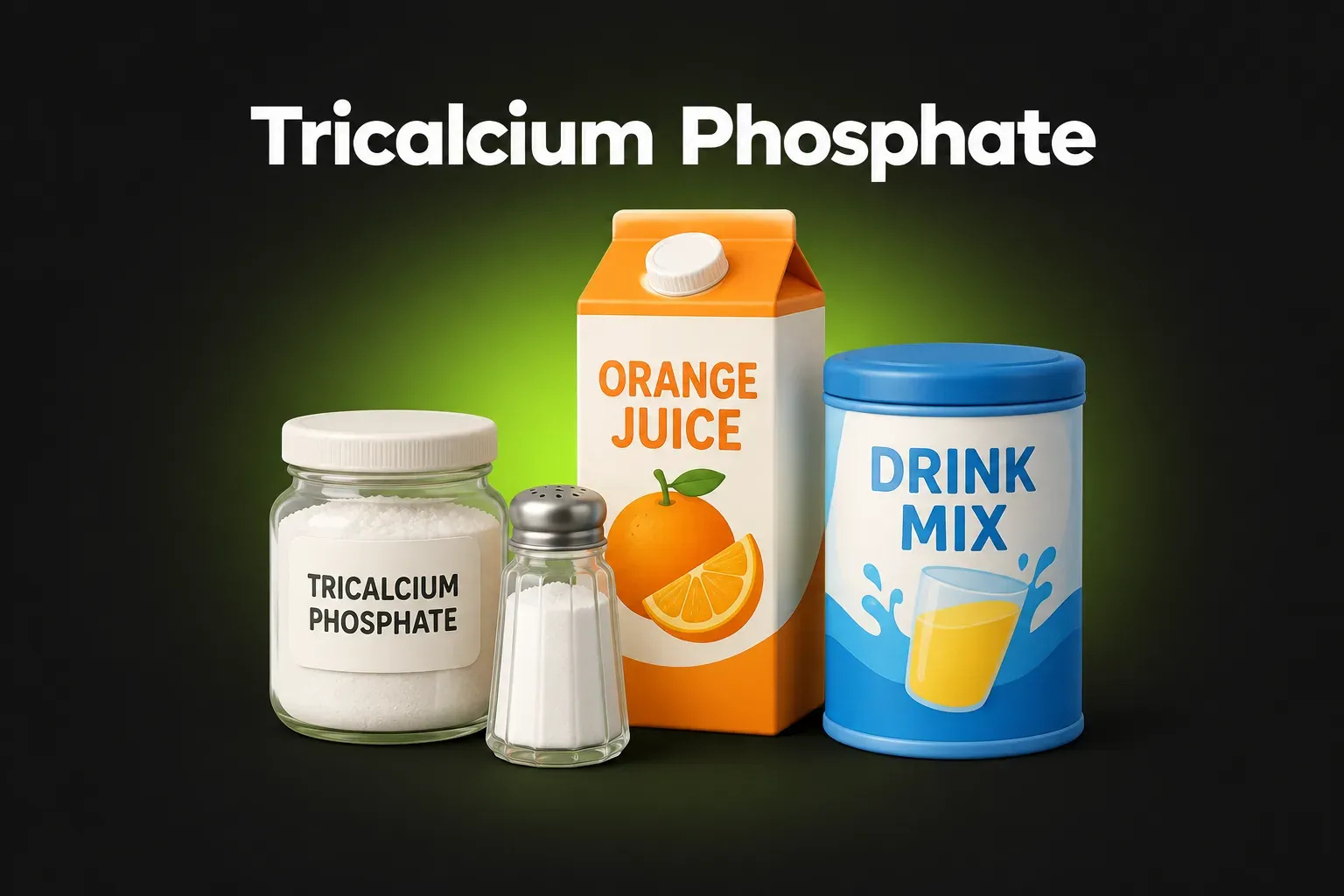
Tricalcium phosphate is a white powder you’ll find in table salt, spice blends, powdered drink mixes, protein powder, calcium-fortified orange juice and plant-based milks. It’s the same mineral that makes up bones. So why does it get a moderate rating, and who should care?
The short answer: tricalcium phosphate (part of E341, calcium phosphates) is a mineral of calcium and phosphate. It’s used to stop powders from clumping and to add calcium to foods. In normal amounts it’s considered safe. But it belongs to the phosphate additives, which are absorbed much more easily than natural phosphorus. The European Food Safety Authority found that children and big eaters of processed food can go over the safe daily limit for phosphates, and extra phosphate is a real problem for people with kidney disease. That’s why NutriSmart rates it as moderate risk.
What is tricalcium phosphate?
It’s a salt made of calcium and phosphate, usually produced from mined phosphate rock and lime. It’s tasteless, white and doesn’t dissolve easily in water.
On labels, you may see:
| Name | Code |
|---|---|
| Tricalcium phosphate / calcium phosphate | E341(iii) |
| Monocalcium phosphate | E341(i) |
| Dicalcium phosphate | E341(ii) |
All three are grouped as E341 in the EU and UK.
What is tricalcium phosphate used for?
- Anti-caking agent: keeps salt, sugar, spices, powdered milk, drink mixes, cake mixes and protein powders flowing freely.
- Calcium fortification: adds calcium to orange juice, plant-based milks, cereals and tofu.
- Leavening: monocalcium phosphate helps baking powder make cakes and biscuits rise.
- Supplements: used as a calcium source and as a filler in tablets.
Is tricalcium phosphate safe?
Calcium and phosphate are essential minerals, and the calcium in tricalcium phosphate is well absorbed. The questions are about phosphate additives as a whole:
Phosphate additives are absorbed easily
The phosphorus in natural foods like meat, beans and whole grains is only partly absorbed (about 40–60%). Phosphate additives, by contrast, are absorbed almost completely – up to about 90%. German kidney specialists warned that these additives can make up a large part of the phosphorus people eat, and that high blood phosphate is linked to heart and blood vessel disease (Ritz et al., Deutsches Ärzteblatt International, 2012).
Children can exceed the safe limit
In 2019, the European Food Safety Authority set a group safe daily limit of 40 mg of phosphorus per kg of body weight for all phosphate additives (E338–E341, E343, E450–E452). It found that infants, toddlers and children – and some teenagers – can go over this limit, mostly from processed foods, and that phosphate supplements can also exceed it (EFSA, 2019).
Kidney disease
Healthy kidneys remove extra phosphate. In chronic kidney disease, phosphate builds up in the blood and can harden blood vessels. That’s why doctors often tell kidney patients to avoid ingredients with “phos” in the name.
For tricalcium phosphate itself, the amount added as an anti-caking agent is usually small. But because it’s part of a group of additives that adds up quickly in processed foods, NutriSmart rates it as moderate risk, like other phosphates such as sodium phosphate and phosphoric acid.
How to eat fewer phosphate additives
- Look for “phos” in the ingredient list: tricalcium phosphate, sodium phosphate, phosphoric acid, sodium hexametaphosphate, E338–E341, E450–E452.
- Limit cola, processed cheese, deli meats and fast food – they’re the biggest sources.
- Choose plain salt or sea salt without anti-caking agents if you prefer.
- Get calcium from food – dairy, tofu set with calcium, leafy greens, almonds.
- If you have kidney disease, ask your doctor or dietitian about a low-phosphate diet.
Spot tricalcium phosphate on any label in seconds. With NutriSmart, you photograph the ingredient list or scan the barcode, and the app tells you right away if the product has tricalcium phosphate. Turn on an alert for it, and the app warns you every time a product you scan contains it. You’ll also see every other additive, the risks of each one and a health score out of 100.Get the app free
You can also read about sodium hexametaphosphate, calcium carbonate and silicon dioxide, another anti-caking agent, or see the full E numbers list.
The bottom line
Tricalcium phosphate (E341) is a calcium-phosphate mineral that keeps powders from clumping and adds calcium to fortified foods. In normal amounts it’s considered safe. But phosphate additives are absorbed far more easily than natural phosphorus, children can exceed the safe daily limit, and extra phosphate is harmful in kidney disease. That’s why NutriSmart rates it moderate risk – and why eating fewer processed foods is the easiest way to keep phosphate additives in check.
FAQ
What is tricalcium phosphate?
Tricalcium phosphate is a white mineral powder made of calcium and phosphate – the same minerals found in bones. In food, it stops powders from clumping and adds calcium to fortified foods like orange juice and plant-based milk. In the EU it's part of E341 (calcium phosphates).
Is tricalcium phosphate safe?
In normal amounts, it's considered safe and provides calcium. The concern is with phosphate additives as a group: they're absorbed much better than the phosphorus in natural foods, and too much phosphate is a problem for people with kidney disease. NutriSmart rates calcium phosphates as moderate risk for that reason.
Why is tricalcium phosphate in salt and spices?
It's an anti-caking agent. It absorbs a little moisture and coats the grains, so salt, sugar, spices, drink mixes and powdered milk keep flowing freely instead of forming lumps.
Is tricalcium phosphate a good calcium supplement?
It's one of several forms of calcium used in supplements and fortified foods, and it's well absorbed. Calcium carbonate and calcium citrate are more common in supplements. Most people can get enough calcium from food.
Who should avoid phosphate additives?
People with chronic kidney disease, because their kidneys can't remove extra phosphate. Doctors often advise them to avoid foods with ingredients that contain "phos" in the name. Children and heavy eaters of processed foods can also exceed the safe daily limit for phosphates.
Is tricalcium phosphate vegan?
Usually yes – most food-grade tricalcium phosphate is made from mined phosphate rock and lime. In the past, some was made from animal bones, so strict vegans may want to check with the manufacturer.