Phosphoric Acid (E338) in Cola: Bones, Kidneys and Teeth
What phosphoric acid (E338) is, why it's in cola, what studies say about bones, kidneys, kidney stones and teeth, and how much is too much.
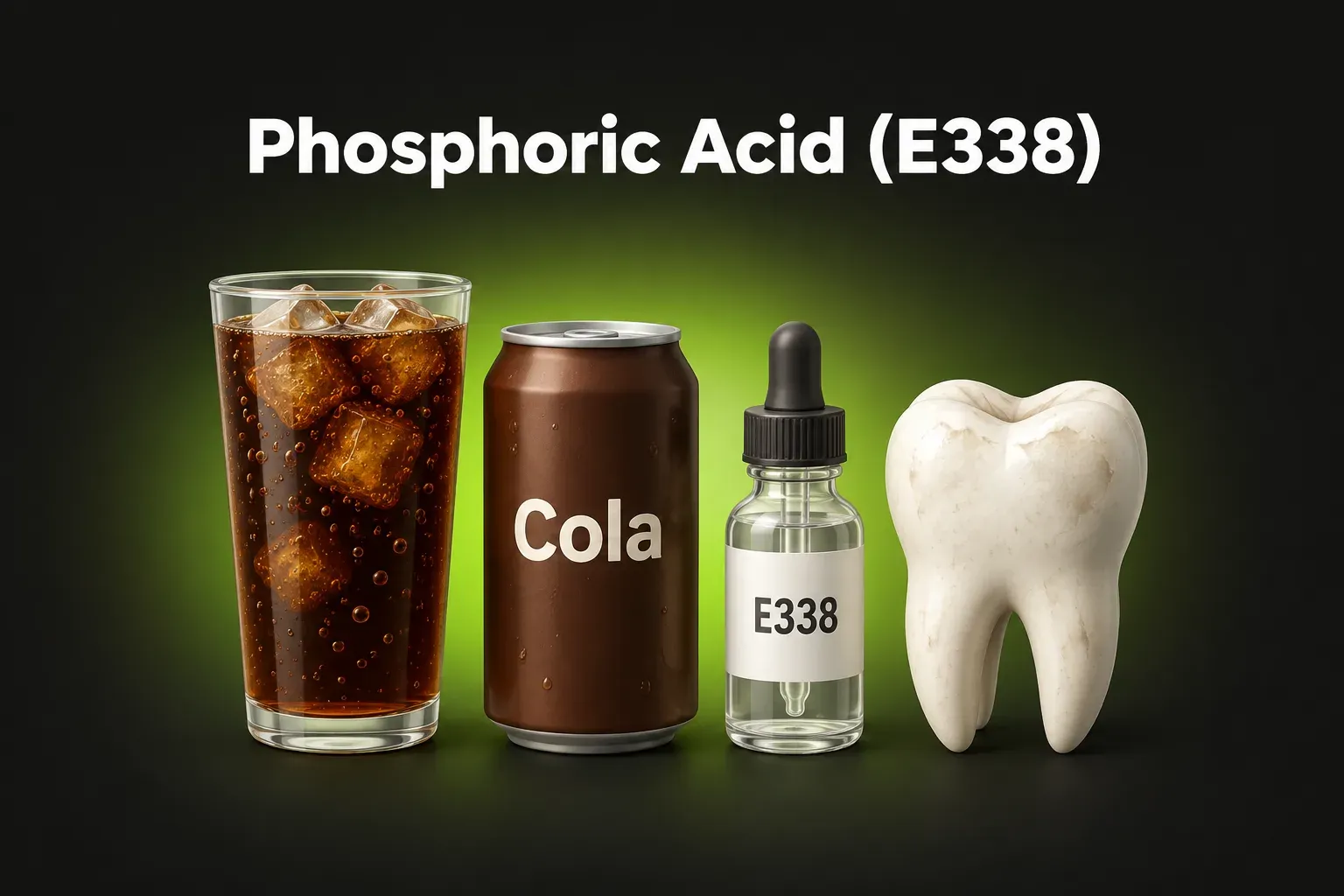
Phosphoric acid is the ingredient that gives cola its sharp, tangy bite. It’s also a common target of internet warnings: it “dissolves your bones”, “ruins your kidneys” and “removes rust”. Some of this is myth – but some of it has real studies behind it.
The short answer: phosphoric acid (E338) is used mostly in colas. In the amounts in food, it isn’t toxic, and the European Food Safety Authority found no concern for cancer or gene damage. But studies link drinking cola every day to lower bone density in women, kidney disease and kidney stones. It’s acidic enough to wear away tooth enamel – even in diet cola. People with kidney disease should avoid added phosphates.
What is phosphoric acid?
Phosphoric acid is a mineral acid made from phosphate rock. The same acid is used in fertilizers and rust removers – but the food-grade version is very pure and used in small amounts.
In food, it does two jobs:
- Taste: it gives cola its sharp, tangy flavor that balances the sugar
- Shelf life: the acid helps stop the growth of mold and bacteria
On labels, it appears as phosphoric acid, orthophosphoric acid or E338. It belongs to the same family as other phosphate additives, like sodium phosphate (E339).
Which foods contain phosphoric acid?
- Colas: regular, diet and zero-sugar – the main source by far
- Some other dark sodas and flavored drinks
- Some sauces, jams and jellies
- Some processed foods, in small amounts
Most clear and fruit sodas (lemon-lime, ginger ale, orange) use citric acid instead.
How much phosphorus does cola add?
A can of cola has only about 30–40 mg of phosphorus. Adults already get 1,000–1,600 mg a day from food like meat, dairy, grains and processed food. So the problem isn’t only the extra phosphorus. Researchers think it may also be the acid itself, the caffeine, or the fact that cola replaces milk in some people’s diets.
Is phosphoric acid bad for you? What the research says
What regulators say
In 2019, the European Food Safety Authority (EFSA) looked at all phosphate additives, including phosphoric acid. It found no concern for cancer, gene damage or harm to babies in the womb. It set a safe daily limit of 40 mg of phosphorus per kg of body weight from all food. But it also found that babies, toddlers and children often go over this limit from their whole diet (EFSA, 2019).
Phosphate from additives is absorbed much better (80–90%) than the phosphate that occurs naturally in food.
Bones
In the Framingham Osteoporosis Study, older women who drank cola every day (one glass, bottle or can counted as one serving) had 3.7% lower bone density at the hip than women who drank less than one cola a month. Diet cola showed the same link. Other fizzy drinks without phosphoric acid didn’t. In men, there was no link (Tucker et al., American Journal of Clinical Nutrition, 2006).
This is an observational study – it shows a link, not proof. But since only colas were linked, the authors think something in cola itself, like phosphoric acid or caffeine, may play a role.
Kidneys
- In a US study, people who drank 2 or more glasses or cans of cola a day – about half a liter or more – had about twice the risk of chronic kidney disease. Other fizzy drinks weren’t linked to it (Saldana et al., Epidemiology, 2007). The authors called the results “preliminary”.
- People with kidney disease can’t get rid of extra phosphate. Kidney doctors warn that phosphate additives raise the phosphate level in their blood and should be avoided (Ritz et al., Deutsches Ärzteblatt International, 2012).
Kidney stones
In a trial with 1,009 men who had had kidney stones, half were told to stop drinking soda. Among men whose usual drink was made with phosphoric acid, those who stopped had a 15% higher chance of staying stone-free after 3 years. Among men who drank sodas with citric acid, stopping made no difference (Shuster et al., Journal of Clinical Epidemiology, 1992).
A larger study of 194,095 people found that sugar-sweetened cola and other sweet sodas were linked to more kidney stones, while coffee, tea and orange juice were linked to fewer (Ferraro et al., Clinical Journal of the American Society of Nephrology, 2013). So the sugar matters too.
Teeth
Cola has a pH of about 2.5 – almost as acidic as lemon juice. In lab tests, both regular and diet sodas wore away tooth enamel. The more acidic the drink, the more damage (Gravelle et al., General Dentistry, 2015). Unlike cavities, this damage comes from the acid, not the sugar – so “zero sugar” doesn’t protect your teeth.
Too much phosphorus overall
In a large US study, adults who got more than 1,400 mg of phosphorus a day from all food had a higher risk of dying during the study (Chang et al., American Journal of Clinical Nutrition, 2014). Phosphate additives in processed food and drinks are one of the reasons many people eat that much.
Myths about phosphoric acid
- “Cola dissolves your bones.” No. Your body keeps blood acidity in a tight range. The link with weaker bones comes from drinking cola every day for years, not from acid touching your bones.
- “Cola removes rust, so it must damage your stomach.” Your stomach acid is usually even more acidic than cola. Cola can loosen light rust because of the phosphoric acid, but that says nothing about your stomach.
How to cut back on phosphoric acid
- Make cola an occasional drink, not a daily one – including diet cola.
- Drink water, sparkling water, milk, tea or coffee instead.
- Use a straw and don’t sip slowly for hours – your teeth get a break between acid attacks.
- Rinse your mouth with water after cola and wait about 30 minutes before brushing.
- If you have kidney disease, check labels for any word with “phos” in it.
Spot phosphoric acid on any label in seconds. With NutriSmart, you photograph the ingredient list or scan the barcode, and the app tells you right away if the product has phosphoric acid. Turn on an alert for it, and the app warns you every time a product you scan contains it. You’ll also see every other additive, the risks of each one and a health score out of 100.Get the app free
You can also read about the sweeteners in diet cola, like aspartame and sucralose, whether Diet Coke is bad for you, and about ultra-processed foods.
Related: Caramel color, the coloring that makes cola brown.
Other phosphate additives include tricalcium phosphate and sodium hexametaphosphate.
The bottom line
Phosphoric acid (E338) gives cola its tangy taste. In the small amounts in food it isn’t toxic, and EFSA found no concern for cancer or gene damage. But drinking cola every day has been linked to lower bone density in women, kidney disease and kidney stones, and the acid wears away tooth enamel – even in diet cola. Most of these studies are observational, but they point the same way. Enjoy cola now and then, not every day, and avoid added phosphates if you have kidney disease.
FAQ
What is phosphoric acid in food?
Phosphoric acid (E338) is an acid made from phosphate rock. In food, it's used mostly in colas, where it gives the sharp, tangy taste and helps keep the drink from spoiling. Small amounts are also used in some sauces, jams and processed foods.
Is phosphoric acid bad for you?
In the small amounts in food, it isn't toxic, and EFSA found no concern for cancer or gene damage. But drinking a lot of cola has been linked to weaker bones in women, kidney disease and kidney stones, and the acid can wear away tooth enamel. People with kidney disease should limit added phosphates.
Does phosphoric acid weaken bones?
It may, in people who drink cola every day. In a large US study, older women who drank cola daily had 3.7% lower bone density at the hip than women who drank less than one a month. Other fizzy drinks without phosphoric acid weren't linked to weaker bones. It's an observational study, so it can't prove that cola caused it.
Is phosphoric acid bad for your kidneys?
Drinking two or more glasses or cans of cola a day (about half a liter or more) was linked to about twice the risk of chronic kidney disease in one study. In a trial with men who had kidney stones, those who stopped drinking sodas made with phosphoric acid had fewer new stones. People with kidney disease can't get rid of extra phosphate well and should avoid added phosphates.
Does diet cola have phosphoric acid?
Yes. Diet and zero-sugar colas contain phosphoric acid too. They're still acidic enough to wear away tooth enamel, and in the bone study, diet cola was linked to lower bone density just like regular cola.
Which drinks don't have phosphoric acid?
Most clear and fruit sodas, like lemon-lime sodas, ginger ale and orange soda, use citric acid instead. Water, sparkling water, milk, tea and coffee don't contain phosphoric acid. Check the label for "phosphoric acid" or "E338".