Caramel Color (E150a–E150d): Is It Safe? 4-MEI Explained
What caramel color is, the four types from E150a to E150d, why 4-MEI in colas raised cancer concerns, what EFSA says, and which foods contain it.
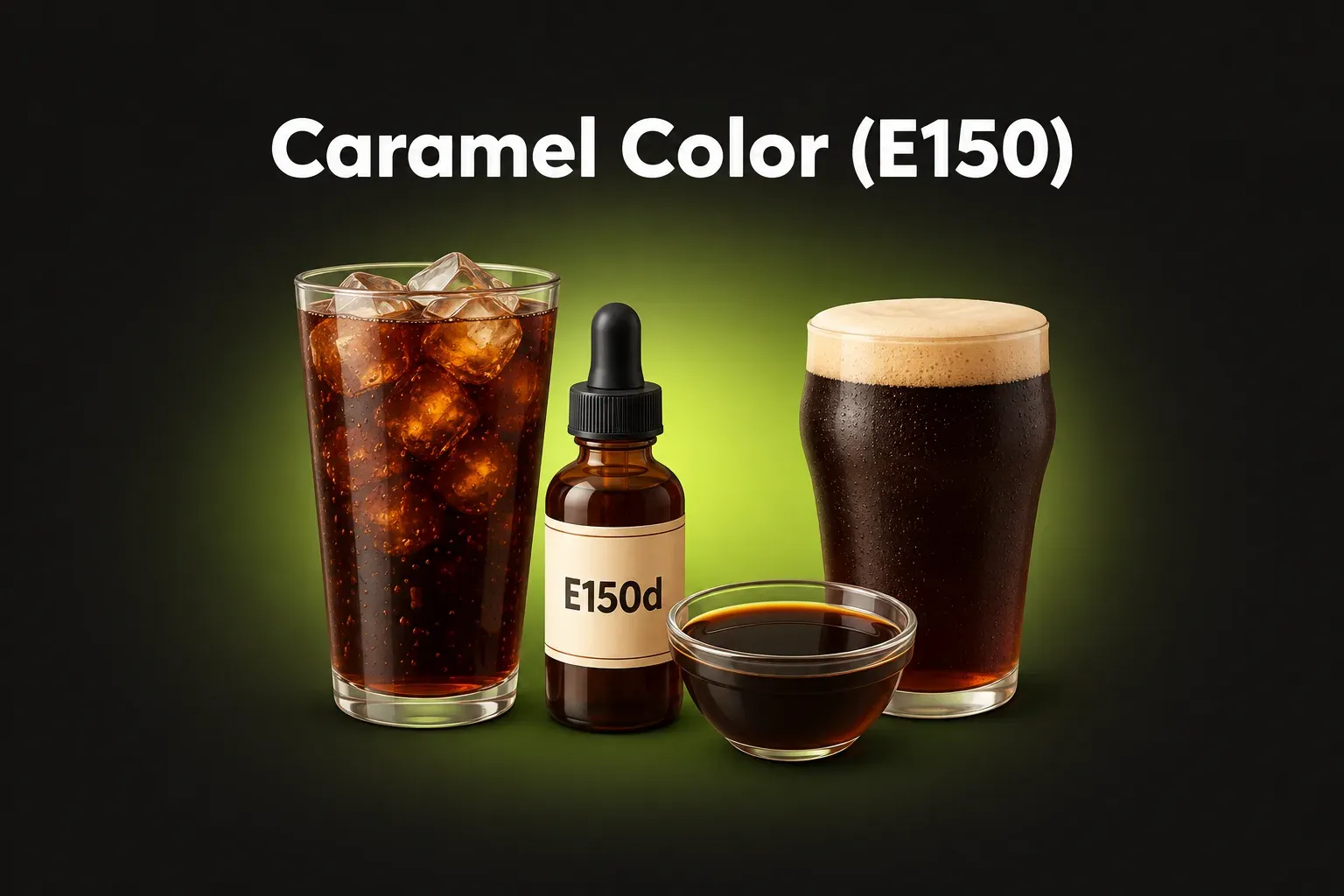
Caramel color is the most used food coloring in the world. It makes cola brown, beer amber and soy sauce almost black. It sounds harmless – like the caramel on a dessert – but most of it is made with ammonia or sulfites, and two of its four types can contain 4-MEI, a substance that caused cancer in mice.
The short answer: caramel color (E150a–E150d) is made by heating sugar, sometimes with ammonia or sulfites. Plain caramel (E150a) is the simplest. E150c and E150d can contain 4-MEI, which the WHO’s cancer agency lists as possibly carcinogenic to humans based on mouse studies. The amounts in food are small and vary a lot between products. The European Food Safety Authority considers caramel colors safe within its limits. But a daily habit of dark sodas is where most of the exposure comes from.
What is caramel color?
Caramel color is made by heating sugars – from corn, wheat, sugar cane or beet – until they turn dark brown. To speed this up or get a certain shade, makers add acids, alkalis, sulfites or ammonia. The result is a brown liquid or powder used only for color: it has almost no taste and no nutrition.
There are four types:
| Type | E‑number | Made with | Typical use |
|---|---|---|---|
| I – Plain caramel | E150a | Sugar and heat only | Whisky, spirits, desserts |
| II – Caustic sulfite caramel | E150b | Sulfites | Some spirits and wines |
| III – Ammonia caramel | E150c | Ammonia | Beer, soy sauce, sauces, bread |
| IV – Sulfite ammonia caramel | E150d | Sulfites and ammonia | Cola and other soft drinks |
E150d is by far the most used, because it stays stable in acidic drinks like cola. On labels, the type often isn’t named – you’ll just see “caramel color”, “colour: caramel” or “E150”.
Which foods contain caramel color?
- Drinks: cola and other dark sodas, iced tea, beer (especially dark), whisky, rum and other spirits
- Sauces: soy sauce, Worcestershire sauce, gravy, brown sauces, stock cubes
- Vinegar: cheap balsamic vinegar
- Bread and bakery: dark “whole grain looking” breads, some cakes and cookies
- Sweets and desserts: chocolate-flavored products, puddings, some ice cream
- Meat: some sausages and marinated meat
- Pet food
Tip: dark bread isn’t always whole grain – sometimes it’s white flour colored with caramel or malt. Check the ingredients for “whole grain” or “wholemeal”.
Is caramel color safe? What the research says
4-MEI and cancer
When sugar is heated with ammonia (E150c and E150d), a substance called 4-methylimidazole (4-MEI) can form. In a long study by the US National Toxicology Program, high doses of 4-MEI caused lung tumors in mice. Based on this, the WHO’s cancer agency (IARC) lists 4-MEI as “possibly carcinogenic to humans” (Group 2B) – the same group as aloe vera extract and pickled vegetables in Asia. Animal studies matter: mice share most of their genes with us, and you can’t test whether something causes cancer in people, because that would put their health at risk.
In California, products that would expose people to more than 29 micrograms of 4-MEI a day need a cancer warning. After this rule, some cola makers changed how they make their caramel color to lower 4-MEI.
US researchers measured 4-MEI in 12 soft drinks. The amounts varied almost 100-fold between brands. For the drink with the most 4-MEI, they estimated that drinking it regularly over a lifetime could add up to about 2 extra cancer cases per 10,000 people – far above the 1 in 100,000 level regulators aim for. The cola with the least 4-MEI was well below it (Smith et al., PLOS ONE, 2015). These are estimates from animal data, not observed cancers.
THI and the immune system
Ammonia caramel (E150c) can also contain THI, a substance that lowered the number of white blood cells in rats. That’s why the European Food Safety Authority set a lower safe daily limit for E150c (100 mg per kg of body weight) than for the other caramel colors (300 mg per kg). EFSA also set limits for 4-MEI and THI in caramel colors.
Hyperactivity, vitamins and other claims
You may read online that E150d causes hyperactivity, chromosome damage or vitamin B12 deficiency. We didn’t find good studies showing this. Caramel color wasn’t part of the Southampton study that linked some synthetic dyes to hyperactivity in children.
How much 4-MEI do you get?
Most people get the most 4-MEI from dark soft drinks, because they drink large amounts. Soy sauce and beer contain some too, but people usually consume less of them. One or two glasses of cola now and then isn’t a big concern. Several cans a day, every day, for years is a different story – and the sugar, caffeine and phosphoric acid in cola are reasons to cut back anyway.
How to cut back
- Drink fewer dark sodas – water, sparkling water and unsweetened tea are better.
- Choose clear sodas if you drink soda – they don’t contain caramel color.
- Choose naturally brewed soy sauce and real balsamic vinegar (“Aceto Balsamico Tradizionale” doesn’t allow caramel).
- Check bread labels – brown color isn’t a sign of whole grain.
- Cook gravies and sauces at home – browning onions gives natural color.
Spot caramel color on any label in seconds. With NutriSmart, you photograph the ingredient list or scan the barcode, and the app tells you right away if the product has caramel color. Turn on an alert for it, and the app warns you every time a product you scan contains it. You’ll also see every other additive, the risks of each one and a health score out of 100.Get the app free
You can also read about other colorings: Red 40, carmine and annatto.
The bottom line
Caramel color (E150) is the most widely used food coloring, made by heating sugar, often with ammonia or sulfites. Plain caramel (E150a) is the simplest. Ammonia caramels (E150c and E150d), used in cola, beer and soy sauce, can contain 4-MEI, which caused cancer in mice, and E150c can contain THI. Regulators consider the amounts in food safe within their limits, but the biggest exposure comes from drinking dark sodas every day – so that’s the habit worth changing.
FAQ
What is caramel color?
Caramel color is the most widely used food coloring in the world. It's made by heating sugars, sometimes with acids, sulfites or ammonia, until they turn dark brown. It gives cola, beer, soy sauce, gravy and many sauces their brown color. On labels it appears as caramel color or E150a to E150d.
Is caramel color the same as caramel?
No. Caramel you make at home is melted sugar with flavor. Caramel color is made in factories, often with ammonia or sulfites, and is used only for color – it has almost no taste and no nutrition.
Does caramel color cause cancer?
Two types, E150c and E150d, can contain 4-MEI, a substance that caused lung tumors in mice. The WHO's cancer agency lists 4-MEI as possibly carcinogenic to humans. The amounts in food are small, but they vary a lot between products. Regulators consider the risk low, but drinking a lot of dark sodas every day isn't a good idea.
Which caramel color is safest?
Plain caramel (E150a) is made only by heating sugar, with no ammonia or sulfites, and doesn't contain 4-MEI. E150c and E150d can contain 4-MEI, and E150c can also contain THI, which affected the immune system in rats.
Which foods contain caramel color?
Cola and other dark sodas, beer, whisky and other spirits, soy sauce, gravy and stock cubes, cheap balsamic vinegar, dark bread, brown sauces, chocolate-flavored products, some sweets and desserts, and pet food.
Is caramel color E150d bad for kids?
There's no proof that it causes hyperactivity or other problems in children. The main concern is 4-MEI in dark sodas. Children shouldn't drink sodas regularly anyway, because of the sugar and caffeine.