Is Red 40 Bad for You? Red Dye 40 Side Effects & Bans
What Red 40 (Red Dye 40, Allura Red, E129) is, what studies say about hyperactivity and gut health, where it's banned in 2026 and how to spot it on labels.
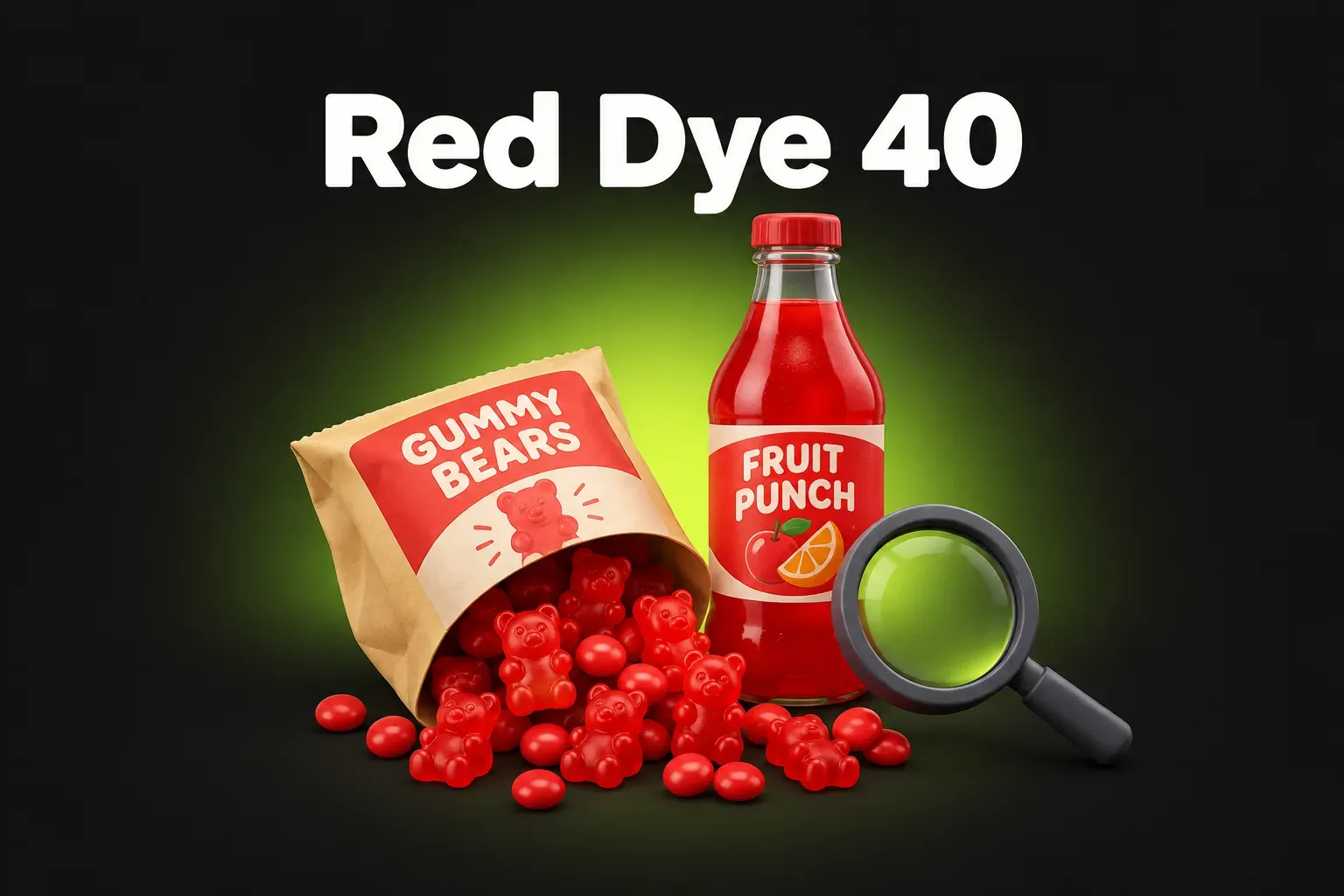
Red Dye 40 is the most widely used food dye in the United States. It gives the bright red color to sweets, cereals, sports drinks and snack chips. And it’s at the center of one of the biggest food debates of the last few years.
The short answer: the FDA and European food safety agencies say Red 40 is safe in normal amounts. But good studies link lab-made dyes like Red 40 to more hyperactivity and trouble focusing in some children. Europe requires a warning label on foods that contain it. And the FDA has asked companies to stop using it by the end of 2026. It adds nothing but color, so cutting back is an easy win – especially for children.
What is Red Dye 40?
Red Dye 40 is an artificial dye made from chemicals that come from oil. It has several names, and you’ll find all of them on labels:
| Name | Where you’ll see it |
|---|---|
| Red 40, Red Dye 40, FD&C Red No. 40 | United States |
| Red 40 Lake | US – a version that doesn’t dissolve in water, used in coatings, chips and candy shells |
| Allura Red AC | Chemical name, used worldwide |
| E129 | European Union, UK and many other countries |
| CI 16035 | Cosmetics |
It’s cheap, lasts a long time and is very bright. That’s why it replaced older red dyes. According to the FDA, it’s used mostly in cereals, beverages, gelatins, puddings, dairy products and confectionery (FDA).
Is Red Dye 40 bad for you? What the research says
Hyperactivity and attention in children
This is the biggest worry, and the reason Europe has stricter rules for Red 40.
- The Southampton study (2007). About 300 children aged 3 and 8–9 took part in a careful test. Some drinks had a mix of lab-made dyes (including Allura Red) and the preservative sodium benzoate. Others had no additives. Neither the families nor the scientists knew which drink was which. The drinks with additives made the children more hyperactive (McCann et al., The Lancet). This happened in ordinary children, not only in children with ADHD.
- California’s review (2022). Scientists working for the state of California looked at studies in people and animals. They concluded that lab-made food dyes can affect how active and focused some children are (Miller et al., Environmental Health).
- The FDA’s position. The FDA says that “most children have no adverse effects when consuming foods containing color additives, but some evidence suggests that certain children may be sensitive to them” (FDA).
What this means for you: not every child reacts, and Red 40 doesn’t cause ADHD. But if your child seems more restless or less focused after brightly colored sweets or drinks, try cutting back and see if it helps.
Gut health
In a 2022 study, mice ate Allura Red for a long time. They became more likely to get colitis (swelling of the gut). The dye changed the levels of serotonin, a chemical messenger, in their gut (Kwon et al., Nature Communications). A 2023 study from the University of South Carolina found that Red 40 damaged DNA in cells and in mice. Mice that ate it for 10 months with a high-fat diet got mild, constant swelling in the colon, and their gut bacteria changed. The authors link these effects to the rise of colon cancer in young people (Toxicology Reports, 2023).
These are animal studies. They’re done in mice and rats because these animals share most of their genes with humans, and their bodies work in many of the same ways. Testing a suspect substance on people would put their health at risk. The studies don’t prove the same happens in people. But two independent labs found gut damage, and that’s a strong reason to take it seriously.
Cancer
Red 40 itself has not been shown to cause cancer in the amounts people eat. Both the FDA and the European Food Safety Authority (EFSA) still say it’s safe below the daily limit. A different dye, Red No. 3, is the one the FDA banned from food in January 2025. It caused cancer in male rats at high doses. People often mix up the two.
Allergic reactions
A small number of people react to lab-made dyes with hives, itching or swelling. It’s rare. But if it keeps happening after you eat colored foods, check the labels and talk to your doctor.
How much Red 40 is safe?
The safe daily limit (officially, the “acceptable daily intake”) is 7 mg per kg of body weight. It was set by the WHO’s expert group (JECFA) and confirmed by EFSA (EFSA). That works out to about:
- 210 mg a day for a child who weighs 30 kg (66 lb)
- 490 mg a day for an adult who weighs 70 kg (154 lb)
In 2009, EFSA warned that some children could go above this limit. In 2015, it checked again with newer data on how much dye companies really use. This time, people of every age stayed below the limit (EFSA, 2015). Children still get the most, because they eat the most colored sweets, cereals and drinks for their body weight.
Keep in mind: the daily limit is about general long-term safety. It doesn’t cover the effects on behavior in sensitive children described above. Those showed up at amounts found in normal foods.
Is Red Dye 40 banned?
In the United States: not banned (yet). As of October 2026:
- Whole country: Red 40 is still FDA-approved. On April 22, 2025, the FDA and HHS said they would work with companies to remove Red 40 and five other lab-made dyes from food by the end of 2026 (FDA). This depends on companies switching on their own, so many products still contain it. Many large brands have said they’ll change their recipes.
- States: California will ban Red 40 in food served in public schools from the end of 2027 (CNN). West Virginia passed a wider law for schools and, later, for all food sold in the state. That law is being fought in court. Other states – including Utah, Delaware, Iowa, Tennessee and Virginia – have limited lab-made dyes in school food (ASTHO). Rules and dates are still changing, so check your state’s current law.
In the EU and UK: allowed, with a warning. Since 2010, any food containing E129 must say that it “may have an adverse effect on activity and attention in children”. Most companies switched to natural colors instead of printing that warning. That’s why the same sweets and drinks often look less red in Europe.
Red Dye 40 side effects: the summary
| Possible effect | How strong is the evidence? |
|---|---|
| More hyperactivity and trouble focusing in some children | Good – careful trials and expert reviews; the reason for the EU warning label |
| Hives, itching or other sensitivity reactions | Rare, individual cases |
| Gut inflammation and DNA damage | Animal studies from two independent labs |
| Cancer | Not shown for Red 40 at normal intakes (Red No. 3 is a different dye) |
Which foods contain Red Dye 40?
Common sources (always check the label – recipes differ between brands and countries):
- Sweets: gummies, hard candy, red and pink chocolates, frosting and sprinkles
- Drinks: fruit punch, sports drinks, energy drinks, powdered drink mixes, some sodas
- Breakfast: colorful cereals, toaster pastries, flavored instant oatmeal
- Snacks: spicy or “flaming” chips and puffs (as Red 40 Lake), fruit snacks
- Desserts and dairy: gelatin desserts, puddings, strawberry milk and some flavored yogurts
- Other: maraschino cherries, some sauces and dressings, children’s medicines and vitamins
How to avoid Red Dye 40
- Read the ingredient list, not the front of the pack. Look for every name in the table above – “Red 40 Lake” and “E129” are easy to miss.
- Be careful with bright colors that don’t come from fruit. A strawberry yogurt that’s pink because of strawberries is fine. A neon-red sports drink almost always has added dye.
- Choose products colored with food. Beetroot red (E162), paprika extract (E160c), colors from berries and grapes (E163) and lycopene from tomatoes (E160d) give similar colors without lab-made dyes.
- Swap the biggest sources first. For most children, that’s colored drinks, sweets and breakfast cereals. Replacing those removes most of the dye.
Spot Red 40 on any label in seconds. With NutriSmart, you photograph the ingredient list or scan the barcode, and the app tells you right away if the product has Red 40. Turn on an alert for it, and the app warns you every time a product you scan contains it. You’ll also see every other additive, the risks of each one and a health score out of 100.Get the app free
You can also read about carmine, a natural red coloring made from insects, and whether Gatorade is healthy.
Related: Caramel color, the most widely used food coloring.
Allura Red (E129) is one of six colours with a warning label in the UK and EU – see our E numbers list.
Read also about Red Dye 3, which the FDA banned from food in 2027, and Blue 2.
The bottom line
Red Dye 40 isn’t poison, and a red sweet now and then won’t harm most people. But it adds nothing except color. The proof about children’s behavior is strong enough for Europe to require a warning. And US officials now want it gone. If you have children – or just want fewer additives in your food – it’s one of the easiest ingredients to cut out.
FAQ
Is Red Dye 40 banned in the US?
No. Red 40 is still approved by the FDA. In April 2025, the FDA asked food companies to remove it and five other lab-made dyes by the end of 2026. But that plan depends on companies agreeing to do it – it's not a ban by law. Several states, including California and West Virginia, have passed their own limits, mostly for food served in schools.
Is Red Dye 40 banned in Europe?
No. In the EU and the UK it is allowed as E129. But any food that contains it must carry the warning "may have an adverse effect on activity and attention in children". Because of that label, many European companies replaced it with colors from beetroot, paprika or berries.
Does Red Dye 40 cause ADHD?
There is no proof that Red 40 causes ADHD. But studies show that lab-made food dyes, including Red 40, can make some children more hyperactive and less able to focus. This happens in children with and without ADHD. That's why the EU requires a warning label, and why many parents choose to limit it.
Is Red Dye 40 made from bugs?
No. Red 40 is made in labs from chemicals that come from oil. The red color made from insects is carmine (cochineal, E120), a different additive. Red 40 is not made from animals, though it has been tested on animals.
What are the side effects of Red Dye 40?
The best-proven effect is more hyperactivity and trouble focusing in some sensitive children. Rarely, people react to it with hives or itching. In animal studies, eating a lot of it for a long time was linked to gut inflammation (swelling). This hasn't been shown in humans.
How much Red Dye 40 is safe per day?
Both the European Food Safety Authority and the WHO's expert group set the safe daily limit at 7 mg per kg of body weight. That's about 210 mg a day for a 30 kg child or 490 mg for a 70 kg adult. Most people eat far less. But children who have a lot of brightly colored drinks and sweets can get closer to that limit.