Red Dye 3 (Erythrosine): Why the FDA Banned It
What Red Dye 3 (erythrosine, E127) is, which foods still contain it, why the FDA banned it from food in 2027, and what it does to the thyroid.
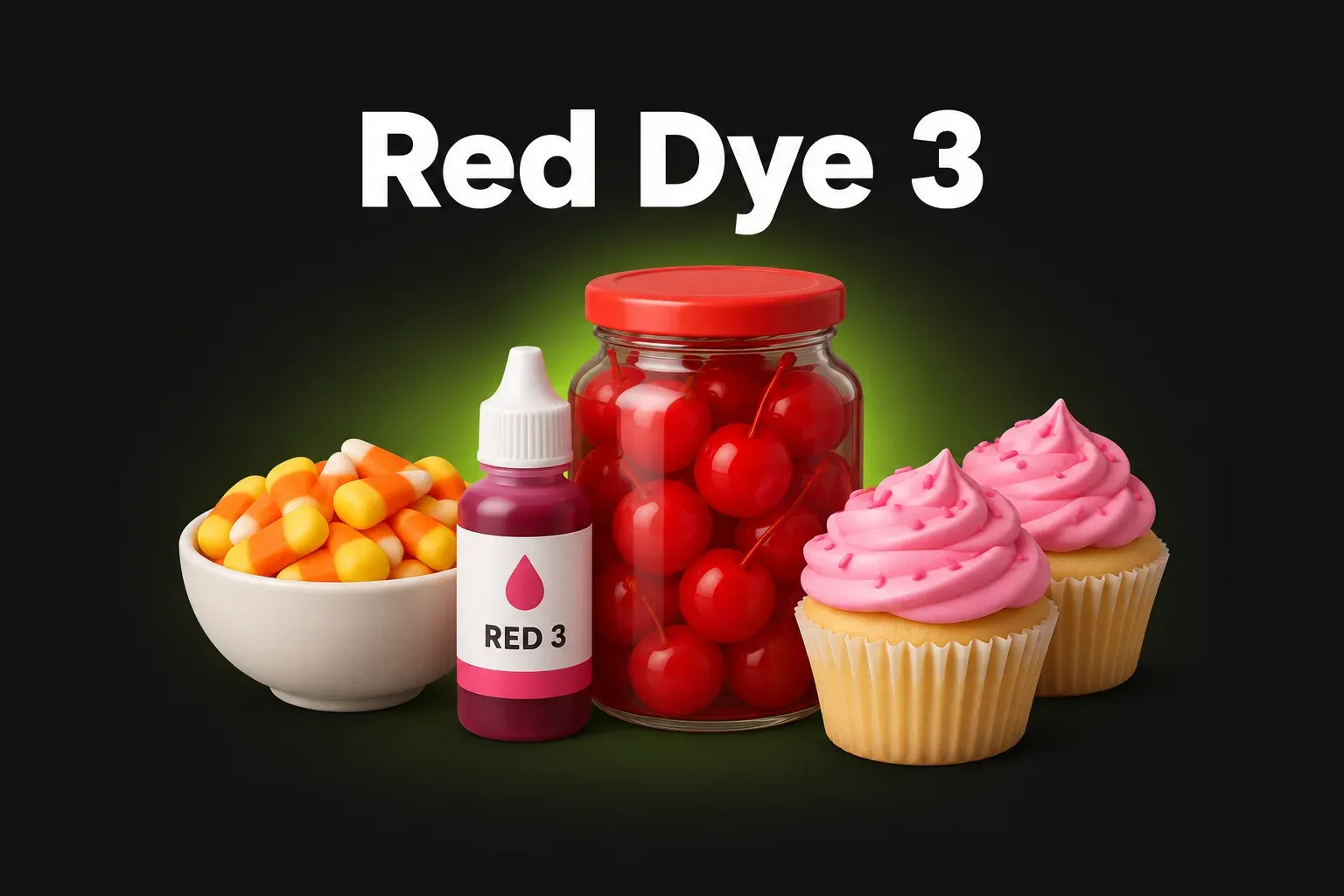
Red Dye 3 gives candy corn, maraschino cherries, frosting and pink candies their bright cherry-pink color. In January 2025, the FDA banned it from food – the first lab-made food dye to be banned in the US in decades. Here’s why, and where you might still find it.
The short answer: Red Dye 3 (erythrosine, FD&C Red No. 3, E127) is a lab-made dye from petroleum that’s about 58% iodine. High doses caused thyroid tumors in male rats, so under US law the FDA revoked its use in food – companies have until January 15, 2027 to remove it, and medicines until January 18, 2028. It’s been banned in cosmetics since 1990. In the EU, it’s allowed only in cocktail and candied cherries. NutriSmart rates it as high risk.
What is Red Dye 3?
Erythrosine is a synthetic dye made from petroleum-based chemicals. Unlike most food dyes, it contains a lot of iodine – about 58% of its weight. It’s pink-red, works well in candy and frosting, and has been used since the early 1900s.
On labels, you’ll see:
| Name | Where |
|---|---|
| Red 3 / FD&C Red No. 3 | US labels |
| Erythrosine | UK, EU, medicines |
| E127 | EU, UK and many other countries |
It’s different from Red 40, the most common red dye in the US, which is orange-red.
Which foods contain Red Dye 3?
Until the 2027 deadline, you might still find it in:
- Candy corn, conversation hearts and some gummies and hard candies
- Maraschino and cocktail cherries, and fruit cocktail
- Frosting, sprinkles, cake decorations and decorating gels
- Strawberry milk and some pink yogurts and desserts
- Some cereals and snacks
- Pink pills, vitamins and children’s medicines
Products made before the deadline can stay on shelves after it, so check labels for a while longer.
Why was Red Dye 3 banned?
Thyroid tumors in male rats
In studies used for a 2022 petition, male rats fed high levels of Red 3 developed thyroid tumors. The Delaney Clause, a US law from 1960, doesn’t allow any food or color additive that causes cancer in humans or animals. That’s why the FDA had already banned it in cosmetics and skin products in 1990, and in January 2025 it finally revoked its approval for food (FDA).
The FDA explained that the tumors come from a hormonal effect specific to male rats, and that studies in other animals and in humans didn’t show the same effect – there’s no evidence that Red 3 causes cancer in people. But the law doesn’t allow exceptions.
Effects on the thyroid in people
Because it’s rich in iodine, Red 3 can affect thyroid hormones. In a study of 30 healthy men, taking 200 mg a day for two weeks raised TSH, the hormone that tells the thyroid to work harder. Lower doses of 20 and 60 mg a day didn’t change thyroid hormones (Gardner et al., Toxicology and Applied Pharmacology, 1987). Food intake is usually much lower, but people with thyroid conditions have one more reason to avoid it.
Behavior in children
A 2022 review by California’s environmental health agency concluded that synthetic food dyes, as a group, can cause or worsen behavior problems in some children (Miller et al., Environmental Health, 2022).
Where else is Red Dye 3 restricted?
| Place | Status |
|---|---|
| United States | Banned in food from January 2027, in medicines from January 2028 |
| California | State ban in food from 2027 (Food Safety Act, 2023) |
| European Union and UK | Only in cocktail and candied cherries |
| Cosmetics (US) | Banned since 1990 |
How to avoid Red Dye 3
- Read labels – look for Red 3, FD&C Red No. 3, erythrosine or E127.
- Be careful with bright pink foods – candy, frosting, cherries and strawberry milk.
- Choose products colored with beet juice, carmine, paprika or fruit and vegetable juices.
- Check medicines and vitamins, especially pink ones – ask the pharmacist for dye-free versions.
- Watch older stock after the 2027 deadline – products made earlier can still be sold.
Spot Red 3 on any label in seconds. With NutriSmart, you photograph the ingredient list or scan the barcode, and the app tells you right away if the product has Red 3. Turn on an alert for it, and the app warns you every time a product you scan contains it. You’ll also see every other additive, the risks of each one and a health score out of 100.Get the app free
You can also read about other food dyes: Red 40, Yellow 5, Yellow 6, Blue 1, Blue 2 and carmine.
The bottom line
Red Dye 3 (erythrosine, E127) is a petroleum-based, iodine-rich pink dye. High doses caused thyroid tumors in male rats, so the FDA banned it from US food starting January 2027 and from medicines in 2028; it was already banned in cosmetics. The FDA says there’s no evidence it causes cancer in people, but there’s no reason to eat it. Read labels on pink candy, cherries and frosting until it’s gone.
FAQ
What is Red Dye 3?
Red Dye 3, also called Red 3, FD&C Red No. 3 or erythrosine (E127 in Europe), is a lab-made dye that gives foods a bright cherry-pink color. It's made from petroleum and contains a lot of iodine.
Is Red Dye 3 banned?
Yes, in the US it's being removed. In January 2025, the FDA revoked its approval for food, with a deadline of January 15, 2027, and in 2026 it did the same for medicines, with a deadline of January 18, 2028. It has been banned in cosmetics since 1990. In the EU, it's only allowed in cocktail and candied cherries.
Why was Red Dye 3 banned?
Because it caused thyroid tumors in male rats fed high doses. US law (the Delaney Clause) doesn't allow food additives that cause cancer in humans or animals. The FDA said the effect works through a hormonal mechanism specific to male rats and that there's no evidence it causes cancer in people – but the law still required the ban.
Which foods contain Red Dye 3?
Until it disappears, look for it in candy corn, conversation hearts, some gummies and hard candies, maraschino and cocktail cherries, cake decorations and frosting, strawberry-flavored milk and some cereals, as well as pink medicines and vitamins.
Is Red 3 the same as Red 40?
No. Red 40 (Allura Red, E129) is a different, orange-red dye and is still allowed, although the FDA has asked companies to stop using it by the end of 2026. Red 3 is pinker and has already been banned from US food.
Does Red Dye 3 affect the thyroid?
It can at high doses. Red 3 is about 58% iodine. In a study of healthy men, 200 mg a day for two weeks raised the thyroid-stimulating hormone TSH, while 20 and 60 mg a day didn't. Typical food intake is much lower.