Yellow 6 (Sunset Yellow): Side Effects, Foods and Bans
What Yellow 6 (Sunset Yellow, E110) is, which foods contain it, what studies show about hyperactivity, DNA damage and allergies, and why it's being phased out.
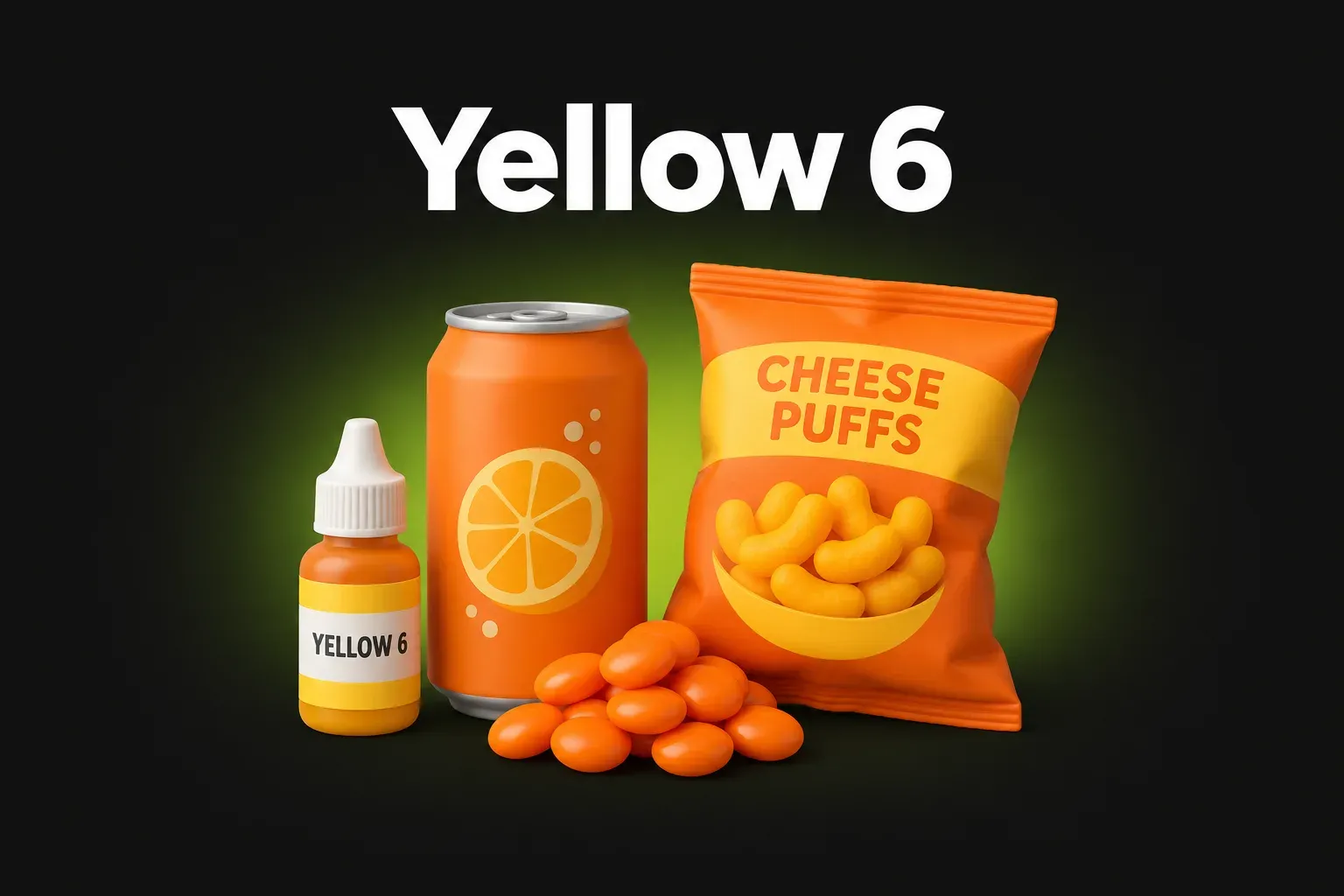
Yellow 6 gives orange soda, cheese puffs, candy and boxed mac and cheese their bright orange color. Together with Yellow 5 and Red 40, it’s one of the three most-used food dyes in the US – and one of the dyes now being phased out.
The short answer: Yellow 6 (Sunset Yellow FCF, E110) is a lab-made dye made from petroleum. It’s still allowed in the US and EU. But it was in both dye mixes that made children more hyperactive in the Southampton study, and recent animal and lab studies linked it to DNA damage, memory problems and gut inflammation. In the EU, foods with it carry a warning label, and in 2025 the FDA asked companies to stop using it. NutriSmart rates it as high risk.
What is Yellow 6?
Yellow 6 is an azo dye: a synthetic color made from petroleum-based chemicals. It’s orange-yellow and dissolves easily in water, so it’s cheap and stable in drinks and candy.
On labels it can appear as:
| Name | Where you see it |
|---|---|
| Yellow 6 / FD&C Yellow No. 6 | US labels |
| Yellow 6 Lake | Candy coatings, tablets, cereal |
| Sunset Yellow FCF | UK and EU labels, medicines |
| E110 | EU, UK and many other countries |
In the US, Yellow 6 is often combined with Yellow 5 or Red 40 to make shades of orange and red.
Which foods contain Yellow 6?
- Orange and fruit-flavored sodas, sports drinks and powdered drink mixes
- Candy, gummies, jelly beans and frosting
- Cheese-flavored snacks and some chips
- Boxed macaroni and cheese and cheese sauces
- Breakfast cereals, toaster pastries and baked goods
- Gelatin desserts, puddings and ice pops
- Medicines and vitamins, especially children’s syrups and chewables
Is Yellow 6 bad for you? What the research says
Hyperactivity in children
- The Southampton study gave nearly 300 ordinary children aged 3 and 8–9 drinks with two different mixes of lab-made dyes and the preservative sodium benzoate. Sunset Yellow was in both mixes. With the dye drinks, children became more hyperactive (McCann et al., The Lancet, 2007). Since 2010, EU foods with E110 must say it “may have an adverse effect on activity and attention in children.”
- In 2021, California’s environmental health agency reviewed 27 human studies and concluded that synthetic food dyes can cause or worsen behavior problems in some children (Miller et al., Environmental Health, 2022).
Brain and memory in animal studies
- Young rats got Sunset Yellow for six weeks, at 2.5 mg per kg – below the official daily limit of 4 mg/kg. They lost brain cells in the hippocampus (a key memory area) and had worse memory (Mousavi et al., International Journal of Developmental Neuroscience, 2024).
- At the official daily limit for 40 days, it caused oxidative damage in several brain regions of young rats (Bhatt et al., Acta Histochemica, 2024).
DNA damage and cancer
- In a 2026 study, Sunset Yellow damaged DNA in human white blood cells in the lab. Rats given it for 7–21 days, at doses close to the daily limit, had blood changes and DNA damage – more than with Yellow 5 – and mixing the two dyes made it worse (Hayat et al., Journal of Applied Toxicology, 2026).
- In rats exposed to a cancer-causing chemical, Sunset Yellow increased the number and size of breast tumors (Salim et al., Toxicology Letters, 2024). This doesn’t show that the dye causes cancer on its own, but it may help tumors grow.
Gut inflammation
In mice, long-term Sunset Yellow made colitis (gut inflammation) worse. It reduced Akkermansia, a helpful gut bacterium, and moving the gut bacteria of exposed mice into other mice made their colitis worse too (Shi et al., Journal of Agricultural and Food Chemistry, 2025).
Allergies
Rarely, Yellow 6 can cause hives, itching or asthma, especially in people who are sensitive to aspirin.
Not every study found harm: a 2019 study funded by the color industry found no effect on sperm in rats, even at very high doses (Bastaki et al., Regulatory Toxicology and Pharmacology, 2019). Most of the warning signs come from animal and lab studies, which can’t prove harm in people. But testing a dye on children for years would be unethical, several independent groups found similar signals, and the dye adds nothing good to food. That’s why NutriSmart rates it as high risk and suggests avoiding it, especially for children.
What regulators say
- EU: allowed, with a safe daily limit of 4 mg per kg of body weight and the warning label for children.
- US: in April 2025, the FDA asked food companies to remove petroleum-based dyes, including Yellow 6, by the end of 2026 (FDA). This is a request, not a ban.
- States: California bans Yellow 6 and five other dyes in public school food from 2027, and West Virginia passed a law to ban it in food sold in the state.
How to avoid Yellow 6
- Read labels – look for Yellow 6, Yellow 6 Lake, FD&C Yellow No. 6, Sunset Yellow or E110.
- Be careful with bright orange foods – orange soda, cheese snacks, candy and boxed mac and cheese.
- Choose products colored with paprika, annatto, beta-carotene or turmeric – or with no added color.
- Check children’s medicines and vitamins – ask the pharmacist for dye-free versions.
- Watch “orange” and “cheddar” flavors in snacks – they’re often colored with Yellow 6.
Spot Yellow 6 on any label in seconds. With NutriSmart, you photograph the ingredient list or scan the barcode, and the app tells you right away if the product has Yellow 6. Turn on an alert for it, and the app warns you every time a product you scan contains it. You’ll also see every other additive, the risks of each one and a health score out of 100.Get the app free
You can also read about other food colorings: Yellow 5, Red 40, Blue 1 and annatto. Sunset Yellow is one of six colors with a warning label in the EU – see the full E numbers list.
The bottom line
Yellow 6 (Sunset Yellow, E110) is a petroleum-based dye used to color orange soda, snacks, candy and medicines. It was part of the Southampton study that linked dyes to hyperactivity in children, and recent animal and lab studies found DNA damage, memory problems and gut inflammation. The FDA has asked companies to remove it by the end of 2026. Reading labels and choosing products without lab-made dyes is the simplest way to avoid it.
FAQ
What is Yellow 6?
Yellow 6, also called Sunset Yellow FCF or FD&C Yellow No. 6 (E110 in Europe), is a lab-made orange-yellow dye made from petroleum. It's used in orange soda, candy, cheese snacks, boxed mac and cheese, cereals, desserts and many medicines.
Is Yellow 6 bad for you?
It's still allowed in the US and EU, but it has several warning signs. It was in both dye mixes that made children more hyperactive in the Southampton study. Recent animal and lab studies linked it to DNA damage, memory problems and gut inflammation. NutriSmart rates it as high risk.
Does Yellow 6 cause ADHD?
It hasn't been shown to cause ADHD. But together with other lab-made dyes, it made ordinary children more hyperactive in the Southampton study, and a large California review concluded that synthetic dyes can affect behavior in some children.
Is Yellow 6 banned?
Not in the US or EU. In the EU, foods with it must carry a warning that it "may have an adverse effect on activity and attention in children". In 2025, the FDA asked companies to stop using it and other petroleum-based dyes by the end of 2026, and California banned it in school food.
What's the difference between Yellow 5 and Yellow 6?
Yellow 5 (tartrazine, E102) is lemon-yellow; Yellow 6 (Sunset Yellow, E110) is orange-yellow. Both are lab-made azo dyes, both were in the Southampton study, and both carry the same EU warning. They're often used together.
What is Yellow 6 Lake?
It's the same dye bound to aluminum so it doesn't dissolve in water. Lakes are used in candy coatings, tablets and fatty foods. On labels it appears as "Yellow 6 Lake" or "FD&C Yellow No. 6 Aluminum Lake".