Annatto: Is This Natural Food Coloring Safe?
What annatto (E160b) is, why cheddar and snacks are orange, whether this natural coloring is safe, who may be allergic to it and what EFSA says about children.
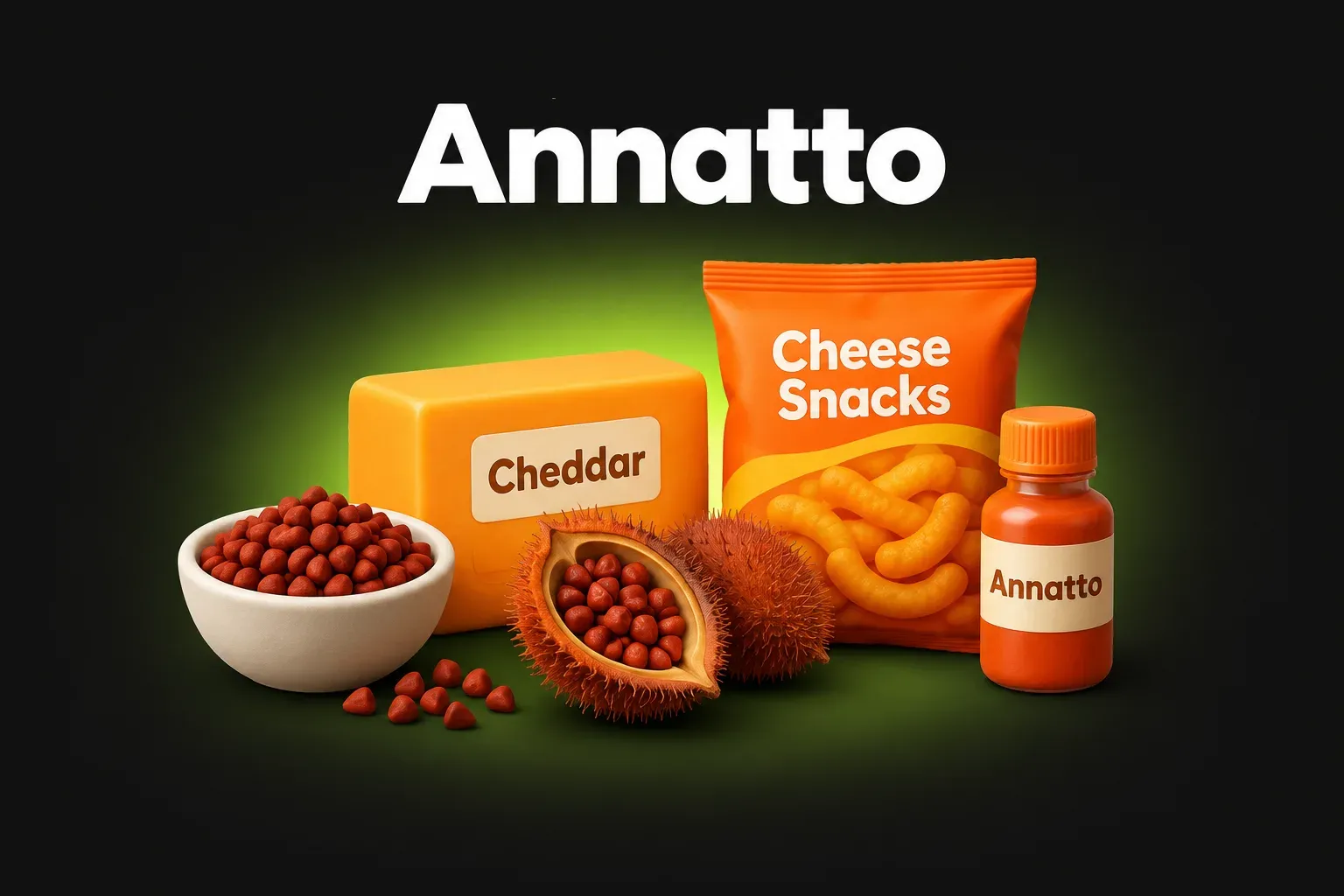
Annatto is the reason cheddar cheese is orange – and also many cheese snacks, crackers, popcorn and butter. It’s a natural coloring from the seeds of a tropical tree, so most people assume it’s harmless. For most people it is, but “natural” doesn’t mean it suits everyone.
The short answer: annatto is a natural yellow-orange coloring from the seeds of the achiote tree. It’s not a synthetic dye like Red 40 or Yellow 5, and it’s considered safe for most people. But it can cause allergic reactions in a small number of people, from hives to rare cases of anaphylaxis (a severe, sudden allergic reaction). And the European Food Safety Authority found that some children who eat a lot of annatto-colored food may go over the safe daily limit for one of its parts.
What is annatto?
Annatto comes from the red seeds of the achiote tree (Bixa orellana), which grows in Central and South America. People there have used it for centuries to color food, skin and cloth. Achiote paste is still used to flavor meat and rice.
The color comes from two natural pigments:
- Bixin – dissolves in fat, used in butter, margarine and oily foods
- Norbixin – dissolves in water, used in cheese and water-based foods
Depending on the amount, annatto gives food a color from light yellow to deep orange. It has a mild, slightly nutty and peppery taste, but in the small amounts used as coloring you can’t taste it.
On labels, you’ll see it as annatto, annatto extract, annatto color, bixin, norbixin or E160b.
Which foods contain annatto?
- Cheese: cheddar, Red Leicester, Colby, processed cheese and cheese slices
- Dairy and fats: butter, margarine, custard, ice cream
- Snacks: cheese crackers, cheese puffs, popcorn, chips
- Breakfast: cereals and cereal bars
- Meat and fish: sausages, smoked fish
- Other: salad dressings, sauces, baked goods, rice mixes
Why is cheddar orange? Cheese made from cows that graze on grass is naturally slightly yellow in summer. Centuries ago, English cheesemakers began adding annatto so their cheese would look the same all year – and the habit stuck.
Is annatto safe? What the research says
What regulators say
Annatto is approved as a food coloring in the US and the EU. In 2016, the European Food Safety Authority (EFSA) set safe daily limits for its two pigments: 6 mg per kg of body weight for bixin and 0.3 mg per kg for norbixin. Adults stay well under these limits. But toddlers and children who eat a lot of annatto-colored foods may go over the limit for norbixin (EFSA, 2016). EFSA also said it couldn’t confirm that some types of annatto extract were safe, because data was missing.
Allergic reactions
Annatto is one of the few natural colorings known to cause allergic reactions. Doctors have reported:
- Hives, swelling and a dangerous drop in blood pressure within 20 minutes of eating a cereal with annatto. The patient’s skin test was strongly positive for annatto, but negative for milk, wheat and corn. The authors think tiny bits of seed protein in the coloring may cause the allergy (Nish et al., Annals of Allergy, 1991).
- A patient who seemed allergic to cheese turned out to be allergic to the annatto in it (Ebo et al., Allergy, 2009).
- A reaction confirmed with a blinded eating test, where the patient doesn’t know if they get annatto or a fake – the most reliable test (Sadowska et al., Annals of Allergy, Asthma & Immunology, 2021).
These reactions are rare, but they’re easy to miss, because people usually blame the cheese or the cereal, not the coloring.
Digestive symptoms
Some gut doctors have reported patients with irritable bowel syndrome (IBS) who felt better when they avoided annatto (Floch, Journal of Clinical Gastroenterology, 2009). This is based on what doctors saw in their patients, not on proper trials.
Possible benefits
Annatto seeds contain carotenoids and tocotrienols (a form of vitamin E), which protect cells. But the amounts in colored foods are tiny, so annatto coloring doesn’t add real nutrition.
Annatto vs synthetic dyes
| Annatto (E160b) | Red 40, Yellow 5 | |
|---|---|---|
| Source | Seeds of the achiote tree | Petroleum |
| Linked to hyperactivity in children | No evidence | Yes (Southampton study) |
| Warning label in the EU | No | Yes (for six dyes) |
| Allergic reactions | Rare | Rare (Yellow 5 more often) |
| Safe daily limit can be exceeded by children | Yes, for norbixin | Possible with high intake |
Annatto is a better choice than synthetic dyes, but the safest choice is food that doesn’t need added color at all.
Should you avoid annatto?
For most people, there’s no need to avoid it. But it’s worth checking labels if:
- you get hives, swelling, itching or stomach symptoms after cheddar, orange snacks or cereals, but not after other dairy
- you have IBS and certain processed foods seem to trigger symptoms
- your children eat a lot of orange cheese snacks, crackers and processed cheese
If you suspect an allergy, keep a food diary and talk to an allergist – skin tests and food challenges can confirm it.
Spot annatto on any label in seconds. With NutriSmart, you photograph the ingredient list or scan the barcode, and the app tells you right away if the product has annatto. Turn on an alert for it, and the app warns you every time a product you scan contains it. You’ll also see every other additive, the risks of each one and a health score out of 100.Get the app free
You can also read about other food colorings: Red 40, carmine and titanium dioxide.
Related: Caramel color (E150).
The bottom line
Annatto is a natural yellow-orange coloring from achiote seeds that makes cheddar, butter and cheese snacks orange. It’s a better choice than synthetic dyes and safe for most people. But it can cause allergic reactions in a few people. And EFSA found that children who eat a lot of annatto-colored food may go over the safe limit for norbixin. If orange foods seem to disagree with you, check the label for annatto or E160b.
FAQ
What is annatto?
Annatto is a natural yellow-orange food coloring made from the seeds of the achiote tree (Bixa orellana), which grows in Central and South America. It's what makes cheddar cheese, butter, cheese snacks and many crackers orange.
Is annatto safe?
For most people, yes. It's a natural coloring used for centuries, and regulators allow it in many foods. But it can cause allergic reactions in a small number of people, from hives to rare cases of anaphylaxis (a severe, sudden allergic reaction). And EFSA found that some children who eat a lot of it may go over the safe daily limit for norbixin, one of its parts.
Can you be allergic to annatto?
Yes, but it's rare. Doctors have reported hives, swelling, stomach symptoms and a few severe allergic reactions (anaphylaxis) after foods colored with annatto. Skin tests or supervised eating tests confirmed them. If you react to cheddar, orange snacks or cereals but not to other dairy, annatto may be the cause.
Is annatto the same as Yellow 5 or Red 40?
No. Annatto is a natural coloring from seeds, while Yellow 5 (tartrazine) and Red 40 are synthetic dyes made from petroleum. Annatto wasn't part of the Southampton study that linked synthetic dyes to hyperactivity in children.
What foods contain annatto?
Cheddar and other orange cheeses, processed cheese, butter and margarine, cheese crackers and snacks, popcorn, cereals, custard, smoked fish, sausages, salad dressings and some baked goods. In Latin American cooking, achiote paste is used to color and flavor meat and rice.
What is E160b?
E160b is the European code for annatto, bixin and norbixin. On labels you'll see it as "annatto", "annatto extract", "annatto color" or "colour: E160b".