Carmine (E120): The Red Coloring Made From Insects
What carmine (E120, cochineal extract) is, how it's made from insects, which foods contain it, who may be allergic to it and what EFSA says about its safety.
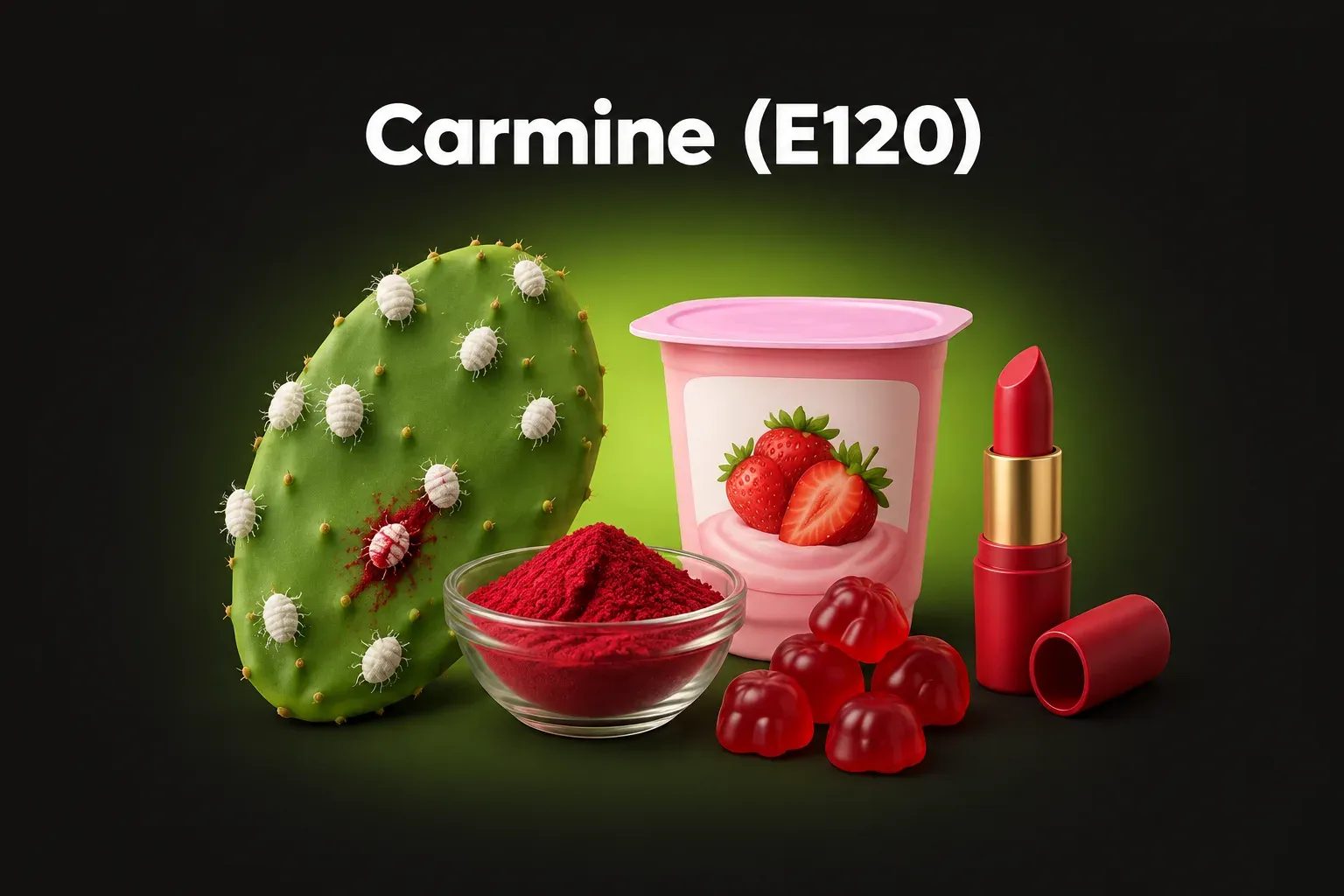
That pink strawberry yogurt, the bright red candy and the red lipstick may all have something in common: insects. Carmine is one of the oldest food colorings in the world – and one of the few made from animals. It’s natural and considered safe for most people. But it’s not vegan, and it can cause allergic reactions.
The short answer: carmine (E120, also called cochineal extract) is a natural red coloring made from dried, crushed cochineal insects. The European Food Safety Authority reviewed it in 2015 and found no signs that it causes cancer or damages genes in animal studies. The amounts people eat stay below the safe daily limit. But leftover insect proteins in the coloring can cause allergic reactions, from hives to rare cases of anaphylaxis (a severe, sudden allergic reaction). And it’s not vegan or vegetarian.
What is carmine?
Cochineal (Dactylopius coccus) is a small insect that lives on prickly pear cacti, mostly in Peru and the Canary Islands. The females make a deep red substance called carminic acid to keep birds and other insects away.
To make the coloring, the insects are collected, dried and crushed. The carminic acid is then washed out with water. Mixed with aluminum or calcium, it becomes carmine – a red that doesn’t fade easily with heat or light. It takes tens of thousands of insects to make about half a kilo (one pound) of coloring.
People in Central and South America used cochineal for centuries to dye cloth. Today, it colors food, drinks and makeup.
On labels, you’ll see it as carmine, cochineal extract, cochineal, carminic acid, natural red 4 or E120. In makeup it’s often listed as CI 75470.
Which foods contain carmine?
- Dairy: strawberry and fruit yogurts, flavored milk, ice cream
- Sweets: red candies, gummies, sprinkles, cake icing, macarons
- Drinks: red juices, fruit drinks and some liqueurs
- Fruit products: jams, fruit fillings, canned cherries
- Meat and fish: sausages, salami, ham and imitation crab sticks
- Makeup: lipstick, blush, eyeshadow
In the US, food makers must write “carmine” or “cochineal extract” on the label since 2011. Before, it could be hidden under “color added”. In the EU, it always appears as carmine or E120.
Is carmine safe? What the research says
What regulators say
In 2015, the European Food Safety Authority (EFSA) looked at all the studies on carmine again. In rats and mice, carmine didn’t cause cancer, didn’t harm reproduction or babies and didn’t damage genes. EFSA kept the safe daily limit at 5 mg of carmine per kg of body weight (2.5 mg of carminic acid). It found that adults and children stay below this limit (EFSA, 2015).
But EFSA added an important warning: no safe dose can be set for allergies. That’s why it asked makers to remove more of the insect proteins when they make the coloring.
Allergic reactions
Carmine is one of the few food colorings known to cause severe allergies. The problem isn’t the red color itself, but tiny bits of insect protein left in it.
- A review of all 22 cases reported in Japan found that every patient was an adult woman, and almost all had anaphylaxis. 13 had first reacted to makeup (red eyeshadow, lipstick or blush). The foods that caused the reactions included strawberry juice, fish sausage and French macarons (Takeo et al., Allergology International, 2018).
- Doctors in Japan described a patient who had anaphylaxis after foods with carmine. The allergy had started from a red eyeliner used on the skin (Miyakawa et al., Journal of Dermatology, 2017).
- A butcher who mixed carmine into sausages developed asthma at work. At the time, doctors had already described 18 cases of work-related asthma caused by carmine (Ferrer et al., International Archives of Allergy and Immunology, 2005).
These reactions are rare, but they’re easy to miss. People often blame the yogurt, the candy or the sausage, not the coloring.
Carmine and vegans
Because it’s made from insects, carmine is not vegan or vegetarian. Some people also avoid it for religious reasons. In 2012, Starbucks stopped using cochineal in its strawberry drinks after complaints from vegan customers and switched to a coloring from tomatoes.
Plant-based red colorings include beetroot red (E162), paprika extract (E160c), lycopene (E160d) and anthocyanins (E163) from berries, grapes or red cabbage.
Carmine vs Red 40
| Carmine (E120) | Red 40 (E129) | |
|---|---|---|
| Source | Cochineal insects | Petroleum |
| Vegan | No | Yes |
| Linked to hyperactivity in children | No evidence | Yes (Southampton study) |
| Warning label in the EU | No | Yes |
| Allergic reactions | Rare, can be severe | Rare |
| Price | Expensive | Cheap |
Carmine is a natural coloring and has a better safety record than synthetic dyes. But “natural” doesn’t mean safe for everyone – and the safest choice is food that doesn’t need added color at all.
Should you avoid carmine?
For most people, there’s no need to avoid it. But check labels if:
- you’re vegan or vegetarian
- you’ve had itching, swelling or a rash from red makeup – you may react to carmine in food too
- you get hives, swelling, stomach cramps or breathing problems after red or pink foods
- you work with red food coloring or spices and have asthma or a runny nose at work
If you suspect an allergy, talk to an allergist. Skin tests and blood tests for cochineal can confirm it.
Spot carmine on any label in seconds. With NutriSmart, you photograph the ingredient list or scan the barcode, and the app tells you right away if the product has carmine. Turn on an alert for it, and the app warns you every time a product you scan contains it. You’ll also see every other additive, the risks of each one and a health score out of 100.Get the app free
You can also read about other food colorings: annatto, Red 40 and titanium dioxide.
The bottom line
Carmine (E120) is a natural red coloring made from cochineal insects. It’s used in yogurts, candies, drinks, sausages and makeup. EFSA found no signs that it causes cancer or damages genes, and people eat less than the safe daily limit. But insect proteins left in it can cause allergic reactions, sometimes severe – especially in people who first reacted to red makeup. It’s also not vegan. If red foods seem to disagree with you, check the label for carmine, cochineal or E120.
FAQ
What is carmine?
Carmine is a natural red food coloring made from cochineal, small insects that live on prickly pear cacti, mostly in Peru and the Canary Islands. The insects are dried and crushed, and the red color (carminic acid) is taken out of them. On labels it appears as carmine, cochineal extract, carminic acid or E120.
Is carmine safe to eat?
For most people, yes. The European Food Safety Authority reviewed it in 2015 and found no signs that it causes cancer or damages genes in animal studies. The amounts people eat stay below the safe daily limit. But carmine can cause allergic reactions, sometimes severe ones, in a small number of people.
Is carmine vegan?
No. Carmine is made from insects, so it's not vegan or vegetarian. Some people also avoid it for religious reasons. Vegan products use plant colorings like beetroot red, paprika extract or anthocyanins instead.
Can you be allergic to carmine?
Yes. The allergy comes from bits of insect protein left in the coloring. Reactions range from hives and swelling to anaphylaxis (a severe, sudden allergic reaction). Many reported cases were women who first reacted to red makeup, like eyeshadow or lipstick, and later to foods with carmine.
What foods contain carmine?
Strawberry and fruit yogurts, ice cream, red candies, gummies, red drinks and liqueurs, cakes and macarons, jams, sausages and other meat products, and imitation crab sticks. It's also common in lipstick, blush and eyeshadow.
Is carmine the same as Red 40?
No. Carmine is a natural coloring from insects, while Red 40 is a synthetic dye made from petroleum. Red 40 was linked to hyperactivity in children in the Southampton study and needs a warning label in the EU. Carmine doesn't.