E Numbers List: What They Mean and Which to Avoid
Full E numbers list with a risk rating for each additive – what E numbers mean, the main groups from E100 to E1500, which ones to avoid and which are harmless.
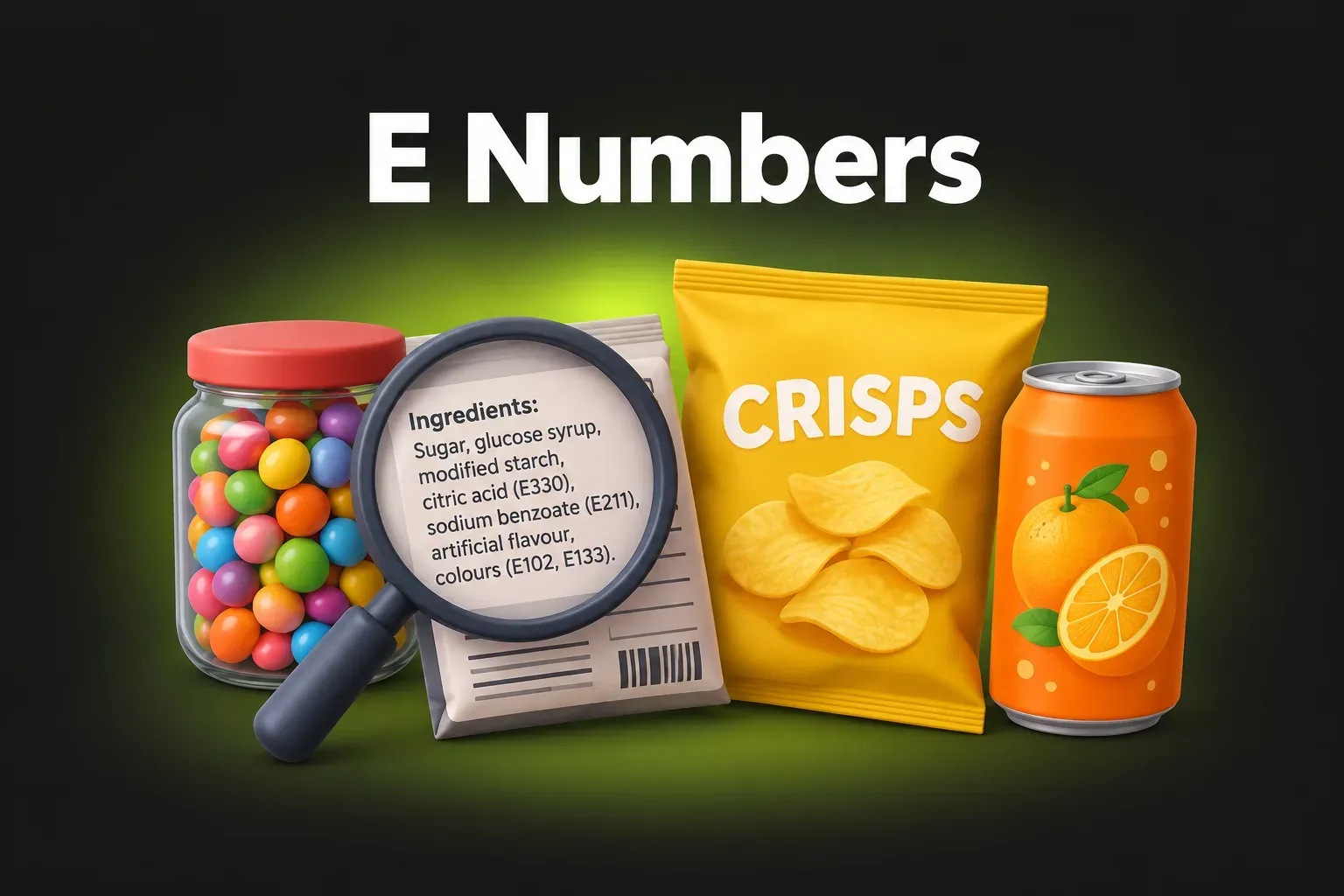
You’ve probably seen them on packets of crisps, sweets, sauces and soft drinks: E102, E211, E471, E621… These E numbers often look scary, and some deserve a closer look. But many are perfectly harmless – E300 is simply vitamin C. Here’s what E numbers mean, how they’re grouped, which ones to avoid, and a full E numbers list with the rating each additive gets in the NutriSmart app.
The short answer: E numbers are codes for food additives approved in the European Union (and still used in the UK). The number tells you the type: E100s are colours, E200s preservatives, E300s antioxidants, E400s thickeners and emulsifiers, and so on. Not all E numbers are bad: many are natural or nutrients. The ones worth limiting include some artificial colours (E102, E110, E129 and others), nitrites (E249–E250), sodium benzoate (E211), titanium dioxide (E171), carrageenan (E407), mono- and diglycerides (E471), MSG (E621) and some sweeteners (E951, E955, E968).
What are E numbers?
E numbers are codes given to food additives that have been assessed and approved for use in the European Union. The “E” stands for Europe. The system makes labels shorter and works across languages – E330 means citric acid in every EU country.
- UK: still uses E numbers after Brexit; the Food Standards Agency now approves new additives for Great Britain.
- Australia and New Zealand: use the same numbers without the “E” – for example 621 instead of E621.
- US and Canada: list additives by name (for example “Red 40” or “sodium benzoate”) instead of numbers.
Having an E number means an additive was judged safe at the time it was approved, at certain doses. But science moves on. Some approved additives were later banned – titanium dioxide (E171) in the EU in 2022 – and others are still under review. That’s why it’s worth knowing which ones are linked to concerns.
E number groups
| Range | Type of additive | Examples |
|---|---|---|
| E100–E199 | Colours | E100 curcumin, E129 Allura Red, E150d caramel colour |
| E200–E299 | Preservatives | E202 potassium sorbate, E211 sodium benzoate, E250 sodium nitrite |
| E300–E399 | Antioxidants and acidity regulators | E300 vitamin C, E322 lecithin, E330 citric acid |
| E400–E499 | Thickeners, stabilisers, emulsifiers | E407 carrageenan, E415 xanthan gum, E471 mono- and diglycerides |
| E500–E599 | Acidity regulators, anti-caking agents | E500 baking soda, E551 silicon dioxide |
| E600–E699 | Flavour enhancers | E621 MSG, E627 and E631 |
| E900–E999 | Glazing agents, gases, sweeteners | E903 carnauba wax, E951 aspartame, E960 stevia |
| E1000+ | Other additives | E1412 modified starch, E1520 propylene glycol |
Are E numbers bad for you?
It depends completely on which E number. Three groups:
- Natural or nutrients – usually harmless: E300 (vitamin C), E306 (vitamin E), E101 (vitamin B2), E160a (beta-carotene), E330 (citric acid), E290 (carbon dioxide), E948 (oxygen).
- Generally low risk: most thickeners from plants, like E440 (pectin), E412 (guar gum) or E415 (xanthan gum), and most modified starches.
- Worth limiting: additives where independent studies – often in animals – raise concerns, even if regulators still allow them.
Example: the “Southampton six”. In a 2007 study, 297 children drank juice with a mix of artificial colours and sodium benzoate. Both 3-year-olds and 8- to 9-year-olds became more hyperactive than with a placebo drink (McCann et al., Lancet, 2007). Since 2010, foods in the EU (and the UK) containing E102, E104, E110, E122, E124 or E129 must carry the warning “may have an adverse effect on activity and attention in children”.
When several independent labs find the same warning sign in animal or human studies, it’s sensible to limit that additive as a precaution – especially for children.
How NutriSmart rates E numbers
Each additive in the NutriSmart app has a risk level based on the European Food Safety Authority (EFSA), the World Health Organization’s cancer agency (IARC) and independent studies:
| Rating | What it means | Effect on the product score |
|---|---|---|
| No known risk | Natural or a nutrient, no concerns | No points lost |
| Low | Minor or theoretical concerns | −2.5 points |
| Moderate | Concerns in some studies, worth limiting | −10 points |
| High | Several studies point to possible harm | −15 points |
Read more about how NutriSmart rates products.
E numbers to avoid (rated high risk)
These 45 additives get a high risk rating in NutriSmart:
- Colours: E102 (tartrazine), E104, E110, E122, E124, E127, E129 (Allura Red), E171 (titanium dioxide), E173 (aluminium)
- Preservatives: E200, E201, E202 (potassium sorbate), E203 (sorbates), E210, E211 (sodium benzoate), E212, E213 (benzoates), E216, E217 (propylparabens), E239, E249, E250, E251, E252 (nitrites and nitrates), E284, E285 (borates)
- Antioxidant: E320 (BHA)
- Thickeners and emulsifiers: E407 (carrageenan), E471 (mono- and diglycerides)
- Aluminium compounds: E520, E521, E522, E523, E541, E554, E555, E556, E559, E1452
- Sweeteners: E950 (acesulfame K), E951 (aspartame), E955 (sucralose), E962 (aspartame-acesulfame salt), E967 (xylitol), E968 (erythritol) – see all artificial sweeteners
Common E numbers that are usually harmless
| E number | Name | What it does |
|---|---|---|
| E300 | Ascorbic acid (vitamin C) | Antioxidant |
| E306 | Tocopherols (vitamin E) | Antioxidant |
| E322 | Lecithins | Emulsifier |
| E330 | Citric acid | Acidity regulator |
| E410 | Locust bean gum | Thickener |
| E412 | Guar gum | Thickener |
| E415 | Xanthan gum | Thickener |
| E440 | Pectin | Gelling agent |
| E500 | Sodium carbonates (baking soda) | Raising agent |
| E1412 | Distarch phosphate | Thickener (modified starch) |
Full E numbers list with ratings
Ratings come from the NutriSmart additive database (October 2026). Names link to our detailed guides where we have one.
E100–E199: colours
| E number | Name | NutriSmart rating |
|---|---|---|
| E100 | Curcumin | Low |
| E101 | Riboflavin (vitamin B2) | No known risk |
| E102 | Tartrazine | High |
| E104 | Quinoline Yellow | High |
| E110 | Sunset Yellow FCF (Yellow 6) | High |
| E120 | Carmine (cochineal) | Low |
| E122 | Carmoisine (azorubine) | High |
| E123 | Amaranth | Moderate |
| E124 | Ponceau 4R | High |
| E127 | Erythrosine (Red 3) | High |
| E129 | Allura Red AC | High |
| E131 | Patent Blue V | Moderate |
| E132 | Indigo carmine (Blue 2) | Moderate |
| E133 | Brilliant Blue FCF | Moderate |
| E140 | Chlorophylls | Low |
| E141 | Copper complexes of chlorophylls | Low |
| E142 | Green S | Moderate |
| E150a | Plain caramel | Low |
| E150b | Caustic sulphite caramel | Low |
| E150c | Ammonia caramel | Moderate |
| E150d | Sulphite ammonia caramel | Moderate |
| E151 | Brilliant Black BN | Moderate |
| E153 | Vegetable carbon | Moderate |
| E154 | Brown FK | Moderate |
| E155 | Brown HT | Moderate |
| E160a | Carotenes (beta-carotene) | No known risk |
| E160b | Annatto | Low |
| E160c | Paprika extract | Low |
| E160d | Lycopene | Low |
| E160e | Beta-apo-8’-carotenal | No known risk |
| E160f | Ethyl esters of beta-apo-8’-carotenal | Low |
| E161b | Lutein | Low |
| E161g | Canthaxanthin | Moderate |
| E162 | Beetroot red (betanin) | Low |
| E163 | Anthocyanins | Low |
| E170 | Calcium carbonate | Low |
| E171 | Titanium dioxide | High |
| E172 | Iron oxides and hydroxides | Low |
| E173 | Aluminium | High |
| E175 | Gold | Moderate |
| E180 | Litholrubine BK | Moderate |
E200–E299: preservatives
| E number | Name | NutriSmart rating |
|---|---|---|
| E200 | Sorbic acid | High |
| E201 | Sodium sorbate | High |
| E202 | Potassium sorbate | High |
| E203 | Calcium sorbate | High |
| E210 | Benzoic acid | High |
| E211 | Sodium Benzoate | High |
| E212 | Potassium benzoate | High |
| E213 | Calcium benzoate | High |
| E214 | Ethylparaben | Moderate |
| E215 | Sodium ethylparaben | Moderate |
| E216 | Propylparaben | High |
| E217 | Sodium propylparaben | High |
| E218 | Methylparaben | Moderate |
| E219 | Sodium methylparaben | Moderate |
| E220 | Sulphur dioxide | Moderate |
| E221 | Sodium sulphite | Moderate |
| E222 | Sodium bisulphite | Moderate |
| E223 | Sodium metabisulphite | Moderate |
| E224 | Potassium metabisulphite | Moderate |
| E226 | Calcium sulphite | Moderate |
| E227 | Calcium bisulphite | Moderate |
| E228 | Potassium bisulphite | Moderate |
| E234 | Nisin | Low |
| E235 | Natamycin | Low |
| E239 | Hexamine | High |
| E242 | Dimethyl dicarbonate | Low |
| E249 | Potassium nitrite | High |
| E250 | Sodium nitrite | High |
| E251 | Sodium nitrate | High |
| E252 | Potassium nitrate | High |
| E260 | Acetic acid | Low |
| E262 | Sodium acetate | Low |
| E263 | Calcium acetate | Low |
| E264 | Ammonium acetate | Low |
| E265 | Dehydroacetic acid | Moderate |
| E270 | Lactic acid | Low |
| E280 | Propionic acid | Moderate |
| E281 | Sodium propionate | Moderate |
| E282 | Calcium propionate | Moderate |
| E283 | Potassium propionate | Moderate |
| E284 | Boric acid | High |
| E285 | Borax (sodium tetraborate) | High |
| E290 | Carbon dioxide | Low |
| E296 | Malic acid | Low |
| E297 | Fumaric acid | Low |
E300–E399: antioxidants and acidity regulators
| E number | Name | NutriSmart rating |
|---|---|---|
| E300 | Ascorbic acid (vitamin C) | No known risk |
| E301 | Sodium ascorbate | Low |
| E302 | Calcium ascorbate | No known risk |
| E304 | Ascorbyl palmitate | No known risk |
| E306 | Tocopherols (vitamin E) | No known risk |
| E307 | Alpha-tocopherol | Low |
| E308 | Gamma-tocopherol | No known risk |
| E309 | Delta-tocopherol | No known risk |
| E310 | Propyl gallate | Moderate |
| E311 | Octyl gallate | Moderate |
| E312 | Dodecyl gallate | Moderate |
| E315 | Erythorbic acid | Low |
| E316 | Sodium erythorbate | Low |
| E319 | TBHQ (tertiary butylhydroquinone) | Moderate |
| E320 | BHA (butylated hydroxyanisole) | High |
| E321 | BHT (butylated hydroxytoluene) | Moderate |
| E322 | Lecithins | Low |
| E325 | Sodium lactate | Low |
| E326 | Potassium lactate | Low |
| E327 | Calcium lactate | Low |
| E330 | Citric acid | Low |
| E331 | Sodium citrates | Low |
| E332 | Potassium citrates | Low |
| E333 | Calcium citrates | Low |
| E334 | Tartaric acid | Low |
| E335 | Sodium tartrates | Low |
| E336 | Potassium tartrates | Low |
| E337 | Sodium potassium tartrate | Low |
| E338 | Phosphoric acid | Moderate |
| E339 | Sodium phosphates | Moderate |
| E340 | Potassium phosphates | Moderate |
| E341 | Calcium phosphates | Moderate |
| E343 | Magnesium phosphates | Moderate |
| E350 | Sodium malates | Low |
| E351 | Potassium malates | Low |
| E352 | Calcium malates | Low |
| E353 | Metatartaric acid | Low |
| E354 | Calcium tartrate | Low |
| E355 | Adipic acid | Low |
| E356 | Sodium adipate | Low |
| E357 | Potassium adipate | Low |
| E363 | Succinic acid | Low |
| E375 | Niacin | No known risk |
| E380 | Triammonium citrate | Low |
| E385 | Calcium disodium EDTA | Low |
| E391 | Phytic acid | Low |
| E392 | Rosemary extract | Low |
E400–E499: thickeners, stabilisers and emulsifiers
| E number | Name | NutriSmart rating |
|---|---|---|
| E400 | Alginic acid | Low |
| E401 | Sodium alginate | Low |
| E402 | Potassium alginate | Low |
| E403 | Ammonium alginate | Low |
| E404 | Calcium alginate | Low |
| E405 | Propylene glycol alginate | Low |
| E406 | Agar | Low |
| E407 | Carrageenan | High |
| E410 | Locust bean gum | Low |
| E412 | Guar gum | Low |
| E413 | Tragacanth gum | Low |
| E414 | Gum arabic (acacia gum) | Low |
| E415 | Xanthan gum | Low |
| E416 | Karaya gum | Low |
| E417 | Tara gum | Low |
| E418 | Gellan gum | Low |
| E420 | Sorbitol | Moderate |
| E421 | Mannitol | Low |
| E422 | Glycerol | Low |
| E425 | Konjac gum | Low |
| E426 | Soybean hemicellulose | Low |
| E428 | Gelatin | Low |
| E431 | Polyoxyethylene (40) stearate | Moderate |
| E432 | Polysorbate 20 | Moderate |
| E433 | Polysorbate 80 | Moderate |
| E435 | Polysorbate 60 | Moderate |
| E440 | Pectin | Low |
| E442 | Ammonium phosphatides | Low |
| E444 | Sucrose acetate isobutyrate | Low |
| E445 | Glycerol esters of wood rosins | Low |
| E450 | Diphosphates | Moderate |
| E451 | Triphosphates | Moderate |
| E452 | Polyphosphates (sodium hexametaphosphate) | Moderate |
| E459 | Beta-cyclodextrin | Low |
| E460 | Cellulose | Low |
| E461 | Methylcellulose | Low |
| E462 | Ethylcellulose | Low |
| E463 | Hydroxypropyl cellulose | Low |
| E464 | Hydroxypropyl methylcellulose | Low |
| E465 | Ethyl methyl cellulose | Low |
| E466 | Cellulose gum (carboxymethylcellulose) | Moderate |
| E469 | Enzymatically hydrolysed cellulose gum | Low |
| E470 | Salts of fatty acids | Low |
| E471 | Mono- and diglycerides of fatty acids | High |
| E472 | Esters of mono- and diglycerides | Moderate |
| E472e | DATEM | Moderate |
| E473 | Sucrose esters of fatty acids | Moderate |
| E474 | Sucroglycerides | Moderate |
| E475 | Polyglycerol esters of fatty acids | Moderate |
| E476 | Polyglycerol polyricinoleate (PGPR) | Low |
| E477 | Propylene glycol esters of fatty acids | Moderate |
| E479b | Thermally oxidised soybean oil | Low |
| E481 | Sodium stearoyl lactylate | Low |
| E482 | Calcium stearoyl lactylate | Low |
| E483 | Stearyl tartrate | Moderate |
| E491 | Sorbitan monostearate | Moderate |
| E492 | Sorbitan tristearate | Moderate |
| E493 | Sorbitan monolaurate | Moderate |
| E494 | Sorbitan monooleate | Moderate |
| E495 | Sorbitan monopalmitate | Moderate |
| E499 | Plant sterols (stigmasterol-rich) | Low |
E500–E599: acidity regulators and anti-caking agents
| E number | Name | NutriSmart rating |
|---|---|---|
| E500 | Sodium carbonates | Low |
| E501 | Potassium carbonates | Low |
| E503 | Ammonium carbonates | Moderate |
| E504 | Magnesium carbonates | Low |
| E507 | Hydrochloric acid | Low |
| E508 | Potassium chloride | Low |
| E509 | Calcium chloride | Low |
| E511 | Magnesium chloride | Low |
| E512 | Stannous chloride | Low |
| E513 | Sulphuric acid | Low |
| E514 | Sodium sulphates | Low |
| E515 | Potassium sulphates | Low |
| E516 | Calcium sulphate | Low |
| E517 | Ammonium sulphate | Low |
| E520 | Aluminium sulphate | High |
| E521 | Aluminium sodium sulphate | High |
| E522 | Aluminium potassium sulphate | High |
| E523 | Aluminium ammonium sulphate | High |
| E524 | Sodium hydroxide | Low |
| E525 | Potassium hydroxide | Low |
| E526 | Calcium hydroxide | Low |
| E527 | Ammonium hydroxide | Low |
| E528 | Magnesium hydroxide | Low |
| E529 | Calcium oxide | Low |
| E530 | Magnesium oxide | Low |
| E534 | Iron tartrate | Low |
| E535 | Sodium ferrocyanide | Low |
| E536 | Potassium ferrocyanide | Low |
| E538 | Calcium ferrocyanide | Low |
| E541 | Sodium aluminium phosphate | High |
| E551 | Silicon dioxide | Moderate |
| E552 | Calcium silicate | Low |
| E553 | Magnesium silicates | Moderate |
| E553b | Talc | Moderate |
| E554 | Sodium aluminium silicate | High |
| E555 | Potassium aluminium silicate | High |
| E556 | Calcium aluminium silicate | High |
| E558 | Bentonite | Low |
| E559 | Aluminium silicate (kaolin) | High |
| E570 | Fatty acids | Low |
| E574 | Gluconic acid | Low |
| E575 | Glucono-delta-lactone | Low |
| E576 | Sodium gluconate | Low |
| E577 | Potassium gluconate | Low |
| E578 | Calcium gluconate | Low |
| E579 | Ferrous gluconate | Low |
| E585 | Ferrous lactate | Low |
E600–E699: flavour enhancers
| E number | Name | NutriSmart rating |
|---|---|---|
| E620 | Glutamic acid | Moderate |
| E621 | Monosodium glutamate (MSG) | Moderate |
| E622 | Monopotassium glutamate | Moderate |
| E623 | Calcium diglutamate | Moderate |
| E624 | Monoammonium glutamate | Moderate |
| E625 | Magnesium diglutamate | Moderate |
| E626 | Guanylic acid | Low |
| E627 | Disodium guanylate | Low |
| E628 | Dipotassium guanylate | Low |
| E629 | Calcium guanylate | Low |
| E630 | Inosinic acid | Low |
| E631 | Disodium inosinate | Low |
| E632 | Dipotassium inosinate | Low |
| E633 | Calcium inosinate | Low |
| E640 | Glycine and its sodium salt | Low |
| E650 | Zinc acetate | Low |
E900–E999: glazing agents, gases and sweeteners
| E number | Name | NutriSmart rating |
|---|---|---|
| E900 | Dimethylpolysiloxane | Low |
| E901 | Beeswax | Low |
| E902 | Candelilla wax | Low |
| E903 | Carnauba wax | Low |
| E904 | Shellac | Low |
| E905 | Microcrystalline wax | Low |
| E907 | Hydrogenated poly-1-decene | Low |
| E912 | Montan acid esters | Low |
| E914 | Oxidised polyethylene wax | Low |
| E920 | L-cysteine | Low |
| E927a | Azodicarbonamide (not allowed in the EU) | Moderate |
| E927b | Carbamide (urea) | Low |
| E938 | Argon | Low |
| E939 | Helium | Low |
| E941 | Nitrogen | Low |
| E942 | Nitrous oxide | Low |
| E943a | Butane | Low |
| E943b | Isobutane | Low |
| E944 | Propane | Low |
| E948 | Oxygen | Low |
| E949 | Hydrogen | Low |
| E950 | Acesulfame K | High |
| E951 | Aspartame | High |
| E952 | Cyclamates | Moderate |
| E953 | Isomalt | Low |
| E954 | Saccharin | Moderate |
| E955 | Sucralose | High |
| E957 | Thaumatin | No known risk |
| E959 | Neohesperidin DC | Low |
| E960 | Steviol glycosides (stevia) | Low |
| E961 | Neotame | Moderate |
| E962 | Aspartame-acesulfame salt | High |
| E964 | Polyglycitol syrup | Low |
| E965 | Maltitol | Low |
| E965(i) | Maltitol | Low |
| E965(ii) | Maltitol syrup | Low |
| E966 | Lactitol | Low |
| E967 | Xylitol | High |
| E968 | Erythritol | High |
| E969 | Advantame | Low |
| E999 | Quillaia extract | Low |
E1000 and above: other additives
| E number | Name | NutriSmart rating |
|---|---|---|
| E1103 | Invertase | Low |
| E1105 | Lysozyme | Low |
| E1200 | Polydextrose | Low |
| E1201 | Polyvinylpyrrolidone | Low |
| E1202 | Polyvinylpolypyrrolidone | Low |
| E1203 | Polyvinyl alcohol | Low |
| E1204 | Pullulan | Low |
| E1404 | Oxidised starch | Low |
| E1410 | Monostarch phosphate | Low |
| E1412 | Distarch phosphate | Low |
| E1413 | Phosphated distarch phosphate | Low |
| E1414 | Acetylated distarch phosphate | Low |
| E1420 | Acetylated starch | Low |
| E1422 | Acetylated distarch adipate | Low |
| E1440 | Hydroxypropyl starch | Low |
| E1442 | Hydroxypropyl distarch phosphate | Low |
| E1450 | Starch sodium octenyl succinate | Low |
| E1451 | Acetylated oxidised starch | Low |
| E1452 | Starch aluminium octenyl succinate | High |
| E1505 | Triethyl citrate | Low |
| E1518 | Triacetin (glyceryl triacetate) | Low |
| E1519 | Benzyl alcohol | Low |
| E1520 | Propylene glycol | Low |
| E1521 | Polyethylene glycol | Low |
How to check E numbers quickly
Reading every E number on a label takes time – and you can’t remember 300 codes. A few tips:
- Shorter ingredient lists usually mean fewer additives.
- Watch for the six colours with the children’s warning – especially in sweets, soft drinks and desserts.
- Check processed meat for nitrites (E249–E252) and choose it less often.
- “No artificial colours” doesn’t mean no additives – check the rest of the list.
- Fewer ultra-processed foods means fewer E numbers overall – read more about ultra-processed foods.
Decode any label in seconds. With NutriSmart, you photograph the ingredients or scan the barcode, and the app finds every E number, explains what each one does and how risky it is, and gives the product a health score out of 100.Get the app free
The bottom line
E numbers are codes for food additives approved in the EU and used in the UK, Australia and New Zealand. Many are natural or harmless, like E300 (vitamin C) or E330 (citric acid). Others are worth limiting, including some artificial colours, nitrites, sodium benzoate, carrageenan, mono- and diglycerides, MSG and certain sweeteners. Use the full list above to check any E number, and choose simpler products with shorter ingredient lists when you can.
FAQ
What are E numbers?
E numbers are codes for food additives approved in the European Union. The "E" stands for Europe. The UK still uses the same codes, and Australia and New Zealand use the same numbers without the "E". Each number stands for one additive – for example E330 is citric acid and E621 is monosodium glutamate (MSG).
Are all E numbers bad for you?
No. Many are natural or even nutrients, like E300 (vitamin C), E306 (vitamin E), E101 (vitamin B2) or E330 (citric acid). Others raise more concern, such as some artificial colours, nitrites, certain emulsifiers and some sweeteners. It's the specific additive that matters, not the letter E.
Which E numbers should I avoid?
The ones NutriSmart rates as high risk include the artificial colours E102, E104, E110, E122, E124 and E129, titanium dioxide (E171), sorbates (E200–E203), benzoates (E210–E213), nitrites and nitrates (E249–E252), BHA (E320), carrageenan (E407), mono- and diglycerides (E471), acesulfame K (E950), aspartame (E951), sucralose (E955), xylitol (E967) and erythritol (E968). The full list with ratings is in this article.
Why do some colours carry a warning in the UK and EU?
Six colours – E102, E104, E110, E122, E124 and E129 – must carry the warning "may have an adverse effect on activity and attention in children". This followed a 2007 University of Southampton study in which mixes of these colours with sodium benzoate made children more hyperactive.
Does the US use E numbers?
No. In the US, additives are listed by name on the ingredient list, for example "citric acid" or "Red 40". Many of the same additives are used, but some E-numbered additives are banned in one place and allowed in the other.
Are natural E numbers always safe?
Not always, but usually lower risk. Natural doesn't automatically mean harmless: carrageenan (E407) comes from seaweed, yet animal studies link it to gut inflammation. Synthetic doesn't always mean harmful either – E300 is vitamin C made in a factory.