Erythritol: Is It Safe? Heart Risk, Side Effects & Uses
What erythritol (E968) is, why it's in keto and zero sugar products, what the studies on blood clots, heart attacks and strokes show, and how much is safe.
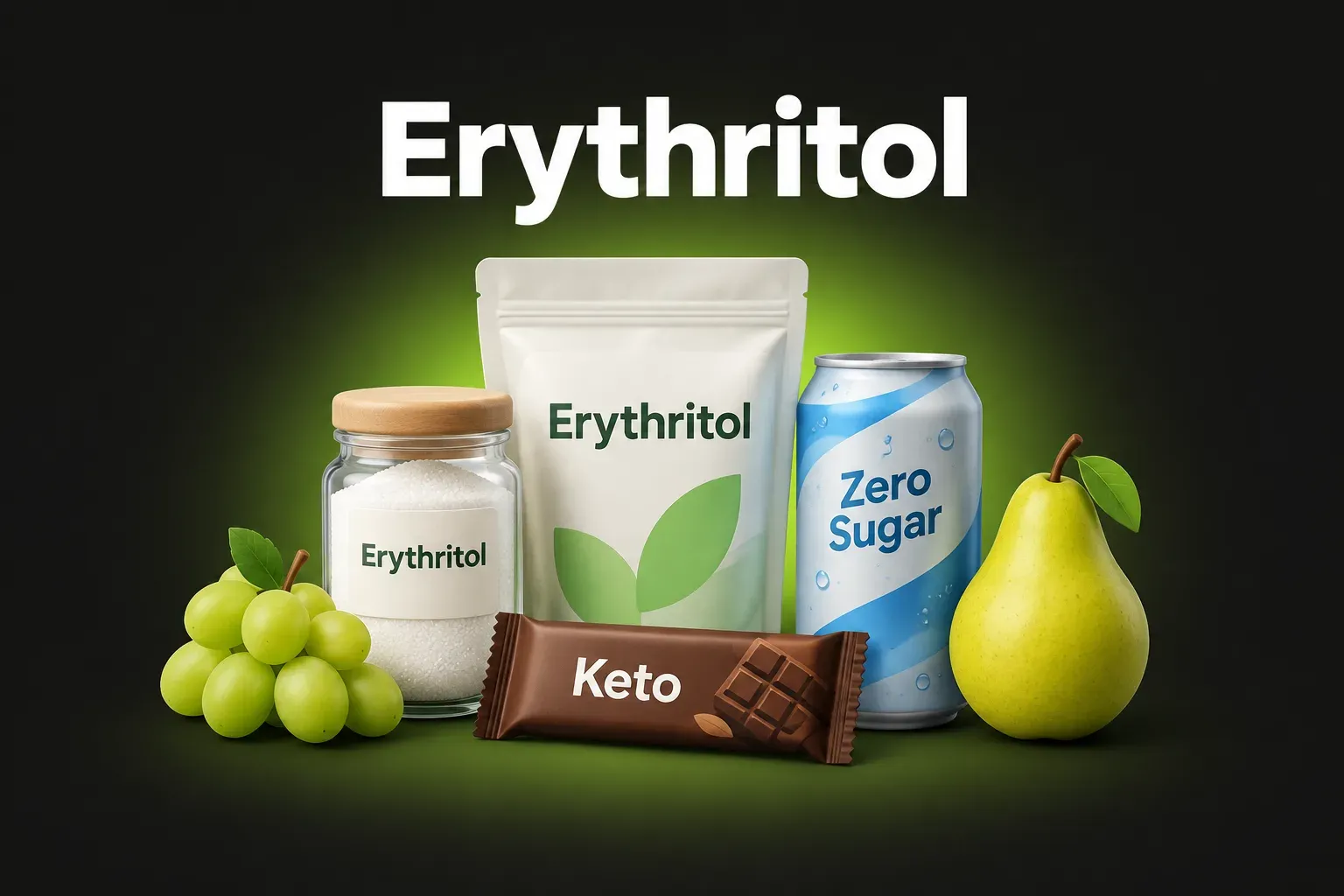
Erythritol is the sweetener behind many keto, “zero sugar” and “sugar-free” products – and it’s often the main ingredient in stevia and monk fruit sweetener blends. It has almost no calories, doesn’t raise blood sugar and doesn’t cause cavities. For years it was considered one of the safest sweeteners. Then, in 2023, a study linked it to heart attacks and strokes.
The short answer: erythritol has almost no calories and a glycemic index of zero. But studies from the Cleveland Clinic found that people with more erythritol in their blood had more heart attacks, strokes and deaths. And 30 g of erythritol made the blood of healthy volunteers clot more easily. Lab studies also found harmful effects on the cells lining brain blood vessels. This isn’t proof that erythritol causes heart disease. But it’s a good reason to use it sparingly, especially if you have heart disease, diabetes or other risk factors.
What is erythritol?
Erythritol is a sugar alcohol (polyol), like xylitol and sorbitol. Small amounts occur naturally in grapes, pears, melons, mushrooms and fermented foods like wine, soy sauce and cheese. Your body makes a little too. The erythritol you buy is made in factories: yeast is fed glucose from corn or wheat.
| Erythritol | Sugar | |
|---|---|---|
| Sweetness | about 60–70% of sugar | 100% |
| Calories | about 0.2 per gram (0 on EU labels) | 4 per gram |
| Glycemic index | 0 | 65 |
| Causes cavities | No | Yes |
About 90% of erythritol passes into the blood and leaves the body unchanged in urine within a day or two. That’s why it causes fewer stomach problems than other sugar alcohols. But it’s also why large amounts reach the blood.
On labels, you’ll see it as erythritol or E968 (“sweetener: E968”).
Where you’ll find erythritol
- Tabletop sweeteners, including many “stevia” and “monk fruit” products, where erythritol is often the main ingredient by weight
- Keto and low-carb products: bars, cookies, chocolate, ice cream, baking mixes
- “Zero sugar” drinks and flavored waters
- Sugar-free candy and chewing gum
- Protein bars and shakes
Erythritol and heart health: what the research says
Higher blood levels, more heart attacks and strokes
In 2023, researchers at the Cleveland Clinic measured erythritol in the blood of over 4,000 people in the US and Europe. These people were being checked for heart disease. Over three years, those with the most erythritol had about twice the risk of a heart attack, stroke or death (Witkowski et al., Nature Medicine, 2023).
In the same study, erythritol made platelets – the blood cells that form clots – stickier in the lab. In mice, it led to more clots. And when healthy volunteers had a drink with 30 g of erythritol, their blood levels rose more than 1,000 times and stayed high for over two days.
Clotting in healthy people
In a 2024 follow-up, 20 healthy volunteers drank either 30 g of erythritol or 30 g of glucose. After erythritol, every single person’s blood clotted more easily. After glucose, nothing changed (Witkowski et al., Arteriosclerosis, Thrombosis, and Vascular Biology, 2024). 30 g is about the amount in a pint of keto ice cream or a large sweetened drink.
Brain blood vessels
In a 2025 lab study, researchers used the amount of erythritol in one sweetened drink. It damaged human cells that line brain blood vessels. It also lowered a substance that keeps blood vessels relaxed and one that breaks down clots. The authors say this could help explain the higher stroke risk (Berry et al., Journal of Applied Physiology, 2025).
What these studies do and don’t show
It’s important to be fair about the limits:
- The first study measured erythritol in the blood, and the body makes some of it too. People with diabetes or obesity naturally make more. So it shows a link, not proof that erythritol from food causes heart attacks.
- The clotting studies were small and short-term.
- The brain study was done on cells in the lab.
But the evidence comes from different kinds of studies – people, blood tests, mice and cells – and points the same way. Testing for years whether erythritol causes heart attacks in people would put their health at risk. So these are the best signals we have. Until more is known, it’s sensible to be careful.
Digestive side effects
Because most erythritol passes into the blood, it’s easier on the stomach than other sugar alcohols. But large amounts can still cause bloating, gas, nausea and diarrhea. In the EU, products with more than 10% added polyols must carry the warning “excessive consumption may produce laxative effects”.
How much erythritol is safe?
In 2023, the European Food Safety Authority (EFSA) set a safe daily limit of 0.5 g per kg of body weight, because of its laxative effect. That’s about 35 g a day for a 70 kg adult. EFSA also noted that children and teenagers who eat a lot of erythritol-sweetened foods could go over this limit (EFSA, 2023).
Given the heart studies, it makes sense to stay well below this limit and to avoid large amounts at once – like a whole drink, a pint of keto ice cream or several keto bars in one sitting.
Erythritol vs other sweeteners
| Sweetener | Calories | Raises blood sugar | Main concerns |
|---|---|---|---|
| Erythritol | ~0.2 kcal/g | No | Platelet clotting, heart and stroke risk in studies; laxative in large amounts |
| Allulose | ~0.4 kcal/g | No | Bloating; few long-term studies; not allowed in the EU |
| Stevia | 0 | No | Few concerns; often mixed with erythritol |
| Xylitol | 2.4 kcal/g | Slightly | Blood clotting and heart risk in studies; toxic to dogs |
| Sucralose | 0 | No, but may affect insulin | Gut bacteria, DNA damage in lab tests, heating |
| Aspartame | ~0 | No | Possible cancer risk (WHO) |
| Sugar | 4 kcal/g | Yes | Weight gain, tooth decay, diabetes |
How to use erythritol more safely
- Use small amounts – a teaspoon in coffee or tea, not 30 g at once.
- Read labels on “stevia” and “monk fruit” sweeteners – many are mostly erythritol. Look for pure stevia or monk fruit drops if you want to avoid it.
- Limit keto desserts and zero sugar drinks, which can contain large amounts.
- Be extra careful if you have heart disease, diabetes or a history of blood clots or stroke – talk to your doctor.
- Get used to less sweetness – your taste buds adjust in a few weeks.
Spot erythritol on any label in seconds. With NutriSmart, you photograph the ingredient list or scan the barcode, and the app tells you right away if the product has erythritol. Turn on an alert for it, and the app warns you every time a product you scan contains it. You’ll also see every other additive, the risks of each one and a health score out of 100.Get the app free
You can also read about other sweeteners: allulose, sucralose and aspartame. Read our overview of all sugar alcohols, and find out whether Monster is bad for you.
Compare all sweeteners and their NutriSmart ratings in our full list of artificial sweeteners.
The bottom line
Erythritol has almost no calories and doesn’t raise blood sugar, which made it popular in keto and zero sugar foods. But since 2023, studies have linked more erythritol in the blood to heart attacks and strokes. They also showed that 30 g makes healthy people’s blood clot more easily. It isn’t proven to cause heart disease. But using it sparingly, and avoiding large amounts at once, is the safer choice.
FAQ
Is erythritol bad for you?
It has almost no calories and doesn't raise blood sugar, but research since 2023 has raised concerns. People with more erythritol in their blood had more heart attacks and strokes. And in small studies, a drink with 30 g of erythritol made healthy people's blood clot more easily. These studies don't prove it causes heart problems, but it's wise to limit it, especially if you have heart disease or diabetes.
Does erythritol raise blood sugar or insulin?
No. Erythritol has a glycemic index of about zero and doesn't raise blood sugar or insulin, which is why it's popular in keto and diabetic-friendly products.
Is erythritol natural?
Small amounts occur naturally in fruits like grapes, pears and melons, and in fermented foods like wine, soy sauce and cheese. Your body also makes a little. But the erythritol sold as a sweetener is made in factories by fermenting glucose with yeast.
How much erythritol is safe?
In 2023, the European Food Safety Authority set a safe daily limit of 0.5 g per kg of body weight, because of its laxative effect. That's about 35 g for a 70 kg adult. Because of the heart studies, it's sensible to stay well below that. Avoid large amounts at once, such as a whole drink or dessert with 30 g or more.
Does erythritol cause digestive problems?
Less than other sugar alcohols, because about 90% passes into the blood and leaves the body in urine. But large amounts can still cause bloating, gas, nausea and diarrhea. That's why products in the EU must warn that too much may have a laxative effect.
What is E968?
E968 is the European code for erythritol. On labels you'll see it as "erythritol", "sweetener: E968" or as part of sweetener blends with stevia or monk fruit.