Sugar Alcohols: Are They Bad for You? A Simple Guide
What sugar alcohols like erythritol, xylitol, sorbitol and maltitol are, their calories and blood sugar effects, side effects, and new heart studies.
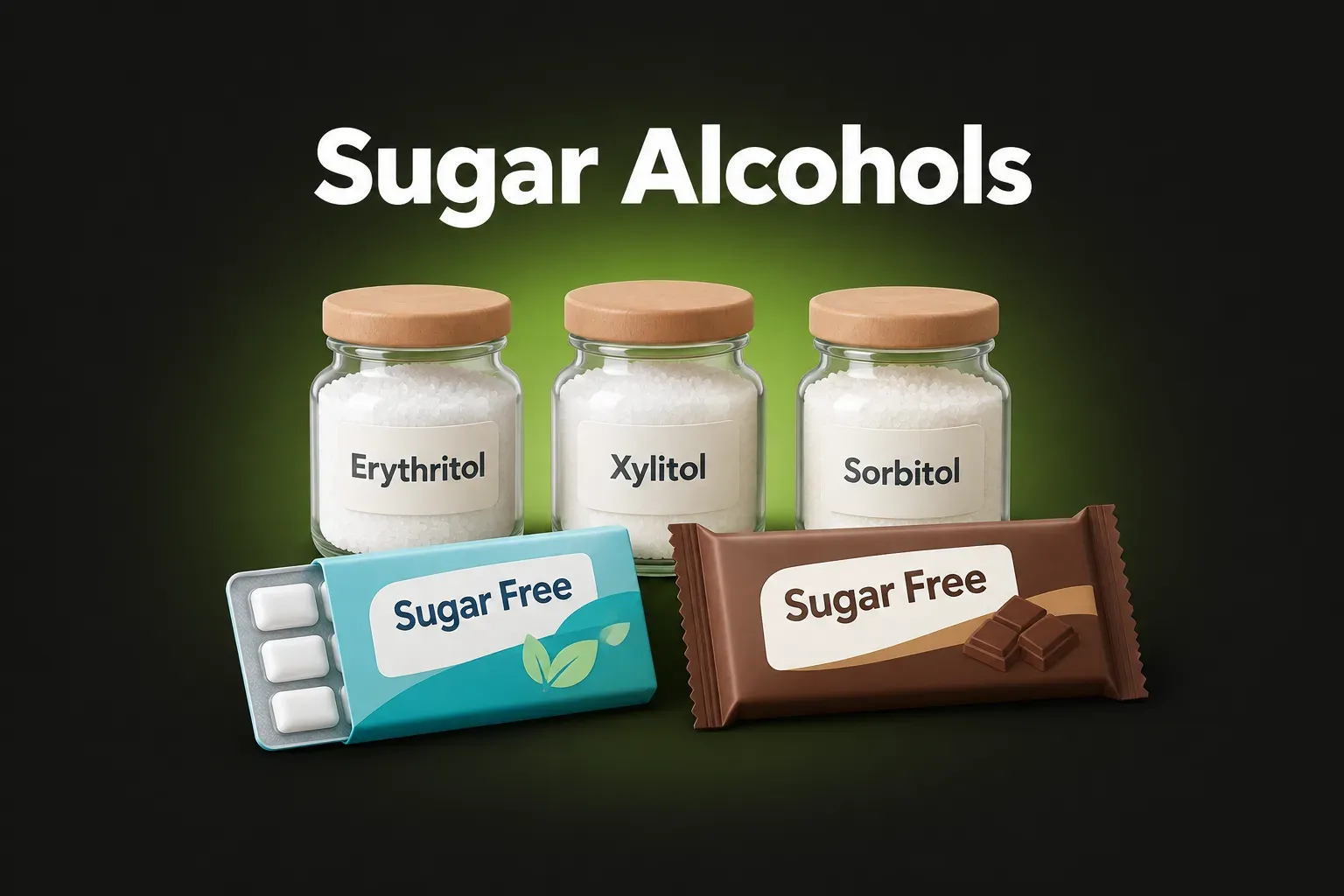
Sugar alcohols are in sugar-free gum, “no sugar added” chocolate, keto snacks, protein bars and even toothpaste. They let companies say “sugar-free” while keeping the sweet taste. But they come with side effects – and two of them have recently been linked to heart problems.
The short answer: sugar alcohols (polyols) like erythritol, xylitol, sorbitol and maltitol have fewer calories than sugar and raise blood sugar less. In larger amounts they often cause bloating, gas and diarrhea. Newer studies found that people with more erythritol or xylitol in their blood had a higher risk of heart attack and stroke, and both made blood clot more easily in healthy volunteers. Small amounts are fine for most people, but they’re not a free pass.
What are sugar alcohols?
Sugar alcohols are sweeteners made from sugars or starches. Their shape is partly like sugar and partly like alcohol. But they don’t contain alcohol and can’t make you drunk. Some are found in small amounts in fruit, like sorbitol in apples and pears. The ones added to food are made in factories.
Your body absorbs only part of them. That’s why they have fewer calories and raise blood sugar less than sugar. It’s also why they cause gut trouble: the rest goes to the large intestine. There it pulls in water, and gut bacteria break it down and make gas.
On labels you’ll see their names, E numbers or simply “polyols” or “sugar alcohols”.
The main sugar alcohols compared
| Sugar alcohol | E number | Calories per gram | Sweetness vs sugar | Blood sugar effect | NutriSmart risk |
|---|---|---|---|---|---|
| Erythritol | E968 | about 0.2 | 60–70% | almost none | High |
| Xylitol | E967 | 2.4 | about 100% | very low | High |
| Sorbitol | E420 | 2.6 | about 60% | low | Medium |
| Maltitol | E965 | 2.1 | about 90% | medium | Low |
| Isomalt | E953 | 2.0 | about 50% | low | Low |
| Mannitol | E421 | 1.6 | about 60% | very low | Low |
| Lactitol | E966 | 2.0 | about 35% | very low | Low |
Calories per gram are the values used by the US FDA; in the EU, all polyols except erythritol count as 2.4 kcal per gram and erythritol as 0. Table sugar has 4 kcal per gram.
Where you’ll find sugar alcohols
- Sugar-free gum and mints – often xylitol, sorbitol or maltitol
- “Sugar-free” and “no sugar added” chocolate and candy – usually maltitol or isomalt
- Keto and low-carb snacks, protein bars and ice cream – often erythritol
- Zero-calorie sweetener blends – many “stevia” and “monk fruit” sweeteners are mostly erythritol
- Toothpaste, mouthwash and cough syrups
- Diabetic foods and baked goods
Are sugar alcohols bad for you? What the research says
Gut side effects
This is the most common problem. From about 10–20 g of sorbitol a day, or 20–30 g of xylitol at once, many people get bloating, gas and diarrhea. People with irritable bowel syndrome (IBS) are often more sensitive. Sorbitol and mannitol belong to the FODMAPs, a group of carbs that are hard to digest – read about the low FODMAP diet. Doctors have even reported patients with months of diarrhea and weight loss caused by sugar-free gum with sorbitol (Bauditz et al., BMJ, 2008).
That’s why, in the EU, foods with more than 10% polyols must say that eating too much “may have laxative effects”.
Erythritol and the heart
Researchers at the Cleveland Clinic measured erythritol in the blood of over 4,000 people. Those with the highest levels had about twice the risk of a heart attack, stroke or death over three years. In healthy volunteers, a drink with 30 g of erythritol made platelets form clots more easily, and blood levels stayed high for over two days (Witkowski et al., Nature Medicine, 2023).
Xylitol and the heart
The same team found that people with more xylitol in their blood had a 57% higher risk of heart attack, stroke or death. A xylitol drink also made platelets clot more easily in healthy volunteers (Witkowski et al., European Heart Journal, 2024).
These studies show links, not proof. Our bodies also make small amounts of erythritol and xylitol. But the clotting tests in volunteers point the same way. That’s why NutriSmart rates both at its highest risk level.
Blood sugar
Most sugar alcohols raise blood sugar only a little, which is why they’re popular with people who have diabetes. Maltitol is the exception: it raises blood sugar about half as much as sugar. A “sugar-free” chocolate bar made with maltitol can still push your blood sugar up. Read more about low glycemic index foods.
Dogs
Xylitol is toxic to dogs. Even small amounts can cause a dangerous drop in blood sugar and liver failure. Keep sugar-free gum, candy and some peanut butters away from pets.
Sugar alcohols and “net carbs”
Many keto products show “net carbs”: total carbs minus fiber and sugar alcohols. That’s roughly fair for erythritol, which your body barely uses. But your body partly digests maltitol, sorbitol and isomalt. If you subtract them all, the product looks lower in carbs than it really is. If you follow the keto diet, check which sugar alcohol is used.
How to use sugar alcohols wisely
- Read the ingredient list – look for names ending in “-itol”, “isomalt” and E420, E421, E953, E965, E966, E967 and E968.
- Keep portions small – one or two pieces of sugar-free candy, not the whole bag.
- Be careful with erythritol-heavy sweeteners – many “zero-calorie” blends are mostly erythritol. Read about stevia, monk fruit and allulose.
- Don’t treat “sugar-free” as “healthy” – sugar-free chocolate still has plenty of fat and calories.
- If you have IBS, try avoiding sorbitol and mannitol for a while and see if you feel better.
Spot sugar alcohols on any label in seconds. With NutriSmart, you photograph the ingredient list or scan the barcode, and the app tells you right away which sugar alcohols the product has – erythritol, xylitol, sorbitol, maltitol and the rest. Turn on an alert for the ones you want to avoid, and the app warns you every time a product you scan contains them. You’ll also see every other additive, the risks of each one and a health score out of 100.Get the app free
You can also read our guide to artificial sweeteners.
The bottom line
Sugar alcohols like erythritol, xylitol, sorbitol and maltitol have fewer calories than sugar and raise blood sugar less. But in larger amounts they cause bloating, gas and diarrhea, and maltitol still raises blood sugar quite a bit. New studies linked erythritol and xylitol to a higher risk of heart attack and stroke and to faster blood clotting. Enjoy sugar-free products in small amounts, and don’t use them as an excuse to eat more.
FAQ
What are sugar alcohols?
Sugar alcohols (also called polyols) are sweeteners made from sugars. Common ones are erythritol, xylitol, sorbitol, maltitol, isomalt, mannitol and lactitol. They taste sweet but have fewer calories than sugar and raise blood sugar less. They don't contain alcohol like beer or wine.
Are sugar alcohols bad for you?
In small amounts most people handle them fine, but larger amounts often cause bloating, gas and diarrhea. Two of them have raised new concerns: in large studies, people with more erythritol or xylitol in their blood had a higher risk of heart attack and stroke, and both made blood clot more easily in volunteers. NutriSmart rates erythritol and xylitol at its highest risk level, sorbitol at medium and the others at low.
Do sugar alcohols raise blood sugar?
Most raise it only a little. Erythritol barely raises it at all. Maltitol raises it the most – about half as much as sugar – so "sugar-free" chocolate made with maltitol isn't free from blood sugar effects.
Do sugar alcohols count as carbs?
On US labels they're listed under total carbohydrates. Many low-carb and keto brands subtract them to show "net carbs". That's roughly fair for erythritol, but not for maltitol, which is partly digested.
Why do sugar alcohols cause diarrhea?
Your gut absorbs only part of them. The rest pulls water into the bowel and is fermented by gut bacteria, which causes gas, bloating and loose stools. In the EU, foods with more than 10% polyols must warn that eating too much may have a laxative effect.
Are sugar alcohols safe for dogs?
Xylitol is very dangerous for dogs: even a small amount can cause a sudden drop in blood sugar and liver failure. Keep sugar-free gum, candy and peanut butter with xylitol away from pets.