Monk Fruit Sweetener: Is It Healthy? Pros, Cons & Safety
What monk fruit sweetener is, how it affects blood sugar, why most monk fruit products are mostly erythritol, what studies show and whether it's allowed in the EU.
Monk fruit sweetener is often sold as the most “natural” sugar substitute: zero calories, no effect on blood sugar, and made from a fruit. It’s in keto products, sugar-free syrups and many tabletop sweeteners. But as with stevia, what’s in the bag is often mostly something else.
The short answer: pure monk fruit extract has no calories, a glycemic index of zero and, in studies so far, few side effects. But there are few long-term studies in people. And most monk fruit sweeteners are mostly erythritol, which recent studies have linked to blood clots and heart risk. In a study with people, the calories saved by switching to monk fruit were fully made up for at the next meal. In the EU, only one specific extract is approved.
What is monk fruit?
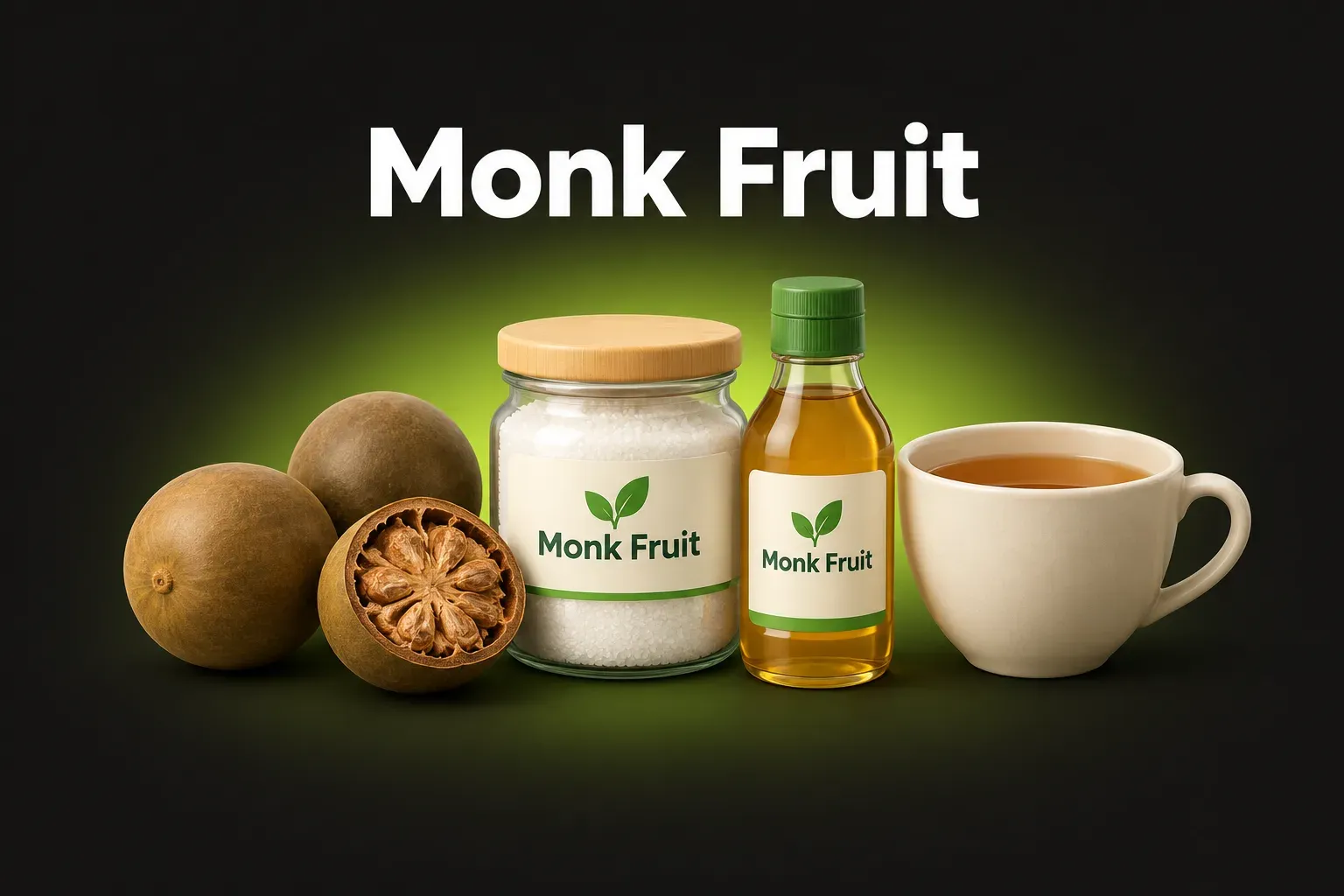
Monk fruit – also called luo han guo – is a small, round green melon from southern China, named after the Buddhist monks who first grew it. It has been used in traditional Chinese medicine for centuries, usually dried and boiled into a tea.
Its sweetness comes from substances called mogrosides, mainly mogroside V, which is about 150–250 times sweeter than sugar. To make monk fruit sweetener, the fruit is crushed and soaked in water. The juice is then cleaned to keep mostly the mogrosides.
| Monk fruit extract | Sugar | |
|---|---|---|
| Sweetness | 150–250 times sweeter | 1× |
| Calories | 0 | 4 per gram |
| Glycemic index | 0 | 65 |
| Causes cavities | No | Yes |
| Taste | Sweet, sometimes a fruity aftertaste | Sweet |
On labels, you’ll see it as monk fruit extract, luo han guo extract, mogrosides or Siraitia grosvenorii extract.
Read the label: most “monk fruit” is mostly erythritol
Because monk fruit extract is so sweet, a product made only of it would be a few grains per spoon. To make it look and measure like sugar, brands add a filler:
- Erythritol – by far the most common, often over 90% of the product. Recent studies have linked it to blood clots and a higher risk of heart attack and stroke.
- Allulose – fewer concerns, but not approved in the EU.
- Dextrose – which raises blood sugar.
If you want pure monk fruit, look for liquid drops or a powder that lists only monk fruit extract.
Is monk fruit healthy? What the research says
Blood sugar and insulin
In a study in Singapore, 30 healthy men had drinks sweetened with monk fruit, stevia, aspartame or sugar. Monk fruit didn’t raise blood sugar or insulin, unlike sugar (Tey et al., International Journal of Obesity, 2017).
But it didn’t cut total calories
In the same study, after the sweetener drinks, the men ate more at lunch. It was enough to fully make up for the calories saved by not drinking sugar. By the end of the day, total calories were the same as after the sugar drink. This matches the World Health Organization’s 2023 advice not to rely on sweeteners for weight control (WHO, 2023).
Possible benefits in animal studies
In animal and lab studies, mogrosides protected cells, lowered blood sugar and calmed inflammation (Feng et al., Nutrients, 2026). These results are promising, but haven’t been confirmed in people.
What we don’t know
Monk fruit extract has been used as a sweetener in the West only since the 2010s. There are no long-term studies on its effects on gut bacteria, appetite or health when eaten daily for years. Other sweeteners once seen as harmless, like sucralose and erythritol, later raised concerns. So it’s wise not to use too much.
Is monk fruit allowed in the EU?
Only partly. In the US, the FDA has accepted pure monk fruit extracts as generally recognized as safe since 2010. In the EU, sweeteners need approval first. In 2024, the EU allowed only one specific monk fruit extract made with water. Very pure mogroside extracts – the kind used in most US products – are still not approved, mostly because safety data is missing (review in PMC, 2025).
Monk fruit vs other sweeteners
| Sweetener | Calories | Raises blood sugar | Main concerns |
|---|---|---|---|
| Monk fruit | 0 | No | Few long-term studies; often mixed with erythritol |
| Stevia | 0 | No | Few; aftertaste; often mixed with erythritol |
| Erythritol | ~0.2 kcal/g | No | Blood clotting and heart risk in studies |
| Allulose | ~0.4 kcal/g | No | Bloating; not allowed in the EU |
| Sucralose | 0 | No, but may affect insulin | Gut bacteria, DNA damage in lab tests |
| Aspartame | ~0 | No | Possible cancer risk (WHO) |
How to use monk fruit well
- Check the ingredients – choose products with monk fruit extract only, or with allulose rather than erythritol.
- Use liquid drops for coffee, tea and yogurt – they’re usually pure.
- Don’t expect it to help you lose weight on its own – you may make up the calories elsewhere.
- Use it to reduce sugar, not to eat more sweets.
- Avoid it if you’re allergic to melons, cucumbers or pumpkins, which belong to the same plant family.
Spot monk fruit on any label in seconds. With NutriSmart, you photograph the ingredient list or scan the barcode, and the app tells you right away if the product has monk fruit. Turn on an alert for it, and the app warns you every time a product you scan contains it. You’ll also see every other additive, the risks of each one and a health score out of 100.Get the app free
You can also read about other sweeteners: stevia, erythritol and allulose.
Compare all sweeteners and their NutriSmart ratings in our full list of artificial sweeteners.
The bottom line
Pure monk fruit extract has no calories, doesn’t raise blood sugar and has few known side effects. That makes it one of the better sweeteners. But most monk fruit products are mostly erythritol, and long-term studies are missing. And in a study with people, the calories saved were made up at the next meal. Read the label, choose pure monk fruit or allulose blends, and use it to need less sweetness, not more.
FAQ
What is monk fruit?
Monk fruit (luo han guo) is a small round melon from southern China. Its sweetness comes from substances called mogrosides, which are 150–250 times sweeter than sugar. Monk fruit sweetener is an extract of these mogrosides, usually mixed with other ingredients.
Is monk fruit sweetener healthy?
Pure monk fruit extract has no calories, doesn't raise blood sugar and has few known side effects. But there are few long-term studies in people. And most monk fruit products are mostly erythritol, which recent studies have linked to blood clots and heart risk. Check the label.
Does monk fruit raise blood sugar or insulin?
No. In a study of healthy men, a drink sweetened with monk fruit didn't raise blood sugar or insulin, unlike the same drink with sugar. Monk fruit extract has a glycemic index of zero.
Why is there erythritol in monk fruit sweetener?
Monk fruit extract is so sweet that only a tiny amount is needed. To make a product that looks and measures like sugar, most brands mix it with erythritol, which often makes up over 90% of the product. Some use allulose or dextrose instead.
Is monk fruit allowed in the EU?
Only partly. In 2024, the EU allowed one specific monk fruit extract made with water, as a new food. Very pure mogroside extracts – the kind used in most US products – are still not approved in the EU.
Does monk fruit have side effects?
Pure monk fruit extract rarely causes side effects. Some people notice an aftertaste. Bloating or diarrhea usually comes from the erythritol or other sugar alcohols added to monk fruit products. Allergies are rare, but possible in people allergic to related plants, like melons and pumpkins.