Azodicarbonamide in Bread: Is It Safe? Why It's Banned
What azodicarbonamide (ADA, E927a) is, why it's in US bread and buns, what it turns into when baked, why it's banned in the EU and UK, and how to avoid it.
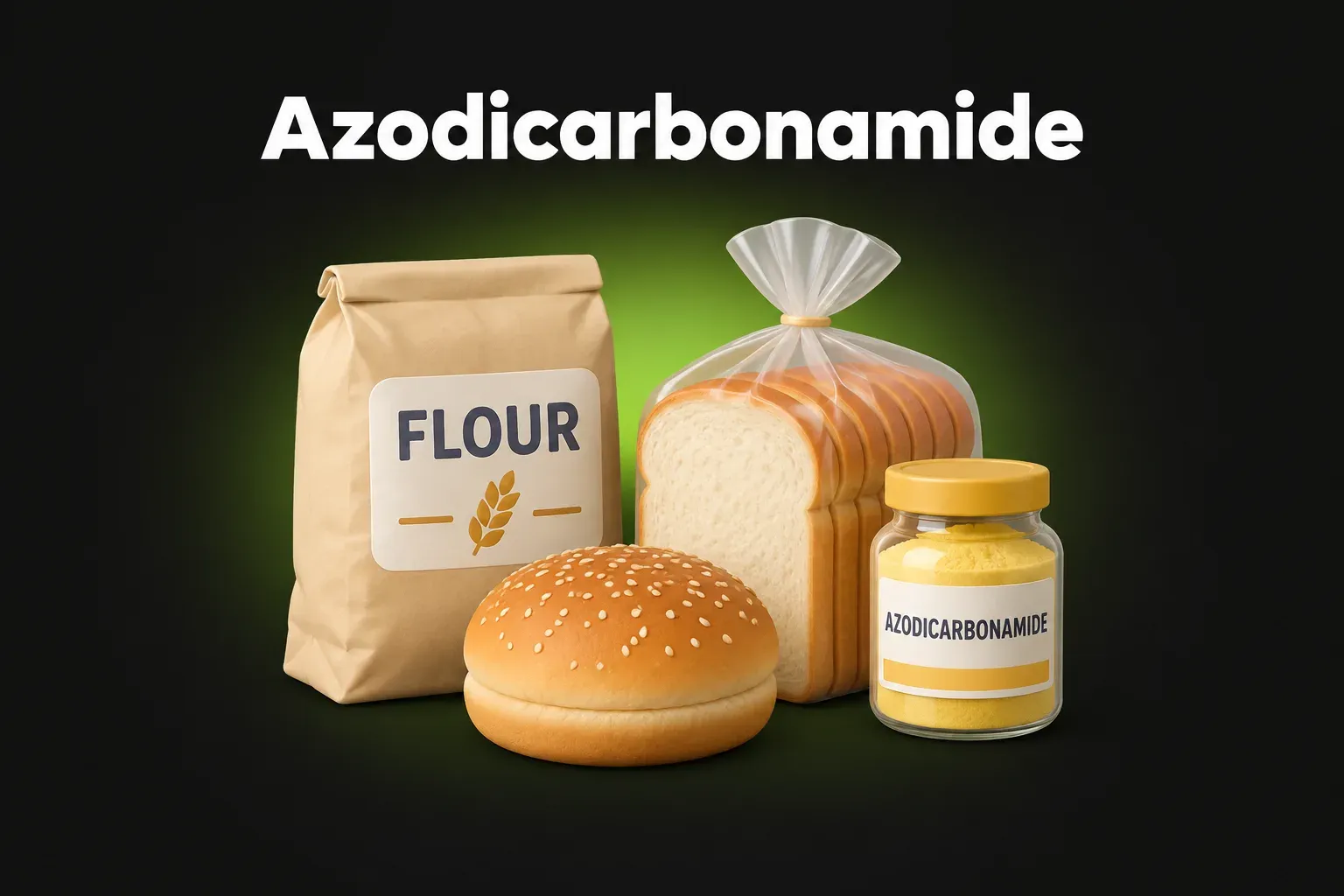
Azodicarbonamide – often shortened to ADA – is a flour additive you’ll find on the ingredient list of many American breads, buns and rolls. It became famous in 2014 as the “yoga mat chemical”, when it turned out the same substance is used to make foam plastics. It’s allowed in the US, but banned in the EU, the UK and Australia. So is it safe?
The short answer: azodicarbonamide is a chemical that whitens flour and makes dough stronger, for softer, fluffier bread. The FDA allows up to 45 mg per kg of flour. The concern is what it turns into when bread is baked: small amounts of urethane, which the WHO’s cancer agency classifies as probably carcinogenic, and semicarbazide, which caused tumors in mice at high doses. The amounts in bread are small, but bakers don’t need it – there are safer alternatives. NutriSmart rates it as moderate risk.
What is azodicarbonamide?
Azodicarbonamide is a yellow-orange powder made in factories. It has two very different uses:
- In flour (food): it’s a flour treatment agent. It whitens flour and strengthens the gluten network, so dough handles better in machines and bread rises higher and stays soft. In the EU, its code would be E927a, but it isn’t allowed there.
- In plastics (industry): it’s a blowing agent that releases gas when heated, making foam for yoga mats, shoe soles, flooring and gaskets.
In wet dough, ADA quickly changes into biurea, which the body mostly passes out. But during baking, small amounts of two other substances can form: semicarbazide and urethane (ethyl carbamate).
Which foods contain azodicarbonamide?
In the US, it’s found mainly in:
- White sandwich bread and soft rolls
- Hamburger and hot dog buns
- Fast-food and sandwich-chain breads
- Frozen bread, pizza dough and some flour tortillas
- Packaged pastries and some bagels
Many big brands and chains removed it after the 2014 controversy, but it’s still used. The only way to know is to read the ingredient list.
Is azodicarbonamide bad for you?
Urethane (ethyl carbamate)
When FDA scientists added ADA at the legal maximum (45 mg/kg), commercial breads had more urethane – an increase of 1–3 micrograms per kg – and toasting increased it further (Cañas et al., Food Additives and Contaminants, 1997). A UK study found the same at 45 mg/kg (Dennis et al., Food Additives and Contaminants, 1997). Urethane is classified by the WHO’s cancer agency (IARC) as “probably carcinogenic to humans” (Group 2A), based on tumors in animals.
Semicarbazide
Health Canada scientists found that semicarbazide forms when ADA-treated flour is heated, reaching levels similar to those in the crust of bread baked with it (Becalski et al., Journal of Agricultural and Food Chemistry, 2004). In Canadian bakery products, levels varied more than tenfold between batches of the same product, suggesting that bakeries don’t always dose ADA consistently (Becalski et al., Food Additives and Contaminants, 2006).
Semicarbazide caused tumors in mice at high doses. The European Food Safety Authority concluded that the amounts found in food aren’t a major concern for cancer, but it still supported removing its sources where possible (EFSA, 2005). In 2005, the EU banned ADA in the seals of glass jar lids, after it was found to release semicarbazide into foods like baby food.
Why NutriSmart rates it moderate risk
The amounts of urethane and semicarbazide from bread are small, and the strongest evidence comes from animal studies of the by-products, not of ADA itself. That’s why NutriSmart rates it moderate, not high like potassium bromate. But ADA has no nutritional benefit, it adds a probable carcinogen to bread, and bakers in Europe make soft bread without it – so there’s no good reason to eat it.
Workers who handle ADA powder can develop asthma from breathing it in. This is a workplace risk, not a risk from eating bread.
Where is azodicarbonamide banned?
| Country | Status |
|---|---|
| European Union | Not allowed in food |
| United Kingdom | Not allowed in food |
| Australia and New Zealand | Not allowed in food |
| United States | Allowed, up to 45 mg/kg of flour |
| Canada | Allowed, up to 45 mg/kg of flour |
In 2014, a public petition led Subway to remove ADA from its bread, and many other US chains and bakeries followed. Some US states have proposed bills to ban it, together with other additives.
How to avoid azodicarbonamide
- Read the ingredient list – look for “azodicarbonamide” in bread, buns, rolls and tortillas.
- Choose bread with short ingredient lists – flour, water, yeast, salt and maybe oil.
- Look for “unbleached” or “unbromated” flour and bakery bread.
- Ascorbic acid (vitamin C) is a common, harmless alternative used to strengthen dough.
- Organic bread in the US can’t contain ADA.
Check any bread in seconds. With NutriSmart, you scan the barcode or photograph the ingredient list, and the app flags azodicarbonamide, potassium bromate and other additives, explains each one and gives the product a health score out of 100.Get the app free
See our guide to the healthiest bread and our E numbers list.
The bottom line
Azodicarbonamide is a flour additive that makes US bread softer and whiter. It’s allowed in the US and Canada but not in the EU, the UK or Australia. During baking it forms small amounts of urethane, a probable carcinogen, and semicarbazide, which caused tumors in mice at high doses. The amounts are small, which is why NutriSmart rates it moderate risk – but it adds nothing good to bread, so choosing breads without it is easy and sensible.
FAQ
What is azodicarbonamide?
Azodicarbonamide (ADA) is a chemical added to flour as a whitening and dough-conditioning agent. It makes dough stronger and more elastic, so bread rises better and is softer. It's also used to make foamed plastics, which is why it's been called the "yoga mat chemical".
Is azodicarbonamide safe to eat?
The FDA allows it up to 45 mg per kg of flour. But during baking, part of it turns into semicarbazide and urethane. Urethane is classified as probably carcinogenic, and semicarbazide caused tumors in mice at high doses. The amounts in bread are small, but the EU, UK and Australia don't allow it, and NutriSmart rates it as moderate risk.
Why is azodicarbonamide banned in Europe?
It was never approved as a flour additive in the EU, and it's not allowed in the UK or Australia either. In 2005, the EU also banned it in food packaging seals, after it was found to release semicarbazide into foods like baby food in jars.
Which foods contain azodicarbonamide?
In the US, mainly white bread, hamburger and hot dog buns, sandwich rolls, frozen bread and pizza dough, tortillas and some fast-food breads. Check the ingredient list for "azodicarbonamide".
Is azodicarbonamide the same as a yoga mat?
No. The same chemical is used, in much larger amounts, to make foam plastics like yoga mats and shoe soles. That doesn't make bread a yoga mat – but it's an additive that bakeries don't need, since there are alternatives like ascorbic acid.
Did Subway remove azodicarbonamide?
Yes. In 2014, after a public petition, Subway said it would remove azodicarbonamide from its bread, and many other US bakeries and chains followed.