DATEM (E472e) in Bread: What It Is and Is It Safe?
What DATEM (E472e) is, why it's in sandwich bread, buns and tortillas, what a large study found about type 2 diabetes, and how to avoid it.
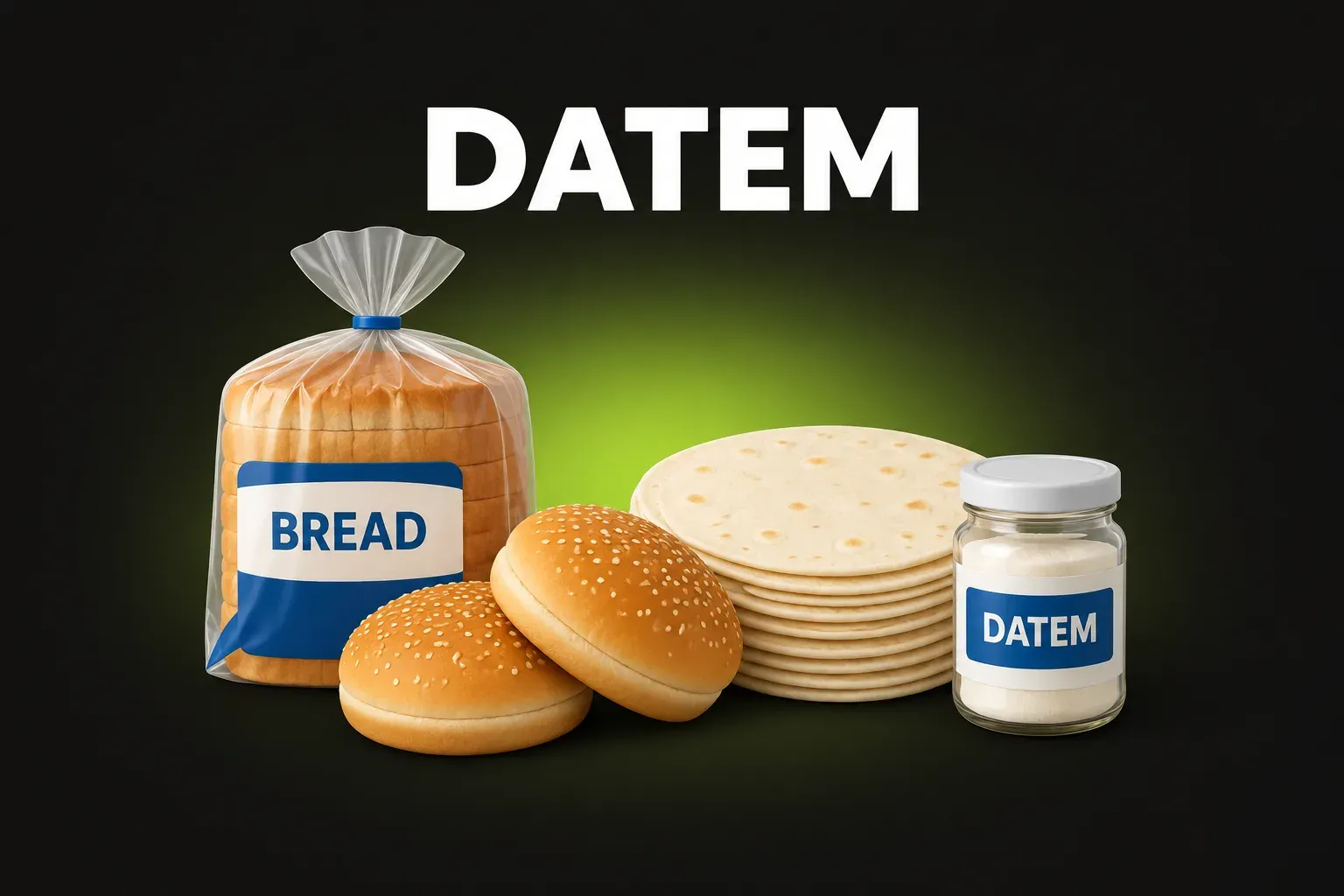
DATEM is a short name you’ll see on many packaged breads, buns, rolls and tortillas. It’s one reason supermarket bread is so soft, tall and uniform. Here’s what it is and what newer research suggests.
The short answer: DATEM (E472e) stands for diacetyl tartaric acid esters of mono- and diglycerides. It’s an emulsifier and dough conditioner made from fats and tartaric acid. It strengthens dough, so bread rises higher and stays soft. It’s approved, but a large French study linked higher intake to a slightly higher risk of type 2 diabetes, and emulsifiers as a group may affect gut bacteria. NutriSmart rates it as moderate risk.
What is DATEM?
DATEM is made from mono- and diglycerides (fat molecules, usually from vegetable oils) combined with tartaric acid (the acid in grapes) and acetic acid. It belongs to the family of E472 emulsifiers, together with lactic, citric and acetic acid esters.
In bread dough, DATEM strengthens the gluten network and helps it trap gas. That means:
- taller loaves with a more even, fine crumb;
- dough that handles better in bakery machines;
- bread that stays softer for longer.
On labels: DATEM, diacetyl tartaric acid esters of mono- and diglycerides, mono- and diacetyl tartaric acid esters of mono- and diglycerides of fatty acids or E472e.
Which foods contain DATEM?
- Sandwich bread and soft white or wheat loaves
- Hamburger and hot dog buns, rolls and bagels
- Flour tortillas and wraps
- Frozen dough and par-baked bread
- Crackers, cakes and some cookies
- Coffee creamers and some dairy desserts
Is DATEM safe? What the research says
A link with type 2 diabetes
In the French NutriNet-Santé study, researchers followed more than 100,000 adults for about seven years and tracked the emulsifiers in their diets using brand-specific data. People who ate more DATEM (E472e) had a slightly higher risk of type 2 diabetes – about 4% higher for each extra 100 mg a day. Several other emulsifiers, including carrageenan, xanthan gum, guar gum and sodium citrate, showed similar links (Salame et al., The Lancet Diabetes & Endocrinology, 2024).
This is an observational study, so it can’t prove that DATEM causes diabetes. People who eat lots of packaged bread may also differ in other ways. The researchers called for more research and a re-evaluation of emulsifier rules.
Gut bacteria
Lab and animal studies show that some emulsifiers can change gut bacteria and weaken the gut’s protective mucus layer – most clearly for polysorbate 80 and carboxymethylcellulose. DATEM itself has been studied much less, so we can’t say whether it does the same.
Why NutriSmart rates it moderate risk
There’s no proof of harm, but there’s an early signal from a large human study and open questions about emulsifiers and the gut. Like other E472 esters and mono- and diglycerides, DATEM gets a moderate rating.
How to find bread without DATEM
- Read the ingredient list – look for DATEM or E472e, and other dough conditioners like mono- and diglycerides, azodicarbonamide or potassium bromate.
- Choose bakery bread or sourdough with short ingredient lists – flour, water, yeast or starter, salt.
- Try corn tortillas – they usually contain just corn, water and lime.
- Freeze good bread in slices – it keeps fresh without additives.
Check any bread in seconds. With NutriSmart, you scan the barcode or photograph the ingredient list, and the app finds DATEM and every other additive, explains what each one does and gives the product a health score out of 100.Get the app free
See our guide to the healthiest bread and the full E numbers list.
The bottom line
DATEM (E472e) is an emulsifier that makes packaged bread, buns and tortillas soft and tall. It’s approved, but a large French study linked it to a slightly higher risk of type 2 diabetes, and emulsifiers may affect gut bacteria. NutriSmart rates it moderate risk. Bakery bread or sourdough with a short ingredient list is an easy way to avoid it.
FAQ
What is DATEM?
DATEM stands for diacetyl tartaric acid esters of mono- and diglycerides. It's an emulsifier and dough conditioner made from fats and tartaric acid (the acid in grapes). In the EU it's E472e. It makes dough stronger, so bread rises higher and has a softer, more even crumb.
Is DATEM safe?
It's approved in the US and EU. But a large French study found that people who ate more DATEM had a slightly higher risk of type 2 diabetes, and emulsifiers as a group may affect gut bacteria. These are early signals, not proof. NutriSmart rates it as moderate risk.
Which foods contain DATEM?
Mainly packaged bread: sandwich bread, hamburger and hot dog buns, rolls, bagels and flour tortillas. It's also in some crackers, cakes, frozen dough and coffee creamers.
Is DATEM vegan?
Usually, but not always. The mono- and diglycerides in it are mostly made from vegetable oils like soybean or palm oil, but they can come from animal fat. Labels rarely say which.
Is DATEM gluten-free?
DATEM itself doesn't contain gluten, but it's used mostly in wheat bread to strengthen gluten. In gluten-free products, it's rarely used.