Calcium Propionate: Is This Bread Preservative Bad for You?
What calcium propionate (E282) is, why it's in almost all packaged bread, and what studies show about insulin, blood sugar, weight gain and children's behavior.
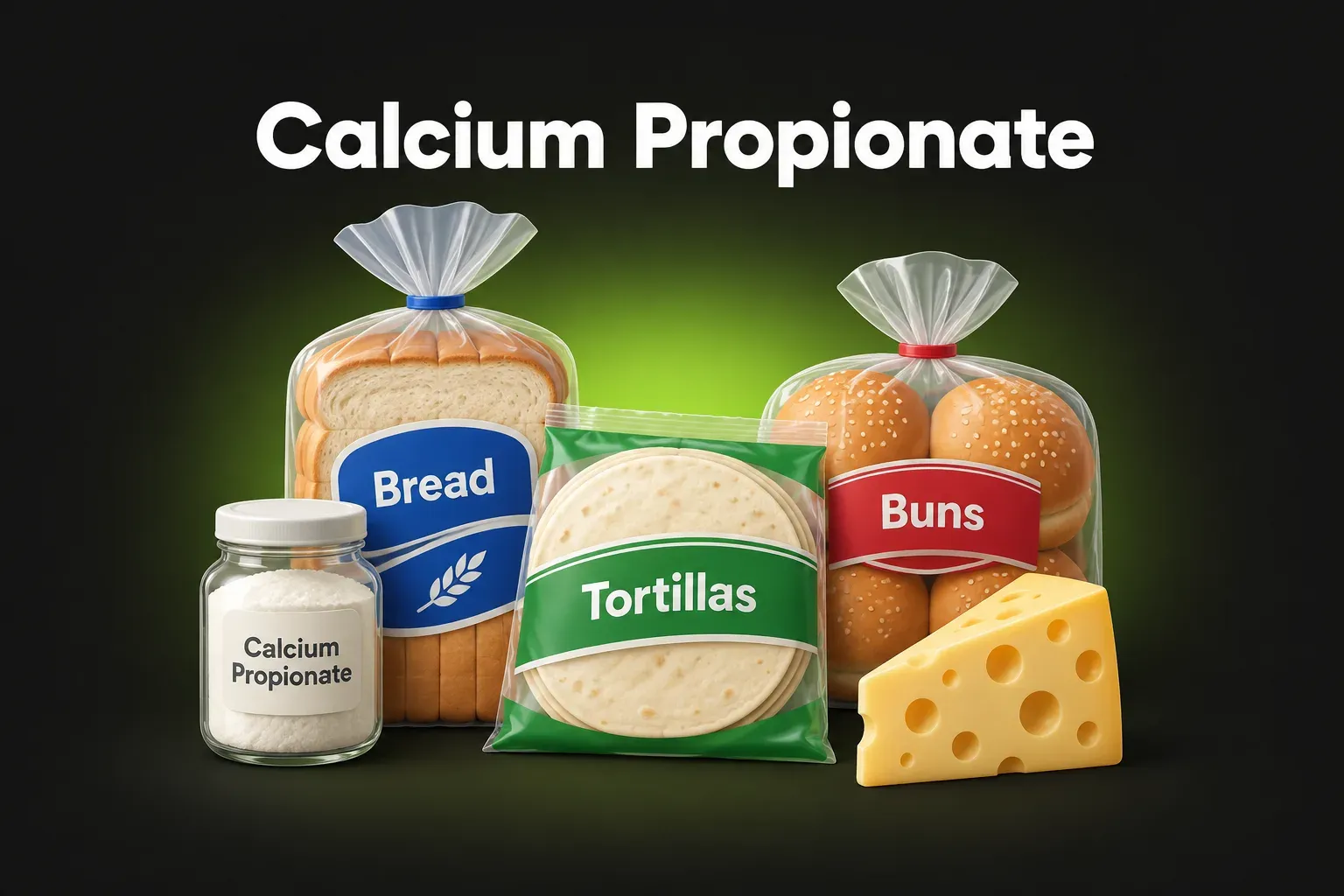
Calcium propionate is the preservative that keeps packaged bread soft and mold-free for weeks. It’s in most sliced bread, buns, tortillas and wraps – so many people eat it every day without knowing it.
The short answer: regulators consider calcium propionate safe, and your gut makes a similar substance naturally. But eating it as an additive may not be the same. In a Harvard study, people who ate propionate with a meal had more of the hormones that raise blood sugar, and their insulin worked less well. Mice given it for months gained weight. A small study also found that it made some sensitive children more irritable and restless. If you eat packaged bread every day, it’s worth choosing fresh bread more often.
What is calcium propionate?
Calcium propionate is a salt made from propionic acid and calcium. Bacteria make propionic acid naturally. It gives Swiss cheese part of its taste, and your gut bacteria make it when they break down fiber. But the calcium propionate added to bread is made in factories.
It stops mold and certain bacteria from growing, which is why packaged bread can stay “fresh” for a week or two – or longer.
On labels, you’ll see it as:
| Name | Where you’ll see it |
|---|---|
| Calcium propionate | Ingredient lists worldwide |
| E282, “preservative: E282” | European Union, UK and many other countries |
| Propionic acid (E280), sodium propionate (E281), potassium propionate (E283) | Related preservatives |
Which foods contain calcium propionate?
- Bread: sliced bread, sandwich bread, whole wheat bread, buns and rolls
- Wraps: tortillas, wraps, flatbreads, pita
- Baked goods: pizza dough, cakes, muffins, pastries
- Other: some processed cheese and meat products
It’s especially common in “healthy” bread – whole wheat and multigrain loaves often contain it too, so the label is the only way to know.
Is calcium propionate bad for you? What the research says
What regulators say
Calcium propionate is “generally recognized as safe” by the FDA. In 2014, the European Food Safety Authority (EFSA) decided there was no need to set a daily limit. One reason: the body already deals with the propionate made in the gut. In the EU, bread can contain up to 2,000–3,000 mg per kilogram, depending on the type.
Insulin, blood sugar and weight gain
The most important study comes from Harvard. In mice, propionate raised the stress hormone norepinephrine and two hormones that push blood sugar up (glucagon and FABP4). Mice that got propionate for months, at a dose like the one in food, slowly gained weight.
Then the researchers tested it in healthy people. They ate the same meal twice, once with propionate and once without, and didn’t know which was which. After the meal with propionate, the same hormones rose. Their insulin worked less well, so their bodies had to release more insulin to keep blood sugar under control (Tirosh et al., Science Translational Medicine, 2019).
The authors say that, over time, this could lead to weight gain, insulin that stops working well, and type 2 diabetes. More research is needed. It’s a small, short study – but it was done in people, with a realistic dose.
Children’s behavior
An Australian study looked at 27 children whose behavior had improved on a diet without additives. They got bread with or without calcium propionate, without knowing which. With calcium propionate, about half of the children became more irritable and restless, had more trouble paying attention and slept worse (Dengate and Ruben, Journal of Paediatrics and Child Health, 2002). These children were already sensitive to food additives, so the results don’t apply to all children. But they show that a daily preservative can affect some of them.
The brain: what animal studies show
Researchers injected propionic acid straight into the brains of rats. The rats started repeating the same movements, became hyperactive and had social problems, similar to some signs of autism (MacFabe et al., Behavioural Brain Research, 2007). To be clear: this was an injection into the brain, not food, so it doesn’t show that bread causes autism. But it shows that a lot of propionate can affect the brain. Scientists are still studying how propionate from the gut and from food reaches the brain.
Studies on animals matter, because testing these effects on people on purpose would put their health at risk. And rats and mice share most of their genes and body processes with us.
Stomach problems in large amounts
In 2023, 721 people in Finnish schools got sick – mostly with nausea and stomach pain right after lunch. Investigators found tortillas with over 12 times the legal limit of calcium propionate. They concluded it was the likely cause (Varo et al., Eurosurveillance, 2026). Normal bread doesn’t contain this much, but it shows that the amount matters.
Some people also report headaches, migraines, stomach upset or skin rashes from bread with calcium propionate, but there are few studies on this.
How to avoid calcium propionate
- Buy fresh bread from a bakery – it usually has no preservatives. Ask if you’re not sure.
- Freeze bread instead of relying on preservatives: slice it, freeze it and toast slices as you need them.
- Read labels on sliced bread, buns, tortillas and wraps – some brands don’t use it.
- Bake your own bread if you can – flour, water, salt and yeast are all you need.
- Eat more fiber from whole grains, beans and vegetables. Your gut bacteria will make their own propionate, which is not the same as the additive.
Spot calcium propionate on any label in seconds. With NutriSmart, you photograph the ingredient list or scan the barcode, and the app tells you right away if the product has calcium propionate. Turn on an alert for it, and the app warns you every time a product you scan contains it. You’ll also see every other additive, the risks of each one and a health score out of 100.Get the app free
You can also read about other preservatives: potassium sorbate and sodium benzoate.
The bottom line
Calcium propionate keeps packaged bread fresh for weeks, and regulators consider it safe. But in a Harvard study, it raised blood sugar hormones and made insulin work less well in people. It also caused weight gain in mice. And in a small study, it made some sensitive children irritable and restless. Since many people eat packaged bread every day, choosing fresh or frozen bread more often is an easy way to eat less of it.
FAQ
Is calcium propionate bad for you?
Regulators consider it safe in the amounts used in bread. But in a Harvard study, people who ate propionate with a meal had more of the hormones that raise blood sugar, and their insulin worked less well. Mice given it for months gained weight. A small study also found that it made some sensitive children more irritable and restless. It's worth limiting, especially if you eat packaged bread every day.
Is calcium propionate natural?
Propionic acid is naturally made by bacteria – in Swiss cheese and in your own gut when bacteria break down fiber. But the calcium propionate added to bread is made in factories.
What foods contain calcium propionate?
Mostly packaged bread and baked goods: sliced bread, buns, rolls, tortillas, wraps, pizza dough, cakes and muffins. It's also used in some processed cheese and meat products.
Why is calcium propionate in bread?
It stops mold and the bacteria that make bread go bad, so packaged bread can stay soft and fresh on the shelf for one to two weeks or longer. Fresh bakery bread usually doesn't contain it.
Can calcium propionate cause headaches or stomach problems?
Some people report headaches, stomach upset or skin reactions, but there are few studies. In large amounts it does cause stomach problems: in 2023, over 700 people in Finnish schools got sick after eating tortillas with more than 12 times the allowed amount of calcium propionate.
What is E282?
E282 is the European code for calcium propionate. Related preservatives are propionic acid (E280), sodium propionate (E281) and potassium propionate (E283).