Polydextrose (E1200): Is This Added Fiber Good or Bad?
What polydextrose (E1200) is, why it's in low-sugar and high-fiber foods, whether it counts as real fiber, its side effects and what EFSA says about it.
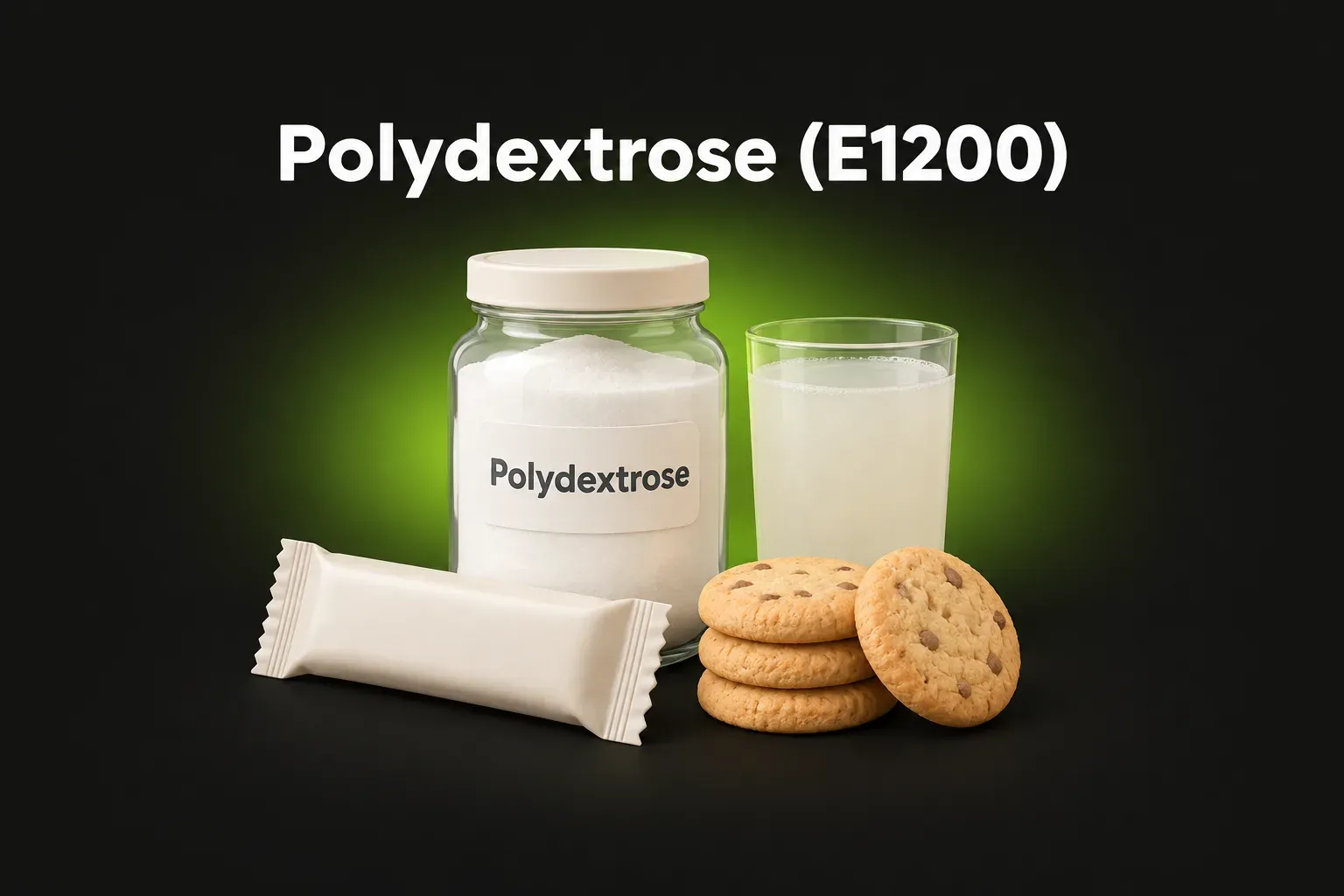
If a protein bar, cookie or ice cream says “high fiber” or “low sugar”, there’s a good chance it contains polydextrose. It’s one of the most common ways food makers add fiber and replace sugar. But it isn’t fiber from oats or beans – it’s made in a factory. So is it good for you, or just a label trick?
The short answer: polydextrose (E1200) is a man-made soluble fiber with about 1 calorie per gram. In 2021, the European Food Safety Authority found no safety concern and no need for a daily limit. It acts like fiber: it can soften stools, feed gut bacteria and may reduce how much you eat at the next meal. In larger amounts it causes gas, bloating and loose stools. It’s not harmful, but it’s not the same as fiber from whole foods – and it’s mostly found in ultra-processed products.
What is polydextrose?
Polydextrose is made by heating glucose with a small amount of sorbitol and citric acid. This links the glucose into long, branched chains that the enzymes in your gut can’t break down. So most of it passes to the large intestine, where gut bacteria ferment part of it.
| Polydextrose | Sugar | |
|---|---|---|
| Calories | about 1 per gram | 4 per gram |
| Sweetness | Not sweet | Sweet |
| Raises blood sugar | Very little | Yes |
| Counts as fiber on labels | Yes | No |
Polydextrose isn’t sweet. It’s used to give bulk and texture – the “body” that sugar or fat would normally provide – so manufacturers can cut sugar and fat and add sweeteners instead.
On labels, you’ll see it as polydextrose or E1200.
Where you’ll find polydextrose
- Protein bars and “high fiber” bars
- Low-sugar and “no added sugar” ice cream, chocolate and candy
- Cookies, cakes and muffins labeled light, keto or high fiber
- Breakfast cereals with added fiber
- Fiber drinks, yogurts and dairy desserts
- Diabetic and keto products
- Fiber supplements
Benefits of polydextrose
Bowel movements
In a two-week study with 192 adults with constipation, 12 g of polydextrose a day increased the number of bowel movements and improved other constipation symptoms. Smaller doses (4–8 g) had less effect (Ibarra et al., Nutrients, 2019). The study was paid for by a polydextrose maker, and the people in it weren’t very constipated to begin with.
Eating less at the next meal
A review of studies found that people who had polydextrose as a mid-morning snack ate less at lunch. The more polydextrose, the bigger the effect – about 0.7% fewer calories at lunch for every gram (Ibarra et al., Appetite, 2015). That’s a small effect: 10 g would mean about 7% less at lunch. Some of the authors also worked for a polydextrose maker.
Gut bacteria and blood sugar
Gut bacteria ferment part of polydextrose into short-chain fatty acids, which feed the cells of the colon. And because it’s barely digested, it raises blood sugar very little.
Side effects and safety
What EFSA says
In 2021, the European Food Safety Authority re-evaluated polydextrose. Animals were given huge doses – up to 15 g per kg of body weight a day – with no harm to organs, genes, reproduction or babies. EFSA concluded there’s no safety concern and no need for a daily limit. It did ask for lower limits on lead and arsenic in polydextrose, because the amounts allowed in the product were higher than needed (EFSA, 2021).
Gas, bloating and diarrhea
Like other fibers, polydextrose can cause gas, bloating and loose stools, especially in large amounts or if you’re not used to fiber. In the US, products with more than 15 g per serving must carry a warning that sensitive people may notice a laxative effect. People with IBS may react to smaller amounts.
The ultra-processed food problem
Polydextrose itself isn’t the issue. But it’s almost always found in ultra-processed foods – sweetened bars, “diet” desserts and snacks – alongside sweeteners, emulsifiers and refined flour. A cookie with added polydextrose is still a cookie. Read more about ultra-processed foods.
Polydextrose vs other added fibers
| Fiber | Source | Main notes |
|---|---|---|
| Polydextrose (E1200) | Made from glucose | Low calorie, adds bulk; gas in large amounts |
| Inulin | Chicory root | Helps constipation; often causes gas; mouse liver study |
| Psyllium | Plant seed husks | Best evidence for constipation and cholesterol |
| Soluble corn fiber | Corn starch | Similar to polydextrose |
| Maltodextrin | Starch | Not a fiber – raises blood sugar fast |
Should you avoid polydextrose?
For most people, there’s no need. But keep in mind:
- Don’t count on it for your fiber. Get most of your fiber from beans, oats, whole grains, fruit, vegetables and nuts – see our list of high-fiber foods.
- Watch your gut. If “high fiber” bars give you gas or loose stools, polydextrose (or inulin) is a likely cause.
- Read the whole label. “High fiber” and “low sugar” don’t mean healthy if the product is full of sweeteners and additives.
- Start slowly if you’re not used to fiber, and drink enough water.
Spot polydextrose on any label in seconds. With NutriSmart, you photograph the ingredient list or scan the barcode, and the app tells you right away if the product has polydextrose. Turn on an alert for it, and the app warns you every time a product you scan contains it. You’ll also see every other additive, the risks of each one and a health score out of 100.Get the app free
You can also read about fiber supplements and sweeteners often used with polydextrose, like maltitol and erythritol.
The bottom line
Polydextrose (E1200) is a man-made soluble fiber with about 1 calorie per gram. It’s used to add fiber and bulk to low-sugar and “high fiber” products. EFSA found no safety concern, and it may help a little with constipation and appetite. In larger amounts it causes gas and loose stools. It’s fine in moderation – but it’s no substitute for fiber from whole foods, and it usually comes inside ultra-processed products.
FAQ
What is polydextrose?
Polydextrose is a man-made soluble fiber. It's made by heating glucose with a little sorbitol and citric acid, which links the glucose into long, branched chains that your body can't digest. It has about 1 calorie per gram and is used to add fiber and bulk to low-sugar and low-fat foods.
Is polydextrose bad for you?
In normal amounts, no. In 2021, the European Food Safety Authority found no safety concern and saw no need for a daily limit. It acts like a fiber in the gut. The main downside is gas, bloating and loose stools in larger amounts – and the fact that it's mostly found in ultra-processed foods.
Is polydextrose a real fiber?
It counts as dietary fiber on US and EU labels, and it acts like a soluble fiber: it adds bulk to stools and feeds gut bacteria. But it doesn't come with the vitamins, minerals and plant compounds you get from fiber in whole foods like beans, oats, fruit and vegetables.
Does polydextrose raise blood sugar?
Very little. Most of it isn't digested, so it has a very low glycemic index. That's why it's used in sugar-free and diabetic products. But the other ingredients in those products may still raise blood sugar.
Does polydextrose cause diarrhea?
In large amounts, it can. In the US, foods with more than 15 g per serving must warn that sensitive people may have a laxative effect. Most people tolerate the amounts in one or two products a day without problems.
Is polydextrose keto-friendly?
Mostly yes. It adds very few digestible carbs and calories, so many keto products use it. Check the rest of the label, though – sugar alcohols like maltitol can raise blood sugar more.