Sodium Alginate: What It Is, Uses and Is It Safe?
What sodium alginate (E401) is, how it's made from seaweed, why it's in ice cream, popping boba and heartburn medicines, what studies show and if it's safe.
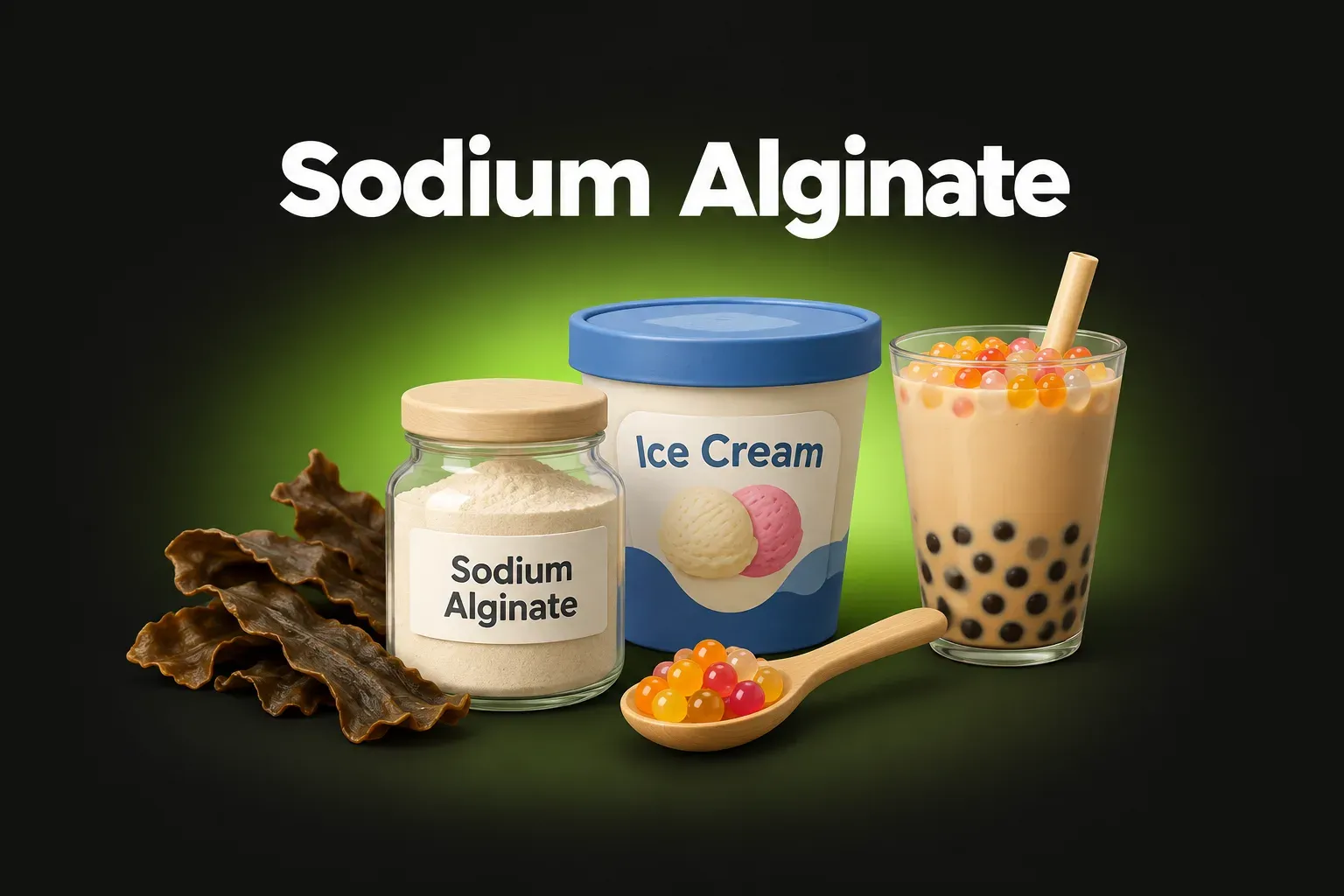
Sodium alginate is a thickener made from seaweed. It’s in ice cream, sauces, fruit fillings and the “popping boba” in bubble tea. It’s also the secret behind the little gel balls that chefs make in fancy restaurants. And it’s the main ingredient in some heartburn medicines.
The short answer: sodium alginate is a natural fiber from brown seaweed, and it’s considered safe for most people. The European Food Safety Authority checked it again in 2017 and found no need for a daily limit. It can even help: in medicines, it forms a gel “raft” that reduces heartburn. Large amounts can cause bloating or loose stools. Very high amounts may make your body take in slightly fewer minerals.
What is sodium alginate?
Alginate is a fiber found in brown seaweed, like kelp. To make sodium alginate, the seaweed is washed and soaked in a special liquid that dissolves the alginate. Then it’s filtered, cleaned and dried into a powder.
Its special trick: when sodium alginate meets calcium, it right away turns into a soft gel. That’s how chefs make gel “caviar”. It’s also how popping boba gets its thin skin with liquid inside.
On labels, you’ll see it as sodium alginate, algin or E401. The alginate family includes:
| Additive | EU code |
|---|---|
| Alginic acid | E400 |
| Sodium alginate | E401 |
| Potassium alginate | E402 |
| Calcium alginate | E404 |
| Propylene glycol alginate | E405 |
Where you’ll find sodium alginate
- Ice cream and frozen desserts – stops ice crystals from forming
- Sauces, dressings and gravies – makes them thicker without starch
- Fruit fillings and bakery creams – helps them keep their shape when baked
- Popping boba and gel desserts
- Foods shaped from a paste – like some onion rings or pimento strips
- Beer – propylene glycol alginate (E405) helps the foam last
- Heartburn medicines and some wound bandages
Is sodium alginate safe? What the research says
What regulators say
Alginates are approved in the US and the EU. In 2017, the European Food Safety Authority checked alginic acid and its forms (E400–E404) again. It found no need for a daily limit and no safety worry at the amounts used in food.
Digestion and gut bacteria
Your body can’t digest alginate on its own – it acts as a fiber. Gut bacteria break down part of it. In normal food amounts, this rarely causes problems. But large amounts (for example from supplements) can cause gas, bloating or loose stools, especially in people with IBS (a sensitive bowel).
Alginate holds on to calcium and other minerals. So very high amounts may make your body take in slightly less of them. This isn’t a worry at the tiny amounts used in food.
Heartburn
In heartburn medicines, alginate mixes with stomach acid and forms a gel “raft”. The raft floats on top of the food in your stomach. It helps keep acid out of the food pipe. A review of studies found that alginates worked better than a fake pill or regular antacids for heartburn (Leiman et al., Diseases of the Esophagus, 2017).
Weight loss
Alginate forms a gel in the stomach, so scientists tested it as a way to feel full. In a 12-week study in Denmark, 96 adults with obesity went on a diet. Before meals, they drank either an alginate drink or a fake drink. In the main results, there was no difference in weight loss. But 80 people finished the study, and among them, the alginate group lost about 1.7 kg more (Jensen et al., American Journal of Clinical Nutrition, 2012). So the effect, if any, is small.
Sodium alginate vs other thickeners
| Thickener | Source | Main concerns |
|---|---|---|
| Sodium alginate (E401) | Brown seaweed | Few; bloating in large amounts |
| Pectin (E440) | Fruit | Few; rare allergy |
| Gellan gum (E418) | Bacterial fermentation | Few; bloating in large amounts |
| Xanthan gum (E415) | Bacterial fermentation | Bloating; risk for babies born too early |
| Carrageenan (E407) | Red seaweed | Gut inflammation; possible cancer link in animals |
| CMC (E466) | Wood pulp or cotton | Gut bacteria, inflammation |
Both alginate and carrageenan come from seaweed, but they’re very different. There’s much stronger proof that carrageenan harms the gut.
Should you avoid sodium alginate?
For most people, there’s no need. It’s a natural, vegan seaweed fiber, and the studies are reassuring. But:
- if you have IBS or a sensitive stomach, watch how you react to products with several thickeners
- take alginate heartburn medicines a couple of hours apart from other medicines and mineral supplements
- a long list of thickeners is often a sign of an ultra-processed product – read more about ultra-processed foods
Spot sodium alginate on any label in seconds. With NutriSmart, you photograph the ingredient list or scan the barcode, and the app tells you right away if the product has sodium alginate. Turn on an alert for it, and the app warns you every time a product you scan contains it. You’ll also see every other additive, the risks of each one and a health score out of 100.Get the app free
You can also read about other thickeners: pectin, gellan gum and carrageenan.
The bottom line
Sodium alginate is a natural fiber from brown seaweed. It thickens ice cream and sauces, makes popping boba and helps heartburn medicines work. It’s one of the gentler thickeners. EFSA found no need for a daily limit, and the main side effect is bloating in large amounts. Unlike carrageenan, another seaweed thickener, it hasn’t been linked to gut inflammation.
FAQ
What is sodium alginate?
Sodium alginate is a natural fiber taken from brown seaweed. It makes liquids thicker. When it meets calcium, it turns into a soft gel. It's used in ice cream, sauces, fillings, popping boba and fancy gel dishes made by chefs. It's also in some heartburn medicines.
Is sodium alginate safe?
Yes, for most people. It's a natural seaweed fiber. In 2017, the European Food Safety Authority checked alginates again and found no need to set a daily limit. Large amounts can cause bloating or loose stools. Very high amounts may make your body take in slightly less of some minerals.
How does sodium alginate help with heartburn?
In heartburn medicines, alginate mixes with stomach acid and forms a gel "raft". The raft floats on top of the food in your stomach. It helps keep acid out of the food pipe. A review of studies found alginates worked better than a fake pill or regular antacids.
Does sodium alginate help with weight loss?
Only a little, if at all. In a 12-week study, adults with obesity on a diet drank an alginate drink before meals. Some of them lost about 1.7 kg more than those who got a fake drink. But this was only among people who finished the study, not in the main results.
Is sodium alginate vegan?
Yes. It comes from seaweed, so it's vegan. It's often used instead of gelatin.
What is E401?
E401 is the European code for sodium alginate. Related additives are alginic acid (E400), potassium alginate (E402), ammonium alginate (E403), calcium alginate (E404) and propylene glycol alginate (E405).