Soy Lecithin vs Sunflower Lecithin: Is It Bad for You?
Soy lecithin vs sunflower lecithin (E322): what they are, how they're made, what new studies show about the gut and allergies, and which one to choose.
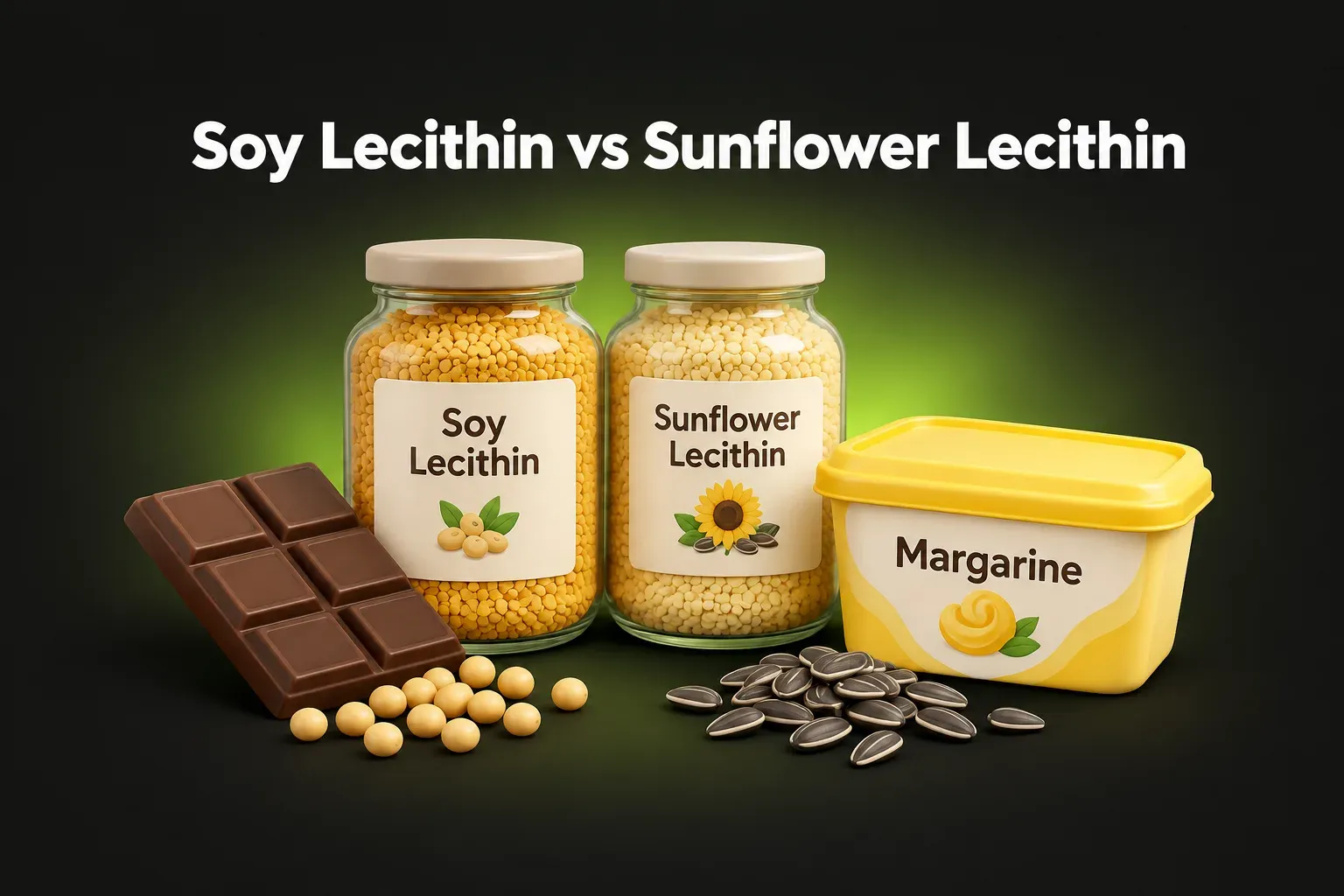
Lecithin is in almost every chocolate bar, in margarine, cookies, protein powders and supplements. On labels you’ll usually see soy lecithin or sunflower lecithin. Many people wonder if one is better than the other, or if they should avoid both.
The short answer: lecithin is one of the milder additives. It’s a natural type of fat also found in eggs and seeds. Large studies of people haven’t linked it to heart disease or cancer. But new lab and mouse studies found that soy lecithin can weaken the gut lining, cause inflammation and make allergies more likely. So it’s not as harmless as people long thought. Sunflower lecithin works the same way. But it’s often made without chemicals like hexane, isn’t GMO and isn’t a major allergen. So it’s usually the better choice.
What is lecithin?
Lecithin is a mix of fats called phospholipids. Your cells use them to build their outer layer. They’re found naturally in egg yolks, soybeans, sunflower seeds, nuts and meat.
In food, lecithin is an emulsifier: it helps fat and water mix and stay mixed. That’s why it’s used to:
- make chocolate smooth and easier to work with
- keep margarine and spreads from separating
- help powders like protein shakes and instant cocoa dissolve
- keep baked goods soft and stop dough from sticking
On labels, you’ll see it as:
| Name | Where you’ll see it |
|---|---|
| Soy lecithin, lecithin (soy) | Ingredient lists worldwide |
| Sunflower lecithin | Ingredient lists worldwide |
| E322, “emulsifier: E322” | European Union, UK and many other countries |
Soy lecithin vs sunflower lecithin
| Soy lecithin | Sunflower lecithin | |
|---|---|---|
| Made from | Soybean oil | Sunflower oil |
| Chemicals used | Usually made with hexane | Often made without chemicals |
| GMO | Most US soybeans are | No |
| Major allergen | Yes (soy) | No |
| Price | Cheaper | More expensive |
| Used in | Most chocolate, spreads and baked goods | “Clean label” foods, supplements |
Both are left over from making cooking oil. The lecithin is separated from the raw oil and dried. Soybean oil is usually pulled out of the beans with hexane, a chemical made from oil. Almost all of it is removed later, but many people prefer to avoid it. Sunflower oil is more often pressed, so sunflower lecithin can be made without chemicals.
Is lecithin bad for you? What the research says
What regulators say
The FDA lists lecithin as “generally recognized as safe”. In 2017, the European Food Safety Authority (EFSA) decided there was no need to set a daily limit. Your body breaks it down like other fats.
The gut and allergies: new studies
Scientists have studied emulsifiers much more in the last ten years. Some of them – like polysorbate 80 and carrageenan – damage the gut in animal studies. Lecithin used to be seen as one of the safe ones. Newer research is less sure:
- Gut lining and allergies: in a 2026 study, scientists tested soy lecithin on tiny copies of the human gut grown in the lab and on mice. They used doses like those people eat every day. It damaged the gut lining, caused inflammation and led to oxidative stress – a kind of cell damage. In mice that ate it, soy lecithin also raised IgE, the antibody behind food allergies. The authors say these results “challenge the presumed safety” of soy lecithin (Yazici et al., Allergy, 2026).
- Gut bacteria and blood sugar: in a 2024 study, lecithin and three other common emulsifiers all changed the gut bacteria of mice for the worse. Lecithin also made blood sugar control worse in a lab test of insulin resistance (when the body stops responding well to insulin) (Panyod et al., Communications Biology, 2024).
- A test with people: in a 2026 study, 60 healthy adults first ate a diet without emulsifiers for two weeks. Their cholesterol went down. Then some got brownies with one emulsifier, such as soy lecithin, and others got brownies without any. Over four weeks, emulsifiers lowered the healthy fatty acids that gut bacteria make. But they didn’t cause inflammation that tests could find (Wellens et al., Clinical Gastroenterology and Hepatology, 2026).
To be fair, not every study agrees. Scientists tested 20 emulsifiers on human gut bacteria in the lab. Lecithin was one of the few that barely changed them (Naimi et al., Microbiome, 2021). And a large French study followed over 100,000 people. Lecithin was not one of the emulsifiers linked to heart disease or cancer (Sellem et al., BMJ, 2023).
Studies on mice and human cells matter. Testing large amounts on people on purpose would put their health at risk. And mice share most of their genes with us, and their bodies work in many of the same ways. There’s no proof yet that the lecithin in food harms people. But the new results are a good reason to eat less of the processed foods it comes in.
Heart health and TMAO
Lecithin contains choline. When you eat a lot of choline – from lecithin, eggs or red meat – some gut bacteria turn it into a substance called TMAO. A study at the Cleveland Clinic followed over 4,000 heart patients for three years. Those with the most TMAO had a higher risk of heart attack, stroke and death (Tang et al., New England Journal of Medicine, 2013). The amount of lecithin in a chocolate bar is small. But this is one reason not to take large doses of lecithin supplements without a good reason.
Soy allergy
Soy lecithin has only tiny traces of soy protein, and most people with a soy allergy can eat it. In a small study of 22 children with a soy allergy, only one had a mild reaction (Gholmie et al., Journal of Human Nutrition and Dietetics, 2020). Still, a few people do react, so in the US soy lecithin must be labeled as soy. If you’re allergic, sunflower lecithin is the safer option.
Lecithin supplements
Sunflower lecithin is popular as a supplement, often in capsules or granules. Some breastfeeding experts suggest it for blocked milk ducts. It’s also sold to help the brain and cholesterol. But there’s little proof for these uses. If you want to try it, talk to your doctor first. And keep in mind the TMAO worry above for high doses.
Which foods contain lecithin?
- Sweets: chocolate, chocolate spreads, candy, ice cream
- Spreads and fats: margarine, butter blends, cooking sprays
- Baked goods: cookies, cakes, bread, crackers
- Powders: protein powders, instant cocoa and coffee drinks, infant formula
- Other: salad dressings, ready meals, vitamins and supplements
How to choose
- Choose sunflower lecithin over soy if you have a soy allergy, want to avoid GMO ingredients or prefer no chemicals like hexane.
- Eat fewer processed foods with long ingredient lists – they usually contain several emulsifiers, not just lecithin. Read more about ultra-processed foods.
- Check the other emulsifiers on the label. There’s stronger proof of harm for carrageenan, polysorbate 80 and carboxymethylcellulose than for lecithin.
- Don’t take large doses of lecithin supplements without talking to your doctor.
Spot soy lecithin on any label in seconds. With NutriSmart, you photograph the ingredient list or scan the barcode, and the app tells you right away if the product has soy lecithin. Turn on an alert for it, and the app warns you every time a product you scan contains it. You’ll also see every other additive, the risks of each one and a health score out of 100.Get the app free
You can also read about other emulsifiers: polysorbate 80, carboxymethylcellulose and carrageenan.
The bottom line
Lecithin is one of the milder additives. Large studies of people haven’t linked it to heart disease or cancer. But new lab and mouse studies show that soy lecithin can harm the gut lining, cause inflammation and make allergies more likely. And many emulsifiers change gut bacteria. Sunflower lecithin is usually the better choice. Eating fewer processed foods is the best way to get less of both.
FAQ
Is soy lecithin bad for you?
In the small amounts used in food, it's one of the milder additives. Large studies of people haven't linked it to heart disease or cancer. But new lab and mouse studies found that soy lecithin can weaken the gut lining and cause inflammation (swelling). It can also make the body more likely to develop allergies. Many emulsifiers also change gut bacteria. It's worth limiting, along with the processed foods it's found in.
What is the difference between soy lecithin and sunflower lecithin?
Both are mostly the same type of fat (phospholipids) and do the same job. Soy lecithin comes from soybean oil. This oil is usually pulled out of the beans with a chemical called hexane, and most US soybeans are genetically modified (GMO). Sunflower lecithin comes from sunflower seeds. It's often made without chemicals, isn't GMO and isn't a major allergen.
Is sunflower lecithin better than soy lecithin?
For most people, the health effects are similar. Sunflower lecithin is a better choice if you're allergic to soy, want to avoid GMO ingredients or prefer a product made without chemicals like hexane.
Can people with a soy allergy eat soy lecithin?
Soy lecithin has only tiny traces of soy protein, and most people with a soy allergy can eat it. But a few do react, so in the US it must be labeled as soy. If you have a soy allergy, ask your doctor, or choose products with sunflower lecithin.
What foods contain soy lecithin?
Chocolate and chocolate spreads, candy, margarine and spreads, cookies, cakes and other baked goods, salad dressings, instant drinks, protein powders, infant formula and many supplements.
What is E322?
E322 is the European code for lecithins. The label may say "emulsifier: E322", "soy lecithin", "sunflower lecithin" or "lecithin (soy)".