Natamycin (E235): Is This Cheese Preservative Safe?
What natamycin (E235) is, why it's used on cheese and salami, if you should eat the rind, what scientists say about resistance to mold medicines, and how to avoid it.
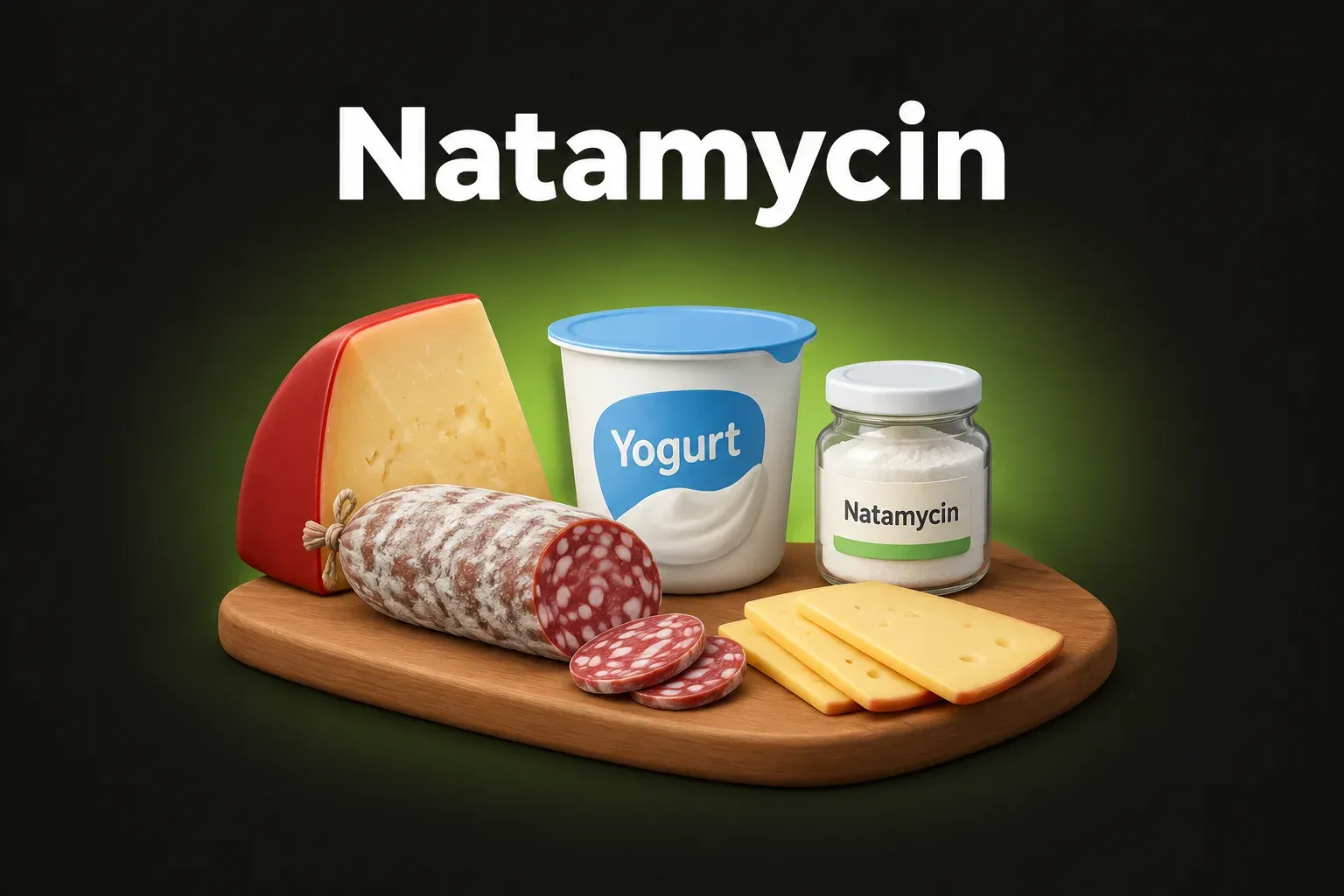
Natamycin is the preservative you’ll see on many cheese and salami labels – often with a note that the rind isn’t edible. It’s a natural antifungal, which means it kills mold and yeast. It stops mold from growing on the outside of the food. It’s considered safe in small amounts. But it’s also a medicine, and that raises a question scientists still argue about.
The short answer: natamycin (E235) is a mold-killer made by soil bacteria. It’s used on the outside of cheese and dry sausages to stop mold. Your body takes in very little of it, it doesn’t harm bacteria, and in small amounts it’s considered safe. The worries are different. It’s also a medicine against fungi, and some scientists warn that using it in food could help fungi stop responding to similar drugs. There are also few long-term studies on gut microbes (the tiny living things in your gut). Simple fix: cut off the rind or casing.
What is natamycin?
Natamycin – also called pimaricin – was found in 1955 in soil bacteria called Streptomyces natalensis. It belongs to the same family of medicines as amphotericin B and nystatin (called polyene antifungals). It sticks to ergosterol, a substance found only in the outer layer of fungal cells. So it kills mold and yeast but not bacteria.
That’s why it’s useful in food. It stops mold on cheese and sausages without harming the good bacteria that help them age. In medicine, it’s used as eye drops for fungal eye infections.
On labels, you’ll see it as natamycin, pimaricin or E235.
Where you’ll find natamycin
- Hard and semi-hard cheese – on the rind or coating (Gouda, Edam, cheddar, Parmesan-style cheeses)
- Shredded and sliced cheese – to stop mold in the bag (allowed in the US)
- Dry cured sausages and salami – on the casing
- Yogurt, cottage cheese and baked goods – in some countries, including the US
- Wine and juices – in some countries outside the EU
In the EU, natamycin may only be used on the outside of hard, semi-hard and semi-soft cheeses and dry sausages. The limit is 1 mg per square decimeter (a 10 × 10 cm square), and it can’t go deeper than 5 mm into the food.
Is natamycin safe? What the research says
What regulators say
The European Food Safety Authority has set a safe daily limit of 0.3 mg per kg of body weight. The FDA allows it in several foods. Your gut takes in very little natamycin, so almost none reaches your blood. With the amounts used on cheese and sausages, people eat only a little of it.
Fungi that stop responding to medicine
This is the main worry. Natamycin is in the same family as amphotericin B. That’s one of the most important medicines against dangerous fungal infections in hospital patients. Scientists have warned about using this kind of drug a lot in food and farming. Fungi could get used to it, and then these medicines might not work as well on them (Dalhoff and Levy, International Journal of Antimicrobial Agents, 2015).
In a lab study, scientists gave 20 types of fungi more and more natamycin over time. 13 of them got harder to kill. One mold also got harder to kill with amphotericin B and nystatin (Streekstra et al., International Journal of Food Microbiology, 2016). The companies that make natamycin say the risk is low. It hasn’t been clearly shown to happen outside the lab. But it’s a good reason not to use mold-killers in food more than needed.
Gut microbes and long-term effects
A 2026 review looked at the research on natamycin. It found that its safety rests mostly on short-term studies. We still don’t know much about eating it for many years. We also don’t know how it affects gut microbes, including the fungi that normally live in the gut (Bangeppagari et al., Pharmaceuticals, 2026). There’s no proof of harm yet – it simply hasn’t been studied much.
Allergies and side effects
Allergic reactions to natamycin in food are very rare. As eye drops, it can cause mild irritation.
Should you eat the cheese rind?
Usually, no – at least not on cheese treated with natamycin. The rind or coating is where natamycin is put, and many labels say it isn’t edible. Cutting off the rind or peeling off the sausage casing removes most of the natamycin.
How to avoid natamycin
- Read labels on cheese, shredded cheese and salami – look for natamycin or E235.
- Cut off the rind of hard cheeses and peel the casing off salami.
- Buy cheese from the counter or natural-rind cheeses without preservatives.
- Choose block cheese and shred it yourself – bagged shredded cheese often has natamycin and anti-caking agents (powders that stop it from sticking).
- Store cheese well – wrapped in paper, in the fridge – so it doesn’t need preservatives to last.
Spot natamycin on any label in seconds. With NutriSmart, you photograph the ingredient list or scan the barcode, and the app tells you right away if the product has natamycin. Turn on an alert for it, and the app warns you every time a product you scan contains it. You’ll also see every other additive, the risks of each one and a health score out of 100.Get the app free
You can also read about other preservatives: potassium sorbate, sodium benzoate and calcium propionate.
The bottom line
Natamycin is a natural mold-killer used on cheese and salami. Your body takes in very little of it, and it’s considered safe in small amounts. But it’s also a medicine against fungi. Scientists worry that using it in food could help fungi stop responding to similar drugs. There are few long-term studies. Cutting off the rind and casing – where natamycin is put – is an easy way to avoid most of it.
FAQ
What is natamycin?
Natamycin (E235), also called pimaricin, is a natural antifungal – a substance that kills mold and yeast. It's made by bacteria that live in soil (Streptomyces natalensis). It stops mold from growing on the outside of cheese and dry sausages. It's also used as an eye medicine for fungal infections.
Is natamycin safe to eat?
In the small amounts used in food, it's considered safe. Your gut takes in very little of it, and it doesn't harm bacteria. The EU safe daily limit is 0.3 mg per kg of body weight. The main worry isn't that it's toxic. It's that using a mold-killer in food could help fungi stop responding to similar medicines.
Should I eat the rind of cheese treated with natamycin?
It's better not to. In the EU, natamycin may only be used on the outside of cheese and sausages. Labels often say the rind isn't edible. Cut off the rind or casing – this also removes most of the natamycin.
Does natamycin cause antibiotic resistance?
It doesn't affect bacteria, so it doesn't cause antibiotic resistance. But some scientists are worried about fungi. Using mold-killers like natamycin a lot in food and farming could help fungi get used to similar medicines, such as amphotericin B. In lab studies, some fungi got harder to kill after long contact with natamycin.
Is natamycin natural?
It's made by bacteria found in soil, so it comes from nature. But it's still a purified mold-killing drug added to food, not a traditional ingredient.
What is E235?
E235 is the European code for natamycin. On labels you'll see "natamycin", "preservative: E235" or "pimaricin". In the EU it's only allowed on the surface of hard, semi-hard and semi-soft cheeses and dry sausages.