BHA and BHT (E320, E321): Are These Preservatives Safe?
What BHA and BHT are, which cereals, gums and snacks contain them, why BHA is called a possible carcinogen, what the FDA and EFSA say, and how to avoid them.
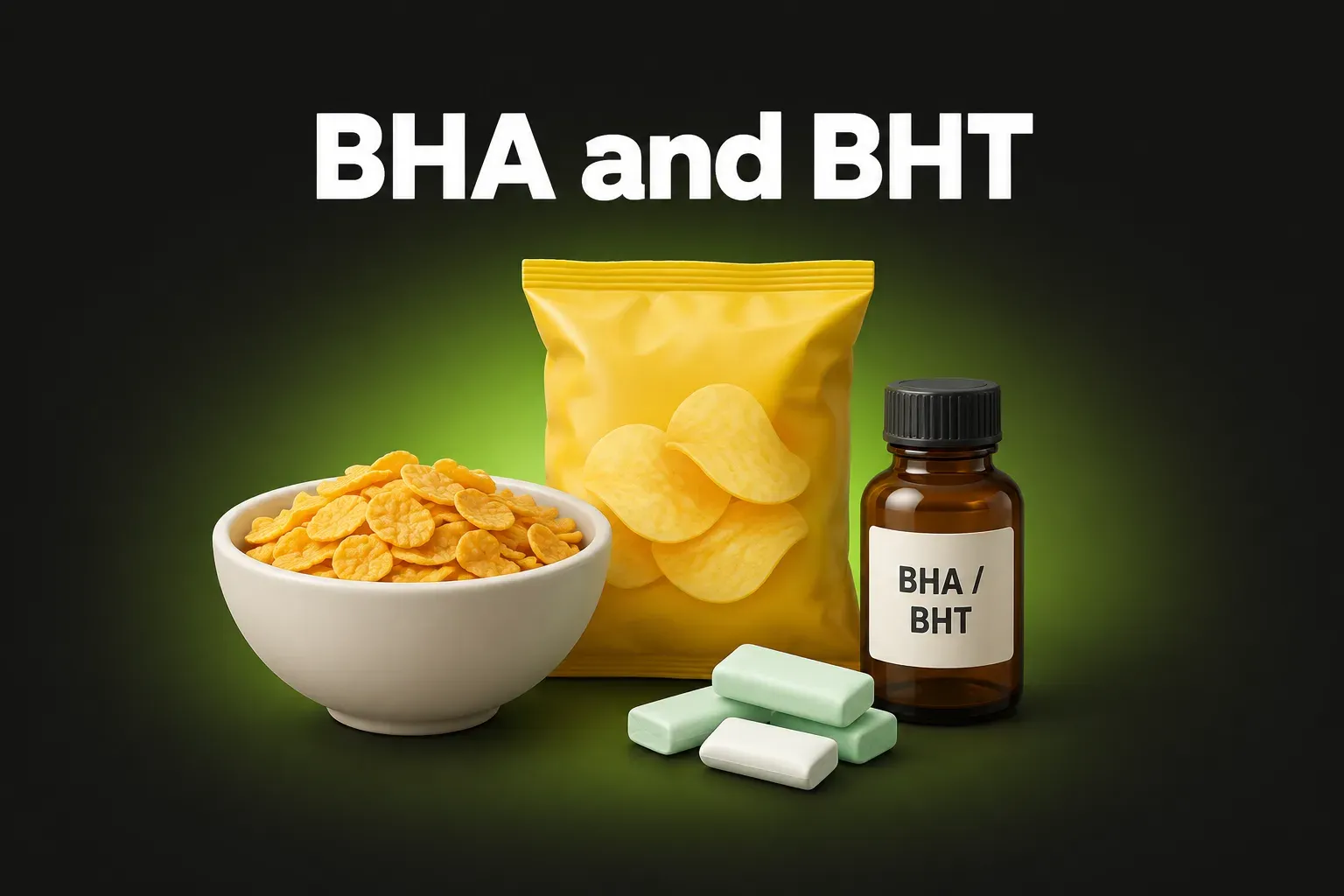
BHA and BHT are two preservatives with long chemical names and short labels. They keep cereals, chewing gum and chips from tasting stale – sometimes without even being in the food itself, but in the packaging liner. One of them, BHA, has been called a possible carcinogen for almost 40 years, and in 2026 the US FDA started reviewing both.
The short answer: BHA (E320) and BHT (E321) are lab-made antioxidants that stop fats from going rancid. BHA caused stomach tumors in rodents and is listed as “possibly carcinogenic to humans” by the WHO’s cancer agency, and as “reasonably anticipated to be a human carcinogen” in the US. BHT has mixed evidence from animal studies. The EU allows both only in certain foods, with low safe daily limits. In 2026, the US FDA began reassessing both. They’re easy to avoid – and there are natural alternatives.
What are BHA and BHT?
BHA (butylated hydroxyanisole) and BHT (butylated hydroxytoluene) are synthetic antioxidants. Fats and oils react with oxygen over time and go rancid – they smell and taste bad. BHA and BHT slow this down, so products last longer.
They’re often used together, and sometimes with a third preservative, TBHQ (E319). They’re also used in cosmetics, medicines, rubber, plastics and food packaging.
On labels, look for BHA, BHT, butylated hydroxyanisole, butylated hydroxytoluene, E320 or E321. Sometimes the label says “BHT added to packaging material to preserve freshness”.
Which foods contain BHA and BHT?
- Breakfast cereals – often in the bag liner, from which small amounts move into the food
- Chewing gum
- Potato chips and other snacks
- Shortening, lard and vegetable oils
- Cake mixes, cookies and pastries
- Dried meat, sausages and bacon bits
- Some sweets and dessert mixes
They’re more common in the US. In the EU, they’re allowed only in certain foods, such as fats and oils, chewing gum, dried potato products and some snacks.
Are BHA and BHT safe? What the research says
BHA and cancer
When rats and hamsters were fed high doses of BHA, they developed tumors in the forestomach – a part of the stomach that humans don’t have. Based on this, in 1986 the WHO’s cancer agency (IARC) listed BHA as “possibly carcinogenic to humans” (Group 2B). The US National Toxicology Program lists it as “reasonably anticipated to be a human carcinogen”.
Some scientists argue that the forestomach tumors aren’t relevant to humans, because we don’t have a forestomach, and that IARC itself later said the mechanism doesn’t apply to people – but the classification was never changed (Felter et al., Regulatory Toxicology and Pharmacology, 2021). Other researchers point to lab studies suggesting BHA may also act on hormones (endocrine disruption) and damage DNA (Zhang et al., Journal of the Science of Food and Agriculture, 2023).
Animal studies matter: rodents share most of their genes with us, and you can’t feed people a suspected carcinogen for years to see what happens, because that would put their health at risk.
BHT
The research on BHT is mixed. At high doses, some animal studies found effects on the liver, thyroid, lungs and blood clotting, and a few found more tumors – while others found no harm or even less cancer. IARC says BHT is not classifiable as a human carcinogen.
What regulators say
- EU: the European Food Safety Authority set safe daily limits of 1 mg per kg of body weight for BHA (2011) and 0.25 mg per kg for BHT (2012) – among the lowest for any preservative. Both are allowed only in certain foods.
- US: both are allowed in many foods. But in February 2026, the FDA started a full safety reassessment of BHA, and in May 2026 it added BHT to its list of food chemicals to review.
- California lists BHA as a substance known to cause cancer under its Proposition 65 law.
BHA, BHT and natural alternatives
| Antioxidant | E‑number | Notes |
|---|---|---|
| BHA | E320 | Possible carcinogen (IARC 2B); FDA reassessment since 2026 |
| BHT | E321 | Mixed animal data; FDA reassessment since 2026 |
| TBHQ | E319 | Lab‑made; immune and animal study concerns |
| Vitamin E (tocopherols) | E306–E309 | Natural; widely used instead |
| Rosemary extract | E392 | Natural; used in oils, meat and snacks |
| Vitamin C (ascorbic acid) | E300 | Natural; used in many foods |
Many companies have already switched to vitamin E or rosemary extract – so if you see BHA or BHT on a label, there’s often a similar product without them.
How to avoid BHA and BHT
- Read labels for BHA, BHT, E320 and E321 – including the note about packaging.
- Choose cereals and snacks preserved with tocopherols (vitamin E) or rosemary extract.
- Buy fresh oils in small bottles and store them in a cool, dark place, so they don’t need strong preservatives.
- Eat fewer packaged snacks – most BHA and BHT comes from ultra-processed foods.
- Check chewing gum – it’s one of the most common sources in the EU.
Spot BHA and BHT on any label in seconds. With NutriSmart, you photograph the ingredient list or scan the barcode, and the app tells you right away if the product has BHA and BHT. Turn on an alert for them, and the app warns you every time a product you scan contains them. You’ll also see every other additive, the risks of each one and a health score out of 100.Get the app free
The bottom line
BHA (E320) and BHT (E321) are lab-made antioxidants that keep fats in cereals, gum, chips and oils from going rancid. BHA caused tumors in rodents and is listed as a possible human carcinogen, while BHT’s animal data are mixed. The EU allows both only in certain foods with low limits, and the US FDA began reassessing both in 2026. Natural alternatives like vitamin E and rosemary extract are widely used – so choosing products without BHA and BHT is easy.
FAQ
What are BHA and BHT?
BHA (butylated hydroxyanisole, E320) and BHT (butylated hydroxytoluene, E321) are lab-made antioxidants. They're added to fats, oils and foods that contain them to stop them from going rancid. They're also used in cosmetics, medicines and food packaging.
Is BHA a carcinogen?
BHA caused stomach tumors in rats and hamsters fed high doses. Because of this, the WHO's cancer agency lists it as possibly carcinogenic to humans, and the US National Toxicology Program says it is reasonably anticipated to be a human carcinogen. Rodents have a forestomach that humans don't have, so experts disagree about how much this matters for people.
Is BHT safe?
The evidence is mixed. Some animal studies found harm to the liver, thyroid and lungs at high doses, while others found no harm or even protective effects. The European Food Safety Authority set a low safe daily limit of 0.25 mg per kg of body weight. In 2026, the US FDA added BHT to its list of food chemicals to reassess.
What foods contain BHA and BHT?
Mostly breakfast cereals (often in the packaging liner), chewing gum, potato chips and snacks, shortening and vegetable oils, cake mixes, dried meats, sausages, and some sweets. They're more common in the US than in the EU.
Are BHA and BHT banned in Europe?
No. Both are allowed in the EU, but only in certain foods – mainly fats, oils, chewing gum, cereals and some snacks – and in small amounts. The EU's limits are stricter than in the US.
How do I avoid BHA and BHT?
Read labels for BHA, BHT, butylated hydroxyanisole, butylated hydroxytoluene, E320 or E321. Choose cereals, snacks and oils that use natural antioxidants like vitamin E (tocopherols, E306–E309) or rosemary extract instead.