Disodium EDTA and Calcium Disodium EDTA: Are They Safe?
What disodium EDTA and calcium disodium EDTA (E385) are, why they're in mayonnaise, dressings and canned beans, and what studies show.
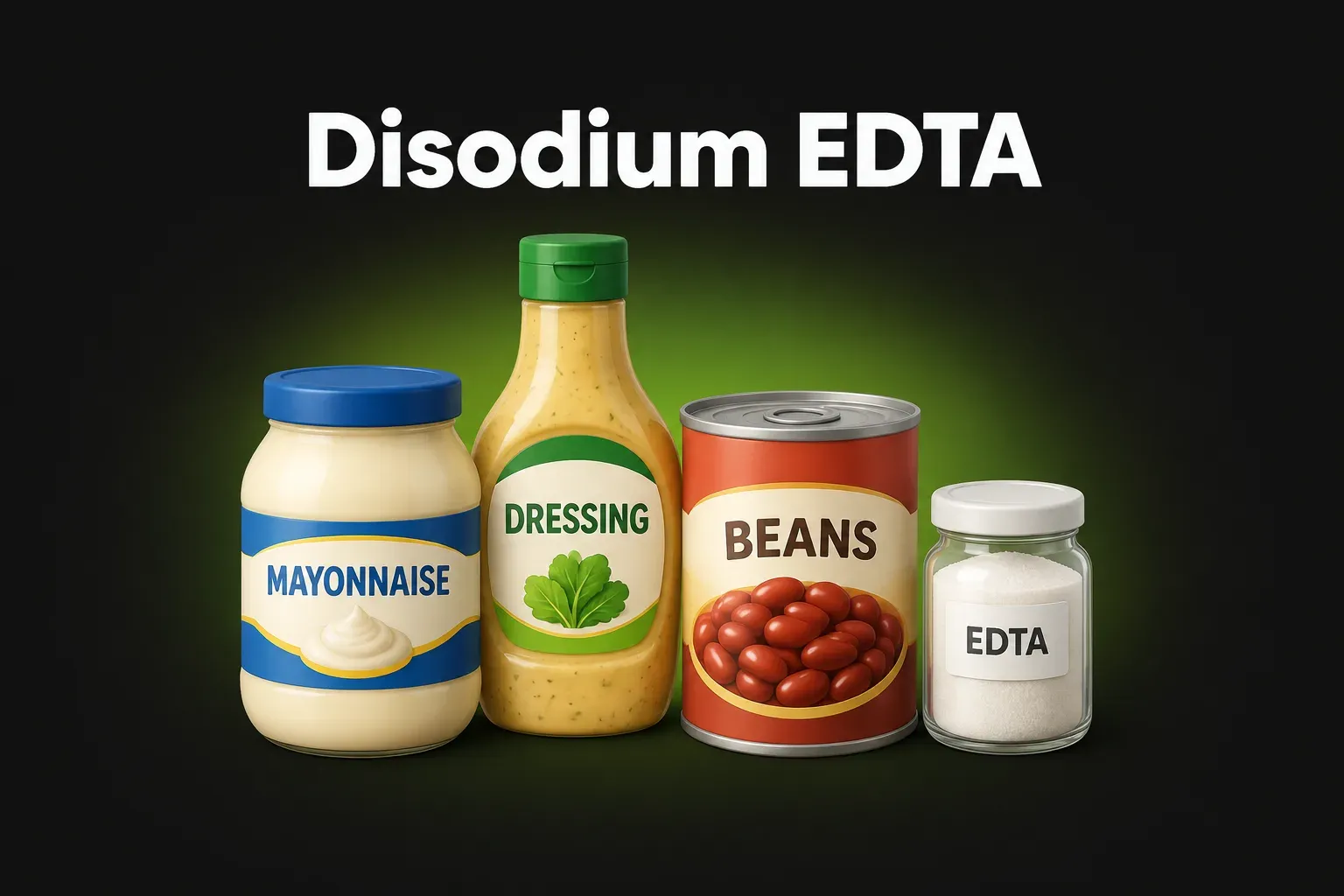
Disodium EDTA and calcium disodium EDTA appear on the labels of mayonnaise, salad dressings, canned beans, pickles, sauces and some sodas. The long chemical names sound alarming – and some websites say EDTA “steals minerals” from your body. Here’s what it really does and what the studies show.
The short answer: EDTA is a chelating agent – it grabs tiny amounts of metals like iron and copper in food, which keeps oils from going rancid and colors and flavors from changing. Only about 5% is absorbed. Harmful effects in animals appeared only at doses hundreds of times higher than in food, and in human studies, EDTA in food didn’t lower calcium or zinc. A 2025 mouse study found it can change gut bacteria. NutriSmart rates it as low risk.
What is EDTA?
EDTA stands for ethylenediaminetetraacetic acid. It’s a lab-made molecule shaped like a claw that wraps around metal ions and holds them tightly. Tiny amounts of iron and copper in food speed up spoiling – they make fats go rancid, colors fade and flavors turn metallic. EDTA “locks away” these metals so it doesn’t happen.
On labels you’ll see:
| Name | Where |
|---|---|
| Calcium disodium EDTA / E385 | US and EU |
| Disodium EDTA | US only |
| “Added to protect flavor” / “to preserve freshness” | Often written after the name on US labels |
Calcium disodium EDTA is already loaded with calcium, so it doesn’t pull calcium out of the body. It’s the only form allowed in EU food.
Which foods contain EDTA?
- Mayonnaise, salad dressings and sandwich spreads
- Canned beans, chickpeas and vegetables
- Pickles, relish and canned mushrooms
- Some sodas and canned drinks, where it protects flavor and color and can help prevent benzene from forming when sodium benzoate and vitamin C are used together
- Canned seafood, like shrimp and crab
- Margarine and spreads
Is EDTA safe? What the research shows
“EDTA steals your minerals” – not at food levels
This is the most common claim online, and the studies don’t support it for food:
- Women who ate bread fortified with an iron form of EDTA absorbed more zinc, and their calcium balance didn’t change (Davidsson et al., American Journal of Clinical Nutrition, 1994).
- Adding EDTA to zinc-fortified porridge increased zinc absorption by about 30% (Brnić et al., Journal of Nutrition, 2014).
That’s why the WHO supports an EDTA-iron compound for fortifying foods in countries with iron deficiency. The mineral problems you read about come from large intravenous doses used in medicine (chelation therapy), not from food.
High doses in animals
In animal studies, EDTA affected reproduction and development – but the lowest harmful dose was about 750 mg per kg of body weight per day (Lanigan and Yamarik, International Journal of Toxicology, 2002). The safe daily limit for food is 2.5 mg per kg, about 300 times lower.
Gut bacteria: a newer question
In 2025, Harvard researchers gave mice doses close to what people get from food. EDTA changed their gut bacteria. In females exposed from pregnancy onward, it reduced the calories they absorbed and they gained about a third less body fat for the same food intake; males showed no effect (Schell et al., American Journal of Clinical Nutrition, 2025). This is one animal study, and the effect isn’t clearly harmful – but it shows that preservatives like EDTA can affect the gut microbiome, which is worth more research.
Why NutriSmart rates it low risk
The evidence of harm at food levels is weak, the old “mineral-stealing” claim isn’t supported for food, and toxic effects appear only at doses far above what we eat. The gut-bacteria finding is a reason to keep watching the research, not a proven risk. So EDTA gets a low risk rating.
How to eat less EDTA
- Read labels on mayonnaise, dressings and canned foods – look for EDTA or E385.
- Choose dressings and mayonnaise in glass jars with shorter ingredient lists.
- Cook dried beans, or pick canned beans with just beans, water and salt.
- Make your own vinaigrette with oil, vinegar or lemon and herbs.
Spot EDTA on any label in seconds. With NutriSmart, you photograph the ingredient list or scan the barcode, and the app tells you right away if the product has EDTA. Turn on an alert for it, and the app warns you every time a product you scan contains it. You’ll also see every other additive, the risks of each one and a health score out of 100.Get the app free
You can also read about sodium benzoate, potassium sorbate and citric acid, or see the full E numbers list.
The bottom line
Disodium EDTA and calcium disodium EDTA (E385) are chelating agents that keep foods like mayonnaise, dressings and canned beans fresh. At food levels they don’t strip minerals from the body – they can even help with iron and zinc absorption – and toxic effects in animals appeared only at much higher doses. A 2025 mouse study found effects on gut bacteria, so the research isn’t finished. NutriSmart rates EDTA as low risk.
FAQ
What is EDTA in food?
EDTA (ethylenediaminetetraacetic acid) is a chelating agent: it grabs metal traces like iron and copper. In food, this keeps oils from going rancid, colors from fading and flavors from changing. It's added as calcium disodium EDTA (E385) or, in the US, also as disodium EDTA.
Is calcium disodium EDTA safe?
In the amounts used in food, it's considered safe, and NutriSmart rates it as low risk. Only about 5% is absorbed. Harmful effects in animals appeared at doses hundreds of times higher than people get from food. A 2025 mouse study found it can change gut bacteria, which needs more research.
Does EDTA remove minerals from your body?
Not at food levels. In human studies, EDTA in food didn't lower calcium or zinc, and it can even help the body absorb iron and zinc – that's why a form of it is used to fortify foods with iron. Large IV doses used in medicine are a different matter.
What's the difference between disodium EDTA and calcium disodium EDTA?
They're two salts of the same compound. Calcium disodium EDTA (E385) is already bound to calcium, so it doesn't pull calcium from the body. It's the only form allowed in EU food. Disodium EDTA is also allowed in some US foods.
Why is EDTA in soda?
In some soft drinks it protects color and flavor, and it can help prevent benzene from forming when sodium benzoate and vitamin C are used together.
Is EDTA banned in Europe?
No. Calcium disodium EDTA (E385) is allowed in a few foods, such as mayonnaise, sauces, canned beans and some canned fish. Disodium EDTA isn't on the EU's list of food additives.