Is MSG Bad for You? What Science Says About E621
What MSG (monosodium glutamate, E621) is, whether it causes headaches or other side effects, how much is safe per day and which foods contain it.
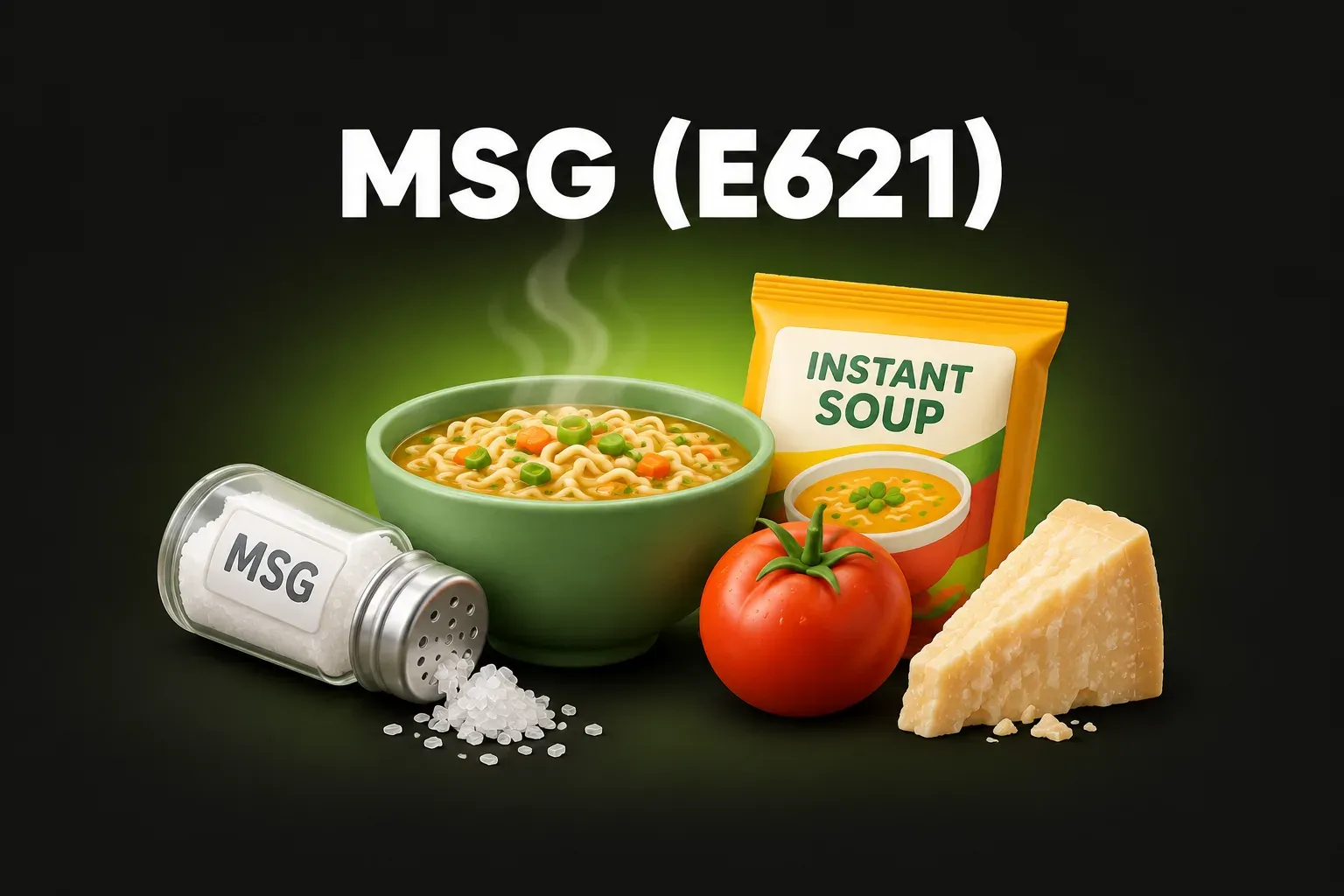
MSG (monosodium glutamate, E621) has one of the worst reputations of any food additive. For decades it was blamed for headaches, sweating and the so-called “Chinese restaurant syndrome”. Today it’s in instant noodles, chips, soups and seasonings – and still at the center of the debate. So is MSG bad for you, or is its reputation unfair?
The short answer: regulators consider MSG safe in normal amounts. Careful studies haven’t been able to clearly show the symptoms people blame on it. A few sensitive people may get mild symptoms that pass quickly, after large doses on an empty stomach. But animal studies have shown that very high doses can harm nerve cells. That’s why many experts still advise caution. The European Food Safety Authority (EFSA) set a daily safety limit and warned that people who eat a lot of processed food can go over it. And the bigger problem is the salty, ultra-processed foods MSG usually comes in.
What is MSG?
MSG is a salt made from sodium and glutamic acid, one of the building blocks of protein (amino acids). Glutamic acid is in almost every protein-rich food. Glutamate is what gives foods their savory, meaty umami taste. It occurs naturally in:
- tomatoes, especially ripe and dried
- aged cheeses like parmesan
- mushrooms, seaweed and soy sauce
- meat broths and cured ham
- breast milk
The MSG added to food is made by fermenting starch, sugar beets, sugar cane or molasses – much like yogurt or vinegar is made. Your body can’t tell the difference between glutamate from a tomato and glutamate from MSG.
On labels, you’ll see it as:
| Name | Where you’ll see it |
|---|---|
| Monosodium glutamate, MSG | United States and worldwide |
| E621, “flavor enhancer: E621” | European Union, UK and many other countries |
| E620, E622–E625 | Glutamic acid and other glutamates, with the same rules as E621 |
Ingredients such as yeast extract, hydrolyzed vegetable protein and soy extracts naturally contain glutamate too. They must be listed on labels, but they don’t have to say “glutamate”. In the US, products that contain them can’t claim “No MSG” (FDA).
Is MSG bad for you? What the research says
Headaches and “MSG symptom complex”
MSG’s bad name started with a letter to a medical journal in 1968. It described symptoms after eating at Chinese restaurants. Since then, many studies have tried to check it.
- The FDA’s position: a scientific review for the FDA concluded that MSG is safe. But some sensitive people may get mild symptoms that pass quickly if they have 3 grams or more of MSG without food: headache, numbness, flushing, tingling, a racing heart or sleepiness. A typical serving of a food with added MSG contains less than 0.5 grams (FDA).
- Careful trials: in a trial at several hospitals, 130 people who believed they reacted to MSG got either MSG or a fake dose, without knowing which. Large doses without food caused more symptoms than the fake dose. But the reactions didn’t happen again when people were tested a second time, and none were serious or lasting (Geha et al., Journal of Allergy and Clinical Immunology, 2000).
In practice: if you notice MSG gives you headaches, it’s fine to avoid it. But for most people, normal amounts eaten with food don’t cause symptoms.
How much is too much?
In 2017, EFSA checked MSG and the other glutamates again. It set a safe daily limit of 30 mg per kg of body weight – about 2.1 g for a 70 kg (154 lb) adult (EFSA, 2017).
EFSA also found that people who eat a lot of foods with these additives can go over that limit, at any age. Children and teenagers who eat the most may reach amounts that some studies link to headaches. EFSA asked for the maximum amounts allowed in foods to be reviewed. For comparison, the FDA estimates that the average American eats about 0.55 g of added MSG a day – and about 13 g of glutamate from protein in normal foods.
Effects on the brain: what animal studies show
Glutamate is also one of the chemicals nerve cells use to talk to each other. Too much of it can overwork nerve cells until they die. Doctors call this excitotoxicity and study it in diseases such as Alzheimer’s and Parkinson’s.
The first alarm came in 1969. A US researcher injected newborn mice with large doses of MSG. The mice got brain damage and, later, obesity (Olney, Science, 1969). Research has continued since:
- A 2023 review looked at 29 studies in mice and rats. Animals given MSG had damaged nerve cells, short-term memory problems and changes like those in Alzheimer’s disease (Frontiers in Pharmacology, 2023).
- In a 2019 study, MSG added to food – not injected – sped up Alzheimer’s-like changes in mice that easily get the disease (Journal of Alzheimer’s Disease, 2019).
Why animal studies matter: they’re done in mice and rats because these animals share most of their genes with humans. In them, too much glutamate harms the brain the same way. And testing a suspect substance on people would put their health at risk. The doses used were high, often injected, and many studies used newborn animals. In people, the link between MSG and diseases such as Alzheimer’s or Parkinson’s hasn’t been studied yet. But no studies doesn’t mean no risk.
As a precaution, we recommend limiting MSG, especially for children, pregnant women and older adults. Even EFSA based its daily limit on a study of how the brain and nerves develop.
Sodium
MSG contains about a third as much sodium as table salt. Because it makes food taste stronger, cooks sometimes use it to add less salt. The catch: most MSG in a typical diet comes from foods that are already very salty – instant soups, chips, seasoning mixes and processed meat.
Weight and appetite
Besides brain damage, the same animal studies found that animals given high doses when young gained weight. Because MSG makes food tastier, it may also make people eat more. Human studies on MSG and weight have given mixed results so far.
Which foods contain MSG (E621)?
- Instant noodles and soups, bouillon cubes and stock powders
- Seasoning mixes and all-purpose seasonings for soups and stews
- Chips and flavored snacks, especially cheese, barbecue and sour cream flavors
- Processed meat: sausages, hot dogs, salami and deli meats
- Ready meals, frozen pizza and some sauces and dressings
- Fast food and restaurant food, especially fried chicken and Asian dishes
Should you avoid MSG?
You don’t need to fear MSG. But eating less of the foods that contain it is a good idea for other reasons too. Consider limiting it if you:
- notice headaches or other symptoms after foods with MSG (try avoiding it for a few weeks and see)
- eat instant soups, chips or processed meat most days – the foods that push intake over the EFSA limit
- are watching your sodium intake or blood pressure
- give children a lot of flavored snacks and instant meals
How to eat less MSG
- Read the ingredient list for “monosodium glutamate”, “E621”, “flavor enhancer” and, if you’re sensitive, “yeast extract” and “hydrolyzed protein”.
- Swap instant soups and bouillon cubes for homemade broth or simple herbs and spices.
- Choose plain snacks – nuts, plain popcorn or lightly salted chips – over strongly flavored ones.
- Use natural umami from tomatoes, mushrooms or a little parmesan to add flavor at home.
Spot E621 in seconds. With NutriSmart, you photograph the label or scan the barcode and the app highlights flavor enhancers and other additives, explains what each one is and gives the product a health score out of 100 – so you can compare two products on the spot.Get the app free
You can also read about natural flavors and ultra-processed foods.
Other flavour enhancers like E627 and E631 are rated in our E numbers list.
Two other flavor enhancers often appear next to MSG: disodium inosinate and guanylate and yeast extract.
The bottom line
MSG is approved, and in small amounts human studies haven’t shown serious harm. But some people react to large doses, and animal studies show that very high doses harm nerve cells. People who eat mostly processed food can also go over EFSA’s safe limit. The best reason to eat less MSG is that it’s mostly found in salty, ultra-processed foods – and those are worth cutting back on anyway.
FAQ
Is MSG bad for you?
In normal amounts, regulators say it's safe. The FDA considers MSG generally recognized as safe, and careful studies haven't clearly linked it to symptoms. The European Food Safety Authority set a safe daily limit of 30 mg per kg of body weight. It noted that people who eat a lot of processed food can go over it. The bigger issue is that MSG is common in salty, ultra-processed foods.
Does MSG cause headaches?
Possibly in a small number of sensitive people, at high doses. A review for the FDA found that some people may get mild symptoms that pass quickly, such as headache, flushing or tingling. This happens if they take 3 grams or more of MSG without food. A typical serving of food with added MSG contains less than 0.5 grams.
Is MSG natural?
Glutamate, the part of MSG that gives the savory umami taste, occurs naturally in tomatoes, parmesan, mushrooms, soy sauce and breast milk. The MSG added to food is made by fermenting starch, sugar beets or molasses. Your body handles glutamate from both sources the same way.
How much MSG is safe per day?
The European Food Safety Authority set a safe daily limit of 30 mg per kg of body weight for glutamates added to food – about 2.1 g a day for a 70 kg adult. The FDA estimates that the average American eats about 0.55 g of added MSG a day.
Is MSG worse than salt?
MSG contains about a third as much sodium as table salt. Used to replace part of the salt in a recipe, it can lower total sodium. But most MSG in the diet comes from processed foods that are already high in salt.
What is E621?
E621 is the European code for monosodium glutamate (MSG), a flavor enhancer. On labels in the EU you'll see it as "flavor enhancer: E621" or "monosodium glutamate". Related additives are E620 (glutamic acid) and E622–E625 (other glutamates).