Healthiest Steak Cut: 10 Cuts Ranked by Fat and Protein
What is the healthiest steak cut? Eye of round, sirloin, flank, filet, ribeye and more compared by calories, protein and fat, plus how to cook steak safely.
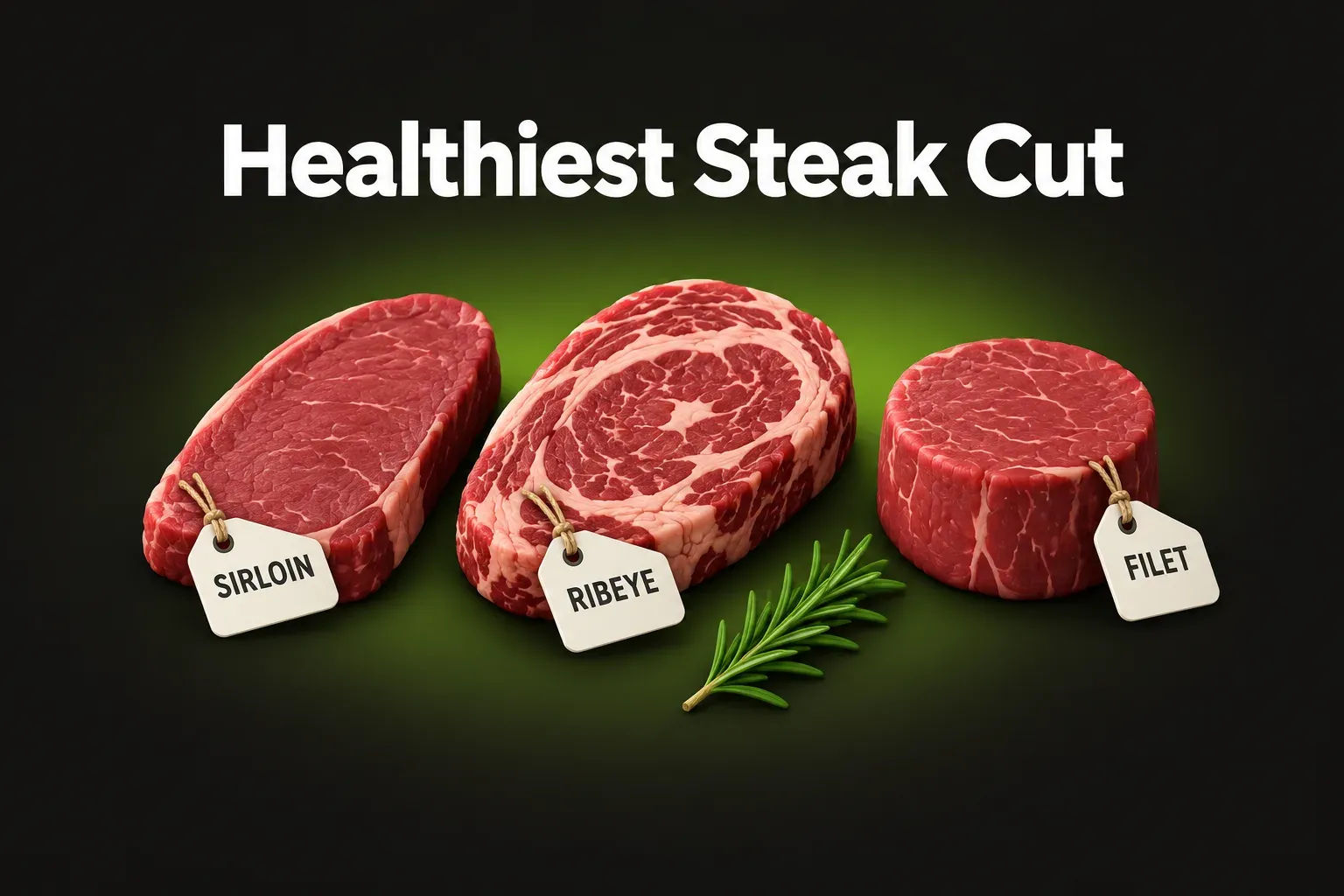
Steak can be part of a healthy diet. But not all cuts are the same. Some have four times as much fat as others.
The short answer: the healthiest steak cuts are the leanest ones: eye of round and top round, followed by top sirloin, flank steak and filet mignon. A 3 oz cooked eye of round has 135 calories, 25 g of protein and under 4 g of fat. The same amount of ribeye has 230 calories and 16 g of fat. For a good mix of taste and leanness, pick top sirloin or flank. Keep the portion to 3–6 oz, don’t char it, and eat red meat a few times a week, not every day.
10 steak cuts compared
The numbers below are for 3 oz (85 g) of cooked steak. That is about the size of a deck of cards. Each cut is trimmed of its outer fat, so only the fat inside the meat counts. A steak that still has a fat edge will have more calories.
| Cut (3 oz cooked) | Calories | Protein | Fat | Saturated fat | USDA range* |
|---|---|---|---|---|---|
| Eye of round | 135 | 25 g | 3.8 g | 1.4 g | Extra lean |
| Top round | 142 | 26 g | 3.6 g | 1.5 g | Extra lean |
| Flank steak | 163 | 24 g | 7.0 g | 2.9 g | Lean |
| Flat iron | 178 | 23 g | 9.4 g | 3.9 g | Not lean |
| Filet mignon | 179 | 26 g | 7.6 g | 3.0 g | Lean |
| Top sirloin | 180 | 25 g | 8.2 g | 3.2 g | Lean |
| Strip (NY strip) | 190 | 24 g | 9.5 g | 3.9 g | Not lean |
| Skirt steak | 208 | 25 g | 12.1 g | 4.3 g | Not lean |
| T-bone | 210 | 21 g | 13.5 g | 5.2 g | Not lean |
| Ribeye | 230 | 21 g | 16.1 g | 7.2 g | Not lean |
Source: USDA FoodData Central, all grades, trimmed to 0” fat, grilled or broiled – eye of round, top round, flank, flat iron (top blade), filet mignon (tenderloin), top sirloin, strip (top loin), skirt (inside), T-bone, ribeye. Values per 100 g, multiplied to 3 oz and rounded. *Based on the cooked values per 100 g; labels judge the raw meat in the pack.
What stands out:
- Protein barely changes. Every cut gives about 21–26 g. The real difference is the fat.
- Fat changes a lot. Ribeye has about 4 times the fat of eye of round, and 5 times the saturated fat (the type of fat that can raise LDL, or “bad,” cholesterol).
- Protein per calorie: eye of round gives about 19 g of protein per 100 calories. Ribeye gives about 9 g. If you want the most protein for your calories, the round cuts win.
- Skirt steak varies. The table shows inside skirt. The outside skirt cut has about 250 calories and 17 g of fat per 3 oz (USDA).
All steaks are also rich in iron, zinc and vitamin B12. The iron in meat is easier for your body to absorb than iron from plants. See more in our foods high in iron list.
What “lean” and “extra lean” mean
These words on a meat label have legal limits. The rules are set in US federal law (9 CFR 317.362). They apply per 100 g (3.5 oz) of meat and per serving:
- Lean: less than 10 g of fat, 4.5 g or less of saturated fat and less than 95 mg of cholesterol.
- Extra lean: less than 5 g of fat, less than 2 g of saturated fat and less than 95 mg of cholesterol.
Using the cooked USDA numbers, eye of round and top round fall in the extra lean range. Flank, top sirloin and filet mignon fall in the lean range. Strip steak and flat iron are just over the fat limit. But if you cut off every bit of visible fat, strip steak drops to about 8.4 g of fat per 100 g. That puts it in the lean range too (USDA).
The healthiest steak cuts, ranked
Best picks: eye of round and top round
These cuts come from the back leg of the cow. They are the leanest steaks you can buy. They also cost less than most other steaks. The downside: they have little fat, so they can turn dry and chewy. Cook them to medium-rare or medium, then slice them thin across the grain.
Great picks: top sirloin, flank and filet mignon
Top sirloin is the best all-around choice. It has good flavor, a fair price and only about 180 calories per 3 oz. Flank steak is a bit leaner. It is great for grilling and slicing. Filet mignon is the most tender steak. Its numbers are close to sirloin, but it costs a lot more.
Middle of the pack: strip and flat iron
Strip steak (also called New York strip) and flat iron have a bit more fat. They are still fine for a healthy meal. Trim the fat edge and keep the portion small.
Enjoy now and then: skirt, T-bone and ribeye
These cuts have the most marbling (thin white streaks of fat inside the meat). That is why they taste so rich. A 3 oz ribeye has 7 g of saturated fat. That’s about a third of the daily limit for a 2,000-calorie diet. And restaurant ribeyes often weigh 12–16 oz before cooking. Save these for special meals, or share one.
Does the beef grade matter?
Yes. The USDA grades you see most in stores are Prime, Choice and Select. Prime has the most marbling and Select the least. For the same cut, a leaner grade means fewer calories:
- Top sirloin, 3 oz: Choice has about 186 calories and 8.9 g of fat. Select has about 175 calories and 7.5 g of fat (Choice, Select).
- Ribeye, 3 oz: Choice has about 242 calories and 17.9 g of fat. Select has about 211 calories and 13.5 g of fat (Choice, Select).
So a Select top sirloin is almost as lean as flank steak.
Is red meat bad for you?
Steak is unprocessed red meat. That is different from processed meat like bacon, hot dogs, deli meat and beef jerky.
The concerns:
- In 2015, the World Health Organization’s cancer agency (IARC) called red meat “probably carcinogenic” (probably a cause of cancer). The link was mainly with colon cancer. It called processed meat a known cause of cancer (Bouvard et al., Lancet Oncology, 2015).
- One study followed about 121,000 US adults for up to 28 years. Each extra daily serving of unprocessed red meat was linked to a 13% higher risk of death (Pan et al., Archives of Internal Medicine, 2012).
- A large analysis pooled 31 studies with almost 2 million adults from 20 countries. Each extra 100 g (3.5 oz) a day of unprocessed red meat was linked to a 10% higher risk of type 2 diabetes (Li et al., Lancet Diabetes & Endocrinology, 2024).
The other side:
- A review of 55 long-term studies (over 4 million people in total) found the same kind of links. But it rated the proof as low certainty. Eating 3 fewer servings a week was linked to only a very small drop in risk of heart disease, stroke and type 2 diabetes (Zeraatkar et al., Annals of Internal Medicine, 2019).
- Studies that follow people over time show a link, not proof. People who eat a lot of red meat may also smoke more or eat fewer vegetables.
- In a review of 36 trials, diets with red meat and other diets had about the same effect on cholesterol and blood pressure. But swapping red meat for beans, soy or nuts lowered LDL cholesterol more (Guasch-Ferré et al., Circulation, 2019).
- In a small trial, 36 adults with high cholesterol ate 4–5 oz of lean beef a day in a low-saturated-fat diet. Their LDL cholesterol dropped about as much as on the DASH diet (Roussell et al., American Journal of Clinical Nutrition, 2012). This study was paid for in part by the Beef Checkoff, a beef industry program.
What to do: the World Cancer Research Fund advises no more than about 3 portions of red meat a week. That’s about 12–18 oz (350–500 g) cooked in total (WCRF). The 2025–2030 Dietary Guidelines for Americans keep the limit on saturated fat at under 10% of daily calories (Harvard Nutrition Source, 2026). Lean cuts make that limit easy to meet. On other days, choose fish, chicken, eggs, beans or lentils. Our list of high protein foods has many ideas.
Grass-fed vs grain-fed steak
Most US beef comes from cattle that finish on grain. Grass-fed cattle eat only grass and hay once they stop drinking milk. A review of 30 years of studies found that grass-fed beef has less total fat. It also has more omega-3 fats (the healthy fats found in fish) and CLA (a fat linked to health benefits in some studies) per gram of fat (Daley et al., Nutrition Journal, 2010).
The review also found that total saturated fat was about the same. And the amount of omega-3 in a steak is small either way. Fatty fish like salmon is a far better source. So grass-fed is a fine choice if you like it. But picking a lean cut matters more than how the cow was fed.
How to cook steak more safely
When meat is cooked at very high heat, harmful compounds can form. They are called HCAs (heterocyclic amines) and PAHs (polycyclic aromatic hydrocarbons). HCAs form most in well-done, grilled or charred meat. PAHs form when fat drips onto flames and smoke coats the meat (National Cancer Institute).
In lab tests, rodents fed HCAs got tumors in many organs. But the doses were thousands of times higher than what people eat. Animal studies still matter. Mice and rats share most of our genes and body processes. Testing these compounds on people would put their health at risk. In people, the proof is mixed. A review found that most studies linked a high intake of well-done meat with a higher cancer risk (Zheng & Lee, Nutrition and Cancer, 2009). Other studies found no link (National Cancer Institute). Since several labs see the same signal, it makes sense to limit charred meat as a precaution.
Simple ways to cut HCAs and PAHs:
- Don’t char it. Cut off any burnt or blackened parts.
- Flip often. Turning the steak keeps the surface from getting too hot.
- Use medium heat and avoid flare-ups from dripping fat.
- Marinate first. In one test, beef steaks soaked for 1 hour in herb and spice marinades had 57–88% fewer HCAs after grilling (Smith et al., Journal of Food Science, 2008).
How much steak is a portion?
A healthy portion is 3–6 oz cooked. About 4 oz of raw steak cooks down to about 3 oz. Many restaurant steaks weigh 8–16 oz before cooking. That is two to four portions in one meal.
A 6 oz cooked top sirloin has about 360 calories and 50 g of protein. A 16 oz ribeye cooks down to about 12 oz. That has about 920 calories and 65 g of fat – before any sides. See exact numbers for each size in our guide to calories in steak. If you cook with ground beef, check calories in ground beef to compare lean ratios.
Build the rest of the plate around vegetables, a potato or whole grains. Our high protein dinner ideas show how. Not sure how much protein you need? Try our protein calculator.
Track your steak dinner without guesswork. With NutriSmart, you photograph what you eat. The app counts the calories, protein, carbs and fat on your plate. It then shows how much you have left for your daily target. That makes it easy to see how a 6 oz sirloin or a 16 oz ribeye fits into your day.Get the app free
The bottom line
The healthiest steak cuts are eye of round and top round, followed by top sirloin, flank and filet mignon. They give about 25 g of protein per 3 oz with little fat. Ribeye, T-bone and skirt steak have three to four times the fat of eye of round, so save them for special meals. Choose Select grade and trim the fat edge to cut calories even more. Keep portions to 3–6 oz and cook over medium heat without charring. Eat red meat about three times a week or less, and mix in fish, chicken and beans on other days.
FAQ
What is the healthiest cut of steak?
Eye of round and top round are the leanest. A 3 oz cooked portion has about 135–142 calories, 25–26 g of protein and under 4 g of fat. Top sirloin, flank steak and filet mignon are lean too, and many people find them more tender.
Is sirloin or ribeye healthier?
Sirloin. A 3 oz cooked top sirloin has about 180 calories and 3 g of saturated fat. The same amount of ribeye has about 230 calories and 7 g of saturated fat. Both have plenty of protein.
Is filet mignon a lean cut?
Yes. Trimmed filet mignon has about 179 calories and 7.6 g of fat per 3 oz cooked. That fits the USDA range for lean beef. It costs more than sirloin, which has almost the same numbers.
Is steak healthy to eat every day?
It's better not to. Large studies link high red meat intake with heart disease, type 2 diabetes and colon cancer. The World Cancer Research Fund advises no more than about 12–18 oz of cooked red meat a week.
Is grass-fed steak healthier?
A little. Grass-fed beef tends to have less fat and more omega-3 fats per gram of fat. But the amounts of omega-3 are small. Choosing a lean cut matters more than how the cow was fed.
What is the healthiest way to cook steak?
Cook it over medium heat and flip it often. Don't let it char, and cut off any burnt bits. Soaking it in a marinade with herbs and spices first can cut the harmful compounds that form on grilled meat.