Is Decaf Coffee Bad for You? Caffeine, Chemicals, Health
Is decaf coffee bad for you? How much caffeine is left, how decaf is made, the methylene chloride debate, what studies show and which brands use which method.
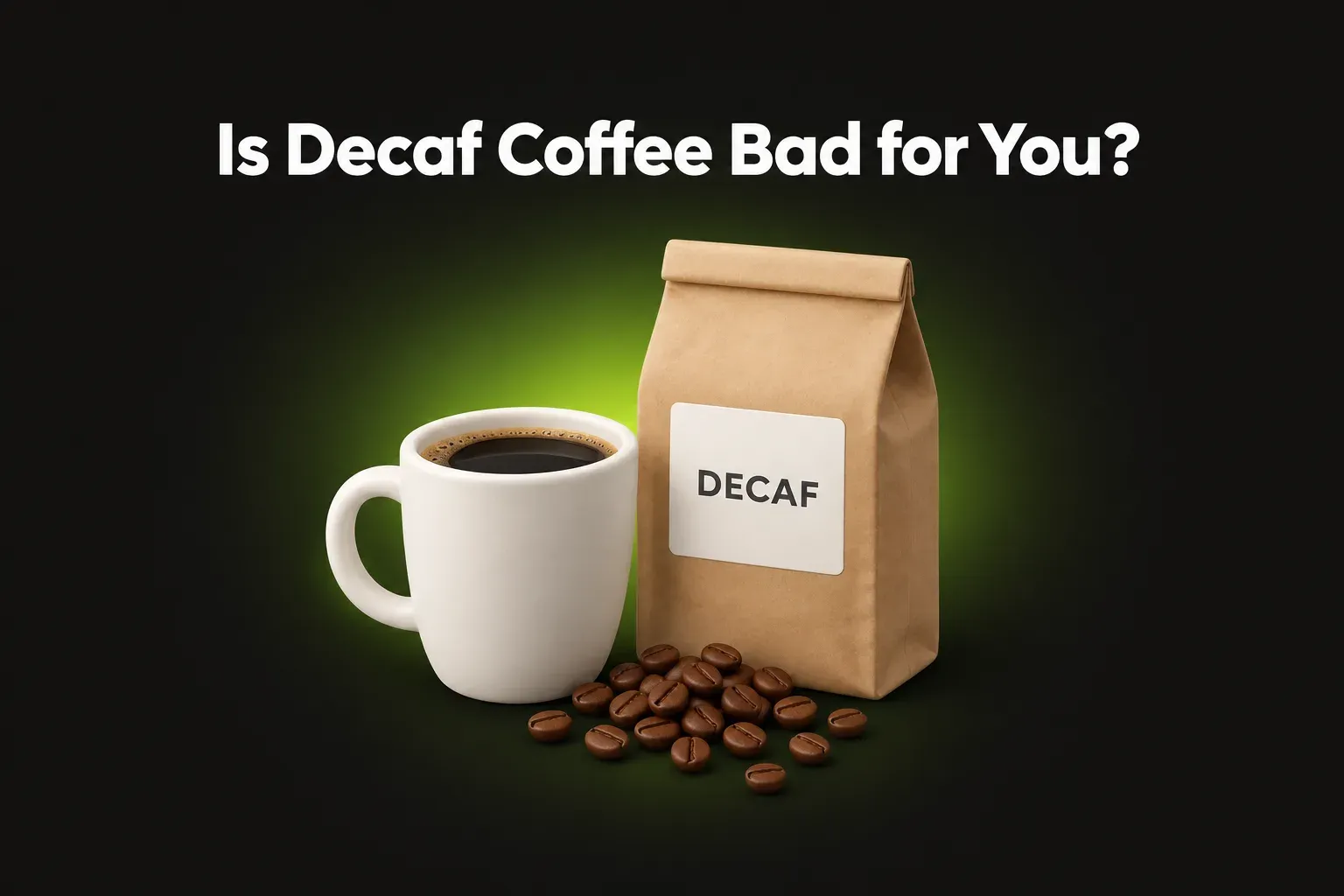
Decaf lets you enjoy coffee without the jitters. But you may have heard that it’s made with harsh chemicals. So is decaf coffee bad for you?
The short answer: for most people, decaf coffee is not bad for you. A cup has almost no calories and usually 2–15 mg of caffeine, versus about 95 mg in regular coffee. Large studies link decaf to a lower risk of early death and type 2 diabetes, much like regular coffee. The main worry is methylene chloride, a solvent used to make some decaf. Only tiny traces are left, and they are allowed by the FDA. But the chemical caused cancer in lab animals at high doses. If that bothers you, pick decaf made with the Swiss Water Process, another water process or CO2.
How much caffeine is in decaf?
Decaf is low in caffeine, not caffeine-free. Here is how it compares with regular coffee:
| Drink | Serving | Caffeine |
|---|---|---|
| Brewed coffee, regular | 8 fl oz (237 ml) | about 95 mg |
| Brewed coffee, decaf | 8 fl oz (237 ml) | about 2 mg |
| Decaf coffee, typical range | 8 fl oz (237 ml) | 2–15 mg |
| Instant coffee, regular | 8 fl oz (237 ml) | about 62 mg |
| Instant coffee, decaf | 8 fl oz (237 ml) | about 2 mg |
| Decaf coffee, average (Nescafé) | 12 fl oz (355 ml) | under 15 mg |
| Coffee-shop decaf (10 shops) | 16 fl oz (473 ml) | 0–14 mg |
| Starbucks decaf espresso | 1 shot | 3–16 mg |
Brewed and instant: USDA FoodData Central (regular brewed, decaf brewed, regular instant, decaf instant). Typical range: FDA. Nescafé: Nescafé US FAQ. Coffee shops and Starbucks: lab tests from 2006 (McCusker et al., Journal of Analytical Toxicology, 2006).
A few mg of caffeine does nothing most people can feel. But five large cups of coffee-shop decaf could add up to about 70 mg. If your doctor told you to avoid caffeine fully, ask whether decaf is OK.
Black decaf also has almost no calories – the USDA lists 0 per cup. The calories come from what you add. See calories in coffee for lattes, sugar and cream.
How decaf coffee is made
Caffeine is removed from green (unroasted) coffee beans. First the beans are soaked or steamed, so the caffeine can get out. Then one of four methods pulls the caffeine away:
- Methylene chloride. This is a solvent – a liquid that dissolves other substances. It grabs the caffeine. It can touch the beans directly or work through water. This is often called the “European method” or “direct contact” method. The National Coffee Association says most decaf is made this way (Daily Coffee News, 2026).
- Ethyl acetate. This solvent can come from natural sources like sugarcane. So bags may say “sugarcane decaf” or “EA decaf”. But it often isn’t made from natural sources, says the water-process company Swiss Water (Swiss Water).
- Swiss Water Process and other water methods. Beans soak in water that’s already full of coffee flavor. Only the caffeine moves out. Carbon filters then catch it. No solvent is used.
- CO2 method. Moist beans meet carbon dioxide under high pressure. The CO2 pulls out the caffeine. It’s the same gas that puts bubbles in soda.
Some bags say “naturally decaffeinated.” The FDA has no formal definition for “natural.” Its policy also doesn’t clearly cover how foods are processed (FDA). So this phrase doesn’t tell you which method was used.
Is methylene chloride in decaf safe?
Methylene chloride has been used in paint strippers. That sounds scary. But the real question is how much ends up in your cup.
What the FDA allows. Decaf beans may hold up to 10 parts per million of methylene chloride. That’s 0.001% (21 CFR 173.255). The solvent boils at about 104°F (40°C) (PubChem). Starbucks says the solvent in its decaf is driven off when the beans are steamed, washed and roasted at over 400°F (204°C) (CNN via KTVZ, 2024).
A quick math check. A cup uses about 0.35 oz (10 g) of beans. Even at the legal limit, that’s at most about 0.1 mg of methylene chloride. In one test, most brands had no amount that could be detected (see below).
What animal studies show. Rats and mice share most of our genes and body processes. And testing a possible cancer cause on people would put their health at risk. So these studies matter:
- Breathed in. Rats breathed air with 1,000–4,000 ppm of methylene chloride. Mice got 2,000–4,000 ppm. That’s 6 hours a day, 5 days a week, for 2 years. The mice got more lung and liver tumors. The rats got more non-cancerous (benign) breast tumors (National Toxicology Program, 1986).
- By mouth, high dose. Rats and mice got 500 mg per kg of body weight by stomach tube for 64 weeks. Male mice got more lung tumors (Maltoni et al., Annals of the New York Academy of Sciences, 1988).
- In drinking water. Mice drank up to 250 mg per kg a day for 2 years. They had no more tumors than normal (Serota et al., Food and Chemical Toxicology, 1986). In rats, the liver changed at 50 mg per kg and up. 5 mg per kg a day caused no harm (Serota et al., Food and Chemical Toxicology, 1986).
For a 150 lb (68 kg) adult, the 0.1 mg in a cup is about 3,000 times less than that no-harm dose in rats. In 2014, the WHO’s cancer agency called methylene chloride “probably carcinogenic” to humans. That means it probably causes cancer. The human evidence came mostly from workers who breathed it in, and it was limited (Benbrahim-Tallaa et al., Lancet Oncology, 2014).
What’s missing: there is no proof of harm in people from the traces in decaf. But several labs saw cancer in animals at high doses. So if you drink a lot of decaf, picking a water or CO2 decaf is a sensible precaution.
Where the rules stand:
- FDA petition. In December 2023, health and environmental groups asked the FDA to end its approval of methylene chloride in food. They were led by the Environmental Defense Fund. The FDA reopened public comments in 2026. It still has not decided (Daily Coffee News, 2026). In November 2026, the FDA ended a few other uses, like inks for marking fruit. Decaf was not part of that (Daily Coffee News, 2026).
- EPA ban. In 2024, the EPA banned consumer uses and most workplace uses of methylene chloride. Food is the FDA’s job, so decaf was not covered (CSPI).
- California. A 2024 bill (AB 2066) first aimed to ban methylene chloride decaf. It was later changed to a label rule. It stalled in committee in May 2024 and did not become law (LegiScan).
- Lab tests and lawsuits. The advocacy group Clean Label Project tested 24 decaf brands in 2019. In 2020, it sued five companies, including Maxwell House, Café Bustelo and Peet’s (Clean Label Project, 2020). In 2024, Peet’s said on its site that all its decafs use a water process. The 2023 FDA petition cites Clean Label Project tests that found methylene chloride in 7 of 17 brands. One brand had 8.9 ppm, close to the 10 ppm limit. The National Coffee Association said most levels were very low (CNN via KTVZ, 2024). In 2026, a class-action lawsuit claimed Starbucks Decaf House Blend contained methylene chloride, benzene and toluene. Starbucks says the claims are inaccurate (Tasting Table, 2026). These are claims, not court findings.
Which decaf brands use which method?
US labels don’t have to name the method. Here is what some brands say:
| Product | Method | What the brand says |
|---|---|---|
| Peet’s decafs | Water process | All its decafs use water; Swiss Water is one supplier |
| Kicking Horse Decaf | Swiss Water | Listed as “Swiss water process” on its site |
| Nescafé Taster’s Choice Decaf | Water process | Beans “extracted using a specialized water process” |
| Lavazza decaf | CO2 | Its decaf line uses CO2 and water |
| Green Mountain organic decafs | Water process | Water process is used for its organic coffees |
| Folgers Classic Decaf Instant | Ethyl acetate | Brand answer: “ethyl acetate process” |
| Green Mountain Breakfast Blend Decaf | Solvent | “Direct process,” normally methylene chloride or ethyl acetate |
| Starbucks decafs (most) | Solvent | “Direct contact method” is its most common process |
Sources: Peet’s, Kicking Horse, Nescafé US FAQ, Lavazza, brand answers on Target listings (Green Mountain, Folgers), Starbucks statement to CNN via KTVZ, 2024. Methods can change, so check the bag or ask the brand.
Tip: look for “Swiss Water,” “water process” or “CO2” on the bag. If the bag says nothing, the brand may use a solvent.
Decaf and your health: what studies show
Coffee has many compounds besides caffeine. Decaf keeps a lot of them. Big studies suggest decaf drinkers get many of the same perks:
- Living longer. About 500,000 adults in the UK were followed for 10 years. Coffee drinkers were less likely to die during the study. The results were similar for decaf (Loftfield et al., JAMA Internal Medicine, 2018).
- Heart health. Another UK study followed about 450,000 adults for 12 years. People who drank 2–3 cups of decaf a day had a 14% lower risk of dying than non-coffee drinkers. They also had less heart disease. But decaf did not lower the risk of irregular heartbeat. Regular coffee did (Chieng et al., European Journal of Preventive Cardiology, 2022).
- Type 2 diabetes. A review pooled 28 studies of over 1 million people. Each daily cup of decaf was linked to a 6% lower risk of type 2 diabetes. For regular coffee, it was 9% (Ding et al., Diabetes Care, 2014).
These studies show links, not cause. Coffee drinkers may differ in other ways. Still, there is no sign that decaf drinkers do worse.
One older warning sign. A 1991 trial split 181 men into three groups for 2 months. Some kept drinking regular coffee, some switched to decaf, and some quit coffee. In the decaf group, LDL (“bad”) cholesterol rose a little, by about 5 mg/dL. Men who quit coffee saw no change (Superko et al., American Journal of Clinical Nutrition, 1991). This was one older, short study. And the big UK study above found less heart disease, not more, in decaf drinkers.
Is decaf better for acid reflux?
For many people, yes. Two small German studies tested this:
- Healthy people. 16 healthy adults drank 10 oz (300 ml) of coffee with breakfast. Regular coffee caused acid reflux. Decaf caused much less. Plain water with caffeine added didn’t cause reflux. So other coffee compounds play a role (Wendl et al., Alimentary Pharmacology & Therapeutics, 1994).
- People with reflux disease. 17 patients drank regular or decaf coffee with breakfast. With regular coffee, acid sat in the food pipe about 18% of the time (the middle value). With decaf, it dropped to about 3% (Pehl et al., Alimentary Pharmacology & Therapeutics, 1997).
So decaf is often gentler. But coffee itself can still cause heartburn. If decaf bothers you too, try a smaller cup, drink it with food or skip it.
Who might choose decaf?
Decaf is a smart swap if you:
- Are pregnant or breastfeeding. Experts say up to 200 mg of caffeine a day in total is OK (EFSA, 2015). Decaf barely touches that limit.
- Sleep badly. Caffeine can stay in your body for hours. An evening decaf is much easier on sleep.
- Feel anxious or jittery, or have a fast heartbeat after coffee.
- Have heartburn that regular coffee makes worse.
- Drink a lot of coffee. Healthy adults can usually have up to 400 mg of caffeine a day (FDA). Swapping a few cups for decaf keeps you under it.
Want other low-caffeine drinks? Read whether mushroom coffee is good for you or is matcha healthy. At a coffee shop, our guide to the healthiest drink at Starbucks can help.
Watch what you add
Black decaf has almost no calories. A decaf latte or flavored decaf is a different story. Milk, syrups, sugar and creamers can add a lot of calories. Many creamers also contain oils, gums and sweeteners. See our guide to the healthiest coffee creamer and our healthiest milk comparison.
See what’s really in your decaf and creamer. With NutriSmart, you photograph the label or scan the barcode. The app lists the sweeteners, preservatives and colors, explains the risks of each one and gives the product a health score out of 100. It also tells you right away if a flavored decaf, instant mix or creamer is ultra-processed, and which ingredients make it so. Set an alert for an ingredient like sucralose. The app then warns you whenever a product you scan contains it.Get the app free
The bottom line
Decaf coffee is not bad for you. It has almost no calories and only 2–15 mg of caffeine per cup. Big studies link it to a longer life and less type 2 diabetes, much like regular coffee. Decaf is also gentler on sleep and often on heartburn. The main concern is methylene chloride. Only tiny traces stay in the beans, and they are far below the doses that harmed lab animals. The FDA is still reviewing a ban. If you’d rather avoid it, choose decaf labeled Swiss Water, water process or CO2. Then keep the cup simple – sugar and creamer matter more than the decaf itself.
FAQ
Is decaf coffee bad for you?
No, not for most people. Decaf has almost no calories and only a little caffeine. Large studies link it to a lower risk of early death and type 2 diabetes, much like regular coffee.
How much caffeine is in decaf coffee?
The FDA says an 8 oz cup of decaf usually has 2–15 mg of caffeine. A cup of regular brewed coffee has about 95 mg. So decaf is low in caffeine, but not caffeine-free.
Is the methylene chloride in decaf safe?
The FDA allows up to 10 parts per million in decaf beans, and most of it evaporates during roasting. At high doses, it caused cancer in lab animals. Health groups have asked the FDA to ban it, and the agency has not decided yet.
What is the safest decaf coffee?
Decaf made with the Swiss Water Process, another water process or CO2 uses no chemical solvent. Peet's, Kicking Horse and Nescafé say they use water. Lavazza says it uses CO2.
Is decaf coffee better for acid reflux?
Often, yes. In a small study of people with reflux, decaf caused much less acid reflux than regular coffee. But coffee itself can still trigger heartburn in some people.
Does decaf have the same benefits as regular coffee?
Many of them. In a study of about 500,000 adults, decaf drinkers had a lower risk of dying during the study, like regular coffee drinkers. These studies show links, not proof.