Is Matcha Healthy? Caffeine, Lead and Sugary Lattes
Is matcha healthy? Caffeine per teaspoon vs coffee, what studies show on EGCG and L-theanine, lead tests, liver risks and 8 matcha powders and drinks compared.
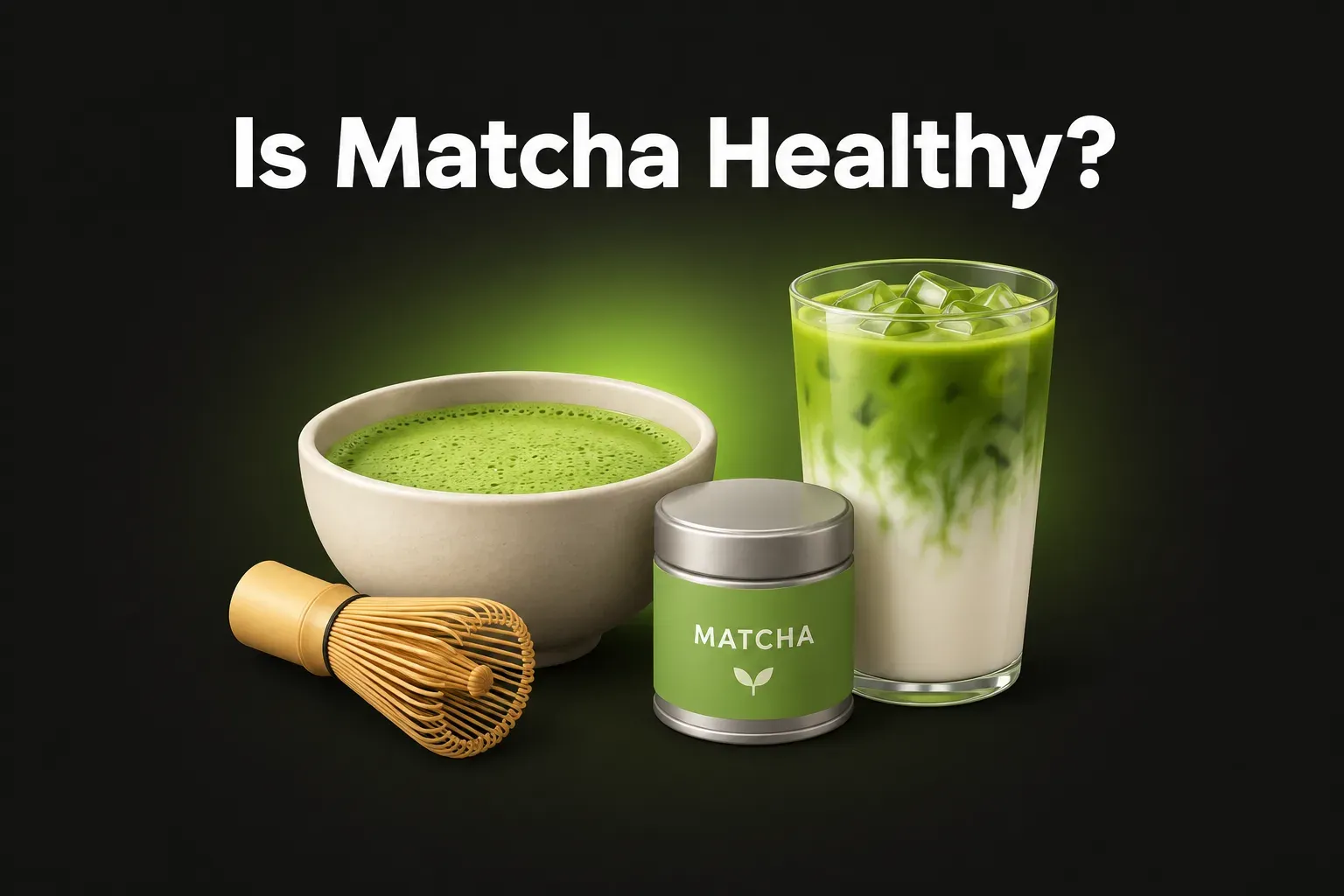
Matcha is green tea ground into a fine powder. It’s everywhere now – in lattes, cans, smoothies and baked goods. But is matcha healthy, or just pretty?
The short answer: plain matcha is a healthy drink for most adults. One teaspoon has about 10 calories, no sugar and about 50–65 mg of caffeine – a bit more than half a cup of coffee. You also get green tea antioxidants called catechins and a calming amino acid called L-theanine. Benefits for the brain and heart are modest. The real problems are sugary lattes, high-dose green tea pills and possible lead. Pick unsweetened matcha from a brand that tests for heavy metals.
What makes matcha different
With regular green tea, you steep the leaves and throw them away. Matcha is the whole leaf, ground and whisked into water or milk. So you drink the leaf itself.
The plants grow in the shade for a few weeks before harvest. Matcha has more amino acids, like L-theanine, than other teas (Baba et al., Nutrients, 2021). And because you drink the leaf, you get everything in it – the good parts and anything the plant took up from the soil.
How much caffeine is in matcha?
A US lab tested 15 green teas, including several matcha brands. Ceremonial matcha averaged about 31 mg of caffeine per gram. Culinary matcha averaged about 26 mg per gram (Meyer et al., Plant Foods for Human Nutrition, 2023).
A level teaspoon of matcha weighs about 2 g. That works out to about 50–65 mg of caffeine per teaspoon. ConsumerLab found 53–72 mg per serving in the pure matcha powders it tested (ConsumerLab, 2015).
Compare that with coffee:
- Brewed coffee: about 95 mg in 8 oz (240 ml) (USDA FoodData Central).
- Starbucks Matcha Latte, grande: about 65 mg (Starbucks).
- Dunkin’ Matcha Latte, medium: about 120 mg, the company said in 2020 (Elite Daily, 2020).
Healthy adults can usually have up to 400 mg of caffeine a day (FDA). One or two cups of matcha fit easily. Compare coffee drinks in our guide to calories in coffee. Another lower-caffeine swap is mushroom coffee.
EGCG and L-theanine: what studies show
Matcha’s best-known compounds are EGCG and L-theanine. EGCG is the main catechin in green tea – a plant compound that acts as an antioxidant. L-theanine is an amino acid that may help you feel calm.
ConsumerLab measured 73–119 mg of EGCG in a cup made with about 1 teaspoon of matcha (ConsumerLab, 2018).
Focus and memory. Here is what human trials found:
- Caffeine plus L-theanine. 27 healthy adults took 50 mg of caffeine, with or without 100 mg of L-theanine. With both, they switched between tasks faster and were less distracted (Owen et al., Nutritional Neuroscience, 2008). The study was run by Unilever, which owned Lipton tea at the time.
- A single drink of matcha. 23 adults had 4 g of matcha as a drink or a snack bar. An hour later, they were a little faster on simple attention tests. Their mood did not change (Dietz et al., Food Research International, 2017).
- Older adults. 61 older adults in Japan drank 3 g of matcha or a fake powder every day for 12 weeks. Only the women in the matcha group scored better on one memory and thinking test (Sakurai et al., Nutrients, 2020).
- The big picture. A 2026 review looked at four trials where adults drank matcha every day. The authors called the evidence limited and inconclusive (Huang et al., Journal of Epidemiology, 2026).
So matcha may give a small, smooth lift. But it’s not a brain booster.
Heart. A review of 14 trials pooled 1,136 adults. Green tea drinks and extracts lowered LDL (“bad”) cholesterol by only about 2 mg/dL (Zheng et al., American Journal of Clinical Nutrition, 2011). A Japanese study followed 40,530 adults for several years. People who drank more green tea were less likely to die of heart disease and stroke. The link was strongest in women who drank 3 or more cups a day (Kuriyama et al., JAMA, 2006). That’s a link, not proof – and it was brewed tea, not matcha.
Weight. A Cochrane review found green tea’s effect on weight too small to matter (Jurgens et al., Cochrane Database of Systematic Reviews, 2012).
Green tea pills and your liver
Brewed tea and matcha are not the same as green tea extract pills. These pills pack the catechins of many cups into one dose. The NIH’s LiverTox database calls green tea extract a well-known cause of liver injury. Cases are rare, but more than 100 have been reported, and a few people died of liver failure. LiverTox also says that drinking green tea has not been linked to liver damage (LiverTox, NIH).
The clearest proof comes from a US trial. 1,021 healthy women took green tea extract or a placebo for one year. The extract gave them about 843 mg of EGCG a day. About 5% of the women on the extract had liver test problems. That was about 7 times the odds of the placebo group. Their liver tests went back to normal when they stopped. The problems came back when they started again (Yu et al., Cancer Prevention Research, 2017).
The European Food Safety Authority agrees. In trials, supplements with 800 mg of EGCG a day or more raised liver enzymes. Tea made the normal way is generally safe (EFSA, 2018). A US Pharmacopeia review warns not to take these pills on an empty stomach (Oketch-Rabah et al., Toxicology Reports, 2020).
A teaspoon of matcha has about 73–119 mg of EGCG. One or two cups a day is far below the pill doses. Just skip green tea extract pills, especially if you have liver problems.
Lead and other contaminants
Plants take up small amounts of metals like lead from the soil. With brewed tea, most of the lead stays in the leaves you throw away (ConsumerLab, 2018). With matcha, you swallow the leaf.
- ConsumerLab tested matcha powders in 2015 and 2018. It found them “very low in lead.” No product went over limits for cadmium or arsenic. The 2015 powders were also almost free of pesticides (ConsumerLab, 2015; 2018).
- Jade Leaf’s Matcha Latte Mix carries a California Prop 65 lead warning. The brand says it tests its products and adds a warning when one goes over the California limit. It also says it never sells a product with metal levels that break the law (Jade Leaf). That limit is very strict: 0.5 micrograms of lead a day (OEHHA). The FDA’s reference level is 8.8 micrograms a day for women who could become pregnant and 2.2 for children (FDA).
The FDA says there is no known safe level of lead. Young children and unborn babies are the most at risk. So stick to 1–2 servings a day, and pick brands that share their lab tests.
Ceremonial vs culinary grade
- Ceremonial grade comes from the youngest spring leaves. It’s smooth and made to whisk with water. It costs more: Encha Ceremonial is $19.99 for 30 g (about 15 cups) (Encha).
- Culinary grade comes from older leaves. It’s stronger and made for lattes and baking. Jade Leaf Organic Culinary is $10.99 for 30 g (Jade Leaf).
Is the pricier one healthier? Not really. In one lab study, ceremonial matcha had a little more caffeine. Culinary matcha had more antioxidants per gram (Meyer et al., Plant Foods for Human Nutrition, 2023). Pick by taste and use.
8 matcha powders, mixes and drinks compared
| Product | Serving | Calories | Sugar | Protein | Caffeine |
|---|---|---|---|---|---|
| Encha Ceremonial Grade (powder) | 1 tsp (2 g) | 10 | 0 g | less than 1 g | not listed* |
| Jade Leaf Organic Culinary (powder) | ½ tsp (1 g) | 4 | 0 g | 0 g | 10–30 mg |
| Jade Leaf Matcha Latte Mix, Original | 2 tsp (10 g) | 40 | 9 g (all added) | 0 g | 20–40 mg** |
| Ito En Matcha Love Unsweetened (can) | 8 oz (237 ml) | 0 | 0 g | 0 g | 45 mg |
| Ito En Matcha Love Sweetened (can) | 8 oz (237 ml) | 50 | 11 g (all added) | 0 g | 45 mg |
| Starbucks Matcha Latte, grande (hot) | 16 oz (473 ml) | 220 | 29 g | 11 g | 65 mg |
| Starbucks Iced Matcha Latte, grande | 16 oz (473 ml) | 190 | 25 g | 9 g | 65 mg |
| Dunkin’ Iced Matcha Latte, medium, whole milk | medium | about 250 | about 32 g (19 g added) | about 10 g | about 120 mg*** |
Sources: labels on the brands’ sites (Encha, Jade Leaf Culinary, Jade Leaf Latte Mix, Ito En Unsweetened, Ito En Sweetened) and Starbucks with its standard milk. Dunkin’: Mist nutrition calculator, based on Dunkin’s published data. *Lab tests of ceremonial matcha average about 31 mg per gram, or about 60 mg per teaspoon (Meyer et al., 2023). **From the Jade Leaf product page, not the label. ***Company figure reported in 2020 (Elite Daily).
What stands out:
- A grande Starbucks Matcha Latte has 29 g of sugar. Part of it is natural milk sugar, and the rest comes from the syrup. For scale, the American Heart Association’s daily limit for added sugar is 25 g for women and 36 g for men (Johnson et al., Circulation, 2009).
- The Jade Leaf Latte Mix lists cane sugar first. In each 10 g serving, 9 g is sugar. So the bag is mostly sugar, not matcha.
- The unsweetened Ito En can and plain powders have no sugar at all.
The sugar and additives in matcha drinks
At Starbucks, the matcha powder itself is just ground green tea. The sweetness comes from classic syrup: sugar, water, natural flavors, potassium sorbate and citric acid (Starbucks). For other low-sugar orders there, see the healthiest drinks at Starbucks.
Regulators allow the preservative potassium sorbate and citric acid. But independent animal studies raise questions:
- Mice got potassium sorbate for 10 weeks, at 150 to 1,000 mg per kg of body weight a day. They developed inflammation in the liver and changes in their gut bacteria. These changes faded within 5 weeks after they stopped. The authors saw that as a sign the harm does not last (Xiao et al., Food and Chemical Toxicology, 2024).
- Rats got potassium sorbate (300 mg per kg a day), citric acid or both in their water for 8 weeks. At these doses, standard safety tests find no harm. Still, all groups lost helpful Lactobacillus gut bacteria. Citric acid, alone or mixed with sodium benzoate, raised bacteria linked to inflammation (Rezaei et al., Journal of the Science of Food and Agriculture, 2026).
One latte has far less than these doses. Why do animal studies matter? Rats and mice share most of our genes and body processes. And testing possible harm on people would put their health at risk. Proof in humans is still missing. But more than one lab has seen gut and inflammation changes. So it makes sense to limit sweetened drinks with preservatives as a precaution.
How to order a healthier matcha latte:
- Ask for fewer pumps of syrup, or none.
- Pick your milk with care. Many oat milks add oil and sugar – see is oat milk bad for you and the healthiest milk.
- Skip sweet foams and creamers. See the healthiest coffee creamer.
Who should go easy on matcha
- Pregnant women: keep total caffeine to 200 mg a day or less (EFSA). Lead matters more for them too, and for kids.
- People with low iron: in a small study, green tea extract added to a meal cut iron absorption from 12% to 9% (Samman et al., American Journal of Clinical Nutrition, 2001). Drink matcha between meals, not with them.
- People sensitive to caffeine or with sleep problems: have it before noon.
Check what’s in your matcha mix. With NutriSmart, you photograph the label or scan the barcode. The app lists the sweeteners, preservatives and colors, explains the risks of each one and gives the product a health score out of 100. It also tells you right away if a matcha drink or mix is ultra-processed, and which ingredients make it so. Set an alert for potassium sorbate, and the app warns you whenever a product you scan contains it.Get the app free
The bottom line
Plain matcha is a healthy drink for most adults. A teaspoon has about 10 calories, no sugar and about 50–65 mg of caffeine – less than a cup of coffee. Studies suggest small benefits for focus and cholesterol, but the effects are modest. The liver risk comes from high-dose green tea pills, not from a cup or two of matcha. Because you eat the whole leaf, choose brands that test for lead. The biggest health trap is sugar: a grande Starbucks Matcha Latte has 29 g. Choose unsweetened matcha and keep it to 1–2 cups a day.
FAQ
Is matcha healthy?
Plain matcha is a healthy drink for most adults. It has no sugar, few calories and plenty of green tea antioxidants. The catch is the sugar in many matcha lattes and mixes, and the caffeine if you drink a lot.
How much caffeine is in matcha?
One teaspoon (2 g) of matcha powder has about 50–65 mg of caffeine. That's a bit more than half of an 8 oz cup of brewed coffee, which has about 95 mg. A grande Starbucks matcha latte has about 65 mg.
Is matcha better than coffee?
Neither one is clearly better. Matcha has less caffeine per cup and also contains L-theanine, which may make the energy feel smoother. Both are fine without sugar, and both can keep you awake if you drink them late.
Does matcha contain lead?
Tea leaves can take up small amounts of lead from soil. With matcha you swallow the whole leaf, so you get more of it than from brewed tea. Independent tests by ConsumerLab found the matcha powders they tested very low in lead.
Can matcha hurt your liver?
A cup or two of matcha a day is not linked to liver harm in healthy people. The liver cases come mostly from green tea extract pills. In trials, pills with 800 mg of EGCG a day or more raised liver enzymes.
Is a Starbucks matcha latte healthy?
It's more of a sweet treat than a health drink. A grande hot Matcha Latte has 220 calories and 29 g of sugar, from classic syrup and milk. Ask for less syrup or none to cut the sugar.