Healthiest Milk: Dairy vs Plant Milks Compared
What is the healthiest milk? Whole, skim, fairlife, A2, soy, almond, oat and pea milk compared by protein, sugar and calcium, plus how to read the carton.
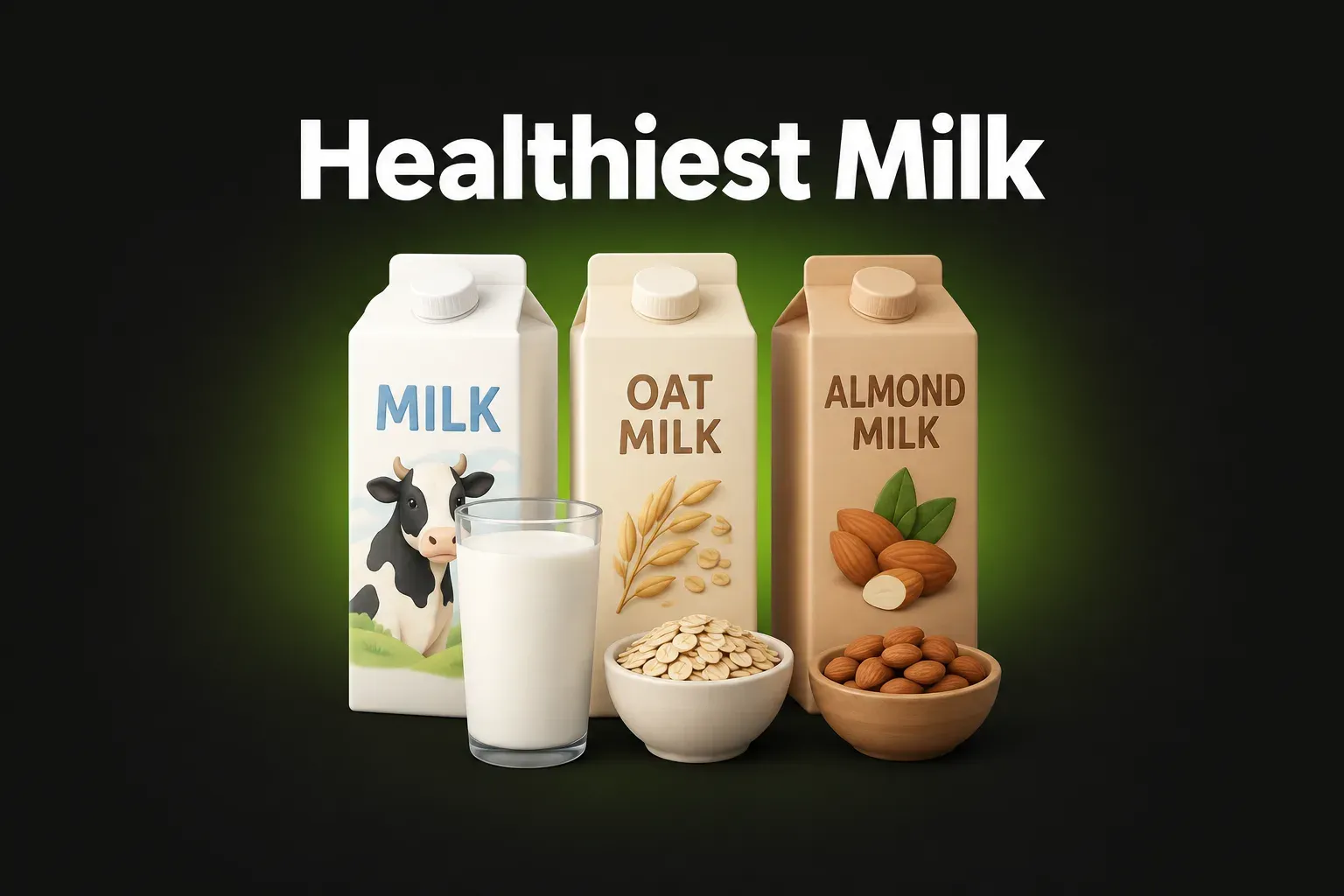
The milk aisle is huge now. You can buy whole, skim, lactose-free, A2 and ultra-filtered milk. There is also soy, almond, oat, pea, coconut and rice milk. So which one is the healthiest milk?
The short answer: for most people, the healthiest everyday milk is plain cow’s milk (skim, 1% or 2%) or unsweetened soy milk. Both give about 8 g of protein per cup, plus calcium and vitamin D. Pea milk is a good dairy-free match. For more protein, ultra-filtered milk has about 13 g. For the fewest calories, unsweetened almond milk has about 30–45. Skip sweetened plant milks, and check the carton for added sugar, oils and gums.
Milk types compared per cup
Here are the basic numbers for 1 cup (8 oz / 240 ml) of each milk type. They come from the USDA food database.
| Milk (1 cup) | Calories | Protein | Sugar | Calcium | Saturated fat |
|---|---|---|---|---|---|
| Whole milk | 149 | 7.7 g | 12 g | 276 mg | 4.5 g |
| 2% milk | 122 | 8.1 g | 12 g | 293 mg | 3.1 g |
| Skim milk | 83 | 8.2 g | 12 g | 298 mg | 0.1 g |
| Soy milk, unsweetened | 91 | 8.5 g | 1.3 g | 242 mg | 0.8 g |
| Almond milk, unsweetened | 46 | 1.6 g | not listed* | 379 mg | not listed |
| Oat milk, unsweetened | 115 | 1.9 g | 5.6 g | 355 mg | not listed |
| Coconut milk drink, sweetened | 74 | 0.5 g | 6 g | 451 mg | 5 g |
| Rice milk, unsweetened | 113 | 0.7 g | 12.7 g | 283 mg | 0 g |
Source: USDA FoodData Central – whole, 2%, skim, soy, almond, oat, coconut, rice. Values per 100 g, multiplied to one cup and rounded. *Unsweetened almond milk labels usually show 0 g of sugar. Calcium in plant milks is added and varies by brand.
What stands out:
- Protein: cow’s milk and soy milk have about 8 g per cup. Almond, oat, coconut and rice milk have 2 g or less. Read more in is coconut milk healthy?
- Sugar: the 12 g in cow’s milk is lactose (the natural sugar in milk). It is not added sugar. Rice milk has just as much, because rice starch turns into sugar when the drink is made.
- Calories: unsweetened almond milk is the lightest. Skim milk is the lightest one with real protein.
- Calcium: all of them are in the same range (about 240–450 mg). That is because plant milks have calcium added.
9 popular milks compared (labels)
Brands differ a lot, even within one milk type. Here are 9 real products, per 1 cup.
| Product | Type | Calories | Protein | Sugar (added) | Oils and gums |
|---|---|---|---|---|---|
| fairlife 2% | Ultra‑filtered dairy | 120 | 13 g | 6 g (0 g) | None |
| a2 Milk 2% | A2 dairy | 120 | 8 g | 12 g (0 g) | None |
| Silk Unsweet Soymilk | Soy | 90 | 8 g | 1 g (0 g) | Gellan gum |
| Ripple Unsweetened Original | Pea | 80 | 8 g | 0 g (0 g) | Sunflower or safflower oil; gum arabic, guar and gellan gum |
| Elmhurst Milked Almonds Unsweetened | Almond | 130 | 5 g | 1 g (0 g) | None – just water and almonds |
| Silk Unsweet Almondmilk | Almond | 30 | 1 g | 0 g (0 g) | Sunflower oil, gellan gum |
| Oatly Original | Oat | 120 | 3 g | 7 g (7 g) | Rapeseed (canola) oil |
| Oatly Unsweetened | Oat | 40 | 0 g | 0 g (0 g) | Rapeseed (canola) oil, citrus fiber |
| So Delicious Organic Unsweetened | Coconut | about 45 | 0 g | 0 g (0 g) | Plant gums |
Sources: brand sites for fairlife, Silk soy, Silk almond and Oatly (Original, Unsweetened); Open Food Facts and US retailer labels for a2 Milk, Ripple, Elmhurst and So Delicious, checked November 2026. Recipes change – always check the carton.
A few things to notice:
- fairlife is filtered to keep more protein and remove some lactose. Lactase (an enzyme that breaks down lactose) is added, so it is lactose-free. Read more: is fairlife milk healthy?
- Oatly Original lists 7 g of added sugar. Oatly says this sugar forms when enzymes break down the oats, not from sugar poured in. The US label still has to count it as added. Read more: is oat milk bad for you?
- Elmhurst has the shortest list, but its label shows only about 60 mg of calcium. Many other plant milks add 300–470 mg.
- Almond milk is low in calories, but also low in protein. See is almond milk healthy?
The healthiest milk for your goal
For the most protein
Pick ultra-filtered milk (about 13 g per cup), regular cow’s milk, soy milk or pea milk (about 8 g each). Protein keeps you full. It also helps your muscles. Not sure how much you need? Try our protein calculator.
For the fewest calories
Unsweetened almond milk (30–45 calories) is the lightest. Some unsweetened oat and coconut milks, like Oatly Unsweetened and So Delicious, have only 40–45. But other unsweetened oat milks have over 100, so check the label. Skim milk (about 83) is the lightest with real protein. A cup of unsweetened almond milk has about 90 fewer calories than 2% milk. That adds up if you drink a lot of milk.
If you can’t digest lactose
Many adults have trouble digesting lactose. It can cause gas, bloating or loose stools. Lactose-free milk is regular milk with lactase added. It has the same protein and calcium. Soy and pea milk are good dairy-free options.
What about A2 milk? Regular milk usually has two kinds of a milk protein called beta-casein: A1 and A2. A2 milk comes from cows that make only the A2 kind. It still has lactose. One trial tested 45 adults in China who said milk upset their stomach. Each person drank both milks, for two weeks each. Regular milk caused more stomach symptoms than A2 milk (Jianqin et al., Nutrition Journal, 2016). One of the authors worked for the a2 Milk Company. The study was small, so the proof is still limited.
Whole, 2% or skim?
Skim milk has fewer calories and almost no saturated fat. But whole milk does not look harmful for healthy people. A large study followed 136,384 adults in 21 countries for about 9 years. Some ate more than 2 servings of dairy a day. Others ate none. The dairy eaters had a 16% lower risk of death, heart attack, stroke or heart failure (Dehghan et al., Lancet, 2018). This kind of study shows a link, not proof. If you’re watching calories, choose skim or 1%. If whole milk keeps you full, that’s fine too.
Is organic milk healthier?
Organic milk comes from cows raised under organic farm rules. A review looked at 170 studies. Organic milk had about 56% more omega-3 fats (healthy fats also found in fish). But it also had less iodine (a mineral your thyroid needs) (Średnicka-Tober et al., British Journal of Nutrition, 2016). The amount of omega-3 in a glass of milk is still small. Organic is a fine choice, but not a must.
The best milk for kids
In 2019, a panel from the American Academy of Pediatrics and other health groups gave clear advice. Children aged 1 to 2 should drink whole milk. At age 2, they can switch to low-fat or fat-free milk. The panel advised against plant milks for young children (Healio, 2019).
Why? Kids need the protein, fat and nutrients in milk to grow. Some kids drank plant drinks instead of milk. Doctors have seen them grow poorly or get rickets (soft, weak bones) (Merritt et al., Journal of Pediatric Gastroenterology and Nutrition, 2020). If your child can’t have dairy, ask a doctor what to use.
A few more points:
- A review looked at 28 studies. Kids who drank whole milk were less likely to be overweight than kids who drank lower-fat milk (Vanderhout et al., American Journal of Clinical Nutrition, 2020). These studies show a link, not proof.
- Children under 5 should not drink rice milk. It can contain arsenic, a poison that rice takes up from soil and water (NHS).
- Advice differs by country. The UK’s NHS says unsweetened plant drinks with added calcium are OK from age 1. They should be part of a balanced diet.
In the US, fortified soy milk is the only plant milk counted in the dairy group. Its key nutrients are similar to cow’s milk (FDA). Kids often want the chocolate kind – read is chocolate milk healthy?
How to read a milk carton
- Look for “unsweetened”. “Original” often means sweetened. Aim for 0 g of added sugar. Cow’s milk has 12 g of natural sugar and 0 g added.
- Check the protein. Want a real milk swap? Look for 7–8 g or more per cup.
- Check calcium and vitamin D. Plant milks should have about 300 mg of calcium or more per cup. Shake the carton – added calcium can sink to the bottom.
- Read the oils. Many plant milks add sunflower oil or canola oil for a creamy feel. The amount is small. Most plant milks have about 1.5–5 g of fat per cup in total.
- Read the gums. Gums keep the drink smooth and stop it from splitting. Common ones are gellan gum, guar gum and carrageenan.
Gums: which ones to limit
Gellan gum is one of the gentler ones. In a study, 10 volunteers ate large amounts every day for about three weeks. It acted like fiber and caused no harm in blood tests (Anderson et al., Food Additives and Contaminants, 1988).
Carrageenan is different. Some plant milks still list it. Regulators in the US and EU allow it. But independent labs keep finding warning signs:
- Mice got carrageenan in their drinking water (10 mg per liter). Their blood sugar stayed higher after a sugar test. They also got insulin resistance (the body stops responding well to insulin) (Bhattacharyya et al., Diabetologia, 2012).
- In a human trial, 20 young men took 250 mg of carrageenan twice a day for two weeks. Overall, insulin worked just as well. But in the men who were overweight, insulin worked less well. Their signs of inflammation (the body’s alarm response) also went up (Wagner et al., BMC Medicine, 2024).
Animal studies matter. Mice and rats share most of our genes and body processes. Testing an additive on people for years would put their health at risk. Proof of harm in people is still missing. But several labs see the same signal, and carrageenan only adds texture. So it makes sense to limit it as a precaution – there are plenty of milks without it.
Compare milks in the store. With NutriSmart, you photograph the label or scan the barcode. The app lists the sweeteners, preservatives and colors, explains the risks of each one and gives the product a health score out of 100. It also tells you right away if a plant milk is ultra-processed, and which ingredients make it so. You can even set an alert for an ingredient like carrageenan. The app then warns you whenever a scanned carton contains it.Get the app free
The bottom line
The healthiest milk for most people is plain cow’s milk or unsweetened soy milk. Both have about 8 g of protein per cup, plus calcium and vitamin D. Choose ultra-filtered milk for extra protein, and unsweetened almond milk for the fewest calories. Use lactose-free milk, soy milk or pea milk if lactose bothers you. For young kids, US experts advise cow’s milk, not plant drinks. In the store, look for “unsweetened” and 0 g of added sugar. Pick a carton with at least 300 mg of calcium. Choose a short list without carrageenan.
FAQ
What is the healthiest milk to drink?
For most people, plain cow's milk (skim, 1% or 2%) or unsweetened soy milk. Both give about 8 g of protein per cup, plus calcium and vitamin D. The best choice depends on your goals: more protein, fewer calories or no lactose.
What is the healthiest plant-based milk?
Unsweetened soy milk or pea milk. They have about 8 g of protein per cup, like cow's milk, and no added sugar. Almond, oat, coconut and rice milk have little protein. Pick a carton with added calcium and vitamin D.
Is skim milk healthier than whole milk?
Skim milk has about 65 fewer calories per cup and almost no saturated fat. It has the same protein and calcium. But studies do not show that whole milk harms healthy people, so either can fit a healthy diet.
Which milk has the most protein?
Ultra-filtered milk like fairlife has about 13 g of protein per cup. Regular cow's milk, soy milk and pea milk have about 8 g. Most almond milks have 1–2 g, and coconut and rice milk have almost none.
Which milk is best for kids?
US experts advise whole milk from age 1 to 2, then low-fat or fat-free milk. They say plant milks are not a full swap for young kids. Children under 5 should not drink rice milk because of arsenic.
Is oat milk healthy?
It's fine in small amounts, but it is not a great milk swap. A cup of Oatly Original has 120 calories, 3 g of protein and 7 g of sugar. The US label counts that sugar as added. Unsweetened oat milk has less sugar but almost no protein.