Is Fairlife Milk Healthy? Protein, Sugar and Price Compared
Is fairlife milk healthy? How ultra-filtered milk gets more protein and half the sugar, what's added, the price, and how it compares to other milks.
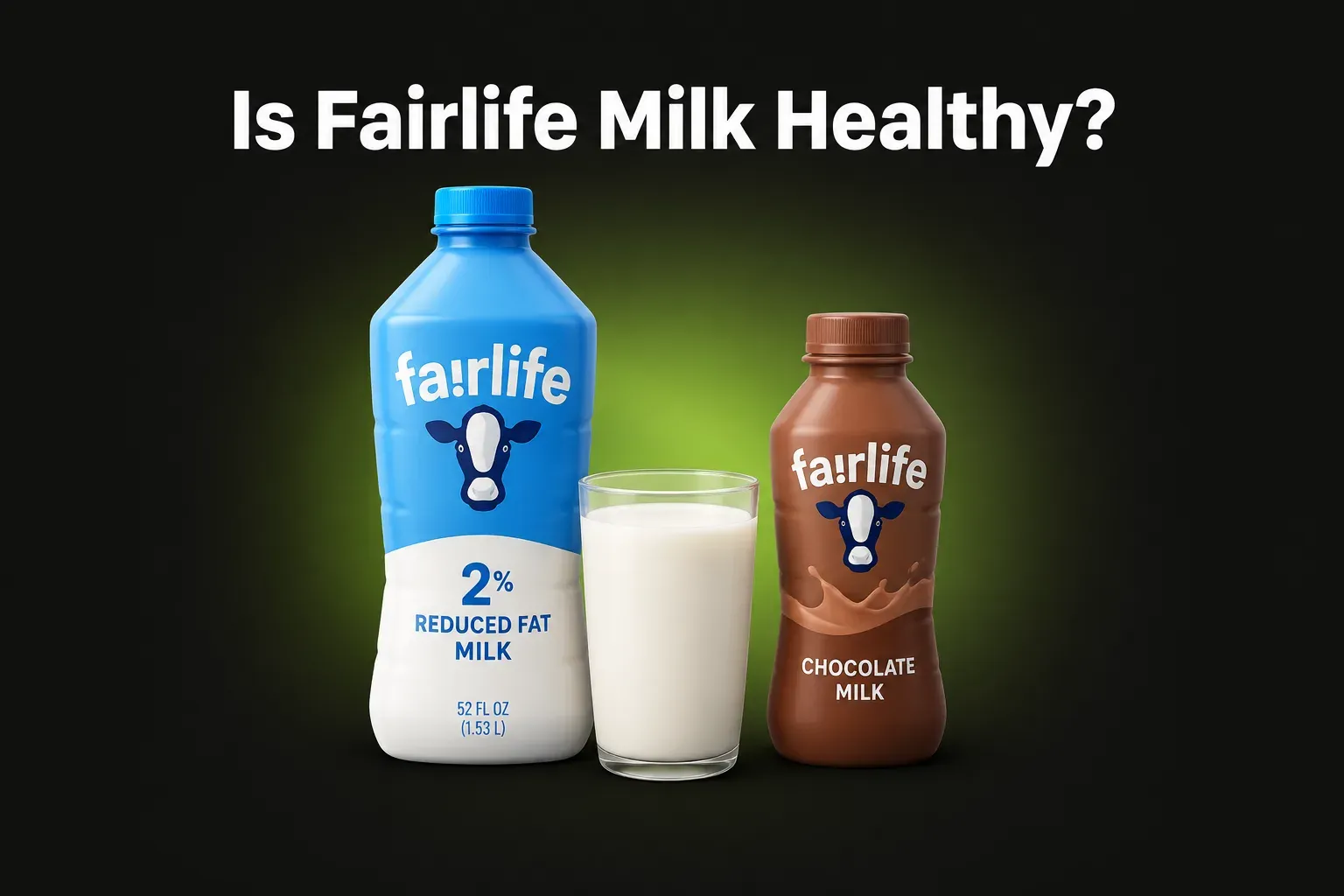
fairlife is a cow’s milk that promises 50% more protein and 50% less sugar than regular milk. It’s also lactose-free – and it costs much more. So is fairlife milk healthy, or just clever marketing?
The short answer: yes – plain fairlife milk is real milk with only an enzyme and two vitamins added. A cup of fairlife 2% has 13 g of protein and 6 g of sugar. Regular 2% milk has about 8 g and 12 g. It’s a good pick if you want more protein or you’re lactose intolerant. The downsides? It costs about 3 times as much per ounce. And the chocolate version adds sugar, two sweeteners and carrageenan (a thickener).
What is fairlife milk?
fairlife is a US milk brand owned by Coca-Cola. Its main milks are whole, 2%, fat-free and chocolate. All of them are ultra-filtered.
The label of fairlife 2% is short (fairlife):
Ingredients: reduced fat ultra-filtered milk, lactase enzyme, vitamin A palmitate, vitamin D3.
That’s it. No added sugar, no thickeners, no flavors. Regular US milk often has vitamins A and D added too.
How ultra-filtration works
Milk is mostly water. It also carries protein, fat, milk sugar (lactose) and minerals like calcium.
In ultra-filtration, milk is pushed through very fine filters. Small things, like water and part of the lactose, slip through. Bigger things, like protein, are held back. fairlife says its filters pack in more protein and calcium and remove most of the sugar (fairlife).
fairlife also adds lactase. That’s the same enzyme your gut makes to digest milk. It splits the lactose that’s left into two simple sugars: glucose and galactose. That’s why the milk is lactose-free. It also tastes a little sweeter, even though no sugar is added.
fairlife vs regular milk: the numbers
Here is one cup (8 oz / 240 ml) of fairlife 2% next to regular 2% milk:
| Per cup | fairlife 2% | Regular 2% |
|---|---|---|
| Calories | 120 | 122 |
| Protein | 13 g | 8.1 g |
| Sugar | 6 g | 12.3 g |
| Lactose | Lactose‑free | 12.2 g |
| Fat | 4.5 g | 4.8 g |
| Saturated fat | 3 g | 3.1 g |
| Calcium | 380 mg | 293 mg |
| Potassium | 400 mg | 342 mg |
| Sodium | 120 mg | 115 mg |
fairlife: brand nutrition label. Regular 2% milk: USDA FoodData Central, 244 g cup.
The calories and fat are almost the same. The big changes are more protein, half the sugar and more calcium.
Milk protein is complete protein. That means it has all the building blocks (amino acids) your body can’t make on its own. So the extra 5 g per cup is good-quality protein.
Is fairlife good for lactose intolerance?
Yes. People with lactose intolerance don’t make enough lactase. Milk sugar then reaches the gut undigested. This can cause gas, bloating and diarrhea.
The US National Institutes of Health says lactose-free milk is just as healthy as regular milk (NIDDK). It also says many people with lactose intolerance can handle about 12 g of lactose. That’s about one cup of milk. They get mild symptoms or none. fairlife is lactose-free.
One warning: lactose-free is not allergy-free. A milk allergy is a reaction to milk protein, not milk sugar. fairlife has more milk protein, so people with a milk allergy must avoid it.
Who benefits most from fairlife
- People who want more protein. Two cups give you 26 g of protein for 240 calories. That can help older adults and people trying to lose weight. Find your daily target with our protein calculator.
- People who lift weights. A review pooled 49 trials with 1,863 adults. Those who took extra protein while strength training gained a bit more muscle and strength. But gains stopped at about 1.6 g of protein per kg (0.7 g per pound) of body weight a day (Morton et al., British Journal of Sports Medicine, 2018). Past that, more protein didn’t help.
- People who are lactose intolerant. You get real milk without the stomach trouble.
- People watching carbs or sugar. A cup has 6 g of carbs instead of about 12 g.
If you already eat plenty of protein, fairlife won’t add much. Has a doctor told you to limit protein, for example for kidney disease? Then ask before switching.
What about chocolate fairlife?
The plain milks are simple. The chocolate 2% is a different product. A cup has 140 calories and 12 g of sugar. Of that, 6 g is added sugar (fairlife).
It also contains two sweeteners, sucralose and acesulfame potassium, plus the thickener carrageenan. Regulators allow all three. But independent studies raise questions:
- Carrageenan: Male mice got carrageenan in their drinking water (10 mg per liter). Their bodies got worse at handling sugar. They also showed insulin resistance. That means their cells stopped responding well to insulin, the hormone that lowers blood sugar (Bhattacharyya et al., Diabetologia, 2012). A small trial followed people with ulcerative colitis (a bowel disease) that was calm at the start. Twelve of them finished the study. Three who took carrageenan capsules had a flare-up. None on the dummy capsules did (Bhattacharyya et al., Nutrition and Healthy Aging, 2017).
- Acesulfame potassium: Mice got 37.5 mg per kg of body weight each day for 4 weeks. Their gut bacteria changed, and male mice gained more weight (Bian et al., PLOS ONE, 2017).
Why do mouse studies matter? Rodents share most of our genes and body processes. And testing a possibly harmful additive on people would put their health at risk. Still, proof in humans is missing. The doses in these studies are also not the same as one glass of milk.
Several labs see similar warning signs. So it makes sense to limit the chocolate version. Choose plain milk most days. Adding your own cocoa powder works too. We compare other brands in is chocolate milk healthy?
The 2019 animal welfare controversy
In June 2019, the group Animal Recovery Mission released an undercover video. It was filmed in 2018 at Fair Oaks Farms in Indiana, a dairy that supplied fairlife. The video showed workers kicking, throwing and hitting young calves.
Three workers were charged with animal cruelty. The farm’s owners apologized. Some stores, like Jewel-Osco, pulled fairlife from their shelves (CBS News Chicago, 2019).
Shoppers then sued, saying fairlife’s ads about caring for cows were misleading. In 2022, a court approved a $21 million settlement (Mealey’s, 2022). This doesn’t change what’s in the milk. But some people weigh it when they choose a brand.
How much does fairlife cost?
In November 2026, a 52 fl oz (1.5 liter) bottle of fairlife 2% cost $5.39 at Target. That’s about 10 cents per fluid ounce (Target). Prices vary by store. In October 2026, a gallon of regular whole milk cost $4.10 on average. That’s about 3 cents per ounce (US Bureau of Labor Statistics via FRED).
So fairlife costs about 3 times as much per ounce. Per gram of protein, it’s about twice as much. If you just want cheap protein, regular milk, eggs or Greek yogurt cost less. See more options in our list of high-protein foods.
fairlife vs organic, A2, almond and oat milk
| Milk (1 cup) | Calories | Protein | Sugar | Lactose‑free |
|---|---|---|---|---|
| fairlife 2% | 120 | 13 g | 6 g | Yes |
| fairlife whole | 150 | 13 g | 6 g | Yes |
| fairlife fat-free | 80 | 13 g | 6 g | Yes |
| fairlife chocolate 2% | 140 | 13 g | 12 g (6 g added) | Yes |
| Regular 2% | 122 | 8.1 g | 12.3 g | No |
| Regular whole | 149 | 7.7 g | 12.3 g | No |
| Horizon Organic 2% | 130 | 8 g | 12 g | No |
| a2 Milk 2% | 120 | 8 g | 12 g | No |
| Silk Unsweet Almondmilk | 30 | 1 g | 0 g | Yes |
| Oatly Original | 120 | 3 g | 7 g (all added) | Yes |
Brand labels: fairlife, Horizon, a2 Milk, Silk, Oatly. Regular milk: USDA FoodData Central (2%, whole).
- Organic milk has the same protein and sugar as regular milk. A review of 170 studies found it has about 56% more omega-3 fats. But it had less iodine and selenium (two minerals) (Średnicka-Tober et al., British Journal of Nutrition, 2016).
- A2 milk comes from cows that make only one type of a milk protein (A2 beta-casein). A trial gave 45 Chinese adults both milks for 2 weeks each. All of them said milk usually upset their stomach. Regular milk caused more stomach symptoms than A2 milk (Jianqin et al., Nutrition Journal, 2016). One author worked for the a2 Milk Company. A2 milk still has lactose.
- Almond milk is very low in calories but has almost no protein. Read more in is almond milk healthy?
- Oat milk has more calories than almond milk and little protein. Oatly says its sugar forms when the oats are broken down during making. The label counts it as added sugar.
For the full ranking, see our guide to the healthiest milk. If you want protein in a bottle, also read is Premier Protein healthy? For more ready-to-drink options, see the healthiest protein shakes.
See what’s really in your fairlife milk. With NutriSmart, you photograph the label or scan the barcode. The app lists the sweeteners, preservatives and colors, explains the risks of each one and gives the product a health score out of 100. It also tells you right away if a product is ultra-processed and which ingredients make it so. Set an alert for carrageenan or sucralose. The app then warns you whenever a product you scan contains it.Get the app free
The bottom line
Plain fairlife milk is healthy. It’s real milk with more protein, half the sugar and more calcium. And it’s lactose-free. Only an enzyme and vitamins A and D are added. It’s a smart pick if you need more protein or can’t digest lactose. But it costs about 3 times as much as regular milk. And regular milk is just as healthy for most people. Go easy on the chocolate version, which adds sugar, two sweeteners and carrageenan.
FAQ
Is fairlife milk healthy?
Plain fairlife milk is a healthy choice for most people. It's real cow's milk with only an enzyme and two vitamins added. A cup of fairlife 2% has 13 g of protein and 6 g of natural sugar. Regular 2% milk has about 8 g and 12 g.
Why does fairlife have more protein and less sugar?
fairlife pushes milk through very fine filters. The filters hold back protein and calcium and let some of the milk sugar (lactose) pass through. The result has more protein and less sugar per cup than regular milk.
Does fairlife milk have added sugar?
The plain white versions (whole, 2% and fat-free) have no added sugar. Their 6 g of sugar per cup comes from the milk itself. The chocolate version has 6 g of added sugar plus two sweeteners, sucralose and acesulfame potassium.
Is fairlife milk good for lactose intolerance?
Yes. fairlife adds lactase, the enzyme that breaks down milk sugar, so the milk is lactose-free. But it's still cow's milk, so it's not safe for people with a milk allergy.
Is fairlife worth the price?
It depends on your goals. fairlife costs about 3 times as much per ounce as regular milk. Per gram of protein, it costs about twice as much. It's worth it if you need more protein or can't digest lactose. Otherwise, regular milk is just as healthy.
Is fairlife better than almond or oat milk?
For protein, yes. A cup of fairlife has 13 g of protein. Unsweetened almond milk has about 1 g and Oatly Original has 3 g. Almond milk has far fewer calories, though, and plant milks suit people who avoid dairy.