Is Almond Milk Healthy? Nutrition, Brands and Who It Suits
Is almond milk healthy? Calories, protein, sugar and calcium per cup, how many almonds it has, what's added, and 9 brands compared.
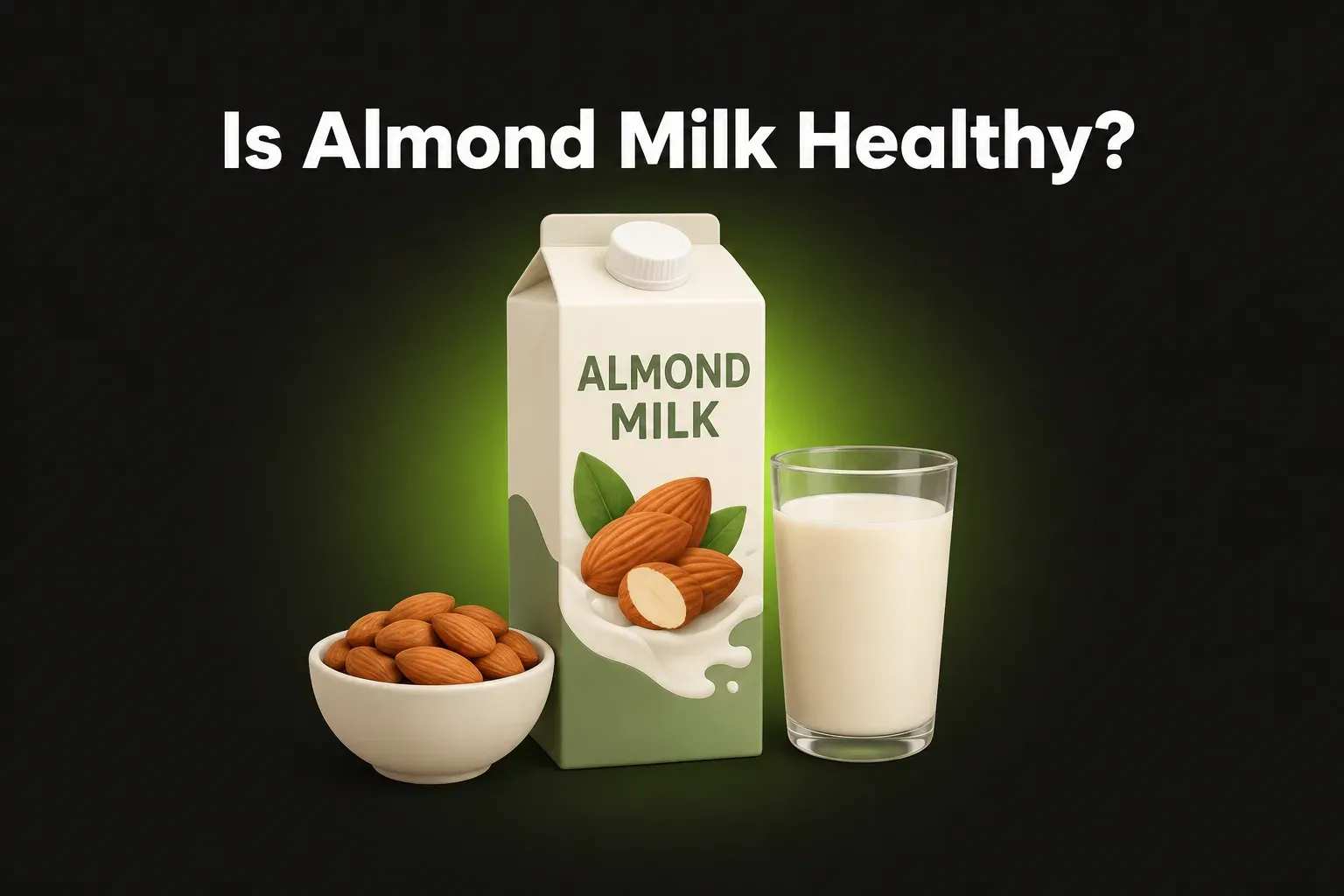
Almond milk is one of the most popular plant milks in the US. It’s light, creamy and dairy-free. But what’s really in the carton?
The short answer: unsweetened almond milk is a healthy, low-calorie drink for most adults. A cup has about 30–40 calories, 0 g of sugar and, in most brands, added calcium and vitamin D. But it has only about 1 g of protein. Big brands are mostly water. One brand’s UK label lists just 2% almonds. Pick unsweetened, and get your protein from other foods. It’s not a good main milk for young kids, and it’s off-limits if you have a tree nut allergy.
Almond milk vs dairy, soy and oat milk
Here is how one cup (8 oz / 240 ml) compares. The numbers are from the USDA food database.
| Milk (1 cup) | Calories | Protein | Sugar | Calcium |
|---|---|---|---|---|
| Almond milk, unsweetened | 36 | 1.3 g | 0 g | 415 mg |
| Almond milk, sweetened vanilla | 91 | 1.0 g | 15 g | 451 mg |
| 2% cow’s milk | 122 | 8.1 g | 12 g | 293 mg |
| Soy milk, unsweetened | 91 | 8.5 g | 1.3 g | 242 mg |
| Oat milk, unsweetened | 115 | 1.9 g | 5.6 g | 355 mg |
Source: USDA FoodData Central – almond, unsweetened, almond, sweetened vanilla, 2% milk, soy, oat. Values per 100 g, multiplied to one cup and rounded. Calcium in plant milks is added and varies by brand.
What stands out:
- Calories: unsweetened almond milk is one of the lightest milks you can buy. A cup has about 90 fewer calories than 2% milk.
- Protein: cow’s milk and soy milk have about 8 g. Almond milk has about 1 g. That’s a big gap if milk is part of your breakfast protein. Coconut milk drinks have even less – see is coconut milk healthy?
- Sugar: the 12 g in cow’s milk is lactose (milk’s natural sugar), not added sugar. The sugar in sweetened almond milk is added.
- Calcium: most almond milks have as much as cow’s milk or more. That’s because it’s added as a powder.
Almond milk is also rich in vitamin E (a nutrient that protects your cells). Silk lists 4 mg per cup, or 25% of the daily value. Almonds are naturally high in it, and many brands add more.
Unsweetened vs original vs vanilla
The word “original” sounds plain. On almond milk, it usually means sweetened. Here are the three main types from Silk, per cup:
| Silk Almondmilk | Calories | Sugar (added) | Protein |
|---|---|---|---|
| Unsweet | 30 | 0 g (0 g) | 1 g |
| Original | 60 | 7 g (7 g) | 1 g |
| Vanilla | 80 | 13 g (13 g) | 1 g |
Source: Silk product pages for Unsweet, Original and Vanilla, checked November 2026.
A cup of Silk Vanilla has 13 g of added sugar. That’s about 3 teaspoons. It’s also a quarter of the 50 g daily value on US labels. If you drink two cups a day, that’s half. So choose “unsweetened”. If you want flavor, look for “unsweetened vanilla”.
How many almonds are in almond milk?
Fewer than most people think. Big US brands don’t print the amount. But the UK version of Almond Breeze Unsweetened lists “almonds (2%)” on its label (Open Food Facts).
What does 2% mean? A cup weighs about 240 g. So 2% is about 5 g of almonds. One almond weighs about 1.2 g (USDA). That’s about 4 almonds in a cup. It also explains why the protein is so low.
In 2015, shoppers sued Blue Diamond, the maker of Almond Breeze, over this. They said the “made from real almonds” claims were misleading. Blue Diamond said its recipe is private, but that it lists all its ingredients (FoodNavigator, 2015).
Some brands use much more nuts. Elmhurst and Three Trees are made from just water and almonds. Their labels show 4–5 g of protein and 100–130 calories per cup. That points to several times more almonds.
9 almond milks compared
Here are 9 real products, per 1 cup.
| Product | Calories | Protein | Sugar (added) | Calcium | Gums and emulsifiers |
|---|---|---|---|---|---|
| Silk Unsweet | 30 | 1 g | 0 g (0 g) | 470 mg | Gellan gum (plus sunflower oil) |
| Silk Original | 60 | 1 g | 7 g (7 g) | 470 mg | Gellan gum |
| Silk Vanilla | 80 | 1 g | 13 g (13 g) | 470 mg | Gellan gum |
| Almond Breeze Unsweetened Original | 30 | 1 g | 0 g (0 g) | 450 mg | Sunflower lecithin, gellan gum |
| Almond Breeze Original | 60 | 1 g | 7 g (7 g) | 450 mg | Sunflower lecithin, gellan gum |
| Califia Farms Unsweetened | 35 | 1 g | 0 g (0 g) | 470 mg | Sunflower lecithin, guar gum, gellan gum |
| Kirkland Signature Unsweetened Almond | 30 | 1 g | 0 g (0 g) | about 600 mg | Sunflower lecithin, locust bean gum, guar gum, gellan gum |
| Three Trees Unsweetened Original | 100 | 4 g | 1 g (0 g) | 66 mg | None – water and almonds |
| Elmhurst Milked Almonds Unsweetened | 130 | 5 g | 1 g (0 g) | 60 mg | None – water and almonds |
Sources: brand sites for Silk and Califia Farms; Open Food Facts for Almond Breeze Unsweetened, Almond Breeze Original, Kirkland, Three Trees and Elmhurst, checked November 2026. Recipes change – always check the carton.
What to notice:
- The big brands are almost the same: about 30 calories, 1 g of protein and lots of added calcium.
- Three Trees and Elmhurst have the shortest lists and the most protein. But they have more calories and little calcium, because none is added.
- Kirkland has the longest list of gums. It also has the most calcium.
What’s added to almond milk
Water and a few almonds would split into layers in the fridge. So most brands add a few helpers. Here is what they do and what research says.
Calcium and vitamins
Most brands add calcium carbonate (the same mineral as chalk and many calcium pills). Your body seems to absorb it well. In a study, 20 young women drank cow’s milk or soy milk with added calcium carbonate. They absorbed the same share of calcium from both (Zhao et al., Journal of Nutrition, 2005).
There is a catch. Added calcium can sink to the bottom of the carton. Two calcium experts warned about this “settling problem” in soy drinks with added calcium (Heaney and Rafferty, Journal of the American Dietetic Association, 2006). Almond milk uses the same kind of added calcium. If it stays at the bottom, you get less than the label says. So shake the carton well before you pour.
Gellan gum
Almost every big brand uses gellan gum. It keeps the calcium and almond bits from settling. It looks like one of the gentler thickeners. In a study, 10 volunteers ate large amounts every day for about three weeks. That was 175–200 mg per kg of body weight. For a 150 lb (68 kg) adult, that’s about 12–14 g a day – far more than a cup of almond milk has. It acted like fiber and caused no harm in blood tests (Anderson et al., Food Additives and Contaminants, 1988). Some brands also add guar gum or locust bean gum. Both are fibers from seeds.
Sunflower lecithin and oil
Sunflower lecithin is an emulsifier (something that helps oil and water mix). It’s a natural fat from sunflower seeds. A large French study followed about 95,000 adults for about 7 years. It looked at many emulsifiers and heart disease. Lecithin was not one of those linked to higher risk (Sellem et al., BMJ, 2023). Silk Unsweet also has a little sunflower oil. The amount is small – the whole cup has 3 g of fat.
Carrageenan
Carrageenan is a thickener made from seaweed. None of the 9 products in the table above use it. Almond Breeze listed it back in 2015, so older cartons and other brands may still have it.
It has more warning signs than gellan gum. In one mouse study, carrageenan was added to drinking water (10 mg per liter). The mice cleared sugar from their blood more slowly, and insulin worked less well (Bhattacharyya et al., Diabetologia, 2012). In a human trial, 20 young men took 250 mg twice a day for two weeks. Overall, there was no clear change. But in the men who were overweight, insulin worked less well. Signs of inflammation (the body’s alarm response) also went up (Wagner et al., BMC Medicine, 2024).
Why do animal studies matter? Mice share most of our genes and body processes. Testing an additive on people for years would put their health at risk. Proof of harm in people is still missing. The large French study above did not link carrageenan to heart disease. But several labs see the same warning signs in mice and in people. So it makes sense to limit carrageenan as a precaution – plenty of almond milks don’t have it.
Is almond milk ultra-processed?
Most store-bought almond milk counts as ultra-processed, because it has added gums, emulsifiers and “natural flavors”. Brands like Elmhurst and Three Trees, made from just water and almonds, don’t.
Almond milk and water use
Almonds need a lot of water to grow. But dairy needs even more. A huge study compared foods using data from about 38,700 farms (Poore and Nemecek, Science, 2018). Here is the water used to make 1 liter (about 34 oz) of each milk:
| Milk | Water used per liter |
|---|---|
| Dairy milk | 628 liters |
| Almond milk | 371 liters |
| Rice milk | 270 liters |
| Oat milk | 48 liters |
| Soy milk | 28 liters |
Source: Our World in Data, based on Poore and Nemecek, 2018.
So almond milk uses less water than dairy, but far more than oat or soy milk. If water is your main worry, soy and oat milk are the better picks. Here’s what to know about the sugar and additives in oat milk.
Who almond milk suits – and who should skip it
Almond milk is a good fit if you:
- Want fewer calories. Unsweetened almond milk is one of the lightest milks on the shelf. Use our calorie calculator to see your daily needs.
- Can’t digest lactose or avoid dairy.
- Like it in coffee, cereal or smoothies and get protein from other foods.
Think twice if you:
- Have a tree nut allergy. Almonds are a tree nut, one of the major food allergens. Even “milk” made from them can cause a reaction.
- Need more protein. If you’re older, lifting weights or losing weight, 1 g per cup won’t help much. Soy milk, cow’s milk or fairlife give 8–13 g. Check your target with our protein calculator.
- Are feeding a young child. Children’s doctors say plant milks are not a full swap for cow’s milk. Almond milk gives young kids very little protein. Using plant drinks in place of milk has led to poor growth, rickets (soft, weak bones) and other problems (Merritt et al., Journal of Pediatric Gastroenterology and Nutrition, 2020). In France, doctors described 9 babies who got very sick. They were given plant drinks instead of formula, including almond drinks (Le Louer et al., Archives de Pédiatrie, 2014). Babies need breast milk or formula.
- Get kidney stones. Almond milk is high in oxalate (a natural plant compound that can form kidney stones). In a test of popular brands, almond milk had the most oxalate of all the plant milks tested (Borin et al., Journal of Renal Nutrition, 2022). Doctors in Pittsburgh also described 3 children with urinary problems, including kidney stones. They drank a lot of almond milk. The problems went away when they stopped (Ellis and Lieb, Journal of Pediatrics, 2015).
How to pick a healthy almond milk
- Look for “unsweetened” and 0 g of added sugar.
- Check the calcium. Aim for about 300 mg or more per cup. Brands with only water and almonds have little.
- Read the ingredient list. Shorter is better. Skip cartons with carrageenan.
- Shake it well so the calcium doesn’t stay at the bottom.
- Want more protein? Try a brand with more almonds, or mix in protein from other foods. Compare all your choices in our guide to the healthiest milk.
See what’s really in your almond milk. With NutriSmart, you photograph the label or scan the barcode. The app lists the sweeteners, preservatives and colors, explains the risks of each one and gives the product a health score out of 100. It also tells you right away if an almond milk is ultra-processed, and which ingredients make it so. Set an alert for carrageenan, and the app warns you whenever a carton you scan contains it.Get the app free
The bottom line
Unsweetened almond milk is a healthy, low-calorie drink for most adults. It has about 30–40 calories per cup, no sugar, and plenty of added calcium and vitamin E. But it’s mostly water, with only about 1 g of protein per cup. Choose unsweetened, skip carrageenan and shake the carton. Don’t use it as the main milk for young kids, and avoid it with a tree nut allergy. If you need protein, soy milk or cow’s milk is the better pick.
FAQ
Is almond milk healthy?
Unsweetened almond milk is a fine low-calorie drink. A cup has about 30–40 calories, 0 g of sugar and, in most brands, added calcium and vitamin D. But it has only about 1 g of protein, so it is not a full swap for cow's milk or soy milk.
How many almonds are in almond milk?
Not many. The UK Almond Breeze label lists 2% almonds. That works out to about 4 almonds in a cup. Brands made with just water and almonds, like Elmhurst and Three Trees, use much more.
Is almond milk better than cow's milk?
It has fewer calories and no lactose. But cow's milk has about 8 g of protein per cup, and almond milk has about 1 g. For most people, the better choice depends on their goals.
Is almond milk good for weight loss?
Unsweetened almond milk can help, because it has about 90 fewer calories per cup than 2% milk. Sweetened versions have up to 13 g of added sugar per cup. Drinks alone don't cause weight loss – your total calories do.
Can kids drink almond milk?
Not as their main milk. Children's doctors say plant milks are not a full swap for cow's milk in young kids. Babies need breast milk or formula. Almond milk is too low in protein and calories for growing children.
Is the gellan gum in almond milk safe?
Gellan gum looks like one of the gentler thickeners. In a human study, large daily amounts for three weeks acted like fiber and caused no harm. Carrageenan has more warning signs, so it's worth checking the label for it.