Is Coconut Milk Healthy? Canned vs Carton, 8 Brands
Is coconut milk healthy? Saturated fat, calories and protein in canned vs carton coconut milk, what's added, and 9 products compared.
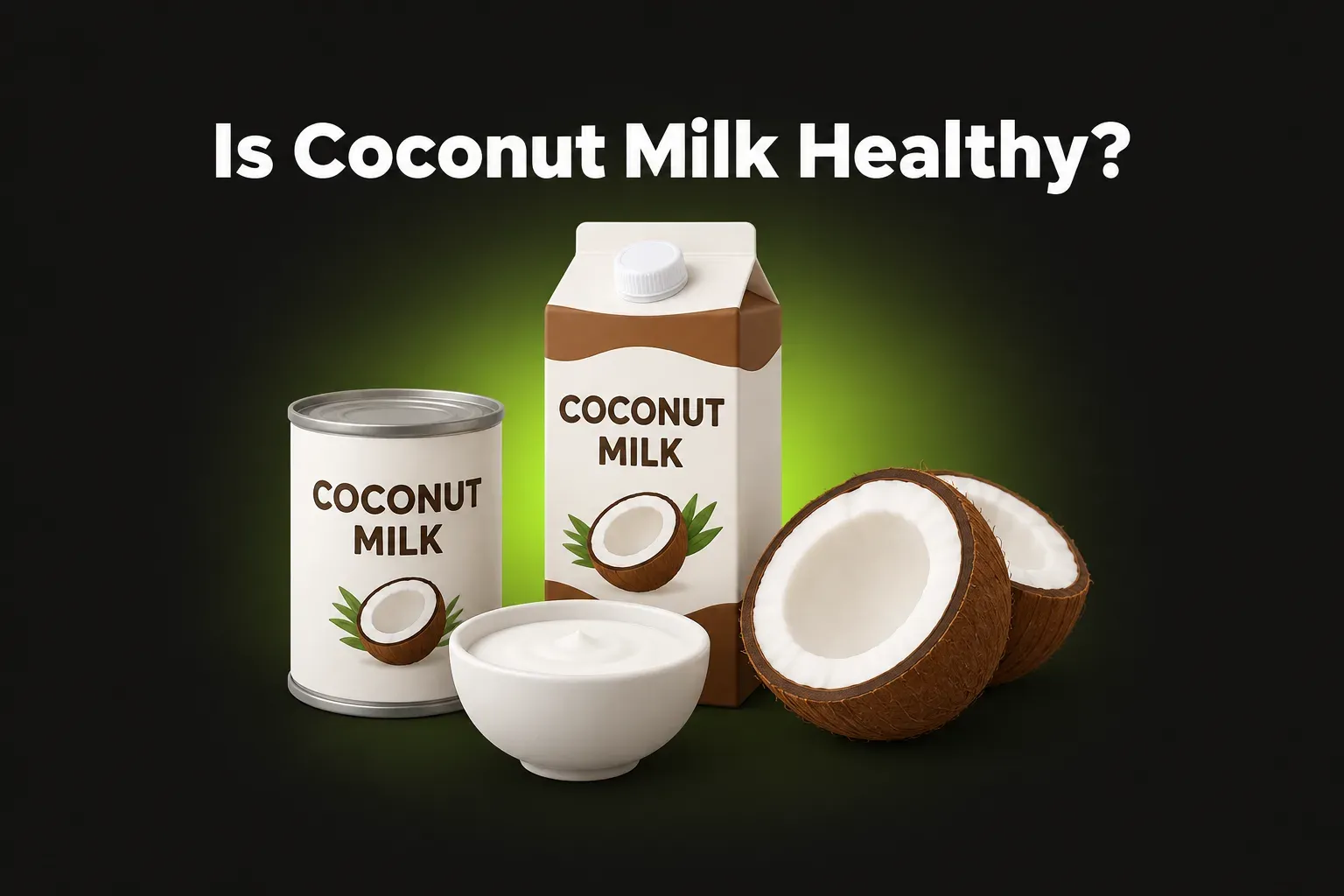
Coconut milk is in curries, smoothies and coffee drinks. But the coconut milk in a can and the one in a carton are very different products.
The short answer: coconut milk can fit a healthy diet, but the type matters. Canned coconut milk is rich and very high in saturated fat. A 1/3 cup of a full-fat can has about 11–14 g. That’s more than half the Daily Value on US labels. Use it in small amounts for cooking, or pick a light can. Coconut milk in cartons is mostly water. Unsweetened cartons have only 40–50 calories a cup and lots of added calcium. But they have 0 g of protein, so they’re not a full swap for cow’s milk or soy milk. Skip sweetened cartons, and read the label for added sugar and sulfites.
Canned vs carton: two different products
Both say “coconut milk.” But they’re made for different jobs.
Canned coconut milk is made by grating the white flesh of mature coconuts and pressing it with water. It’s thick and creamy. It’s meant for curries, soups and desserts. It’s about one-fifth fat by weight.
Coconut milk in cartons is a drink. It’s mostly water with some coconut cream. Most brands add calcium, vitamins and gums (thickeners that keep it smooth). It’s made to pour on cereal or into coffee.
Here’s how a cup (8 oz / 240 ml) of each compares with cow’s milk and soy milk:
| Milk (1 cup) | Calories | Protein | Saturated fat | Calcium |
|---|---|---|---|---|
| Coconut milk, canned | 445 | 4.6 g | 43 g | 41 mg |
| Coconut milk drink, sweetened (carton) | 74 | 0.5 g | 5.0 g | 451 mg |
| 2% cow’s milk | 122 | 8.1 g | 3.1 g | 293 mg |
| Soy milk, unsweetened | 91 | 8.5 g | 0.8 g | 242 mg |
Source: USDA FoodData Central – coconut milk, canned, coconut milk drink, sweetened, 2% milk, soy milk. Values per 100 g, multiplied to one cup (226–244 g) and rounded. Calcium in carton coconut milk is added and varies by brand.
What stands out:
- Canned: a cup has 445 calories and 43 g of saturated fat. That’s more than twice the 20 g Daily Value on US labels. Nobody drinks it by the cup. But one curry can use a whole can.
- Carton: it has fewer calories than 2% milk. But it has almost no protein.
- Calcium: cartons have it because it’s added. Canned coconut milk has very little.
Coconut milk is not the same as coconut water, the thin, clear juice inside young coconuts.
Saturated fat and your cholesterol
Almost 90% of the fat in canned coconut milk is saturated fat. That’s the kind that’s solid at room temperature. Saturated fat can raise LDL cholesterol, the “bad” kind. Too much LDL builds up in blood vessels and raises the risk of heart disease.
There are few studies on coconut milk itself. Most research looks at coconut oil, which has the same fats.
- A review of 16 trials in people compared coconut oil with common plant oils, like olive or soybean oil. Coconut oil raised LDL by about 10 mg/dL more. It also raised HDL (“good”) cholesterol by about 4 mg/dL (Neelakantan et al., Circulation, 2020).
- Does lower LDL matter? A large review pooled 15 trials with about 59,000 people. In them, some people cut back on saturated fat for at least two years. They had about 21% fewer heart problems and strokes (counted together) than people who didn’t. It did not change the overall risk of dying (Hooper et al., Cochrane Database of Systematic Reviews, 2020).
- Not every study agrees. In Sri Lanka, 60 healthy adults ate porridge made with coconut milk 5 days a week for 8 weeks. Their LDL dropped by about 15 mg/dL, and HDL rose by about 10 mg/dL (Ekanayaka et al., Journal of Nutrition and Metabolism, 2013). But there was no separate group for comparison at the same time. So other changes could explain the results.
What does this mean in real meals? A 13.66 oz (404 ml) can of Thai Kitchen has about 5 servings. That’s about 55 g of saturated fat in the can. Split a curry four ways, and each plate gets about 14 g. That’s most of a day’s 20 g.
So a coconut curry now and then is fine. A can or more every week adds up. If your LDL is high, use light coconut milk or use less. Read more in our guide to coconut oil.
What about the MCTs?
Coconut products are often sold with “MCT” claims. MCTs (medium-chain triglycerides) are fats the body burns quickly for energy.
- Only about 13% of the fat in canned coconut milk is caprylic and capric acid. These are the MCTs used in most studies.
- About 44% is lauric acid. Some sellers count it as an MCT. But in the body, most of it acts more like a regular fat.
The weight-loss proof comes from pure MCT oil. In one study, 31 overweight adults finished a 16-week weight-loss program. They ate 18–24 g of MCT oil or olive oil a day. The MCT group ended about 3.7 lb (1.7 kg) lighter (St-Onge and Bosarge, American Journal of Clinical Nutrition, 2008). That was MCT oil, not coconut milk. And the review of 16 coconut oil trials above found no effect on weight.
So don’t count on coconut milk to help you lose weight.
Low protein: not a swap for cow’s or soy milk
All three carton brands below list 0 g of protein per cup. Cow’s milk and soy milk have about 8 g. Even almond milk has about 1 g.
If coconut milk goes on your cereal, add protein from eggs, Greek yogurt or nuts. Check your daily target with our protein calculator.
This matters most for kids. Children’s doctors say plant milks are not a full swap for cow’s milk in young children (Merritt et al., Journal of Pediatric Gastroenterology and Nutrition, 2020). Coconut milk drinks give them almost no protein. Babies need breast milk or formula.
9 coconut milks compared
Canned coconut milk (per 1/3 cup / 80 ml)
| Product | Calories | Fat | Saturated fat | Ingredients |
|---|---|---|---|---|
| Thai Kitchen Unsweetened | 120 | 12 g | 11 g | Coconut, water, guar gum |
| Native Forest Organic Classic | 140 | 14 g | 13 g | Organic coconut, filtered water, organic guar gum |
| Aroy‑D | 150 | 15 g | 14 g | Coconut extract, water, polysorbate 60 (other cans: only coconut extract and water) |
| Goya* | about 135 | about 12 g | about 12 g | Coconut milk, water, potassium metabisulfite |
| Trader Joe’s Organic Reduced Fat* | about 85 | about 9 g | about 7 g | Water, organic coconut |
| Thai Kitchen Organic Lite | 50 | 5 g | 4 g | Water, organic coconut, organic guar gum |
Sources: Open Food Facts for Thai Kitchen (nutrition, 13.66 oz can ingredients), Native Forest, Aroy-D, Goya, Trader Joe’s and Thai Kitchen Organic Lite, checked November 2026. *Goya lists 1/4 cup (59 ml): 100 calories, 9 g fat, 9 g saturated fat. Trader Joe’s lists 65 ml: 70 calories, 7 g fat, 6 g saturated fat. We scaled both to 1/3 cup. Recipes change – always check the can.
What to notice:
- Full-fat cans are close. Each 1/3 cup has 120–150 calories and 11–14 g of saturated fat.
- Light cans help. Thai Kitchen Organic Lite has 4 g of saturated fat – about a third of the regular can.
- Shortest list: Trader Joe’s is just water and coconut. Goya adds a sulfite preservative.
Coconut milk in cartons (per 1 cup / 8 oz / 240 ml)
| Product | Calories | Saturated fat | Sugar (added) | Protein | Calcium | Gums and additives |
|---|---|---|---|---|---|---|
| Silk Unsweet Coconutmilk | 40 | 3.5 g | 0 g (0 g) | 0 g | 470 mg | Gellan gum, dipotassium phosphate, natural flavor |
| Califia Farms Unsweetened Coconutmilk | 50 | 3.5 g | 2 g (0 g) | 0 g | 470 mg | Acacia (gum arabic), gellan gum, natural flavor |
| So Delicious Organic Original | 70 | 4 g | 7 g (7 g) | 0 g | 130 mg | Sunflower lecithin, gellan gum, locust bean gum |
Sources: brand sites for Silk, Califia Farms and So Delicious, checked November 2026.
What to notice:
- Unsweetened is light. Silk has 40 calories and Califia 50, with 0 g of added sugar. Califia’s 2 g of sugar is natural. It likely comes from the coconut water in it.
- “Original” means sweetened. So Delicious Original has 7 g of added sugar per cup. That’s 14% of the 50 g Daily Value.
- Calcium: Silk and Califia add 470 mg – more than a cup of 2% milk. So Delicious Original has 130 mg.
- Protein: all three have none.
What’s added to coconut milk
Guar gum
Thai Kitchen and Native Forest add guar gum. It’s a fiber from guar beans. It keeps the cream from splitting off in the can. The amount in one serving is small. Still, a few studies point the same way:
- A French study followed over 100,000 adults. People who ate more guar gum from processed foods had a slightly higher risk of type 2 diabetes. The risk was about 11% higher for every extra 500 mg a day (Salame et al., The Lancet Diabetes & Endocrinology, 2024). This shows a link, not proof.
- In one mouse study, the diet had 7.5% guar gum for 4 weeks. Then the mice were given gut inflammation (colitis). It was much worse than in mice fed cellulose, another fiber (Paudel et al., Gut Microbes, 2024).
Polysorbate 60
The Aroy-D label we checked lists polysorbate 60 (E435). It’s an emulsifier, which helps fat and water mix. Other Aroy-D cans list only coconut extract and water. It hasn’t been tested much on its own. But in mice, a close relative, polysorbate 80, was added to drinking water at 1% for 12 weeks. It thinned the gut’s protective mucus. It also caused low-grade inflammation and weight gain (Chassaing et al., Nature, 2015).
Why do animal studies matter? Mice share most of our genes and body processes. Testing an additive on people for years would put their health at risk. Proof of harm in people is still missing for these additives. But several labs see warning signs. So it makes sense to limit gums and emulsifiers as a precaution – especially if you have a sensitive gut. Trader Joe’s, for example, is just water and coconut.
Sulfites
Goya uses potassium metabisulfite, one of the sulfites. It’s a preservative. But sulfites can trigger asthma attacks. Most studies find that 3–10% of people with asthma react to them (Vally et al., Clinical & Experimental Allergy, 2009). If you have asthma, pick a can without them.
Gellan gum and other carton helpers
Cartons use gellan gum to keep the added calcium from sinking. In one study, 10 volunteers ate large amounts every day for about three weeks. It acted like fiber and caused no harm (Anderson et al., Food Additives and Contaminants, 1988). Still, shake the carton before you pour.
Who coconut milk suits – and who should skip it
Coconut milk is a good fit if you:
- Cook curries, soups or rice dishes now and then, and want the rich taste.
- Avoid dairy and soy, and want a light carton (40–50 calories a cup) for coffee or cereal.
Think twice if you:
- Have high LDL cholesterol or heart disease. Use light coconut milk, or less of it.
- Need more protein. Pick soy milk or cow’s milk. Compare all your options in our guide to the healthiest milk.
- Are feeding a young child. Coconut drinks are too low in protein to be their main milk.
- Have asthma. Check the can for potassium metabisulfite.
How to pick a healthier coconut milk
- For cooking, choose a light can. Or use half a can and add broth or water.
- For drinking, look for “unsweetened” and 0 g of added sugar.
- Check the calcium. Aim for about 300 mg or more per cup.
- Read the ingredients. Shorter is better. Skip sulfites if you have asthma.
- Get protein from other foods. Want other plant milks? See what’s in oat milk and almond milk.
See what’s really in your coconut milk. With NutriSmart, you photograph the label or scan the barcode. The app lists the sweeteners, preservatives and colors, explains the risks of each one and gives the product a health score out of 100. It also tells you right away if a coconut milk is ultra-processed, and which ingredients make it so. Set an alert for sulfites or guar gum, and the app warns you whenever a product you scan contains them.Get the app free
The bottom line
Coconut milk can be part of a healthy diet, but the type matters. Canned coconut milk is very high in saturated fat, which can raise LDL cholesterol. Use it for cooking, in small amounts, or choose a light can. Unsweetened coconut milk in cartons is light and has added calcium. But it has no protein, so it can’t replace cow’s milk or soy milk. Skip sweetened cartons, and check the label for sulfites and long lists of gums.
FAQ
Is coconut milk healthy?
It depends on the type. Canned coconut milk is very high in saturated fat, so it's best used in small amounts for cooking. Unsweetened coconut milk in cartons is light, at 40–50 calories a cup, but it has no protein.
Is coconut milk bad for your cholesterol?
It can raise LDL ("bad") cholesterol if you have a lot of it. In a review of 16 trials, coconut oil raised LDL by about 10 mg/dL more than common plant oils. Canned coconut milk is rich in the same fats.
What's the difference between canned and carton coconut milk?
Canned coconut milk is thick and made for cooking. A 1/3 cup has about 120–150 calories and 11–14 g of saturated fat. Carton coconut milk is mostly water with added calcium and vitamins, and has 40–70 calories per cup.
Is light coconut milk healthier?
Yes, for your heart. It has less fat, because more water is added. Thai Kitchen Organic Lite has 50 calories and 4 g of saturated fat per 1/3 cup. Thai Kitchen's regular can has 120 calories and 11 g.
Does coconut milk have protein?
Almost none. Carton coconut milks from Silk, So Delicious and Califia list 0 g of protein per cup. Cow's milk and soy milk have about 8 g.
Do the MCTs in coconut milk help you lose weight?
There's no good proof. The weight-loss studies used pure MCT oil. Only about 13% of the fat in coconut milk is the kind used in those studies.