Is Coconut Oil Healthy? Benefits, Risks & Uses
Is coconut oil good for you? What it does to cholesterol, the truth about MCTs and weight loss, cooking with it, and what studies show for hair and skin.
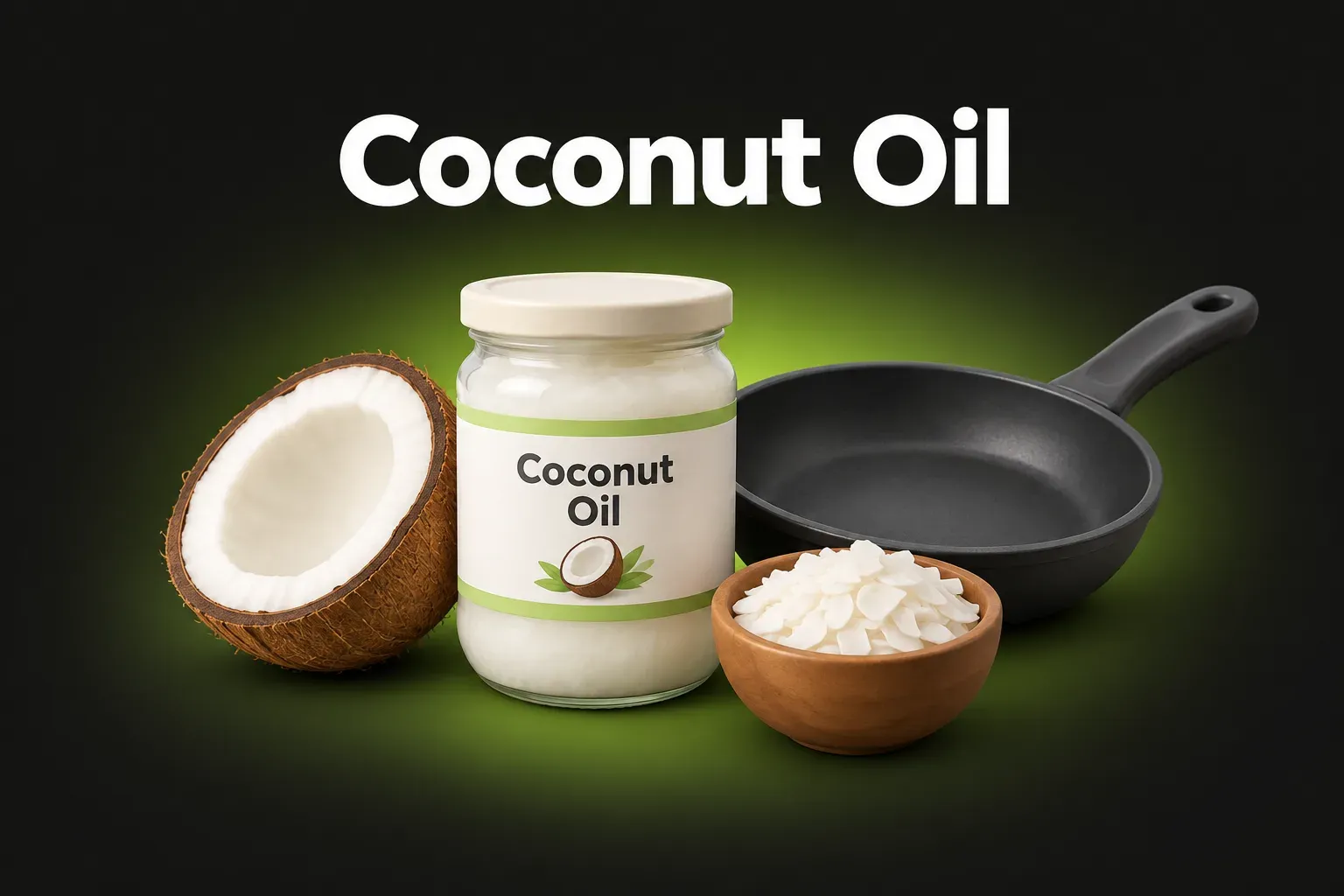
Coconut oil has been one of the most hyped “health foods” of the last decade. Online, you’ll read that it helps you lose weight, protects your heart, boosts memory and even helps with Alzheimer’s disease. It’s in “clean” desserts, in coffee, in keto recipes and, of course, in hair and skin care. But what do the studies actually show?
The short answer: coconut oil is about 82% saturated fat – more than butter. A review of 16 trials in people found that it raises LDL (“bad”) cholesterol more than common plant oils. There’s no good proof that it helps with weight loss or memory. The weight-loss studies used MCT oil, which isn’t the same thing. On the other hand, it holds up well when you cook with it, and it seems to help hair and dry skin when used on the outside. In the kitchen, it’s fine now and then, for flavor. Don’t make it your main oil.
What is coconut oil?
Coconut oil is made from the white flesh of the coconut. At room temperature, below about 76 °F (24 °C), it’s solid and white. When it’s warm, it turns into a clear liquid.
There are two main types:
- Virgin (cold-pressed) coconut oil: made from fresh coconut flesh, without high heat or chemicals. It tastes and smells like coconut and keeps more antioxidants.
- Refined coconut oil: made from dried coconut (copra), then cleaned, bleached and deodorized. It has no taste and handles higher heat.
Both have the same fats, so their effect on cholesterol is similar.
Coconut oil vs other fats
| Fat (per 100 g) | Saturated | Monounsaturated | Polyunsaturated |
|---|---|---|---|
| Coconut oil | 82 g | 6 g | 2 g |
| Butter | 51 g | 21 g | 3 g |
| Palm oil | 49 g | 37 g | 9 g |
| Olive oil | 14 g | 73 g | 11 g |
| Canola oil | 7 g | 63 g | 28 g |
Coconut oil has more saturated fat than any other common cooking fat. Like every oil, it has about 890 calories per 100 g – about 120 per tablespoon.
Is coconut oil healthy? What the research says
Cholesterol and heart health
This is the main problem. Saturated fat usually raises LDL cholesterol, the kind that builds up in your arteries.
- A review of 16 trials in people compared coconut oil with other oils. Coconut oil raised LDL cholesterol by about 10 mg/dL more than common plant oils, such as soybean, canola or sunflower oil. It also raised HDL (“good”) cholesterol by about 4 mg/dL. It didn’t change weight, blood sugar or inflammation (Neelakantan et al., Circulation, 2020).
- The American Heart Association reviewed the evidence in 2017. It concluded that coconut oil raises LDL cholesterol and advised against using it (Sacks et al., Circulation, 2017).
- To be fair, not every study agrees. In a trial at the University of Cambridge, 94 adults ate 50 g a day of coconut oil, butter or olive oil for 4 weeks. Butter raised LDL cholesterol. Coconut oil didn’t raise it more than olive oil and raised HDL cholesterol (Khaw et al., BMJ Open, 2018). But the study was short and small.
In short, coconut oil seems less harmful than butter, but worse than plant oils for cholesterol. And the fact that it also raises HDL doesn’t mean it protects your heart. Drugs that only raised HDL didn’t lower the number of heart attacks.
MCTs and weight loss
Many articles say coconut oil helps you lose weight because it contains medium-chain fats (MCTs). These go straight to the liver and are burned for energy faster.
The problem is that MCT oil and coconut oil aren’t the same thing:
- The MCT oil used in studies is made mostly of caprylic and capric acid. In coconut oil, these make up only about 13–15% of the fat.
- Most of coconut oil is lauric acid, which acts more like a regular fat in the body.
In a 16-week study, people who used MCT oil on a weight-loss diet lost about 3.7 lb (1.7 kg) more than people who used olive oil (St-Onge & Bosarge, American Journal of Clinical Nutrition, 2008). But you can’t apply this to coconut oil. And the review of 16 trials above found no effect on weight.
Memory and Alzheimer’s disease
The idea that coconut oil helps with Alzheimer’s comes from a few personal stories and very small studies. There are no good studies in people showing that it slows the disease. If someone in your family has memory problems, talk to their doctor – don’t rely on coconut oil.
Cooking with coconut oil
Because it’s so high in saturated fat, coconut oil doesn’t break down easily when heated. Refined coconut oil can handle about 400 °F (200 °C), and virgin about 350 °F (175 °C). It works well for frying, baking and roasting – especially in recipes where you want the coconut flavor, such as curries, baked goods or granola.
The problem isn’t the heat, it’s the amount. If you use it every day, you get a lot of saturated fat.
Coconut oil for hair and skin
Here, coconut oil has better evidence:
- Hair: in a lab study, scientists tested coconut oil, sunflower oil and mineral oil on hair. Only coconut oil reduced protein loss from the hair, used before and after washing. Its small molecules can get inside the hair (Rele & Mohile, Journal of Cosmetic Science, 2003).
- Dry skin: in a study of people with dry skin on their legs, virgin coconut oil moisturized the skin as well as mineral oil, with no side effects (Agero & Verallo-Rowell, Dermatitis, 2004).
- Eczema in children: in 117 children with mild to moderate eczema (atopic dermatitis), virgin coconut oil used on the skin for 8 weeks reduced symptoms by about 68%, compared with 38% for mineral oil (Evangelista et al., International Journal of Dermatology, 2014).
If you break out easily, be careful using it on your face: thick oils can clog pores in some people.
How to use coconut oil
- Use it now and then, for flavor – in curries, baked goods, granola or Asian dishes.
- For everyday cooking, choose extra virgin olive oil or canola oil. For frying, high oleic sunflower oil also works well.
- Don’t add spoonfuls of coconut oil to your coffee “for weight loss” – you’re only adding calories and saturated fat.
- Don’t take it as a supplement for your heart, memory or weight.
- For hair and dry skin, virgin coconut oil is a good, cheap choice.
- Read the label on “healthy” treats and vegan products – many contain coconut or palm oil.
Spot coconut oil on any label in seconds. With NutriSmart, you photograph the ingredient list or scan the barcode, and the app tells you right away if the product has coconut oil. Turn on an alert for it, and the app warns you every time a product you scan contains it. You’ll also see every other additive, the risks of each one and a health score out of 100.Get the app free
You can also read about other oils: palm oil, canola oil, sunflower oil and seed oils. If you follow the keto diet, coconut oil is allowed, but also choose unsaturated fats like olive oil, avocado and nuts.
The bottom line
Coconut oil isn’t the superfood the internet promised. It has more saturated fat than butter, and in studies with people it raises LDL cholesterol more than common plant oils. There’s no good proof that it helps with weight loss or memory – those studies used MCT oil. It’s stable for cooking and good for hair and dry skin. Use it now and then for flavor, and make olive oil or canola oil your main cooking oil.
FAQ
Is coconut oil healthy?
Not as healthy as its reputation. It's about 82% saturated fat – more than butter. A review of 16 trials in people found that it raises LDL ("bad") cholesterol more than common plant oils. It also raises HDL ("good") cholesterol, but that doesn't cancel out the LDL. Using it now and then for flavor is fine. For everyday cooking, olive oil or canola oil are better choices.
Does coconut oil help you lose weight?
There's no good proof. The weight-loss studies used MCT oil, not coconut oil. Coconut oil contains only a small amount of those fats. And like any oil, it has about 120 calories per tablespoon, which adds up quickly.
Is virgin or refined coconut oil better?
Virgin (cold-pressed) coconut oil tastes and smells like coconut and keeps more antioxidants. Refined coconut oil has no taste and handles higher heat. Both have the same saturated fats, so their effect on cholesterol is similar.
Can you fry with coconut oil?
Yes. Because it's so high in saturated fat, it doesn't break down easily when heated. Refined coconut oil can handle about 400 °F (200 °C), and virgin about 350 °F (175 °C). The problem isn't frying – it's the amount of saturated fat if you use it every day.
Is coconut oil good for your hair?
It seems to help. In a lab study, coconut oil was the only oil tested that reduced protein loss from hair, both before and after washing. Sunflower oil and mineral oil didn't have this effect.
Is coconut oil good for your skin?
For dry skin, yes. In studies, virgin coconut oil moisturized dry skin as well as mineral oil and helped children with eczema (atopic dermatitis) more. If you break out easily, be careful using it on your face, because thick oils can clog pores in some people.