Is Coconut Water Healthy? Sugar, Potassium and 8 Brands
Is coconut water healthy? Calories, sugar and potassium per carton, how it hydrates vs water and Gatorade, kidney risks, and 8 US brands compared.
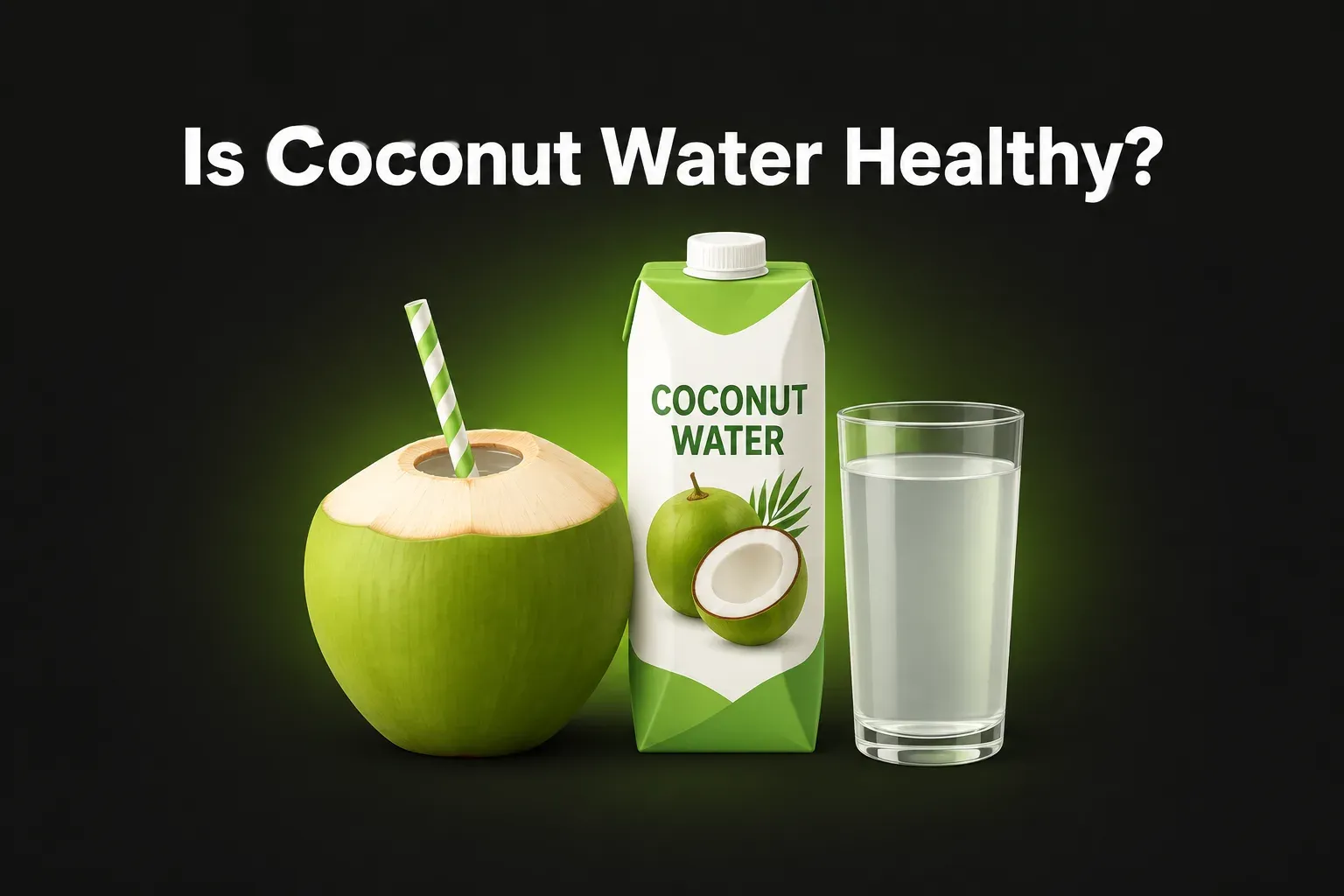
Coconut water is sold as nature’s sports drink, and it’s in almost every gym fridge. But is coconut water healthy, or just a pricey juice?
The short answer: plain coconut water is a healthy drink for most people. An 11 oz (330 ml) carton has about 60 calories, 13 g of natural sugar and 545 mg of potassium – more than a banana. It hydrates you about as well as water or a sports drink. But it’s not magic. It has less sodium (salt) than a sports drink, and the calories still count. Choose cartons with no added sugar. If you have kidney disease or take certain blood pressure pills, ask your doctor first.
What’s in coconut water
Coconut water is the clear liquid inside young green coconuts. It’s not the same as coconut milk, which is made from the white flesh (see our guide on coconut milk). Here is what one small carton gives you:
| Per 11.1 fl oz (330 ml) | Calories | Sugar | Sodium | Potassium |
|---|---|---|---|---|
| Packaged coconut water, unsweetened | 59 | 13 g | 86 mg | 545 mg |
| Fresh coconut water | 63 | 9 g | 347 mg | 825 mg |
| Gatorade Thirst Quencher | about 75 | about 20 g | about 150 mg | about 45 mg |
| Plain water | 0 | 0 g | 0 mg | 0 mg |
Source: USDA FoodData Central – coconut water, ready-to-drink, unsweetened and coconut water, fresh, values per 100 g multiplied to 330 ml and rounded. Gatorade scaled from the 12 oz Lemon-Lime label on Open Food Facts (80 calories, 21 g sugar, 160 mg sodium).
What stands out:
- Potassium: this is coconut water’s big strength. A carton has 545–825 mg. A medium banana has about 422 mg (NIH Office of Dietary Supplements). The Daily Value on US labels is 4,700 mg. Most Americans get less potassium than they should.
- Sugar: plain coconut water has about 9–13 g of sugar per carton. That sugar comes from the coconut itself. It’s less than in Gatorade.
- Sodium: packaged coconut water has much less salt than a sports drink. Fresh coconuts vary a lot from one to the next.
- Calories: about 60 per carton. That’s low for a drink with flavor, but water has none.
Coconut water also has some magnesium, a mineral your muscles and nerves need. It has almost no protein, fat or fiber.
Does coconut water hydrate better than water?
Not really. Several small lab studies have tested this. They all used the same basic plan. Healthy young people exercised until they lost water through sweat. Then they drank water, coconut water or a sports drink. Researchers measured how much fluid each person kept in their body.
- Malaysia, 2002: 8 men exercised in the heat. Afterward, they drank fresh coconut water, a sports drink or plain water. All three drinks rehydrated them about the same. The men found coconut water sweeter and easier to drink. It also caused less nausea (Saat et al., Journal of Physiological Anthropology, 2002).
- US, 2012: 12 trained men ran on a treadmill for an hour. Then they drank water, pure coconut water, coconut water from concentrate or a sports drink. There was no real difference in hydration or in a later running test. The men felt more bloated and had more stomach upset with coconut water. Vita Coco paid for this study (Kalman et al., Journal of the International Society of Sports Nutrition, 2012).
- Costa Rica, 2014: 12 active adults lost about 2% of their weight in sweat. The sports drink helped them keep more fluid than water did. Fresh coconut water landed in between. It was not clearly better or worse than either one. The authors said the extra potassium added no benefit over a sports drink with sodium (Pérez-Idárraga and Aragón-Vargas, Applied Physiology, Nutrition, and Metabolism, 2014).
- Canada, 2026: 8 athletes cycled for an hour. They then drank flavored water, coconut water or a sports drink. People peed less after coconut water and the sports drink than after flavored water. But in the end, their fluid levels were about the same with all three (Bell and Spriet, Journal of Strength and Conditioning Research, 2026).
What this means for you: coconut water works as a recovery drink, about as well as a sports drink. But these studies were tiny – 8 to 12 people each. Most were young, fit men. For a normal day or a short workout, plain water is enough. Also, sweat is salty. You lose much more sodium than potassium. One Malaysian study added salt to coconut water. It then worked as well as a sports drink, and caused less stomach upset (Ismail et al., Southeast Asian Journal of Tropical Medicine and Public Health, 2007).
So if you sweat for over an hour in the heat, coconut water alone may be too low in salt. A salty snack helps. Read more in our guides on Gatorade and Liquid I.V., which has about 560 mg of sodium per stick. BodyArmor is a sports drink made with coconut water – see is BodyArmor good for you?
8 coconut waters compared
Here are 8 coconut waters sold in the US. All values are per 8 fl oz (240 ml), the serving size on most labels.
| Coconut water (8 oz) | Calories | Sugar (added) | Sodium | Potassium | Ingredients |
|---|---|---|---|---|---|
| Vita Coco Original | 45 | 11 g (1 g) | 60 mg | 470 mg | Coconut water, less than 1% fruit sugar, vitamin C |
| Vita Coco Extra Coconut (Pressed) | 60 | 10 g (1 g) | 60 mg | 470 mg | Coconut water, coconut purée, 1% fruit sugar, vitamin C, gellan gum |
| Harmless Harvest Organic | 60 | 14 g (0 g) | 40 mg | 560 mg | Organic coconut water |
| Zico Natural | 45 | 9 g (0 g) | 60 mg | 490 mg | Coconut water |
| C2O The Original | about 40 | about 9 g (2 g) | about 45 mg | about 500 mg | Coconut water (some labels: less than 1% sugar) |
| Taste Nirvana Real | about 40 | about 9 g | about 50 mg | about 340 mg | Coconut water |
| 365 Organic (Whole Foods) | 45 | 9 g (0 g) | 50 mg | 480 mg | Organic coconut water |
| Goya Coconut Water with Pulp | 80 | 18 g (12 g) | 25 mg | 230 mg | Coconut juice, water, sugar, coconut pulp, citric acid, potassium metabisulfite |
Sources: labels on Open Food Facts for Vita Coco Original (16.9 oz bottle label, halved), Vita Coco with Pressed Coconut (now sold on the brand site as Extra Coconut), Harmless Harvest, Zico, C2O (10.5 oz / 310 ml can label, scaled), Taste Nirvana (9.5 oz / 285 ml bottle label from 2024, scaled), 365 Organic and Goya with Pulp; Zico and Vita Coco brand sites, checked November 2026. Zico says it adds no sugar, though one label listing shows 2 g. Recipes change – always check the carton.
What stands out:
- Most plain brands are close. They have about 40–60 calories and 9–14 g of sugar per 8 oz. The sugar comes from the coconut.
- A little added sugar. Vita Coco adds about 1% fruit sugar to keep the taste the same. Coconuts from different farms taste different. That’s 1 g of added sugar per serving – a tiny amount. C2O’s label also lists about 2 g.
- Harmless Harvest has the most sugar of the plain brands, but no added sugar. All of its sugar comes from the coconut.
- “With pulp” and flavored drinks are a different story. The Goya drink with pulp is partly water and has 12 g of added sugar per 8 oz. That’s about 3 teaspoons. Fruit-flavored versions also tend to have more sugar, from juice or added sugar. C2O with Pineapple, for example, lists about 13 g of sugar per 8 oz.
- Taste Nirvana numbers come from an older listing, so treat them as rough.
From concentrate, pasteurized or raw?
Coconut water spoils fast once the nut is open. So brands treat it in different ways.
Pasteurized. Most cartons are flash-pasteurized. That means they’re heated quickly to kill germs. Vita Coco and Zico both say they do this. Vita Coco says its cartons can sit on a shelf for up to 12 months.
Filtered, not heated. Harmless Harvest’s refrigerated bottles are not heat-treated. The brand uses fine filters to remove germs instead. These bottles must stay cold. The water can turn pink over time. The brand says this comes from natural antioxidants reacting to light. It’s not a sign that the drink went bad.
From concentrate. Some coconut water is heated to remove most of its water. The thick syrup is shipped and then mixed with water again. In the 2012 study above, the version from concentrate hydrated people just as well. But it’s more processed. If you want the simplest product, look for “not from concentrate” on the label. Even then, Vita Coco says it sometimes tops up some of these drinks with concentrate when coconuts run short.
Additives to know. Plain coconut water needs no additives. Some drinks add a few:
- Gellan gum keeps the coconut purée in Vita Coco Extra Coconut from settling. It looks like one of the gentler thickeners. In one study, 10 volunteers ate large amounts every day for about three weeks. The dose was about 200 mg per kg of body weight. It acted like fiber and caused no harm in blood tests (Anderson et al., Food Additives and Contaminants, 1988). Read more in our guide to gellan gum.
- Potassium metabisulfite is a sulfite preservative, used in the Goya drink with pulp. About 3–10% of people with asthma react to sulfites, often with wheezing (Vally et al., Clinical & Experimental Allergy, 2009). In 2022, the European Food Safety Authority withdrew its safe daily limit for sulfites. It said the data were too weak. In rat studies, high doses slowed nerve signals from the eyes to the brain. EFSA used a dose of about 38 mg per kg of body weight a day as its starting point. Tests like this use animals because rodents share most of our genes and body processes. Testing high doses on people would put their health at risk. EFSA said people who eat and drink a lot of sulfites may be at risk (EFSA, 2022). Proof of harm in people without asthma is still missing. Even so, it makes sense to limit them. See our guide to sulfites.
Coconut water, potassium and your kidneys
Healthy kidneys remove extra potassium easily. But weak kidneys can’t. Some medicines also make the body hold on to potassium. These include blood pressure pills called ACE inhibitors (like lisinopril or ramipril) and ARBs (like losartan). Too much potassium in the blood is called hyperkalemia. It can make the heart beat in a dangerous way.
Doctors in London described one case. A 26-year-old woman had type 1 diabetes and kidney damage. She took blood pressure medicine. During hot weather, she drank over 2 liters (about 68 oz) of coconut water in one day. That added at least 5 g of potassium. Her blood potassium rose to a dangerous level. Her heart tracing changed. She recovered with hospital treatment (Rees et al., British Journal of Hospital Medicine, 2012).
This doesn’t only happen to people with kidney disease. A 2019 review looked at 44 cases of high potassium caused by food or drink. 17 of the people had normal kidneys. Most cases came from large amounts of fruit, vegetables or salt substitutes (Te Dorsthorst et al., European Journal of Clinical Nutrition, 2019). These cases are rare. But they show that “natural” doesn’t mean “unlimited”.
Ask your doctor before drinking coconut water if you:
- Have kidney disease or are on dialysis.
- Take ACE inhibitors, ARBs or potassium-sparing diuretics (water pills like spironolactone).
- Use a salt substitute or take potassium pills.
For other ways to get potassium, see our list of foods high in potassium.
Who coconut water is good for
- People who don’t like plain water. It’s a lighter swap for soda or juice. Compare it with our picks for the healthiest soda, or read is sparkling water healthy?
- People after a sweaty workout. It rehydrates about as well as a sports drink, with less sugar. Add a salty snack after long, hot workouts.
- People who need more potassium. Most Americans fall short. Coconut water helps, but beans, potatoes and leafy greens give you fiber too.
Who should be careful: people watching their sugar or calories, people with diabetes (count it as carbs), and anyone with kidney problems. If you want electrolytes without sugar, look at Propel.
Check your coconut water before you buy it. With NutriSmart, you photograph the label or scan the barcode. The app lists the sweeteners, preservatives and colors, explains the risks of each one and gives the product a health score out of 100. It also tells you right away if a coconut water drink is ultra-processed, and which ingredients make it so. You can set an alert for an ingredient like sulfites or added sugar. The app then warns you on every scanned product that contains it.Get the app free
The bottom line
Plain coconut water is a healthy drink for most people. A small carton has about 60 calories, 9–13 g of natural sugar and over 500 mg of potassium. It hydrates you about as well as water or a sports drink – not better. It has less salt than a sports drink, so add a salty snack after long, sweaty workouts. Pick a brand with only coconut water on the label, and skip versions with added sugar. If you have kidney disease or take certain blood pressure pills, ask your doctor first.
FAQ
Is coconut water healthy?
Plain coconut water is a healthy drink for most people. An 11 oz carton has about 60 calories, 13 g of natural sugar and over 500 mg of potassium. Pick one with no added sugar, and don't treat it as a free drink – the calories still count.
Is coconut water better than water?
Not for everyday thirst. In lab studies, people rehydrated about as well with plain water as with coconut water after exercise. Coconut water adds potassium and some sugar, but water has no calories and costs much less.
Is coconut water better than Gatorade?
It has fewer calories and less sugar, and much more potassium. But it has less sodium, the salt you lose most in sweat. For short workouts, both work about as well as water. For long, salty sweating, a sports drink or a salty snack helps more.
How much coconut water can I drink a day?
There's no official limit. For healthy adults, a carton or two a day is fine. Very large amounts can raise potassium too much, and the sugar and calories add up.
Is coconut water bad for your kidneys?
Healthy kidneys handle it well. But if you have kidney disease, coconut water can raise blood potassium to a dangerous level. Doctors described a woman with kidney disease whose potassium spiked after she drank over 2 liters in a day. Ask your doctor first.
Does coconut water have added sugar?
Many brands have none. Some add a little – Vita Coco Original lists 1 g of added sugar. Flavored and "with pulp" versions can have as much as 12 g of added sugar per 8 oz, so check the label.