Is Propel Healthy? Electrolytes, Sweeteners and Vitamins
Is Propel healthy? What's in Propel Fitness Water, powder and Immune Support, its two sweeteners, and how it compares to Gatorade Zero and water.
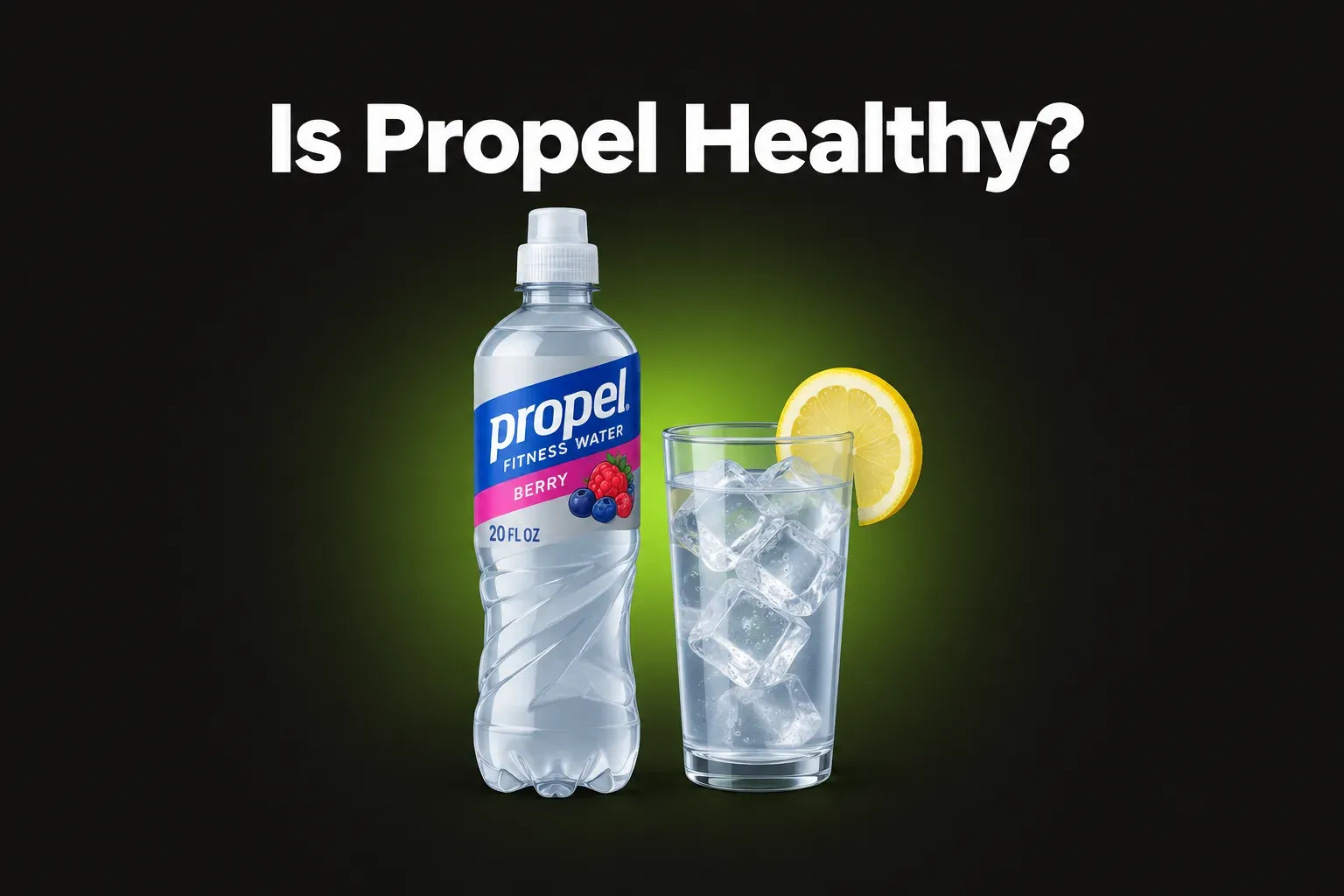
Propel is the “fitness water” from the makers of Gatorade. It promises electrolytes and vitamins with zero sugar. But is Propel healthy, or just water with extras?
The short answer: Propel is a better pick than soda or regular Gatorade. A 20 oz bottle has 0 calories, 0 g of sugar and 270 mg of sodium. But it’s sweetened with sucralose and acesulfame K, two sweeteners with open questions. For everyday drinking, plain water is still the healthiest choice. Propel makes the most sense during long, sweaty workouts.
What’s in a bottle of Propel
Propel is made by PepsiCo’s Gatorade brand. Here is the label of the classic Propel Fitness Water, Berry, 20 oz (591 ml):
| Per bottle (20 oz) | Amount | % Daily Value |
|---|---|---|
| Calories | 0 | – |
| Sugar | 0 g | 0% |
| Sodium | 270 mg | 12% |
| Potassium | 70 mg | under 2% |
| Niacin (B3) | 12 mg | 80% |
| Pantothenic acid (B5) | 6 mg | about 120% |
| Vitamin B6 | 1.2 mg | about 70% |
| Vitamin C | 30 mg | 35% |
| Vitamin E | 3 mg | 20% |
Source: label on Kroger. B5 and B6 amounts from Open Food Facts, with % Daily Value worked out by us.
Ingredients: water, citric acid, sodium hexametaphosphate (to protect flavor), natural flavor, salt, potassium sorbate (preserves freshness), potassium citrate, sodium citrate, vitamin C, sucralose, acesulfame potassium, calcium disodium EDTA (to protect flavor), and vitamins B5, B3, E and B6.
What do these do?
- Salt, sodium citrate and potassium citrate are the “electrolytes.” Electrolytes are minerals that help your body hold on to water. You lose them when you sweat.
- Sucralose and acesulfame K make it sweet with no calories. They’re 200 to 600 times sweeter than sugar, so only a tiny amount is used.
- Sodium hexametaphosphate and calcium disodium EDTA grab onto metals in the water. This keeps the taste and color stable.
- Potassium sorbate is a preservative. It stops mold and yeast from growing.
- Vitamins are added on top. We look at whether you need them below.
At Kroger, a single 20 oz bottle costs about $2 to $2.60.
Other Propel products
Propel comes in more than one form. The labels differ a bit:
- Propel powder packets. You pour one packet into a bottle of water. A Grape packet has 0 calories, 220 mg of sodium and 70 mg of potassium. The powder adds maltodextrin and modified food starch, two starch-based fillers. It also adds vitamin B12, which the current bottles don’t list (Kroger).
- Propel Immune Support. A 16.9 oz (500 ml) bottle has 5 calories and 230 mg of sodium. It gives 90 mg of vitamin C (100% of the Daily Value) and 3.3 mg of zinc (30%). It also has polysorbate 60, an emulsifier that helps oil-based ingredients mix with water (Kroger).
- Propel Energy Boost. It adds caffeine: 100 mg per serving, about as much as an 8 oz cup of coffee. The regular waters and packets have no caffeine (Propel FAQ).
Propel’s electrolyte waters and powder packets all use the same two sweeteners, says the brand’s FAQ. The exception is the newer Propel Clear Protein powder, which uses stevia. The good news: the current labels we checked list no artificial dyes.
Does Propel hydrate better than water?
For most people, no. Here’s what the research shows.
At rest, salty sports drinks don’t beat water. Scientists in the UK gave 72 healthy men 1 liter (34 oz) of different drinks. Then they measured how much they peed over 4 hours. A sports drink kept no more water in the body than plain water. Only drinks with much more salt, like an oral rehydration solution, did better. Milk did better too (Maughan et al., American Journal of Clinical Nutrition, 2016).
Propel has about the same sodium per bottle as Gatorade. So for sitting at a desk, it won’t hydrate you better than tap water.
During long, hard exercise, electrolytes can help. The American College of Sports Medicine says drinks with electrolytes and carbs can work better than water “under certain circumstances” (ACSM, Medicine & Science in Sports & Exercise, 2007). This mostly means workouts over an hour, often in the heat. Propel has the salt but no carbs. So it won’t give tired muscles quick energy the way regular Gatorade does. For cramps, some athletes sip pickle juice instead – but it’s far saltier per sip.
Most Americans already get plenty of salt. The average American eats about 3,400 mg of sodium a day. The Daily Value is less than 2,300 mg (FDA). Two or three bottles of Propel add 540 to 810 mg. If you have high blood pressure or kidney disease, ask your doctor before drinking electrolyte drinks every day.
Do you need the added vitamins?
Probably not. A large US survey looked at what over 16,000 people ate and took as supplements. Only about 8% fell short on vitamin B6. Fewer than 6% fell short on niacin (B3) and B12 (Fulgoni et al., Journal of Nutrition, 2011).
The same survey found that many people fall short on vitamins C and E. Propel does give some of each. But an orange, a cup of strawberries or a handful of almonds gives you more – plus fiber.
The survey also found that about 10% of people already got more niacin than the safe upper limit. A Propel bottle adds 80% of the Daily Value of niacin. That’s fine on its own, but it adds up with cereals, energy drinks and vitamin pills.
The sweeteners: sucralose and acesulfame K
This is the main question mark. The US Food and Drug Administration (FDA) allows both sweeteners. But independent studies have found warning signs. Many come from animal studies. These matter because mice and rats share most of their genes and body processes with us. And feeding people a substance for years to test for harm would put their health at risk.
Sucralose:
- Blood sugar in people. Scientists in Israel gave 120 healthy adults sweetener packets for two weeks. The doses were below the official daily limit. Sucralose changed their gut bacteria and made their blood sugar control worse. Then the scientists moved these people’s gut bacteria into mice. The mice got the same problem (Suez et al., Cell, 2022).
- Liver in mice. Mice drank water with sucralose for six months. The dose matched the daily limit allowed for people (5 mg per kg of body weight). Their gut bacteria changed. Their livers showed signs of inflammation (Bian et al., Frontiers in Physiology, 2017).
- A by-product in lab tests. Sucralose-6-acetate is left over from making sucralose. In lab tests, it damaged DNA. Both it and sucralose weakened the lining of human gut tissue in the lab (Schiffman et al., Journal of Toxicology and Environmental Health, Part B, 2023).
Acesulfame K:
- Weight in mice. Mice got 37.5 mg of acesulfame K per kg of body weight each day for four weeks. Their gut bacteria changed, and male mice gained more weight (Bian et al., PLOS ONE, 2017).
- Heart disease in people. A French study followed 103,388 adults for years. People who took in more acesulfame K had a 40% higher risk of coronary heart disease. For sucralose, the risk was 31% higher (Debras et al., BMJ, 2022).
- Cancer in people. In the same group, people who took in more acesulfame K had a 13% higher risk of cancer (Debras et al., PLOS Medicine, 2022).
The World Health Organization also advises against using sweeteners to control weight (WHO, 2023).
To be fair, proof of harm in humans is missing. The French studies show links, not cause. The label also doesn’t say how much sweetener is in each bottle. But several labs have seen similar signals in the gut, blood sugar and heart. So it makes sense to limit sweetened drinks as a precaution. Compare more options in our guide to artificial sweeteners.
Propel vs Gatorade Zero, Liquid I.V., Vitaminwater Zero and water
| Drink (serving) | Calories | Sugar | Sodium | Potassium | Sweetener |
|---|---|---|---|---|---|
| Propel Fitness Water, Berry (20 oz) | 0 | 0 g | 270 mg | 70 mg | Sucralose + acesulfame K |
| Propel Immune Support, Lemon Blackberry (16.9 oz) | 5 | 0 g | 230 mg | 60 mg | Sucralose + acesulfame K |
| Propel powder, Grape (1 packet) | 0 | 0 g | 220 mg | 70 mg | Sucralose + acesulfame K |
| Gatorade Zero, Lemon Lime (20 oz) | 5 | 0 g | 270 mg | 80 mg | Sucralose + acesulfame K |
| Gatorade Thirst Quencher, Lemon Lime (20 oz) | 140 | 34 g | 270 mg | 80 mg | Sugar + dextrose |
| Liquid I.V. Sugar-Free, Lemon Lime (1 stick) | 20 | 0 g | about 500–530 mg | about 370–380 mg | Allulose + stevia |
| Vitaminwater Zero Sugar, Squeezed Lemonade (20 oz) | 0 | 0 g | 0 mg | trace | Stevia + monk fruit |
| Tap water (20 oz) | 0 | 0 g | about 24 mg | 0 mg | None |
Labels on Kroger: Propel Berry, Propel Immune Support, Propel powder, Gatorade Zero, Gatorade, Liquid I.V. Sugar-Free (Open Food Facts lists slightly lower sodium and potassium). Vitaminwater Zero Sugar: Coca-Cola US. Tap water: USDA FoodData Central, scaled to 20 oz; it varies by town. Recipes change – check the label.
What stands out:
- Propel and Gatorade Zero are almost twins. Same sodium, same sweeteners. The difference is that Gatorade Zero Lemon Lime lists Yellow 5, a dye. Read more in is Gatorade healthy?
- Regular Gatorade has the same salt but 34 g of sugar. That only makes sense during long, hard exercise.
- Liquid I.V. Sugar-Free has about twice the sodium and over five times the potassium. It uses allulose and stevia instead of sucralose. Read more in is Liquid IV good for you?
- Vitaminwater Zero Sugar has no sodium, so it’s not really a sports drink. It uses plant-based sweeteners. Read more in is Vitaminwater healthy?
- Water costs almost nothing and has nothing you need to worry about.
When Propel makes sense – and when water is better
Propel can be a good fit if:
- You exercise hard for more than an hour, especially in the heat.
- You sweat a lot and see white salt marks on your clothes.
- You’re trying to quit soda and want something sweet with no sugar.
Plain water is better if:
- You’re sitting at a desk or doing a short workout.
- You’re watching your blood pressure or salt intake.
- You want to avoid artificial sweeteners.
- It’s for kids. Water and milk are the best drinks for them.
Tips for a healthier swap:
- Add fruit to water. A slice of lemon, lime or cucumber adds flavor with no sweeteners. Pricey alkaline water won’t hydrate you better – see is alkaline water good for you?
- Try sparkling water. It feels more like soda. See is sparkling water healthy?
- Need electrolytes from food? A banana or a glass of coconut water gives you potassium. A salty snack after a long run gives you sodium.
- Keep Propel for workouts, not for every meal.
See what’s really in your Propel. With NutriSmart, you photograph the label or scan the barcode. The app lists the sweeteners, preservatives and colors, explains the risks of each one and gives the product a health score out of 100. It also tells you right away if a drink is ultra-processed and which ingredients make it so. Set an alert for sucralose or acesulfame K. The app then warns you every time a product you scan contains it.Get the app free
The bottom line
Propel is healthier than soda or regular Gatorade. It has no sugar, no calories and, in the flavors we checked, no dyes. A 20 oz bottle gives 270 mg of sodium and some B vitamins, vitamin C and vitamin E. But it doesn’t hydrate you better than water unless you sweat hard for a long time. Most people don’t need the extra salt or vitamins. It’s also sweetened with sucralose and acesulfame K, which have warning signs in animal and human studies. Enjoy Propel during long workouts, but make plain water your everyday drink.
FAQ
Is Propel healthy?
Propel is a better choice than soda or regular Gatorade, because it has no sugar and no calories. But it uses the sweeteners sucralose and acesulfame K, which have open questions. For most people, plain water is the healthiest everyday drink.
Is Propel better than water?
Not for everyday drinking. At rest, a drink with this much salt doesn't keep you better hydrated than water. Propel can help a bit during long, sweaty workouts, when you lose salt in sweat.
How much sodium is in Propel?
A 20 oz bottle of Propel Fitness Water has 270 mg of sodium. That's the same as a 20 oz Gatorade and about 12% of the Daily Value. A powder packet has about 220 mg.
What sweeteners are in Propel?
Propel's electrolyte waters and powder packets are sweetened with sucralose and acesulfame potassium (acesulfame K). Both are artificial sweeteners with zero calories. The newer Propel Clear Protein powder uses stevia instead.
Does Propel have artificial colors?
The current Propel labels we checked – Berry bottles, Immune Support and Grape packets – list no added colors. Many Gatorade Zero flavors do contain dyes such as Yellow 5.
Is it OK to drink Propel every day?
One bottle a day is unlikely to harm a healthy adult. But it adds salt and sweeteners you don't need if you're not sweating hard. Make plain water your main drink and save Propel for workouts.