Is Pickle Juice Good for You? Cramps, Salt and Brands
Is pickle juice good for you? What studies show on cramps, hydration and blood sugar, the sodium in jar brine vs pickle shots, and who should skip it.
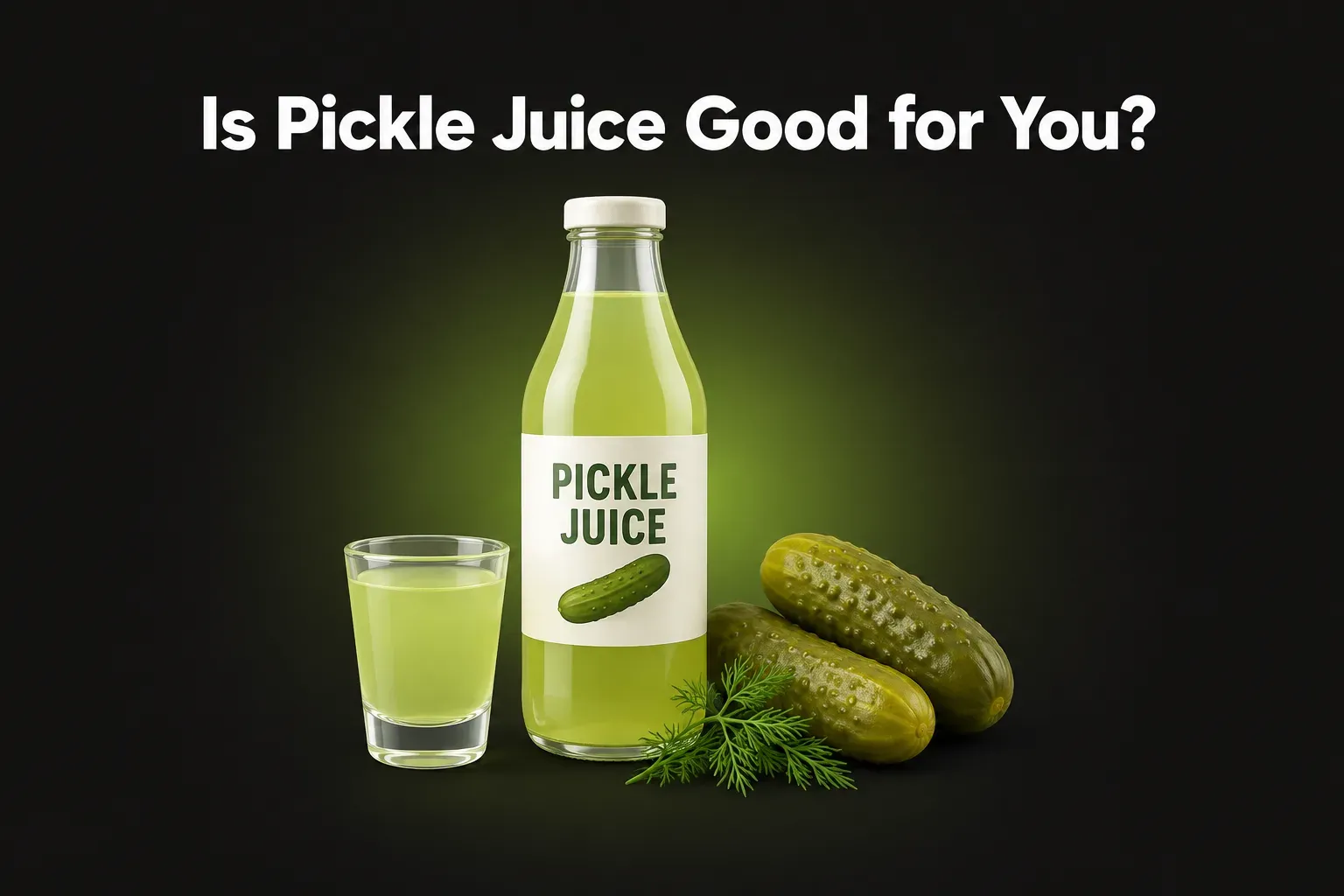
Athletes swear by it, and some people now drink it straight from the jar. Pickle juice even comes in sports shots. But is pickle juice good for you?
The short answer: pickle juice can help stop a muscle cramp fast, and that’s the best proof we have. It has almost no calories or sugar. But it is very salty. Most 2.5 oz shots have about 450–650 mg of sodium – about a quarter of the daily limit. It doesn’t hydrate you much on its own. And the blood sugar claims come from vinegar studies, not from pickle juice. Use it as a cramp tool, not as a daily health drink.
Pickle juice and muscle cramps
This is where the science is strongest.
- The cramp test. Researchers first made men mildly dehydrated. They lost about 3% of their body weight in fluid. Then the team used a small electric shock to cause a cramp in a foot muscle. The men drank pickle juice or water – about 1 ml per kg of body weight. That’s around 2.5 oz for a 165 lb person. With pickle juice, the cramp ended about 49 seconds sooner. It lasted 85 seconds instead of 134 seconds (Miller et al., Medicine & Science in Sports & Exercise, 2010).
- Not because of the salt. The salt in the blood barely changed in those few minutes. So the salt didn’t have time to work. The authors think the sour, salty taste sends a signal from the mouth and throat. That signal may tell the cramping muscle to relax.
- People with liver disease. Many people with cirrhosis (a scarred liver) get painful cramps. In a trial, 82 patients took sips of pickle juice or tap water when a cramp started. After 28 days, cramp pain fell by 2.25 points on a 0–10 scale with pickle juice. With water, it fell by only 0.36 points (Tapper et al., American Journal of Gastroenterology, 2022).
These studies were small. The first one used cramps made in a lab, not real cramps from a game or a run. Still, they point the same way. A small sip can shorten a cramp.
Does pickle juice hydrate you?
Not really. Hydration means getting water and salt back into your body. A shot is too small for that.
- In one study, active adults exercised hard in the heat for 2 hours. They lost about 2 liters of sweat and about 2,200 mg of sodium. Then they drank about 2.7 oz (79 ml) of pickle juice. Their blood salt and fluid levels didn’t change in the next hour. The small shot didn’t refill what they lost (Miller, Journal of Athletic Training, 2014).
- Some coaches feared pickle juice would make athletes drink less water. A study found the opposite. Men who drank a small shot after exercise still drank as much water as usual (Allen et al., Journal of Athletic Training, 2013).
- In another test, men drank a little more – about 2 ml per kg of body weight – before a run in the heat. It didn’t help or hurt how long they could run (Peikert et al., Journal of Athletic Training, 2014).
- Big amounts sit in the stomach. Rested men drank a large dose: 7 ml per kg of body weight. That’s about 18 oz (540 ml) for a 165 lb person. Water kept leaving the stomach. Pickle juice stopped leaving after the first 5 minutes. The authors blame its saltiness and acid (Miller et al., Journal of Athletic Training, 2010).
Pickle juice seems safe in small amounts for healthy athletes. But it is not a sports drink. For long, sweaty exercise, drink water with salt and some sugar. Read more in Is Gatorade healthy? and Is Liquid IV good for you?
Pickle juice and blood sugar
Most pickle juice is made with vinegar. Vinegar has acetic acid, which gives it the sour taste. A lab test found that pickle juices and pickle shots all have moderate amounts of acetic acid (Hooper Marosek et al., Journal of Strength and Conditioning Research, 2020).
Vinegar with a meal may help a little with blood sugar. A review pooled clinical trials on this. People who had vinegar with a meal had a smaller rise in blood sugar and insulin after eating (Shishehbor et al., Diabetes Research and Clinical Practice, 2017).
But there’s a catch. No good study has tested pickle juice itself on blood sugar. Pickle juice also brings a lot of salt, which plain vinegar doesn’t. If you have diabetes, don’t use it in place of your medicine. A splash of vinegar on a salad gives you the acid without the salt.
How much sodium is in pickle juice?
Here’s where pickle juice falls short. We compared pickle shots, brine from the jar and a regular sports drink. To make them fair, we turned every label into the same amount: 2.5 oz (75 ml), the size of one Pickle Juice shot.
| Drink | Label serving | Sodium per serving | Sodium per 2.5 oz | Calories | Dyes or preservatives |
|---|---|---|---|---|---|
| Pickle Juice Extra Strength shot | 2.5 oz | 470 mg | 470 mg | 0 | None |
| Mt. Olive Pickle Juicers | 2 oz | 520 mg | about 650 mg | 0 | None (turmeric for color) |
| SuckerPunch Hydrate Pickle Juice | 2 oz | 420 mg | about 525 mg | 0 | None (fruit juice for color) |
| Bob’s Pickle Potion #9 | 2.1 oz | 525 mg | about 625 mg | 0 | Yellow 5, polysorbate 80, sodium benzoate, potassium sorbate |
| Picklexir (Pittsburgh Pickle Co.) | 1 oz | 180 mg | about 450 mg | 0 | None (turmeric) |
| Brine from Vlasic pickle jars (lab test) | – | – | about 550–1,260 mg | about 10 | Vlasic spears label: Yellow 5, polysorbate 80 |
| Gatorade Thirst Quencher | 20 oz | 270 mg | about 34 mg | 140 per bottle | Some flavors have dyes |
Labels: Pickle Juice – The Feed; Mt. Olive – Publix and Open Food Facts; SuckerPunch – The Feed; Bob’s – Bob’s Pickle Pops (label photo on the product page); Picklexir – Open Food Facts; Gatorade – Open Food Facts. Jar brine: lab test of brine from two Vlasic pickle jars (whole and sliced) with 7.4 and 17.1 g of sodium per liter and 3–4% carbohydrate (Dale et al., Journal of Athletic Training, 2003); Vlasic spears label – Open Food Facts. Values per 2.5 oz are scaled by us and rounded.
What stands out:
- Most pickle shots have about 450–650 mg of sodium in 2.5 oz. That’s 13 to 19 times the sodium in the same amount of Gatorade.
- Jar brine can be even saltier. In a 2003 lab test, brine from sliced Vlasic pickles had more than twice the salt of brine from whole ones. You can’t know how much you get unless the jar tells you – and pickle labels count the pickle, not the brine.
- Few electrolytes besides sodium. Pickle Juice lists only about 20 mg of potassium per shot. SuckerPunch adds more – 140 mg of potassium and 25 mg of magnesium per 2 oz. Jar brines in the lab test had about 90–100 mg of potassium per 2.5 oz.
- The pickle shots have 0 calories and 0–1 g of sugar. Jar brine had a little sugar from the cucumbers – about 2–3 g per 2.5 oz in the lab test.
Sodium and blood pressure
The American Heart Association says to keep sodium under 2,300 mg a day. The ideal goal for most adults is 1,500 mg. Most Americans already eat over 3,100 mg (American Heart Association).
So one shot can use up a third or more of the ideal 1,500 mg. Two or three shots a day, plus normal meals, can push you well past the limit.
Less salt means lower blood pressure for most people. A big review looked at 34 trials with over 3,000 people. People cut about 4.4 g of salt a day (about 1,700 mg of sodium) for at least 4 weeks. Their top blood pressure number fell by about 4 points. In people with high blood pressure, it fell by more than 5 points (He et al., BMJ, 2013).
Jar brine vs bottled pickle shots
You can drink the brine left in a pickle jar. It’s free. But there are a few differences.
- Unknown salt. Pickle labels show the sodium in a pickle, not in the brine. As the lab test showed, brine can be very salty.
- Dyes and preservatives. Many jar pickles add things the shots don’t. Open Food Facts lists Yellow 5 and polysorbate 80 for Vlasic Kosher Dill Spears (Open Food Facts). Claussen Kosher Dill Spears list sodium benzoate and polysorbate 80, with turmeric for color (Open Food Facts). Labels change, so check your jar.
- Shots are made to drink. The current Pickle Juice Extra Strength shot lists water, organic vinegar, salt, organic dill oil, tapioca starch, rosemary extract, potassium, zinc and vitamins C and E. No dyes. An older Pickle Juice bottle on Open Food Facts still listed Yellow 5 and polysorbate 80 (Open Food Facts).
What research says about these additives:
- Yellow 5 (tartrazine). In a UK trial, nearly 300 children drank juice with a mix of dyes, including tartrazine, plus sodium benzoate. They became more hyperactive than with plain juice (McCann et al., The Lancet, 2007). The study can’t say which additive caused it. In a 2026 study, rats got tartrazine for 7–21 days. The lowest dose was 3.75 mg per kg of body weight a day – half the European daily limit. The rats had blood changes and short-term DNA damage. Higher doses and more days made it worse (Hayat et al., Journal of Applied Toxicology, 2026).
- Polysorbate 80. This is an emulsifier – it helps oil and water mix. Mice drank water with 1% polysorbate 80 for 12 weeks. They got mild gut inflammation, weight gain and early signs of diabetes (Chassaing et al., Nature, 2015).
The FDA still allows all of these. But in 2025, it asked food companies to phase out dyes made from petroleum, like Yellow 5. So why look at animal studies? Rats and mice share most of our genes and body processes. And testing possible harm on people would put their health at risk. Proof in humans is still missing. But more than one lab has seen warning signs for these dyes and emulsifiers. So it makes sense to pick brine or shots without them when you can.
Fermented brine and probiotics
Not all pickle juice is the same. Most shelf-stable pickles are made with vinegar and heat-treated. Their brine has no live bacteria.
Fermented pickles are different. They sit in salt water, and good bacteria turn their natural sugars into acid. Bubbies Kosher Dills are one example. The brand says they have no vinegar and are naturally fermented, and they’re sold in the fridge (Bubbies). Look for “fermented” or “live cultures” on the label. And shop the cold section of the store.
Can that brine help your gut? Nobody has tested pickle brine alone. But in a Stanford study, 36 healthy adults ate either more fiber or more fermented foods for 17 weeks. The fermented-food group had more kinds of gut bacteria and lower signs of inflammation (Wastyk et al., Cell, 2021).
Fermented brine is still very salty. For more fermented foods, see Is sauerkraut healthy? and Is kombucha good for you? To learn about the pickles themselves, read Are pickles healthy?
Who should skip pickle juice
- People with high blood pressure or heart failure. The salt can raise blood pressure and make your body hold water.
- People with kidney disease. Your kidneys may not clear extra sodium well. Some shots, like SuckerPunch, add potassium chloride. The National Kidney Foundation warns that potassium chloride can be a problem if you need to limit potassium (National Kidney Foundation).
- Anyone on a low-salt diet, or taking medicine for blood pressure. Ask your doctor first.
- People with heartburn or a sensitive stomach. Pickle juice is acidic. In the lab test, jar brine had a pH of about 3.5–3.8 – the lower the number, the more acidic (Dale et al., Journal of Athletic Training, 2003). Acid is also hard on tooth enamel, so rinse with water after.
How to use pickle juice wisely:
- Keep it small. One shot (2–2.5 oz) when a cramp hits is enough.
- Drink water too. A shot won’t hydrate you by itself.
- Count the sodium toward your daily total.
- Pick labels without Yellow 5 or polysorbate 80 when you have the choice.
- Choose fermented brine if you want live bacteria, and keep it cold.
Check the label on your pickle juice. With NutriSmart, you photograph the label or scan the barcode. The app lists the sweeteners, preservatives and colors, explains the risks of each one and gives the product a health score out of 100. It also tells you right away if a pickle shot or jar of pickles is ultra-processed, and which ingredients make it so. Set an alert for Yellow 5 or polysorbate 80, and the app warns you whenever a product you scan contains it.Get the app free
The bottom line
Pickle juice is good for one thing with real proof: stopping a muscle cramp fast. A small shot seems to work through a reflex in the mouth and throat, not by refilling salt. It has almost no calories. But it is very salty – about 450–650 mg of sodium in 2.5 oz, and jar brine can have even more. It won’t hydrate you on its own. Its blood sugar benefit is still unproven. Some brands add Yellow 5 and polysorbate 80. If you have high blood pressure or kidney disease, skip it or ask your doctor first. For everyone else, keep it to a shot now and then.
FAQ
Is pickle juice good for you?
A small shot can help stop a muscle cramp, and it has almost no calories. But it is very salty – about 450–650 mg of sodium in 2.5 oz. It's a cramp tool, not a daily health drink.
Does pickle juice really help with cramps?
Yes, in small studies. In a lab test, cramps stopped about 49 seconds sooner after pickle juice than after water. In people with liver disease, sips of pickle juice made cramps less painful over four weeks.
Is pickle juice good for hydration?
Not on its own. A shot is too small to replace the water and salt you lose in a long, sweaty workout. Drink it with plenty of water, or use a real sports drink for long exercise.
How much sodium is in pickle juice?
Most pickle shots have about 450–650 mg of sodium per 2.5 oz. Brine from a jar can have even more – up to about 1,260 mg in one lab test. The daily limit is 2,300 mg.
Can pickle juice lower blood sugar?
Pickle juice has vinegar, and vinegar with a meal can lower the rise in blood sugar a little. But no good study has tested pickle juice itself. Don't use it in place of diabetes medicine.
Who should not drink pickle juice?
People with high blood pressure, heart failure or kidney disease, and anyone told to eat less salt. Ask your doctor first. Shots with added potassium need extra care if you have kidney disease.