Is Kombucha Good for You? Probiotics, Sugar and Risks
Is kombucha good for you? What studies show on probiotics, its alcohol and caffeine, and the sugar in GT's, Health-Ade, Humm and other US brands.
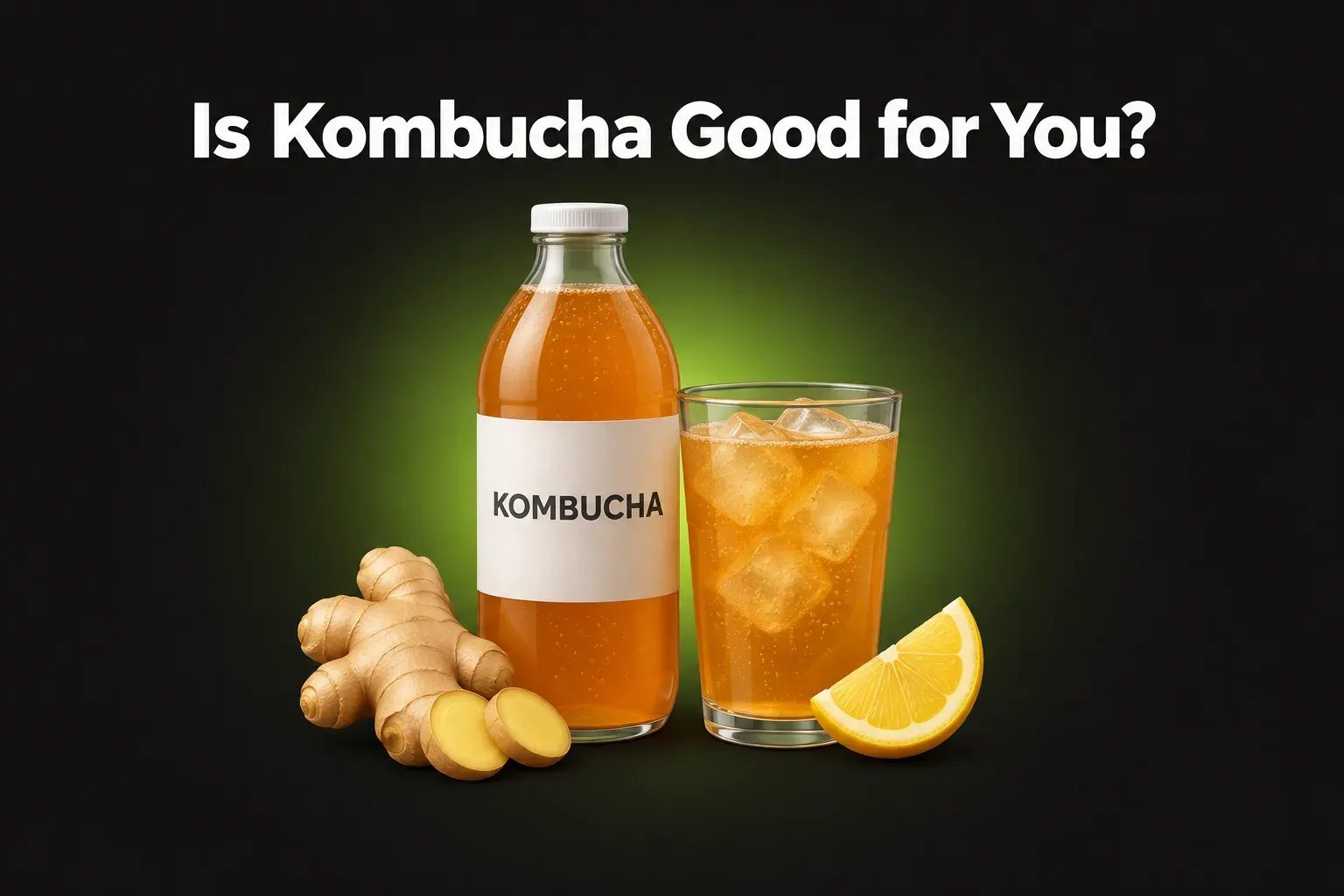
Kombucha is the fizzy, tangy tea you see next to the juices in the cold aisle. Fans say it helps your gut, but is kombucha good for you?
The short answer: kombucha is a better pick than soda for most people. A bottle has about 5–70 calories, while a 12 oz Coke has 140. It also has live cultures. But human studies are few and small, so the gut and health claims are not proven yet. Some bottles have 14 g of added sugar or more. Kombucha also has a little alcohol and is acidic, which is hard on teeth. Pregnant women and people with a weak immune system should skip it.
What is kombucha?
Kombucha is sweet tea that has been fermented. Fermenting means tiny living things eat the sugar and change it into other substances.
To make it, brewers add a SCOBY to sweet black or green tea. SCOBY stands for “symbiotic culture of bacteria and yeast.” It’s a rubbery disk of bacteria and yeast that live together.
Over one to four weeks, the yeast eats sugar and makes a little alcohol and gas. The bacteria turn much of that alcohol into acids. That’s why kombucha tastes sour and fizzy. Most brands then add fruit juice, ginger or herbs for flavor.
Kombucha brands compared: sugar and calories
Here is what the labels say for seven popular kombuchas sold in the US. A regular Coke is at the bottom for comparison.
| Kombucha (bottle or can) | Calories | Total sugar | Added sugar | Sweetened with |
|---|---|---|---|---|
| GT’s Synergy Trilogy (16 oz / 473 ml) | 50 | 12 g | 3 g | Cane sugar for fermenting, fruit juice |
| Health-Ade Ginger-Lemon (16 oz / 473 ml) | 70 | 15 g | 14 g | Cane sugar, fruit juice |
| Brew Dr. Clear Mind (14 oz / 414 ml) | 60 | 12 g | 12 g | Cane sugar |
| KeVita Master Brew Grapefruit (15.2 oz / 450 ml) | 40 | 9 g | 8 g | Cane sugar, stevia |
| Humm Original Blackberry (12 oz / 355 ml) | 30 | 7 g | 0 g | Cane sugar for fermenting, fruit juice |
| Humm Zero Sugar Raspberry Lemonade (12 oz / 355 ml) | 10 | 0 g | 0 g | Allulose, monk fruit |
| Liquid Remedy Raspberry Lemonade (8.5 oz / 250 ml) | 5 | 0 g | 0 g | Erythritol (4 g), stevia |
| Coca-Cola (12 oz / 355 ml) | 140 | 39 g | 39 g | High‑fructose corn syrup |
Per bottle or can. Sources: labels on the brand sites for GT’s, Health-Ade, Humm (Zero Sugar) and Liquid Remedy; Open Food Facts for Brew Dr., KeVita and Coca-Cola. Recipes change – check the bottle.
What stands out:
- Every kombucha here has far less sugar than soda. Even the sweetest one has less than half the sugar of a Coke.
- Added sugar varies a lot. Health-Ade Ginger-Lemon has 14 g of added sugar. That’s 28% of the Daily Value. GT’s lists only 3 g, and Humm Original lists 0 g.
- The American Heart Association says women should keep added sugar under 25 g a day and men under 36 g (AHA). One Health-Ade bottle uses more than half of a woman’s limit.
- “Zero sugar” versions swap sugar for sweeteners. More on those below.
Does kombucha really help your gut?
This is the big selling point. Kombucha has live bacteria and yeast. Some brands also add a probiotic, which is a live microbe meant to help your health. GT’s lists 9 billion probiotic organisms per bottle at bottling. Humm lists 2 billion.
But do these microbes do anything for you? Here is what the research says:
- 2019 review. Researchers searched all the kombucha studies they could find – 310 papers. They found only one study done in people. The many claims came from lab and animal studies (Kapp and Sumner, Annals of Epidemiology, 2019).
- Gut study, 2024. 24 healthy adults on a typical Western diet took part. 16 of them drank kombucha for four weeks. Their gut bacteria changed only a little. Blood markers of inflammation did not change. Fasting insulin went up a bit in the kombucha group. GT’s paid for this study (Ecklu-Mensah et al., Scientific Reports, 2024).
- Gut study, 2025. 46 adults drank black tea kombucha for eight weeks. Some “good” gut bacteria went up, mostly in people with obesity. But there was no group that skipped kombucha to compare with (Costa et al., Journal of Nutrition, 2025).
- Diabetes pilot, 2023. 12 adults with type 2 diabetes drank 8 oz (240 ml) of kombucha a day for four weeks. Their fasting blood sugar dropped from 164 to 116 mg/dL. A fake drink (placebo) lowered it less, from 162 to 141. That change could have been chance. It was a very small study, so the authors called for bigger ones (Mendelson et al., Frontiers in Nutrition, 2023).
- Weight-loss diet, 2026. 59 adults with extra weight ate 500 fewer calories a day for 10 weeks. Half also drank 200 ml (about 7 oz) of green tea kombucha daily. Cholesterol dropped in the kombucha group. But in the end, the two groups were not clearly different (Bonifácio et al., Journal of Food Science, 2026).
Animal studies look more hopeful. In one, diabetic rats got kombucha for 30 days. Their blood sugar and liver and kidney markers improved more than with plain black tea (Aloulou et al., BMC Complementary and Alternative Medicine, 2012). Rats are useful because they share most of our genes and body processes. Still, results in rats don’t always hold up in people.
Bottom line on the gut: kombucha might help a bit, but the proof in people is weak. Don’t count on it to fix gut problems.
Alcohol: small, but not zero
Fermenting makes alcohol, so all kombucha has some. In the US, kombucha that reaches 0.5% alcohol or more at any point counts as an alcoholic drink. That includes alcohol that forms after bottling (TTB). This is one reason many brands say “keep refrigerated.” Cold slows down fermenting.
Some kombucha has more. The kombucha used in the 2023 diabetes study had 1.5% alcohol (Mendelson et al., 2023). Homemade kombucha in a CDC report had 0.7% to 1.3% (CDC, MMWR, 1995).
For most adults, this is a tiny amount. But it matters if you are pregnant, avoid alcohol or take medicines that don’t mix with it.
Caffeine: usually low
Kombucha is made from tea, so it has some caffeine. Much of it fades during fermenting. Health-Ade says its kombucha has 5–15 mg of caffeine per serving, close to decaf coffee (Health-Ade). An 8 oz cup of brewed coffee has about 95 mg (USDA).
Some brands add more. KeVita Master Brew lists caffeine from green coffee beans in its ingredients, but its website doesn’t say how much (KeVita). If you are sensitive to caffeine, check the label.
Kombucha and your teeth
Kombucha is very acidic. In a Finnish lab study, seven kombuchas had a pH of 2.82–3.66. pH measures acid – the lower it is, the more acidic. Water is 7. The kombuchas pulled more calcium out of tooth minerals than cola did (Lind et al., Acta Odontologica Scandinavica, 2023).
A Brazilian study used cow teeth in a machine that copies the mouth. Two kombuchas were tested. One wore down the tooth surface as much as Coca-Cola. The other did less damage than Coke, but more than water (Racki et al., Odontology, 2026).
How to protect your teeth:
- Drink it with a meal, not in sips all day.
- Use a straw.
- Rinse with water afterward.
- Don’t brush right away. Acid softens enamel for a while, and brushing can wear it down faster.
Is kombucha safe?
For healthy adults, store-bought kombucha in normal amounts seems safe. But there are rare, serious cases.
- The CDC case, 1995. Two women in Iowa got very sick after drinking homemade kombucha daily for about two months. Their blood became too acidic. One woman died. The CDC could not prove the tea caused it. At least 115 other people used cultures from the same source, and none of them got sick this way. The CDC said the usual amount, about 4 oz (120 ml) a day, “may not cause adverse effects in healthy persons.” That’s a quarter of a 16 oz bottle (CDC, MMWR, 1995).
- Weak immune system. A 22-year-old man who had just learned he had HIV got a high fever, acid buildup in his blood and kidney failure. It happened within 15 hours of drinking kombucha (Kole et al., Journal of Intensive Care Medicine, 2009).
- Homemade in ceramic pots. A couple in Australia got lead poisoning. They had brewed kombucha for six months in a glazed ceramic pot. The acid likely pulled lead out of the glaze (Phan et al., Medical Journal of Australia, 1998).
Who should skip kombucha:
- Pregnant women. The MotherToBaby experts advise avoiding it. They point to the alcohol, caffeine and the risk of germs in raw or homemade kombucha (MotherToBaby).
- People with a weak immune system, such as from HIV, cancer treatment or an organ transplant.
- People with kidney or liver disease – ask your doctor first. A review found case reports of suspected liver damage and acid buildup in the blood after drinking kombucha (Ernst, Forschende Komplementärmedizin, 2003).
If you brew it at home, use glass jars, clean tools and a trusted starter culture. Throw out any batch with fuzzy mold.
What about zero-sugar kombucha?
Zero-sugar kombuchas use sweeteners instead of sugar. The FDA allows all of them. But independent labs have raised some questions, so it helps to know what they found.
- Erythritol (in Liquid Remedy, 4 g per can). In a 2024 study, 10 healthy adults drank 30 g of erythritol. In every person, it made platelets stickier. Platelets are the blood cells that form clots (Witkowski et al., Arteriosclerosis, Thrombosis, and Vascular Biology, 2024). In an earlier study, people with more erythritol in their blood had more heart attacks and strokes (Witkowski et al., Nature Medicine, 2023). One can has much less than 30 g, and there’s no proof about small daily amounts. Still, it’s wise not to drink a lot of it.
- Stevia (in Liquid Remedy and KeVita). Young rats drank low doses of a stevia sweetener for 9 weeks. It changed their gut bacteria. It also affected a brain system linked to pleasure and cravings. It did not change their weight or blood sugar (Nettleton et al., Nutrients, 2019). Rat studies matter because rats share most of our genes and body processes. Testing possible harm on people would put their health at risk. Still, proof in humans is missing.
- Allulose and monk fruit (in Humm Zero Sugar) have fewer warning signs so far. Large amounts of allulose can cause bloating and diarrhea. One study suggests staying under about 28 g at once for a 154 lb (70 kg) adult (Han et al., Nutrients, 2018). A can of Humm Zero Sugar has 10 g of carbs in total, so it stays well below that.
If you drink kombucha daily, a version with little added sugar and no sweeteners – like Humm Original or GT’s – avoids both problems.
Kombucha vs soda and other fizzy drinks
Kombucha is a smart swap if you drink soda every day. You save about 70–135 calories per bottle compared with a 12 oz Coke. See is Coke bad for you.
Other options:
- Sparkling water has no sugar, no sweeteners and no alcohol. See is La Croix bad for you.
- Prebiotic soda has fiber that feeds gut bacteria. See is Olipop healthy.
- Compare them all in our guide to the healthiest soda.
Check the label of your kombucha. With NutriSmart, you photograph the label or scan the barcode. The app lists the sweeteners, preservatives and colors, explains the risks of each one and gives the product a health score out of 100. It also tells you right away if a drink is ultra-processed and which ingredients make it so. Set an alert for erythritol or stevia, and the app warns you whenever a product you scan contains it.Get the app free
The bottom line
Kombucha is a decent drink, but not a health cure. It has far less sugar than soda, a little caffeine and live cultures. The gut benefits are not proven in people yet. Watch for added sugar: in our comparison, it ranged from 0 to 14 g per bottle. It’s also acidic, so drink it with a meal and rinse with water. Skip it if you are pregnant or have a weak immune system. For most healthy adults, one bottle a day seems like a reasonable treat.
FAQ
Is kombucha good for you?
It can be a better choice than soda, since most bottles have 30–70 calories. A 12 oz Coke has 140. It has live cultures, but proof of health benefits in people is still thin. Pick a brand with little added sugar.
Is it OK to drink kombucha every day?
For most healthy adults, one bottle a day seems fine. Check the label, because some bottles have 14 g of added sugar or more. Kombucha is also acidic, so it's easier on your teeth with a meal.
Does kombucha have alcohol?
Yes, a little. Store-bought kombucha sold as non-alcoholic must stay under 0.5% alcohol. Homemade kombucha can have more – in one CDC report, it had 0.7% to 1.3%.
How much caffeine is in kombucha?
Usually not much, because it's made from tea. Health-Ade says its kombucha has 5–15 mg per serving, close to decaf coffee. A cup of brewed coffee has about 95 mg.
Who should not drink kombucha?
Pregnant women and people with a weak immune system should skip it. People with kidney or liver disease should ask their doctor first. Rare cases of severe illness have been linked to it.
Which kombucha has the least sugar?
In our comparison, Humm Zero Sugar and Liquid Remedy have 0 g of sugar. They use sweeteners like allulose, monk fruit, erythritol or stevia instead. Humm Original Blackberry has 7 g of sugar and no added sugar.