Is Olipop Healthy? Sugar, Fiber and Bloating Explained
Is Olipop healthy? What's in a can – 6–9 g of fiber, 2–5 g of sugar, stevia – plus gas, the lawsuit and how it compares with Poppi, Coke and kombucha.
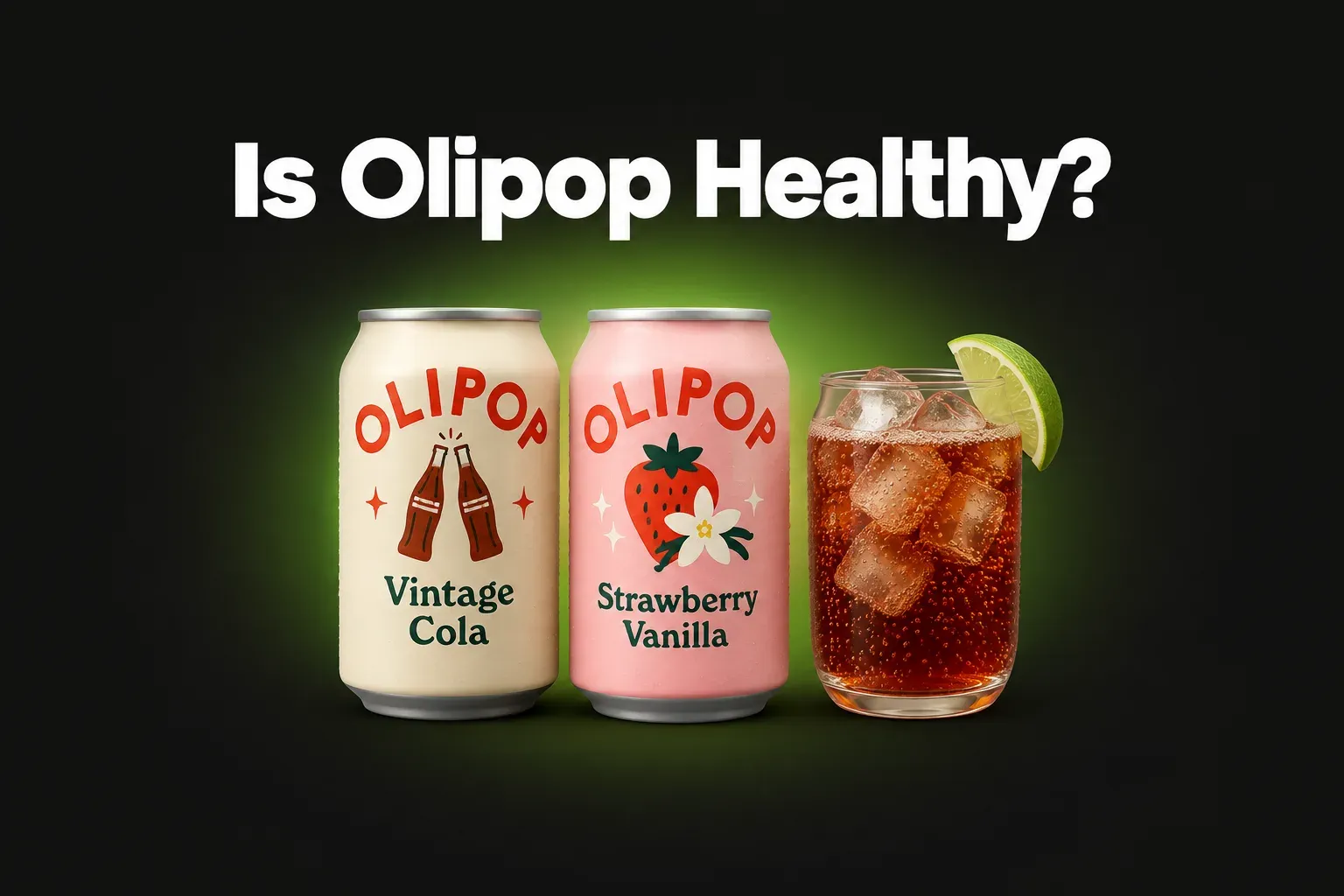
Olipop calls itself “a new kind of soda” – with fiber, plant extracts and very little sugar. Fans call it a gut-friendly swap for Coke. But is Olipop healthy, or is it just a clever soda?
The short answer: Olipop is much better than regular soda, but it’s not a health drink. A 12 oz (355 ml) can has 30–50 calories, 2–5 g of sugar and 6–9 g of fiber. A regular Coke has 140 calories and 39 g of sugar. The fiber is real, but there’s no proof that one can a day improves your gut. And the fiber can cause gas and bloating, especially if you have IBS.
What’s in a can of Olipop
Olipop now sells two lines. The 9 g fiber line is kept in the fridge. The 6 g fiber line is shelf-stable, so you can store it anywhere cool and dry. Here’s what some of the labels say, according to the Olipop website:
| Flavor (12 oz can) | Calories | Total sugar | Added sugar | Fiber | Caffeine |
|---|---|---|---|---|---|
| Vintage Cola (9 g line) | 50 | 5 g | 2 g | 9 g | 50 mg |
| Strawberry Vanilla (9 g line) | 45 | 5 g | 1 g | 9 g | 0 |
| Classic Root Beer (9 g line) | 40 | 3 g | 1 g | 9 g | 0 |
| Vintage Cola (6 g line) | 40 | 4 g | 2 g | 6 g | 50 mg |
| Cream Soda (6 g line) | 40 | 2 g | 2 g | 6 g | 0 |
| Shirley Temple (6 g line) | 40 | 4 g | 1 g | 6 g | 0 |
Labels from drinkolipop.com, checked November 2026. Across all flavors, a can has 30–50 calories and 25–35 mg of sodium. Recipes change – check the can.
Ingredients (Vintage Cola, 9 g line): carbonated water, a fiber and plant blend (cassava root fiber, chicory root inulin, Jerusalem artichoke inulin, nopal cactus, marshmallow root, calendula flower, kudzu root), cassava root syrup, apple juice concentrate, natural flavors, lime juice concentrate, stevia leaf extract, galangal root extract, green tea caffeine, pink salt and a mushroom extract.
Two things stand out:
- The fiber is different in the two lines. The 9 g cans use inulin from chicory root and Jerusalem artichoke. The 6 g cans swap the inulin for acacia fiber and guar fiber.
- Some flavors have caffeine. Vintage Cola, Cherry Cola and Doctor Goodwin have 50 mg per can. Citrus Rush has 60 mg. That’s about as much as a Diet Coke (46 mg).
A 12-pack costs $35.99 on the brand’s site. That’s about $3 per can.
The sugar: low, but not zero
Most cans have 2–5 g of total sugar. Only 0–3 g of that is added sugar. Most flavors have 1–2 g. The rest comes from fruit juice. The sweet taste is boosted with stevia. A few flavors, like Cream Soda, also use allulose (a rare sugar with almost no calories).
That’s a huge drop from regular soda. A Coke has 39 g of sugar – almost 10 teaspoons. Sugary drinks are one of the clearest risks in the modern diet. One review combined studies with more than 310,000 people. Some people had 1–2 sugary drinks a day. They had a 26% higher risk of type 2 diabetes than people who rarely had them (Malik et al., Diabetes Care, 2010).
So if Olipop replaces a daily Coke, you cut about 35 g of sugar and 90–110 calories a day.
Is the stevia a problem?
Olipop uses a small amount of stevia, a sweetener made from a plant leaf. It has no calories and doesn’t raise blood sugar. Regulators in the US and EU consider it safe. Independent studies add a few details:
- In people: a study gave 120 healthy adults sweetener packets for two weeks. Stevia changed some gut bacteria. But unlike sucralose and saccharin, it didn’t clearly harm blood sugar control (Suez et al., Cell, 2022).
- In rats: young rats drank a low dose of a stevia compound (Reb A) for 9 weeks. It didn’t change their weight or blood sugar. But it changed their gut bacteria and the brain’s reward system (Nettleton et al., Nutrients, 2019). In the same study, rats fed inulin had less body fat. Stevia didn’t cancel that benefit.
Animal studies matter. Rats share most of their genes and body processes with us. And testing a sweetener on people for years could put their health at risk. Still, human proof of harm from stevia is missing. Olipop doesn’t use monk fruit, but some rival sodas do.
The fiber: real, but don’t expect miracles
Most Americans don’t eat enough fiber. The label says one 9 g can gives you 32% of your daily fiber. That’s a real plus.
Eating more fiber is linked to better health. A big review combined 185 studies that followed people for years, plus 58 trials. People who ate the most fiber had a 15–30% lower risk of several diseases. These included heart disease, stroke, type 2 diabetes and colon cancer. The biggest benefit came at 25–29 g of fiber a day (Reynolds et al., The Lancet, 2019).
But there’s a catch. That review studied fiber from whole foods like beans, oats and vegetables – not fiber added to drinks. Whole foods also bring vitamins, minerals and plant compounds. A soda can’t copy that. For better sources, see our list of high-fiber foods.
And there are no published studies showing that drinking Olipop itself improves gut health.
Olipop, gas and bloating
This is the most common complaint. Inulin is a fiber your gut bacteria ferment – they “eat” it and make gas.
- A study gave 26 healthy adults 5 or 10 g of inulin with breakfast. Mild gas was the most common symptom, then bloating. Up to 10 g of regular inulin was well tolerated. But 10 g of a shorter type of inulin caused clearly more symptoms (Bonnema et al., Journal of the American Dietetic Association, 2010).
- Another study gave 29 healthy adults 5 or 7.5 g of agave inulin a day for three weeks. Bloating, gas and stomach rumbling went up a little. At 7.5 g, stools got softer and more frequent (Holscher et al., Food & Function, 2014).
So one can is usually fine. Two or three cans in a day can add 12–27 g of fiber at once. That’s when gas, cramps and loose stools get more likely.
People with IBS (irritable bowel syndrome, a gut disorder that causes pain and bloating) should be careful. Inulin is a FODMAP – a type of carb that often triggers IBS symptoms. If you follow a low-FODMAP diet, the 6 g line without inulin may be easier on you. Try half a can first.
One more thing about inulin. In 2018, researchers fed mice a diet very high in purified inulin. Mice with an unhealthy mix of gut bacteria developed liver cancer (Singh et al., Cell, 2018). The mice ate far more inulin than a can contains. This hasn’t been seen in people. Still, it’s a good reason to get most of your fiber from whole foods. Don’t rely on several fiber drinks a day.
The Olipop lawsuit
In December 2025, a New York buyer filed a class action against Olipop. That’s a lawsuit on behalf of many buyers. The case is Somers v. Olipop in the federal court for the Eastern District of New York (complaint, ClassAction.org).
The complaint says:
- Each can has only 6–9 g of prebiotic fiber – too little for the gut benefits the cans suggest.
- The studies it cites show benefits at 12 g a day or more, for at least a month. That means about two cans a day.
- Two cans would also add up to 10 g of sugar a day, which could cancel out some of the benefit.
These are claims, not court findings. As of November 2026, we found no public ruling or settlement. A similar lawsuit hit rival Poppi in 2024. In 2025, Poppi’s maker agreed to an $8.9 million settlement (ClassAction.org).
Olipop vs Poppi, Coke, kombucha and sparkling water
| Drink | Calories | Sugar | Fiber | Sweetened with |
|---|---|---|---|---|
| Olipop Vintage Cola (9 g line) | 50 | 5 g | 9 g | Cassava syrup, juice, stevia |
| Olipop Vintage Cola (6 g line) | 40 | 4 g | 6 g | Cassava syrup, juice, stevia |
| Poppi Classic Cola | 35 | 5 g | 3 g | Cane sugar, stevia |
| SunSip Cherry Cola (11.5 oz) | 40 | 5 g | 3 g | Cane sugar, monk fruit, juice |
| Culture Pop Ginger Lemon & Turmeric | 45 | 8 g | – | Fruit juice |
| GT’s Synergy Trilogy kombucha (16 oz) | 50 | 12 g | – | Fruit juice, cane sugar |
| Coca-Cola | 140 | 39 g | 0 g | High‑fructose corn syrup |
| Diet Coke | 0 | 0 g | 0 g | Aspartame |
| LaCroix sparkling water | 0 | 0 g | 0 g | None |
Per 12 oz (355 ml) can unless noted. Olipop from drinkolipop.com; others from Open Food Facts labels: Poppi, SunSip, Culture Pop, GT’s, Coca-Cola, Diet Coke, LaCroix.
What this shows:
- Olipop has the most fiber of any soda here. Poppi and SunSip have a third to half as much. Both also use agave inulin, so they can cause gas too.
- Culture Pop adds live bacteria (a probiotic) instead of fiber. It has a bit more sugar, all from juice.
- Kombucha is fermented tea. It has live cultures, but this 16 oz bottle has 12 g of sugar. See is kombucha good for you.
- Diet Coke has no sugar, but it uses aspartame and has caramel color and phosphoric acid. Read more in is Diet Coke bad for you.
- Sparkling water has no sugar, sweetener or calories. See is LaCroix bad for you and is sparkling water healthy.
For the full ranking, see our guide to the healthiest soda.
Who should go easy on Olipop
- People with IBS or a sensitive gut – start with half a can, or pick the 6 g line.
- Kids – some flavors have 50–60 mg of caffeine per can.
- Anyone new to fiber – add fiber slowly and drink plenty of water.
- People drinking several cans a day – the fiber, sweetener and cost add up fast.
See what’s really in your prebiotic soda. With NutriSmart, you photograph the label or scan the barcode. The app lists the sweeteners, preservatives and colors, explains the risks of each one and gives the product a health score out of 100. It also tells you right away if a drink is ultra-processed and which ingredients make it so. Set an alert for inulin, and the app warns you every time a product you scan contains it.Get the app free
The bottom line
Olipop is a clear upgrade from regular soda. A can has 30–50 calories, 2–5 g of sugar and 6–9 g of fiber. A Coke has 140 calories and 39 g of sugar. But Olipop is still a soda, not a gut-health treatment. There are no studies on the drink itself, and the inulin can cause gas and bloating. Enjoy one can as a swap for Coke. Get most of your fiber from real food. And reach for plain sparkling water when you just want the fizz.
FAQ
Is Olipop healthy?
Olipop is a much better choice than regular soda. A 12 oz can has 30–50 calories, 2–5 g of sugar and 6–9 g of fiber. A Coke has 140 calories and 39 g of sugar. But Olipop is still a treat, not a health drink, and the fiber can cause gas and bloating.
How much sugar is in Olipop?
A 12 oz can has 2–5 g of total sugar. Only 0–3 g of that is added sugar, and most flavors have 1–2 g. The sugar comes from cassava root syrup and fruit juice, and stevia adds extra sweetness.
Does Olipop make you bloated?
It can. Each can has 6–9 g of fiber, and the 9 g cans include inulin, which gut bacteria turn into gas. Studies show 5–10 g of inulin causes mild gas and bloating in some healthy adults. People with IBS often react more strongly.
Is Olipop good for your gut?
The fiber feeds gut bacteria, and fiber in general is good for health. But there are no published studies showing that drinking Olipop improves gut health. A lawsuit filed in December 2025 claims one can has too little fiber to deliver the promised benefits.
Is Olipop better than Poppi?
Olipop has more fiber (6–9 g vs 3 g in Poppi Classic Cola). Poppi Classic Cola has 35 calories, 5 g of sugar (3 g added) and is sweetened with cane sugar and stevia. Both are much better than regular soda.
How many Olipops can you drink a day?
There's no official limit. One can a day is a sensible amount for most people. Two cans add 12–18 g of fiber, which can cause gas, cramps or loose stools.