Is Coke Bad for You? Ingredients, Sugar and Smarter Swaps
Is Coke bad for you? See the Coca-Cola ingredients and what 39 g of sugar, caffeine, phosphoric acid and caramel color do, plus Coke Zero and Diet Coke.
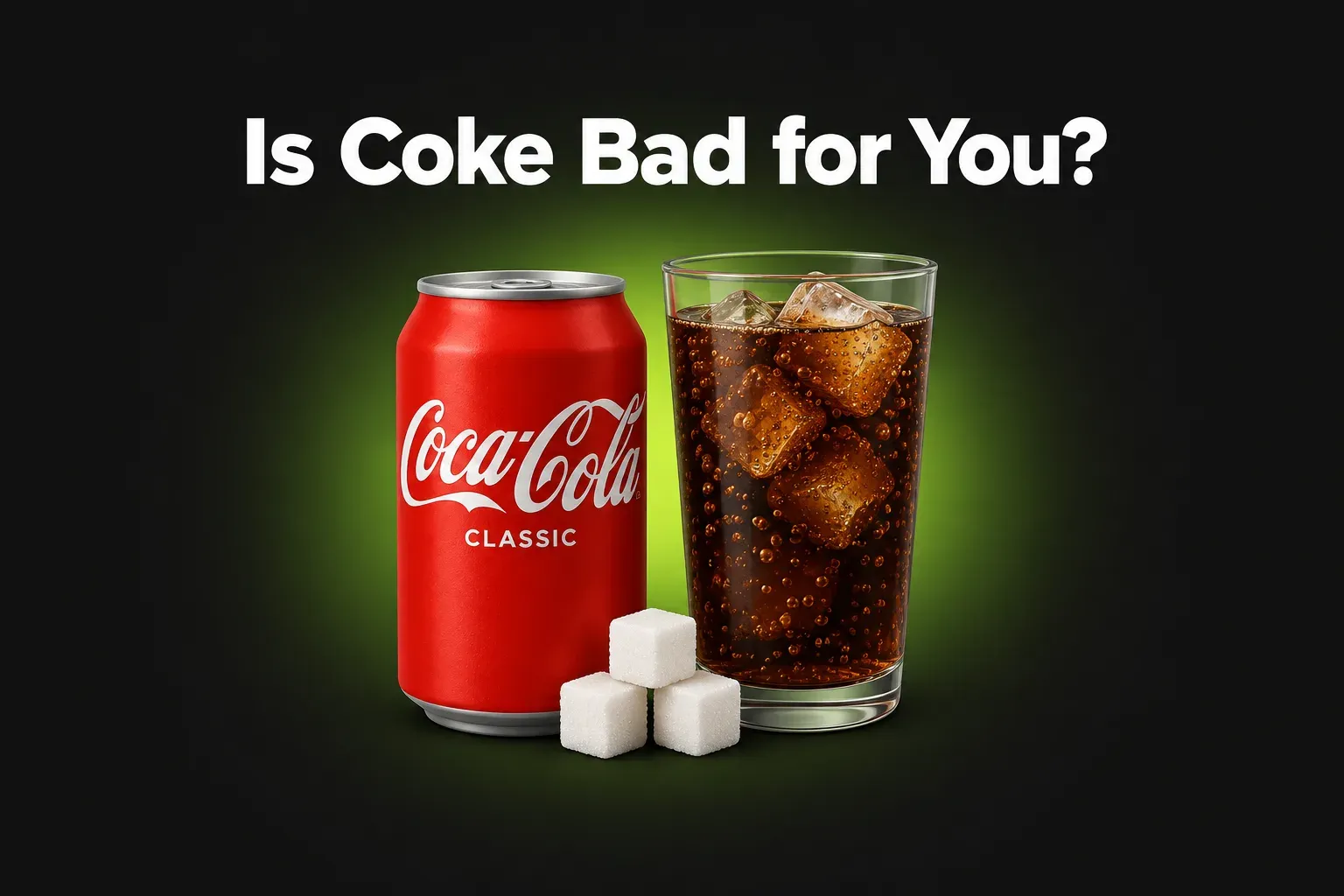
Coca-Cola is the best-selling soda in the world. Millions of Americans drink a can with lunch or a bottle on the road. So is Coke bad for you?
The short answer: one Coke now and then is not a problem for a healthy person. But a 12 oz can has 39 g of added sugar – more than the American Heart Association’s daily limit. Drinking Coke every day is linked to weight gain, type 2 diabetes, cavities and heart disease. Daily cola is also linked to weaker hip bones in women. Caffeine (34 mg) and caramel color are smaller concerns. The sugar is the main problem.
Coca-Cola ingredients: what’s in a can
A classic 12 oz (355 ml) can of Coca-Cola sold in the US has just six ingredients. Here they are in label order:
- Carbonated water – water with carbon dioxide gas added. It makes the bubbles.
- High fructose corn syrup (HFCS) – the sweetener, made from corn. It’s about half fructose and half glucose, like table sugar.
- Caramel color – makes Coke brown. The type used in colas is called E150d.
- Phosphoric acid – gives Coke its sharp, tangy taste. It also makes it very acidic.
- Natural flavors – the flavor mix that makes Coke taste like Coke. The company keeps the exact recipe secret.
- Caffeine – gives a small lift. A can has 34 mg.
Source: ingredient list from Coca-Cola US, checked November 2026. Open Food Facts shows the same list.
Here is the nutrition label of the same can:
| Per can (12 oz) | Amount |
|---|---|
| Calories | 140 |
| Total sugar | 39 g (all added) |
| Caffeine | 34 mg |
| Sodium | 45 mg |
| Fat | 0 g |
| Protein | 0 g |
Source: Coca-Cola US (calories, sugar, caffeine) and USDA FoodData Central (sodium, fat, protein).
Coke has no vitamins, no fiber and no protein. You get calories and nothing else your body needs.
Sugar: the biggest problem
39 g of sugar is almost 10 teaspoons. The American Heart Association suggests a daily limit for added sugar. It’s about 25 g for women and 36 g for men (Johnson et al., Circulation, 2009). So one can goes over both limits. A 20 oz bottle has 65 g.
Sugar in a drink is worse than sugar in food. It doesn’t fill you up, so you don’t eat less later. Here is what studies show:
- Weight. A big review pooled 32 studies in children and adults. Each extra daily sugary drink was linked to more weight gain over time. In trials, adults who added sugary drinks gained almost 2 lb (0.85 kg) (Malik et al., American Journal of Clinical Nutrition, 2013).
- A trial in kids. 641 Dutch children got one 8 oz drink a day for 18 months. Half got a sugary drink. Half got a sugar-free drink that looked and tasted the same. The sugar-free group gained about 2.2 lb (1 kg) less weight and less body fat (de Ruyter et al., New England Journal of Medicine, 2012).
- Type 2 diabetes. A review pooled studies of over 310,000 people. Those who drank 1–2 sugary drinks a day had a 26% higher risk of type 2 diabetes. They were compared with people who drank almost none (Malik et al., Diabetes Care, 2010).
- Heart disease and early death. Over 118,000 US nurses and other health workers were followed for about 30 years. Those who drank 2 or more sugary drinks a day had a 21% higher risk of dying during the study. Their risk of dying from heart disease was 31% higher (Malik et al., Circulation, 2019).
Most of these studies show links, not proof. But the trials point the same way. One Coke a day adds 980 calories a week. Want to see how that fits your day? Try our calorie calculator.
Is high fructose corn syrup worse than sugar?
Most experts say HFCS and table sugar act about the same in people. Both are roughly half fructose. The amount is what matters.
Still, some studies give reasons to limit fructose. In one trial, overweight adults got a quarter of their daily calories from fructose drinks for 10 weeks. That’s a lot. They gained fat around their organs, and their insulin worked less well. People who got glucose drinks instead didn’t have these changes (Stanhope et al., Journal of Clinical Investigation, 2009). In a mouse study, the mice were bred to get gut tumors. A moderate daily dose of HFCS made those tumors grow bigger. This happened even though the mice did not get fat (Goncalves et al., Science, 2019).
Why do mouse studies matter? Mice share most of our genes and body processes. And testing tumor growth on people would put them at risk. Human proof is still missing. But human trials and animal studies point the same way. That’s a good reason to drink less soda, whatever sugar it uses.
Teeth and bones
Teeth. Coke hits your teeth twice. The sugar feeds the germs that cause cavities. A study followed 939 Finnish adults for 4 years. Those who drank 1–2 sugary drinks a day got about 31% more decayed, missing or filled teeth than people who drank none. This was true even for people who used fluoride toothpaste (Bernabé et al., Journal of Dentistry, 2014).
The acid is the second problem. In a lab test, researchers soaked human teeth in sodas for 20 days. All the sodas wore away tooth enamel – the hard outer layer. On the whole, diet and zero-calorie sodas wore away even more than sugary ones (Gravelle et al., General Dentistry, 2015). Real teeth don’t sit in soda for days. But the test shows that “zero sugar” doesn’t mean safe for teeth.
Bones. The Framingham study measured bone density in over 2,500 adults. Women who drank cola every day had about 3.7% lower bone density at the hip. They were compared with women who drank less than one cola a month. Diet cola showed the same link. Other sodas did not. Men showed no link (Tucker et al., American Journal of Clinical Nutrition, 2006). The authors think phosphoric acid or caffeine may play a role. It’s a link, not proof.
Kidneys. In a North Carolina study, people who drank 2 or more colas a day had about twice the risk of chronic kidney disease. Other sodas showed no link (Saldana et al., Epidemiology, 2007). The authors called the results early findings.
Caffeine and caramel color
Caffeine. A can of Coke has 34 mg. An 8 oz cup of brewed coffee has about 95 mg (USDA). The FDA says up to 400 mg a day is usually safe for healthy adults (FDA). So caffeine is a small issue in Coke, except for kids or late at night.
Caramel color (4-MEI). Cola caramel can contain 4-MEI, a substance that forms when sugar is heated with ammonia. In a two-year study, mice got 4-MEI in their food. At about 40–170 mg per kg of body weight a day, they got more lung tumors (Chan et al., Archives of Toxicology, 2008). That is a very high dose.
How much is in Coke? Researchers tested 12 drinks bought in California and New York. Coca-Cola had the least 4-MEI of all of them – about 10 micrograms per liter. That’s about 4 micrograms per can. The drink with the most had about 80 to 100 times more (Smith et al., PLOS ONE, 2015). California requires a cancer warning above 29 micrograms a day. So one can of Coke is well under that limit. Human proof of harm is missing. But the mouse results are clear. So drinking less dark soda is a sensible precaution.
Coke vs Mexican Coke, Pepsi, Coke Zero and Diet Coke
| Drink | Calories | Sugar | Caffeine | Sweetener |
|---|---|---|---|---|
| Coca-Cola (12 oz can) | 140 | 39 g | 34 mg | HFCS |
| Coca-Cola (20 oz bottle) | 240 | 65 g | about 57 mg* | HFCS |
| Coca-Cola (7.5 oz mini can) | 90 | 25 g | about 21 mg* | HFCS |
| Mexican Coke (12 oz / 355 ml glass) | 150 | 39 g | 34 mg | Cane sugar |
| Pepsi (12 oz can) | 150 | 41 g | 38 mg | HFCS + sugar |
| Coke Zero Sugar (12 oz can) | 0 | 0 g | 34 mg | Aspartame, acesulfame K, stevia |
| Diet Coke (12 oz can) | 0 | 0 g | 46 mg | Aspartame |
Coca-Cola, Coke Zero Sugar and Diet Coke: Coca-Cola US (Zero Sugar, Diet Coke). Mini can: USDA FoodData Central. Mexican Coke: USDA FoodData Central and Open Food Facts. Pepsi: USDA FoodData Central and PepsiCo Product Facts (caffeine). *Estimated from 34 mg per 12 oz; Coca-Cola doesn’t list it for these sizes.
What stands out:
- Mexican Coke uses cane sugar, but it has the same 39 g of sugar. It’s not a health upgrade.
- Pepsi has a bit more sugar and caffeine than Coke. The two are very close.
- Coke Zero Sugar now lists stevia extract too, next to aspartame and acesulfame K. Read more in Is Coke Zero bad for you?
- Diet Coke has the most caffeine of the group. See Is Diet Coke bad for you?
- The mini can cuts sugar by more than a third.
What about the new cane sugar Coke?
In October 2025, Coca-Cola started selling Coca-Cola made with US cane sugar in a 12 oz glass bottle. It launched in a few US markets first. A Coca-Cola executive called it “a measured rollout.” He said the supply of US cane sugar and glass bottles is limited. The company planned to grow sales in 2026 (Atlanta Journal-Constitution). The classic can still uses HFCS.
Is cane sugar Coke healthier? No. Cane sugar and HFCS have the same calories per gram. Your body breaks both into fructose and glucose. If the sugar is about the same, so are the risks.
How to cut back on Coke
- Go smaller. Pick the 7.5 oz mini can instead of a 20 oz bottle. You save 40 g of sugar.
- Don’t sip all day. Drink it with a meal, then rinse your mouth with water. Constant sipping keeps your teeth in acid.
- Swap some cans. Try plain or flavored sparkling water, like LaCroix. Add lemon or lime for taste. Or try a low-sugar kombucha.
- Use zero sugar as a bridge. Coke Zero or Diet Coke cut the sugar. But they still have acid, caffeine and sweeteners. Use them to step down, not as a forever drink.
- Don’t keep it at home. If it’s not in the fridge, you’ll drink less.
- Cut down slowly. Go from daily to every other day, then to weekends only.
Want other ideas? See our guide to the healthiest soda. You can also read whether Mountain Dew is bad for you. We also looked at what’s in Dr Pepper.
See what’s really in your Coke. With NutriSmart, you photograph the label or scan the barcode. The app lists the sweeteners, preservatives and colors, explains the risks of each one and gives the product a health score out of 100. It also tells you right away if a soda is ultra-processed and which ingredients make it so. Set an alert for caramel color or aspartame. The app then warns you whenever a product you scan contains it.Get the app free
The bottom line
Coke isn’t poison, and one can now and then won’t harm a healthy person. But a 12 oz can has 39 g of added sugar – more than a full day’s limit. Daily Coke is linked to weight gain, type 2 diabetes, heart disease, cavities and weaker bones in women. Caffeine and caramel color are smaller concerns. Mexican Coke and the new cane sugar Coke have the same amount of sugar, so they’re not healthier. Coke Zero and Diet Coke cut the sugar but keep the acid. The best plan is simple: make Coke a treat, choose small cans, and drink water most of the time.
FAQ
Is Coke bad for you?
One can now and then won't hurt a healthy person. But a 12 oz can has 39 g of added sugar, more than the daily limit the American Heart Association suggests. A can or more every day is linked to weight gain, type 2 diabetes, cavities and heart disease.
What are the ingredients in Coca-Cola?
Coca-Cola Classic in the US has six ingredients: carbonated water, high fructose corn syrup, caramel color, phosphoric acid, natural flavors and caffeine. The corn syrup gives a 12 oz can its 39 g of sugar.
How much sugar is in a can of Coke?
A 12 oz can of Coca-Cola has 39 g of sugar – almost 10 teaspoons. A 20 oz bottle has 65 g. All of it is added sugar.
How much caffeine is in a Coke?
A 12 oz can of Coca-Cola has 34 mg of caffeine. That's about a third of a cup of brewed coffee. Diet Coke has more, 46 mg per can.
Is Mexican Coke healthier than regular Coke?
Not really. Mexican Coke uses cane sugar instead of high fructose corn syrup, but it has the same 39 g of sugar per 12 oz. Your body handles both sugars in a very similar way.
Is Coke Zero better than regular Coke?
It has no sugar and no calories, so it's easier on your weight and blood sugar. But it still has phosphoric acid, caramel color and caffeine. It also uses sweeteners like aspartame, which have open questions.
How many Cokes a day is too many?
Even one can goes over the daily added sugar limit for most people. Studies link one or more sugary drinks a day to higher health risks. Try to keep Coke to a treat, not a daily habit.